

HIVE Digital Technologies (HIVE) Stock Price Prediction, Forecast, and Target for 2025, 2030, 2040, and 2050

HIVE Digital Technologies Ltd. is a trailblazer in the Financials sector, leveraging sustainable Bitcoin mining and HPC to lead the Cryptocurrency Mining / HPC industry.

1. Company Overview

HIVE Digital Technologies Ltd. (HIVE) stands as a global pioneer in Bitcoin mining and sustainable digital infrastructure. With a strong focus on blockchain and AI-driven data centers powered by renewable energy, HIVE has positioned itself at the intersection of innovation and environmental responsibility.

Also Read – The Very First Post You Should Read to Learn Cryptocurrency

The table below outlines the key attributes of the company, followed by a concise summary of its operations and market relevance.

Key Company Details

Company NameHIVE Digital Technologies Ltd.
SectorFinancials
IndustryCapital Markets / Cryptocurrency Mining
IPO Year2017
Stock Exchange ListedNASDAQ, TSX Venture Exchange
Founded ByNot publicly specified
Established In2017
SpecializationBitcoin Mining, AI Infrastructure, Sustainable Data Centers

Founded in 2017 and headquartered in Vancouver, Canada, HIVE made history as the first cryptocurrency miner to go public on the TSX Venture Exchange. It is currently listed on both NASDAQ and TSX. HIVE operates green energy-powered data centers in Canada, Sweden, Iceland, and Paraguay. These facilities specialize in Bitcoin mining and high-performance computing (HPC) for artificial intelligence applications. By leveraging hydroelectric powerโ€”including a 100 MW facility in Paraguayโ€”HIVE has developed a highly efficient infrastructure. With $121 million in revenue over the last 12 months (as of May 2025) and a holding of 2,377 Bitcoins, the company has reinforced its leadership in the global cryptoeconomy.

2. The Stock Market: Fundamentally Driven

The stock market typically reacts to a combination of company performance, macroeconomic conditions, and broader industry trends. In HIVEโ€™s case, its stock is influenced by Bitcoin mining revenues, HPC expansion, cryptocurrency price movements, and energy costs.

In Q3 2025, HIVE reported $29.2 million in revenue, up from $22.6 million in the previous quarter. This increase was driven primarily by the rise in Bitcoin prices and the companyโ€™s continued operational expansion. Broader market factors, including cryptocurrency regulations, energy pricing, and demand for AI infrastructure, also play a significant role in determining its stock performance. Over the long term, HIVEโ€™s ability to scale operations sustainably while navigating the inherent volatility of the crypto market will be a critical determinant of its stockโ€™s success. Therefore, an in-depth understanding of the sector and industry is essential for evaluating its future prospects.

3. Sector Overview: Financials

Understanding the Sector

HIVE operates within the Financials sector, which includes a wide range of companiesโ€”from traditional banks and insurance firms to fintech platforms and cryptocurrency miners. This sector serves as a foundation for capital flow and financial innovation. As digital assets and blockchain technology continue to gain traction, HIVEโ€™s specialization in Bitcoin mining and HPC places it in a strategic position within the digital finance and fintech subsegments.

Fundamental Factors Affecting the Sector

Several key elements influence the Financials sector:

  • Regulatory Environment: Compliance with anti-money laundering (AML) and know-your-customer (KYC) standards and evolving policies on digital asset taxation directly affect cryptocurrency mining operations.
  • Cryptocurrency Prices: The price of Bitcoin, known for its volatility, directly influences mining revenues and asset valuations.
  • Technological Adoption: Increasing integration of AI and blockchain technology boosts investment and innovation in HPC infrastructure.

Growth and Development in Recent Years

In recent years, the Financials sector has seen remarkable growth, especially in fintech and crypto-related services. Adoption of these technologies is expanding rapidly. HIVE’s 58% increase in hashrateโ€”reaching 10.4 EH/s in May 2025โ€”illustrates the sectorโ€™s move toward more scalable and sustainable digital infrastructure. The expansion in Paraguay, backed by hydroelectric power, played a central role in this growth.

Additionally, positive investor sentiment in May 2025โ€”spurred by easing U.S.-China trade tensions and strong S&P 500 performanceโ€”has uplifted crypto-related stocks. HIVEโ€™s move into AI-driven HPC via its Buzz HPC subsidiary, which has achieved a $20 million annualized run rate, signals a diversification strategy in line with broader sector trends.

4. Industry Analysis: Cryptocurrency Mining / HPC

Exploring the Industry

Within the broader Financials sector, HIVE competes in the Cryptocurrency Mining and HPC (High-Performance Computing) industry. The companyโ€™s core focus includes Bitcoin mining, digital asset management, and AI-based computing infrastructure. This space is known for its high volatility, dependence on energy costs, and a growing trend of revenue diversificationโ€”especially after the 2024 Bitcoin halving.

While HIVE competes with major players like Marathon Digital and Bit Digital, its focus on using sustainable, renewable energy gives it a distinct competitive edge.

Fundamental Factors Impacting the Industry

Several dynamics shape the Cryptocurrency Mining and HPC industry:

  • Bitcoin Halving: The 2024 halving event cut mining rewards in half, pushing miners to seek alternative revenue sources like AI-based HPC.
  • Energy Costs: Profitability in mining hinges on access to low-cost, renewable energy sources.
  • HPC Demand: The explosive growth in AI, machine learning, and big data processing has created strong demand for data center services.

Recent Growth and Developments

The industry has undergone rapid evolution, with a strong push toward diversification following the 2024 halving. In May 2025, HIVEโ€™s hashrate reached 10.4 EH/s, marking a 58% jump from Aprilโ€™s 6.6 EH/s. This growth was enabled by a 100 MW hydro-powered facility in Paraguay, which HIVE acquired from Bitfarms for $56 million. The company aims to reach 25 EH/s by Q4 2025, potentially capturing about 3% of the global Bitcoin networkโ€™s processing power.

Meanwhile, Buzz HPCโ€”HIVEโ€™s specialized unit for GPU cloud servicesโ€”is now generating $20 million in annualized revenue. This development mirrors broader industry moves, such as Core Scientific retrofitting its mining facilities to cater to AI workloads.

5. Stock Growth and Fundamental Factors

HIVE’s stock saw a notable 9.89% increase, reaching $2.00 on June 6, 2025. This rise came shortly after the company reported a 58% jump in its hashrate, largely driven by its operations in Paraguay. However, itโ€™s important to note that despite this recent uptick, the stock has declined 36% year-to-date and 38% over the past year due to previous Bitcoin price corrections.

Still, the companyโ€™s Q3 2025 revenue of $29.2 million, up from $22.6 million in Q2, highlights resilience. Ongoing strategic projectsโ€”such as a 200 MW substation in Paraguay and the $20 million HPC revenue run-rateโ€”align closely with the marketโ€™s increasing interest in sustainable mining and AI infrastructure.

HIVE currently holds 2,377 Bitcoins valued at approximately $220 million. Its plan to triple capacity by Q4 2025 shows ambitious growth. However, investors should also consider its challenges, including negative earnings per share (EPS of -$0.06 in Q4 2024) and ongoing cash flow concerns. Still, analysts are optimistic. H.C. Wainwright, for instance, recently raised its price target for HIVE to $10, citing the stockโ€™s current undervaluation.

6. Speculative Targets: Technical Analysis Insights

Technical analysis offers insights into the stockโ€™s near- and long-term potential. As of June 6, 2025, HIVE is trading at $2.00, with a 52-week range between $1.26 and $5.54.

  • Moving Averages: The 50-day moving average of $1.74 remains below the 200-day average of $2.90, suggesting short-term bearish pressure but leaving room for a future recovery.
  • Support and Resistance: The stock finds support near $1.80, while resistance is observed around $2.50.
  • Relative Strength Index (RSI): An estimated RSI of 55 indicates neutral momentum, implying potential for upside movement if positive catalysts emerge.

Speculative Long-Term Price Targets

Using a simplified growth model that considers annual price growth between 5% and 15%, we can estimate the following future stock prices based on HIVEโ€™s current value of $2.00:

YearGrowth ScenarioEstimated Price
20305%$2.55
10%$3.22
15%$4.02
20405%$4.16
10%$8.35
15%$16.27
20505%$6.77
10%$21.67
15%$49.29

These projections are based on the assumption that HIVE continues to expand its mining capacity, successfully grows its HPC business, and benefits from future Bitcoin price increases. However, risks such as negative cash flow, intense competition, and regulatory uncertainties should not be overlooked.

7. Long-Term Growth Prospects

HIVEโ€™s future growth looks promising. Its aggressive hashrate expansionโ€”reaching 10.4 EH/s in May 2025 and aiming for 25 EH/s by year-endโ€”positions it to control a significant share of the Bitcoin network. Its AI-focused subsidiary, Buzz HPC, already generating a $20 million revenue run-rate, further strengthens its position in the growing HPC market.

In addition to this, the companyโ€™s 2,377 Bitcoin holdings (valued at $220 million) and zero-debt balance sheet provide it with substantial financial flexibility. However, persistent negative earnings and cash flow limitations pose real risks. Still, positive sentiment from analystsโ€”such as H.C. Wainwrightโ€™s $10 target and Cantor Fitzgeraldโ€™s $4 to $8 rangeโ€”adds credibility to the narrative that HIVE is undervalued.

If the company continues to scale responsibly while adapting to evolving market conditions, it holds the potential to generate significant long-term returns. Yet, the speculative nature of the crypto and AI markets warrants a cautious approach.

8. Conclusion

HIVE Digital Technologies Ltd. has established itself as an innovative force in the Financials sector, using sustainable mining practices and high-performance computing to shape the future of the Cryptocurrency Mining and HPC industry. With a 10.4 EH/s hashrate, $29.2 million in Q3 2025 revenue, and bold expansion plans in Paraguay, the company showcases strong growth potential.

Speculative price targets for 2030 ($3.22), 2040 ($8.35), and 2050 ($21.67) reflect optimism about HIVEโ€™s trajectory. However, risks tied to Bitcoin volatility, negative earnings, and market competition remain real. Investors should weigh HIVEโ€™s innovative strategies and attractive valuation against these challenges to make informed decisions in an ever-evolving digital asset landscape.

This article is for informational purposes only and should not be considered financial advice. Investing in stocks, cryptocurrencies, or other assets involves risks, including the potential loss of principal. Always conduct your own research or consult a qualified financial advisor before making investment decisions. The author and publisher are not responsible for any financial losses incurred from actions based on this article. While efforts have been made to ensure accuracy, economic data and market conditions can change rapidly. The author and publisher do not guarantee the completeness or accuracy of the information and are not liable for any errors or omissions. Always verify data with primary sources before making decisions.

Bitdeer Technologies Group (BTDR) Stock Price Prediction, Forecast, and Target for 2025, 2030, 2040, and 2050

Bitdeer Technologies Group is a diversified leader in the Cryptocurrency Mining / HPC industry, leveraging its Financials sector position to drive Bitcoin mining and AI innovation.

1. Company Overview

Bitdeer Technologies Group (BTDR) is a prominent name in the technology space, focused on Bitcoin mining and blockchain solutions. The company is also making strong strides in high-performance computing (HPC) for AI applications.

Also Read – I Created the Best Bitcoin Guide Youโ€™ll Ever Read

Below is a snapshot of key company information, followed by a concise overview of its operations and relevance in the market.

Company NameBitdeer Technologies Group
SectorFinancials
IndustryCapital Markets / Cryptocurrency Mining
IPO Year2023 (via SPAC merger)
Stock Exchange ListedNASDAQ
Founded ByJihan Wu
Established In2018
SpecializationBitcoin Mining, Blockchain Solutions, HPC/AI Computing

Established in 2018 by Jihan Wu, who also co-founded Bitmain, Bitdeer Technologies Group is based in Singapore and went public on the NASDAQ in April 2023 through a SPAC merger. The company operates through three key business lines: self-mining, hash rate sharing (via Cloud Hash Rate and Hash Rate Marketplace), and hosting services. It manages seven data centers across the U.S., Norway, and Bhutan, offering a combined electrical capacity of 895 MW and a hash rate of 24.2 EH/s as of Q1 2025. Bitdeerโ€™s proprietary SEALMINER series, including its SEAL02 chip, along with the Bitdeer AI platform, positions it as a diversified force in both blockchain and high-performance computing.


2. The Stock Market: Fundamentally Driven

Stock markets move based on a mix of company fundamentals, broader economic trends, and industry-specific shifts. For Bitdeer, the key fundamentals include revenue from Bitcoin mining, hash rate expansion, growth in AI/HPC services, and the price volatility of cryptocurrencies.

In Q1 2025, Bitdeer reported a revenue drop to $70.1 million, down from $119.5 million year-over-year, mainly due to the Bitcoin halving in April 2024. However, it still posted a net income of $409.5 million, supported by non-cash derivative gains.

Factors like Bitcoinโ€™s price movements, energy costs, and changing regulations in the crypto sector will continue to play a major role in shaping BTDRโ€™s stock performance. Long-term success hinges on the company’s ability to scale its diversified business model and maintain cost efficiency across operations.


3. Sector Overview: Financials

Understanding the Sector

Bitdeer belongs to the Financials sector, which spans traditional banking, fintech, and cryptocurrency-based businesses. This sector is crucial for global economic activity, providing capital and driving technological progress.

Bitdeerโ€™s work in Bitcoin mining and HPC places it within the fast-evolving crypto and fintech landscape. Its operations are closely tied to the rising adoption of digital assets and the increasing demand for computing power in AI.

Fundamental Factors Affecting the Sector

Several critical factors shape the dynamics of the Financials sector:

  • Regulatory Environment: Changes in cryptocurrency regulations, such as anti-money laundering (AML) and know-your-customer (KYC) requirements in the U.S., impact mining and hosting services.
  • Cryptocurrency Prices: The price of Bitcoin directly affects mining profitability and asset valuations.
  • Technological Innovation: Advancements in blockchain and AI increase the demand for powerful computing solutions.

Growth and Development in Recent Years

The Financials sector has witnessed rapid growth, particularly in fintech and crypto. Digital assets are becoming mainstream. In 2025, Bitdeer has expanded its operations with 70 MW added in Norway and 132 MW in Bhutan. It also secured a $200 million financing facility to support future growth.

Positive market sentiment in May 2025, fueled by easing U.S.-China trade tensions and a strong S&P 500 performance, has benefitted the sector overall. Bitdeerโ€™s recent launch of its AI Training Platform through Bitdeer AI reflects the industryโ€™s shift toward diversified technology offerings.


4. Industry Analysis: Cryptocurrency Mining / HPC

Exploring the Industry

Bitdeer operates in the Cryptocurrency Mining / HPC industry, a subcategory of the Financials sector. This industry includes Bitcoin mining, hash rate sharing, hosting services, and AI-focused computing solutions. It is characterized by high volatility, significant energy demands, and an increasing focus on diversification, especially after the 2024 Bitcoin halving.

Bitdeer competes with companies like Marathon Digital and Core Scientific but differentiates itself through its proprietary SEALMINER chips and AI-focused initiatives.

Fundamental Factors Impacting the Industry

Key elements shaping this industry include:

  • Bitcoin Halving: The 2024 halving event reduced mining rewards, pressuring profit margins and pushing companies to diversify into HPC.
  • Energy Efficiency: Access to low-cost and sustainable energy is crucial to remain competitive in mining.
  • AI/HPC Demand: Rising AI adoption is driving increased demand for data center and high-performance computing services.

Recent Growth and Developments

The industry is undergoing rapid transformation, with many mining companies, including Bitdeer, exploring AI to mitigate the impact of reduced Bitcoin rewards.

Although Bitdeerโ€™s revenue dropped to $70.1 million in Q1 2025 from $119.5 million a year earlier, innovation remains strong. The SEAL02 chip boasts an energy efficiency of 9.7 J/TH, and the launch of its AI Training Platform demonstrates a pivot to new revenue opportunities. In April 2025, Bitdeer mined 166 BTC, up 45.6% from March. Its total capacity also rose to 1.1 GW, with a goal to reach 1.6 GW by June 2025. Competitors like Core Scientific are also making moves into AI, reflecting an industry-wide shift.


5. Stock Growth and Fundamental Factors

Bitdeerโ€™s stock has faced significant volatility in 2025, falling 53.81% year-to-date to $15.32 as of May 19, 2025. The drop is linked to post-halving impacts and weakness in Bitcoin prices. However, strategic developments like the SEALMINER A1 and A2 rollouts (3.7 EH/s and 0.5 EH/s, respectively) and a $200 million financing arrangement support a more positive long-term view.

Bitdeerโ€™s infrastructure remains cost-efficient, with air-cooled data centers built for just $140,000 per MW. Its diverse revenue sourcesโ€”spanning self-mining, hosting, and AIโ€”align with current industry trends.

In Q1 2025, the company posted a gross loss of $3.2 million, but non-cash derivative gains resulted in a net income of $409.5 million. A $9 million share repurchase and an additional $20 million buyback program through February 2026 signal strong internal confidence. Bitdeerโ€™s continued innovation and capacity expansion offer promise, though risks tied to cryptocurrency market swings remain.


6. Speculative Targets: Technical Analysis Insights

Technical analysis offers speculative insights into BTDRโ€™s potential price movement. As of May 19, 2025, the stock trades at $15.32, with a 52-week range from $2.77 to $14.65 (noting that the high figure may reflect an outdated price).

Key indicators show:

  • Moving Averages: The current price sits above both the 20-day ($10.13) and 50-day ($8.69) moving averages, suggesting bullish momentum following an April 2025 recovery.
  • Support and Resistance: Support lies around $12.00, while resistance is near $16.00.
  • Relative Strength Index (RSI): An estimated RSI of around 60 suggests neutral momentum with the potential for further gains.

Speculative Long-Term Price Targets

Using a generalized growth model, price targets for BTDR stock are estimated based on an assumed annual growth rate of 10%, with conservative and optimistic scenarios of 5% and 15%, respectively:

2030 (5 years):

  • Median Price (10%): $15.32 ร— (1.10)^5 โ‰ˆ $24.65
  • Lower Bound (5%): $15.32 ร— (1.05)^5 โ‰ˆ $19.54
  • Upper Bound (15%): $15.32 ร— (1.15)^5 โ‰ˆ $30.79

2040 (15 years):

  • Median Price (10%): $15.32 ร— (1.10)^15 โ‰ˆ $64.02
  • Lower Bound (5%): $15.32 ร— (1.05)^15 โ‰ˆ $31.80
  • Upper Bound (15%): $15.32 ร— (1.15)^15 โ‰ˆ $124.67

2050 (25 years):

  • Median Price (10%): $15.32 ร— (1.10)^25 โ‰ˆ $165.94
  • Lower Bound (5%): $15.32 ร— (1.05)^25 โ‰ˆ $51.90
  • Upper Bound (15%): $15.32 ร— (1.15)^25 โ‰ˆ $377.71

These projections assume Bitdeer sustains its hash rate growth (with a 40 EH/s goal by October 2025) and continues its expansion in AI and HPC. However, risks such as Bitcoin volatility, competition, and regulatory challenges remain significant.


7. Long-Term Growth Prospects

Bitdeerโ€™s long-term growth outlook is strong, backed by its multi-pronged business model and focus on innovation. With a hash rate of 24.2 EH/s in Q1 2025 and plans to reach 40 EH/s by October, the company is scaling rapidly.

Its SEALMINER advancements, including the SEAL03 chip with 9.7 J/TH efficiency, improve mining productivity. The company is also tapping into the fast-growing HPC market with its AI Training Platform powered by NVIDIA DGX H100 GPUs.

Current infrastructure includes 1.1 GW of capacity, targeting 1.6 GW by June 2025. The company also maintains low operational costsโ€”mining each Bitcoin at just $17,744. Despite a 53.81% stock decline in 2025 and a Q1 gross loss of $3.2 million, analyst sentiment remains positive, with a price target of $19.50 (a 34.86% potential upside). If Bitdeer succeeds in scaling both its AI and mining arms, it could deliver substantial long-term returns, though crypto and regulatory risks continue to loom.


8. Conclusion

Bitdeer Technologies Group stands out as a diversified leader in the Cryptocurrency Mining / HPC space, leveraging its presence in the Financials sector to advance Bitcoin mining and AI technology. Despite a drop in Q1 2025 revenue, the company reported a solid net income of $409.5 million, supported by innovations like the SEALMINER chips and its AI platform.

Speculative price targets for 2030 ($24.65), 2040 ($64.02), and 2050 ($165.94) indicate promising long-term potential. However, the company must navigate challenges tied to Bitcoin price volatility and intense industry competition. Investors should carefully consider Bitdeerโ€™s low-cost operations, hash rate growth, and expanding presence in HPC before viewing it as a high-risk, high-reward opportunity.

This article is for informational purposes only and should not be considered financial advice. Investing in stocks, cryptocurrencies, or other assets involves risks, including the potential loss of principal. Always conduct your own research or consult a qualified financial advisor before making investment decisions. The author and publisher are not responsible for any financial losses incurred from actions based on this article. While efforts have been made to ensure accuracy, economic data and market conditions can change rapidly. The author and publisher do not guarantee the completeness or accuracy of the information and are not liable for any errors or omissions. Always verify data with primary sources before making decisions.

5 Important RLUSD Facts You Must Know in 2025

RLUSD is a USD-backed stablecoin launched on December 17, 2024, by Standard Custody & Trust Company, a Ripple Labs subsidiary, under NYDFS oversight. Designed for RippleNet payments and DeFi, it competes in the 2025 stablecoin market dominated by USDT and USDC.

What is RLUSD?

RLUSD is a stablecoin launched on December 17, 2024. The coin is regulated under the strict rules of the New York Department of Financial Services (NYDFS), making it one of the more trusted options in the market.

RLUSD is slowly gaining popularity and already has a market cap of $388 million.

While big names like USDT and USDC still lead the stablecoin market, Ripple is trying to stand out by focusing on businesses. Itโ€™s doing this through RippleNet, strong regulation, and the ability to work across different blockchains like the XRP Ledger (XRPL) and Ethereum.

Since RLUSD is backed by the US dollar, itโ€™s seen as a stable and safe option for users who want to move between traditional finance and decentralized finance (DeFi).

Also Read – USDC vs. RLUSD vs. USDT โ€“ Key Differences and Why They Matter

Here are five important facts you should know about RLUSD:

1. Issued by Ripple Labsโ€™ Subsidiary

Fact: RLUSD is issued by Standard Custody & Trust Company, LLC, a Ripple Labs, Inc. subsidiary regulated by the New York Department of Financial Services (NYDFS).

Significance: This centralized issuance places control over RLUSDโ€™s operations, reserves, and compliance squarely with Ripple Labs. While the NYDFS trust charter ensures regulatory oversight, it contrasts with the decentralized ethos of many crypto projects, raising questions about transparency and single points of failure.

Latest Developments: As of June 2025, Rippleโ€™s advisory board includes high-profile figures such as former FDIC Chair Sheila Bair and former IMF Chief Economist Raghuram Rajan, which enhances RLUSDโ€™s institutional credibility. However, the XRPLโ€™s โ€œclawbackโ€ amendment, implemented in January 2025, allows Ripple to freeze or retrieve RLUSD tokens under legal orders. This feature has amplified concerns around centralization, especially among DeFi purists.

2. Fully Backed by USD and Treasuries with Monthly Attestations

Fact: RLUSD is a fiat-collateralized stablecoin, backed 1:1 by USD cash deposits, short-term US Treasury securities, and cash equivalents held by a licensed custodian. Ripple publishes monthly third-party attestation reports by BPM, a reputable accounting firm, to verify reserves.

Transparency: While Rippleโ€™s commitment to NYDFS oversight and monthly audits sets a high standard, RLUSD lacks real-time, on-chain proof of reservesโ€”a feature some competitors like Circleโ€™s USDC are exploring. Ripple is also pursuing global regulatory licenses to enhance user trust.

Significance: The USD and Treasury backing ensures stability, making RLUSD particularly appealing to risk-averse institutions. However, the absence of live reserve verification may deter users who prioritize maximum transparency.

Latest Developments: As of May 2025, RLUSDโ€™s market cap reached $245 million, with 55% ($135 million) on Ethereum and 45% ($110 million) on XRPL. BPMโ€™s attestations confirm full backing, with the latest report in April 2025 showing $240 million in reserves. Ripple also secured a license from the Dubai Financial Services Authority (DFSA) in March 2025, expanding its regulated footprint in the UAE.

3. Native to XRPL with Multi-Chain Expansion

Fact: RLUSD is native to the XRP Ledger but also operates as an ERC-20 token on Ethereum through bridging technology. Ripple plans to expand RLUSD to additional blockchains, with Solana and Hedera under consideration. As of June 2025, only XRPL and Ethereum are active.

Primary Use Cases:

  • RippleNetโ€™s On-Demand Liquidity (ODL): RLUSD provides a stable USD-denominated asset for cross-border payments, reducing reliance on XRPโ€™s volatility in RippleNet corridors (e.g., US-Mexico).
  • XRPL DeFi: Powers lending, borrowing, and liquidity pools on XRPLโ€™s decentralized exchange (DEX).
  • Multi-Chain DeFi: Supports Ethereum-based DeFi protocols, with $180 million in collateral as of May 2025.
  • Trading & Hedging: Offers a stable asset for crypto traders, with pairs like RLUSD/XRP and RLUSD/MXN available on exchanges.

Significance: RLUSDโ€™s value lies in its integration with Rippleโ€™s enterprise payment network and its potential to bridge traditional finance with DeFi. While the stablecoinโ€™s multi-chain ambitions aim to broaden its reach, success will ultimately depend on adoption beyond Rippleโ€™s core ecosystem.

Latest Developments: RLUSD is listed on 12 exchanges, including Uphold, Bitso, Bitstamp, MoonPay, Archax, CoinMENA, Bullish, Mercado Bitcoin, Independent Reserve, Sologenic, Kraken, and OKX. XRPLโ€™s liquidity pool total value locked (TVL) hit $85 million in May 2025, up from $50 million in February. Ethereum DeFi collateral rose to $180 million, thanks to integrations with protocols like Aave. Rippleโ€™s partnership with Axelar for XRPL-EVM sidechain bridging also enhances interoperability.

4. Strengths: Enterprise Focus and Regulatory Edge

Pros:

  • RippleNet Integration: RLUSD streamlines cross-border payments for Rippleโ€™s 300+ financial institution clients. For instance, Santander Bankโ€™s use of RLUSD reduced remittance costs by 70% and processing times from three days to just 20 seconds.
  • Regulatory Compliance: With NYDFS and DFSA licenses, plus monthly attestations, RLUSD stands out as a trusted option amid regulatory scrutiny of stablecoin competitors like USDT. Ripple continues to pursue proactive licensing in jurisdictions such as Singapore.
  • XRPL Liquidity Boost: RLUSD transactions consume XRP for gas fees, boosting demand for XRP. XRPLโ€™s ability to handle 1,500 transactions per second (TPS) at a cost of $0.0002 enhances network efficiency.
  • Brand Credibility: Rippleโ€™s decade-long experience in enterprise blockchain, with partners like Bitstamp and MoonPay, gives RLUSD a strong foundation.

Significance: RLUSDโ€™s enterprise-centric model and strong regulatory backing make it a compelling option for institutions cautious about less-regulated stablecoins. Additionally, its role in boosting XRPL activity could benefit the broader XRP ecosystem.

Latest Developments: RLUSDโ€™s market cap grew 45%, rising from $169.5 million in March to $245 million in May 2025โ€”an indicator of growing enterprise adoption. Partnerships with major market makers like B2C2 and Keyrock help ensure liquidity on exchanges. Rippleโ€™s Q1 2025 report noted a 30% increase in RippleNet ODL transactions using RLUSD, particularly across Asia-Pacific corridors.

5. Challenges: Centralization and Market Dominance

Cons & Debates:

  • Centralization Concerns: Ripple Labs’ control over RLUSDโ€™s issuance, reserves, and clawback feature continues to alienate DeFi users who prioritize decentralization. The risk of a single point of failure also remains a concern.
  • Adoption Hurdles: RLUSDโ€™s $245 million market cap is small compared to USDTโ€™s $145 billion and USDCโ€™s $36 billion. Convincing users to switch may require offering a stronger value proposition beyond RippleNet.
  • Regulatory Uncertainty: Despite approvals from NYDFS and DFSA, RLUSD faces challenges in the EU due to delays in MiCA compliance. The SECโ€™s May 2024 claim that RLUSD is an unregistered asset, though disputed by Ripple, adds further scrutiny.
  • Dependence on Ripple: RLUSDโ€™s success is closely tied to Ripple Labsโ€™ financial health and regulatory standing. The SECโ€™s $125 million fine in 2023, though resolved, underscores the risks involved.

Significance: RLUSD must overcome both entrenched competition and concerns about centralization to achieve wider traction. Regulatory challenges, particularly in the EU, could limit its ability to expand globally.

Latest Developments: RLUSD is still unavailable in the EU, though Ripple is targeting MiCA compliance by Q4 2025. Despite ongoing SEC scrutiny, NYDFS oversight provides a regulatory buffer in the U.S. XRPL DeFiโ€™s growth remains modest, with a TVL of $85 million compared to Ethereumโ€™s $100 billion. Rippleโ€™s $10 billion valuation in Q2 2025 supports RLUSDโ€™s backing but also underscores its dependence on the parent company.

Also Read – I Created the Best Bitcoin Guide Youโ€™ll Ever Read

The Bottom Line

RLUSD is Ripple Labsโ€™ bold attempt to disrupt the stablecoin market, leveraging RippleNetโ€™s enterprise network and a compliance-first approach. Its USD/Treasury-backed model, NYDFS and DFSA licenses, and $245 million market cap as of May 2025 highlight early success. Integration with RippleNet and XRPL, along with increasing traction in Ethereum-based DeFi, positions RLUSD as a versatile and promising digital asset.

However, major hurdles remain. Centralization concerns, the dominance of USDT and USDC, and regulatory uncertaintiesโ€”especially in the EU and the U.S.โ€”continue to pose significant challenges.

This article is for informational purposes only and should not be considered financial advice. Investing in stocks, cryptocurrencies, or other assets involves risks, including the potential loss of principal. Always conduct your own research or consult a qualified financial advisor before making investment decisions. The author and publisher are not responsible for any financial losses incurred from actions based on this article. While efforts have been made to ensure accuracy, economic data and market conditions can change rapidly. The author and publisher do not guarantee the completeness or accuracy of the information and are not liable for any errors or omissions. Always verify data with primary sources before making decisions.
2 Reasons Bitcoin is Surging on 09 June 2025

Why is bitcoin rising today?

Bitcoin (BTC) is rising sharply and is now trading at $108,446 at the time of writing.

Its market capitalization has reached $2,155,543,471,788, and two key factors are pushing this rally forwardโ€”an institutional purchase and a strong technical breakout.

Hereโ€™s a clear look at whatโ€™s happening and what it might mean for Bitcoinโ€™s next move.

1. Strategyโ€™s Massive Bitcoin Purchase

Formerly known as MicroStrategy, Strategy is driving this surge by making a bold purchase today.

As shared by Michael Saylor on X, Strategy bought 1,045 BTC on June 9 for $110.2 million, paying an average of $105,426 per coin. This brings their total holdings to 582,000 BTC, which they acquired at an average price of $70,086, with a total value of around $40.79 billion.

Analyst Adam Livingston calls this move a โ€œsynthetic halvingโ€ because Strategy is buying Bitcoin faster than itโ€™s being mined – 450 BTC are mined daily. This reduces supply and pushes up the price.

The purchase is backed by a $1 billion stock offering, showing strong confidence from Strategy and helping drive the price up.

2. Bitcoinโ€™s Bullish Technical Breakout

Bitcoinโ€™s rally also has strong support from a technical breakout.

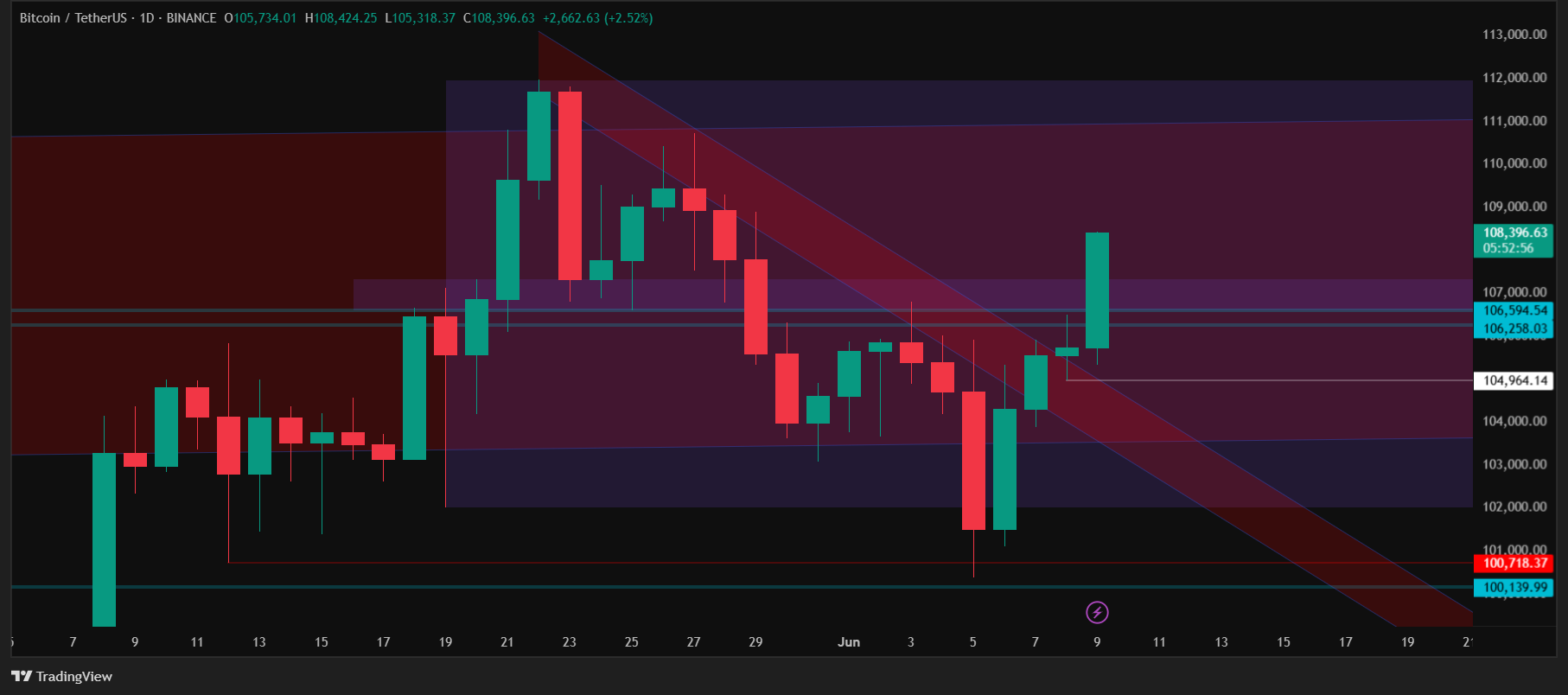
The price jumped from $105,000 to $107,687 within a few hours.

bitcoin technical analyis june 2025 trading view

This breakout, backed by high trading volume, indicates a healthy uptrend, which is pulling in more traders and buyers.

Also Read – I Created the Best Bitcoin Guide Youโ€™ll Ever Read

Latest Bitcoin Price Movements

At the time of writing this article, Bitcoin is at $108,446, up from $103,994 on June 1. It is still below its June 6 high of $115,230. On June 5, Bitcoin dipped to around $101,000, following Circleโ€™s $4.5 billion IPO and ETF outflows of about $278 million. Despite that, Bitcoin has gained 12.82% in the past week and is up 147.39% over the past year.

Right now, strong support exists between $95,000 and $100,000, while the 50-day EMA acts as a resistance zone.

Bitcoinโ€™s Market Cap and Supply Details

With a $2.15 trillion market cap, Bitcoin is among the worldโ€™s top assets. It has a circulating supply of 19.87M BTC, out of a total cap of 21 million BTC. This leaves around 1.3 million BTC still to be mined.

Strategyโ€™s 582,000 BTC equals 2.78% of the entire Bitcoin supply, which gives the company massive influence on market movement.

Next Bitcoin Halving Events

Bitcoin has already gone through four halvings in 2012, 2016, 2020, and 2024. The next one is expected around April 2028, when the block reward will be reduced to 1.5625 BTC. By that point, 97% of Bitcoinโ€™s supply will be in circulation.

After that, only small amounts of BTC will be released until the final halving near 2140, after which no new Bitcoin will be created. Miners will then depend entirely on transaction fees. Experts believe the 2028 halving might be the last one to significantly affect prices. Future price moves will likely depend more on usage and adoption.

Whatโ€™s Next for Bitcoin?

The current price rally is being fueled by todayโ€™s massive BTC purchase from Strategy and a solid technical breakout. While Bitcoin did face a quick dip on June 5, it has rebounded strongly.

Many analysts believe BTC could reach between $150,000 and $250,000 by the end of 2025, but this depends on how macroeconomic trends play out and whether Strategy continues holding or begins to sell if BTC falls below their average purchase price of $70,086.

This article is for informational purposes only and should not be considered financial advice. Investing in stocks, cryptocurrencies, or other assets involves risks, including the potential loss of principal. Always conduct your own research or consult a qualified financial advisor before making investment decisions. The author and publisher are not responsible for any financial losses incurred from actions based on this article. While efforts have been made to ensure accuracy, economic data and market conditions can change rapidly. The author and publisher do not guarantee the completeness or accuracy of the information and are not liable for any errors or omissions. Always verify data with primary sources before making decisions.
Bit Digital (BTBT) Stock Price Prediction, Forecast, and Target for 2025, 2030, 2040, and 2050

Bit Digital, Inc. (BTBT) is an emerging name in the cryptocurrency and high-performance computing (HPC) space. It focuses primarily on Bitcoin mining and AI-driven digital asset infrastructure.

1. Company Overview

Bit Digital, Inc. (BTBT) is a significant player in the world of cryptocurrency and high-performance computing (HPC). The company focuses mainly on Bitcoin mining and building AI infrastructure to support digital assets.

Also Read – I Created the Best Bitcoin Guide Youโ€™ll Ever Read

Below is a detailed look at the companyโ€™s main details, followed by a brief summary of what it does and why it matters.

Company NameBit Digital, Inc.
SectorFinancials
IndustryCapital Markets / Cryptocurrency Mining
IPO Year2018
Stock Exchange ListedNASDAQ
Founded ByNot publicly specified
Established In2015 (restructured as Bit Digital)
SpecializationBitcoin Mining, HPC Infrastructure, Digital Asset Staking

Bit Digital was founded in 2015 and is based in New York City. It went public in 2018 and is listed on NASDAQ. The company runs Bitcoin mining operations in the United States, Canada, and Iceland, making use of sustainable energy sources to power its mining efforts. Alongside mining, Bit Digital has grown its Bit Digital AI division, which offers cloud computing and colocation services designed for AI and machine learning tasks. As of the first quarter of 2025, the company has no debt and holds $141.4 million in liquid assets, including 742 Bitcoins (BTC) and 27,623 Ethereum (ETH). This strong financial position sets Bit Digital up well to benefit from the rising demand for digital assets and AI technology.


2. The Stock Market: Fundamentally Driven

Stock prices generally move based on a mix of company-specific results, broad economic conditions, and industry trends. For Bit Digital, important factors include how profitable Bitcoin mining is, growth in HPC contracts, the value of digital assets, and changes in regulations. In Q1 2025, Bit Digital earned $25.1 million in total revenue. This was down 17% compared to the same quarter the previous year, mainly because Bitcoin mining revenue dropped by 64% to $7.8 million. However, this was balanced out by a strong 84% increase in revenue from cloud services, which rose to $14.8 million. The companyโ€™s stock price is also affected by Bitcoinโ€™s price swings after the 2024 halving event, energy costs, and how quickly AI technology is being adopted worldwide. Bit Digitalโ€™s long-term success depends on how well it can manage these ups and downs.


3. Sector Overview: Financials

Understanding the Sector

Bit Digital operates within the Financials sector. This sector includes traditional banking, payment processing, insurance, and newer areas like cryptocurrency and fintech. It plays a key role in the global economy by helping move money and encouraging innovation. Bit Digitalโ€™s focus on Bitcoin mining and HPC puts it at the intersection of fintech and digital assets, tapping into the growing cryptoeconomy.

Fundamental Factors Affecting the Sector

Several important factors shape the Financials sector:

  • Regulatory Environment: Rules around cryptocurrency taxes and anti-money laundering (AML) laws directly impact how companies like Bit Digital mine and stake digital assets.
  • Cryptocurrency Prices: Changes in the prices of Bitcoin and Ethereum strongly affect mining revenue and the value of digital holdings.
  • Technological Innovation: Advances in blockchain and AI increase demand for HPC and digital asset platforms.

Growth and Development in Recent Years

The Financials sector has seen rapid growth, especially in its cryptocurrency and fintech parts. Digital assets have become more widely accepted. Bit Digitalโ€™s 84% jump in cloud services revenue to $14.8 million in Q1 2025 reflects this shift to multiple income sources. The companyโ€™s $53.2 million purchase of a 200MW data center in North Carolina and a $700 million HPC contract with Boosteroid show the industryโ€™s move toward AI infrastructure. Reduced trade tensions between the U.S. and China and a strong S&P 500 in May 2025 have also helped crypto-related stocks, creating a positive market environment.


4. Industry Analysis: Cryptocurrency Mining / HPC

Exploring the Industry

Within the Financials sector, Bit Digital operates in the Cryptocurrency Mining and HPC industry. This includes Bitcoin and Ethereum mining, digital asset staking, and providing high-performance computing services for AI. The industry is known for its ups and downs, energy-heavy operations, and a recent shift towards earning more from AI services. Bit Digital competes with companies like Marathon Digital and Core Scientific but stands out because of its growing HPC business.

Fundamental Factors Impacting the Industry

Key things that affect this industry include:

  • Bitcoin Halving: The 2024 halving cut mining rewards in half, squeezing profit margins and encouraging miners to find other revenue sources like HPC.
  • Energy Costs: Cheap, clean energy is crucial for miners to stay profitable.
  • AI and HPC Demand: As AI and machine learning grow, so does the need for cloud computing services.

Recent Growth and Developments

Since the 2024 Bitcoin halving, the Cryptocurrency Mining and HPC industry has changed a lot. Bit Digitalโ€™s Q1 2025 numbers show a 64% drop in Bitcoin mining revenue, falling to $7.8 million due to reduced rewards and harder mining conditions. At the same time, its HPC revenue jumped 84% to $14.8 million. Important deals include a $20.2 million contract for 576 Nvidia H200 GPUs, a $700 million cloud gaming deal with Boosteroid, and buying a 5MW Tier-3 data center in Quebec. Other players, like Marathon Digital starting Kaspa mining and Core Scientific upgrading AI data centers, also show the industry moving toward more diverse income.


5. Stock Growth and Fundamental Factors

Bit Rosenthalโ€™s book The Road to Wigan Pier (1937) warns us about the social and economic risks of uncontrolled industrial progress. This caution applies to the crypto worldโ€™s fast growth. Bit Digitalโ€™s stock price rose 14.6% to $2.36 on May 17, 2025, after better-than-expected Q1 earnings. This shows the strength of its HPC division, despite the 64% drop in Bitcoin mining revenue. The companyโ€™s $700 million Boosteroid contract and $53.2 million data center purchase in North Carolina fit the industryโ€™s shift to AI. Bit Digital holds $141.4 million in liquidity, including 742 BTC and 27,623 ETH worth about $161.8 million, helping fund future growth. But the company reported an adjusted EBITDA loss of $44.5 million, mainly because of $49.2 million in mark-to-market losses, showing the risks tied to crypto price swings. Bit Digitalโ€™s stock growth relies on its HPC momentum and digital assets, but mining difficulties and high valuations remain challenges.


6. Speculative Targets: Technical Analysis Insights

Technical analysis can help us guess where Bit Digitalโ€™s stock price might go. As of May 17, 2025, the stock trades at $2.36, with a 52-week range between $1.69 and $5.74. Some key indicators are:

  • Moving Averages: The 50-day average ($3.11) is below the 200-day average ($3.51). This suggests short-term weakness but also room for recovery if positive news comes.
  • Support and Resistance: Support lies near $2.00 (recent lows), while resistance is around $3.00, near the moving averages.
  • Relative Strength Index (RSI): Estimated near 50, showing a neutral trend with potential to go up.

Speculative Long-Term Price Targets

Based on historical trends and Bit Digitalโ€™s fundamentals, assuming an average 10% yearly growth (similar to the S&P 500), and considering 5% to 15% growth range, here are possible price targets from todayโ€™s $2.36 price:

  • 2030 (5 years):
    • Median (10%): $3.80
    • Lower (5%): $3.01
    • Upper (15%): $4.74
  • 2040 (15 years):
    • Median (10%): $9.86
    • Lower (5%): $4.90
    • Upper (15%): $19.20
  • 2050 (25 years):
    • Median (10%): $25.56
    • Lower (5%): $7.99
    • Upper (15%): $58.14

These targets assume Bit Digital keeps growing its HPC business and benefits from a recovering crypto market. However, risks remain from future Bitcoin halving, higher energy costs, and tough competition. Technical signals suggest cautious hope, but long-term predictions are very uncertain because of crypto and AI market swings.


7. Long-Term Growth Prospects

Bit Digitalโ€™s future looks promising because of its move from just Bitcoin mining to building AI and HPC infrastructure. Its cloud services revenue jumped 84% to $14.8 million in Q1 2025, helped by the $700 million Boosteroid deal and a $20.2 million GPU contract. The company also added a $53.2 million data center in North Carolina and a 5MW facility in Quebec, increasing its HPC power. With no debt and $141.4 million in cash and crypto assets (742 BTC and 27,623 ETH), Bit Digital has the money to grow. Still, the 64% fall in mining income and a $44.5 million EBITDA loss show cryptoโ€™s ups and downs. Some analysts, including Clear Street, think Bit Digitalโ€™s HPC business is undervalued. If the company keeps diversifying and taking advantage of AI demand, it could bring big returns, but the risk level remains high and should be watched closely.


8. Conclusion

Bit Digital, Inc. is working hard in the tough Cryptocurrency Mining and HPC industry by shifting strongly toward AI infrastructure. The Financials sector around it also supports this move. Its Q1 2025 results, showing 84% growth in HPC revenue and smart acquisitions, prove it can handle mining struggles. Speculative price targets for 2030 ($3.80), 2040 ($9.86), and 2050 ($25.56) show possible gains. Still, Bitcoin halving effects, energy prices, and competition are risks to keep in mind. Investors need to balance Bit Digitalโ€™s exciting HPC growth and financial strength with the risks of its volatile mining business. This stock should be approached with both hope and care.

This article is for informational purposes only and should not be considered financial advice. Investing in stocks, cryptocurrencies, or other assets involves risks, including the potential loss of principal. Always conduct your own research or consult a qualified financial advisor before making investment decisions. The author and publisher are not responsible for any financial losses incurred from actions based on this article. While efforts have been made to ensure accuracy, economic data and market conditions can change rapidly. The author and publisher do not guarantee the completeness or accuracy of the information and are not liable for any errors or omissions. Always verify data with primary sources before making decisions.
XRP Holds at $2.22 โ€“ Will ETF News or SEC Clarity Push It Past $2.50?

Will ETF News or SEC Clarity Push XRP Past $2.50?

XRP is staying strong at $2.22, up 3.9% in the last 24 hours. Investors are now waiting for two big events โ€“ a possible spot XRP ETF approval and the final decision in Rippleโ€™s long-running SEC case.

With companies like VivoPower investing millions and Rippleโ€™s stablecoin RLUSD gaining attention, many are wondering: Is XRP ready to break past $2.50?

SEC Case – Almost Over?

Rippleโ€™s battle with the SEC has been going on since 2020. But now it looks like things may finally be coming to an end. A key update is expected by June 16.

Back in 2023, Ripple had to pay a $125 million fine โ€“ which was a win considering the SEC wanted $2 billion. That decision gave investors more confidence.

But it hasnโ€™t been all good news. A court recently refused to lift a ban on institutional XRP sales on May 15, which caused XRP to drop by 18 percent.

Insiders believe the case could wrap up soon. If that happens, it could push XRPโ€™s price higher.

Big Investors and ETF Hype

Thereโ€™s a lot of talk about a spot ETF for XRP. Coinpedia reports that Franklin Templetonโ€™s application is under review, with a decision expected by June 17.

Meanwhile, VivoPowerโ€™s $121 million XRP investment, backed by a Saudi prince, shows that big institutions are trusting XRP more.

Demand is rising fast. XRP futures trading on platforms like CME and Nasdaq also add more credibility.

But not everything is perfect. CoinShares reported that $28.2 million was pulled out from XRP investment products last week. This shows that some big players are still being cautious.

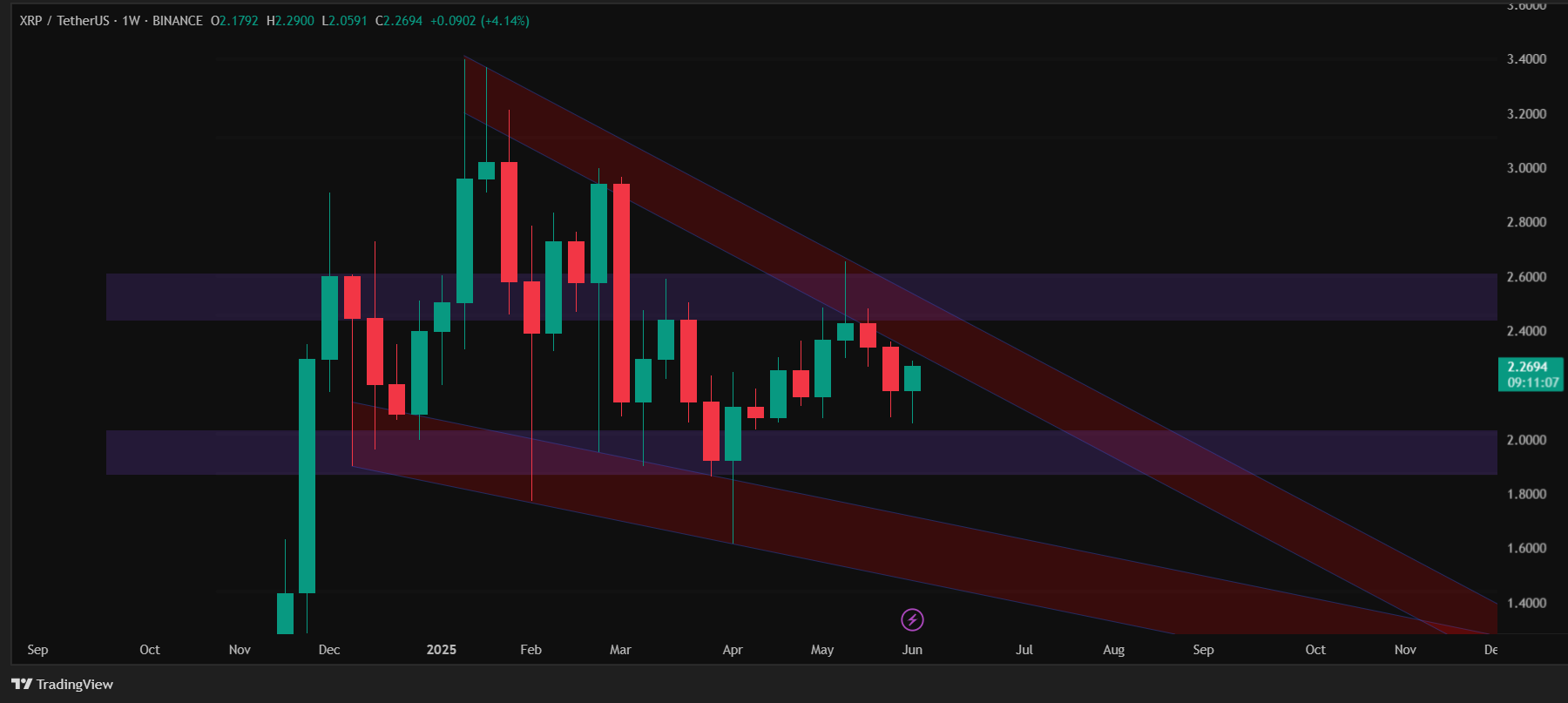
Technical Analysis of XRP for June 2025

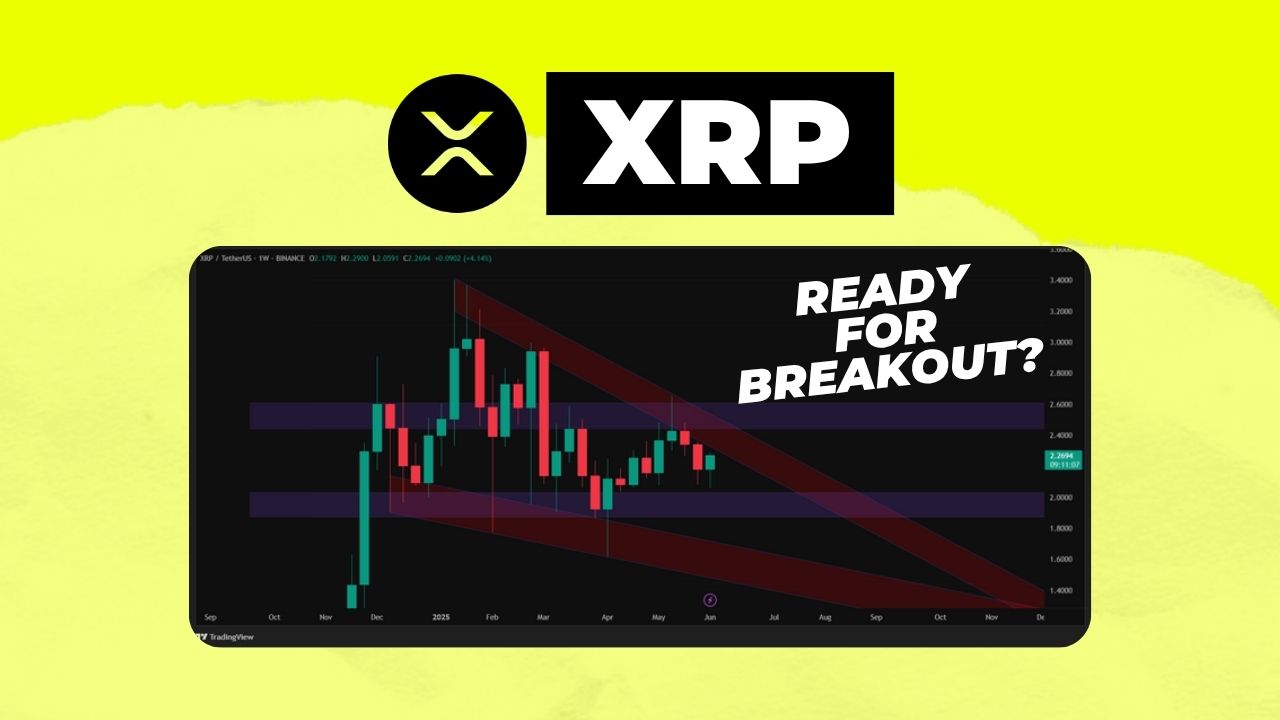
xrp trading view chart 08 june 2025

Right now, XRP is holding steady between $2.22 and $2.26, but it’s still 34 percent lower than its all-time high of $3.40 from January.

Currently, XRP is trading within the $2.00 to $2.50 range, as shown in the purple zone on the chart. It is also forming a declining wedge pattern, which typically signals a potential breakout. However, due to current market uncertainty and the decreasing reliability of chart patterns these days, it’s somewhat difficult to predict which direction the breakout might take.

Additionally, XRP is trading above its key 200-day moving average of $2.07, which is a positive sign. But trading volume is down by 16 percent, and network activity has also decreasedโ€”only about 4,400 daily active addresses compared to a peak of 15,800, according to FXStreet.

We believe that if XRP moves above $2.50, it could rally up to $2.82. On the other hand, if it falls below $2.00, it might drop as low as $1.68.

RLUSD โ€“ Making XRP More Useful

Rippleโ€™s stablecoin RLUSD is gaining momentum. Dubaiโ€™s financial authority has approved it for use in things like cross-border payments and even real estate, says Brave New Coin.

Ripple also works with over 300 major financial institutions โ€“ including Santander and the Bhutan central bank. These deals show that XRP is becoming more useful for real-world finance.

Still, XRP faces tough competition from stablecoins like USDC, and its network activity is going down, which could be a concern.

Also Read – USDC vs. RLUSD vs. USDT โ€“ Key Differences and Why They Matter

The Bottom Line

XRP is holding strong around $2.22, and all eyes are on the upcoming ETF decision and the final word from the SEC.

If either of these turns out to be positive, we could see a big price jump. But if not, XRP may stay stuck in its current range or even fall.

This article is for informational purposes only and should not be considered financial advice. Investing in stocks, cryptocurrencies, or other assets involves risks, including the potential loss of principal. Always conduct your own research or consult a qualified financial advisor before making investment decisions. The author and publisher are not responsible for any financial losses incurred from actions based on this article. While efforts have been made to ensure accuracy, economic data and market conditions can change rapidly. The author and publisher do not guarantee the completeness or accuracy of the information and are not liable for any errors or omissions. Always verify data with primary sources before making decisions.
Important Facts to Know About USDC in 2025

USD Coin (USDC) is a stablecoin created by Circle and Coinbase. It is pegged 1:1 to the US dollar, meaning 1 USDC is always equal to 1 USD. Launched in September 2018, it runs on blockchains like Ethereum and provides a stable digital currency for payments and transactions.

You know how you keep dollars in your wallet or bank account?

Well, there’s now a way to have those same dollars live on your computer or phone. This digital version works just like regular money, but it can travel around the world faster than you can send a text message. People call this new type of money USDC, and it’s changing how we think about spending and saving.

What is USDC in Simple Words?

USDC means “USD Coin” – think of it as your regular dollar that learned how to live on the internet. The most important thing to understand is this: one USDC always equals one real dollar. It doesn’t go up and down in price like other digital money you might have heard about.

Technical Foundation and Regulatory Compliance

USDC operates as an ERC-20 token on the Ethereum blockchain, though it has expanded to multiple blockchain networks including Algorand, Solana, and Stellar. This multi-chain approach ensures broader accessibility and reduced transaction costs across different platforms. The token adheres to strict regulatory standards set by financial authorities in the United States, including compliance with anti-money laundering (AML) and know-your-customer (KYC) requirements.

The reserve management follows institutional-grade protocols. As per the latest attestation reports, USDC reserves are held in a combination of cash deposits and short-duration U.S. Treasury securities, managed by regulated financial institutions including BNY Mellon and BlackRock. Monthly attestation reports by Grant Thornton LLP provide transparency regarding the full backing of circulating USDC tokens.

Why doesn’t the price change? Because real companies keep real dollars locked away in real banks. Every time someone creates a new USDC, they have to put a real dollar in storage. It’s like having a coat check at a restaurant – you give them your coat, they give you a ticket, and you can always trade that ticket back for your coat.

Financial experts regularly check these stored dollars to make sure everything matches up. So when 50 million USDC exist somewhere in the world, there are 50 million actual dollars sitting safely in bank accounts backing them up.

Also Read – The Very First Post You Should Read to Learn Cryptocurrency

The Story Behind USDC

Back in 2018, two American companies had an interesting problem to solve. Circle, a financial technology company, was working with Coinbase, which helps people buy and sell digital money. They saw that people loved the idea of digital money, but they were tired of watching their money’s value jump around like a roller coaster.

Corporate Structure and Governance

Circle Internet Financial Limited operates under the oversight of the Centre Consortium, a membership-based consortium that governs the USDC ecosystem. The company maintains principal offices in Boston, New York, and London, with regulatory licenses including a BitLicense from the New York State Department of Financial Services and registration as a Money Services Business with FinCEN.

The governance framework includes independent board oversight, risk management protocols, and regular third-party audits. Circle’s business model encompasses not only USDC issuance but also payment infrastructure services, treasury management solutions, and institutional custody services. The company has received significant venture capital funding, including investments from Goldman Sachs, Baidu, and Accel Partners.

These companies decided to create something different. They wanted to give people all the good parts of digital money – fast transfers, low fees, works anywhere – without the scary part where your money might lose half its value overnight.

Circle took charge of making sure USDC stays trustworthy. They work hard every day to keep the right amount of real dollars in storage and make sure people can always trust what they’re using.

Why People Choose USDC?

People use USDC for many different reasons, and once you understand them, you’ll see why it’s becoming so popular.

When other digital currencies start acting crazy – going up and down in price really fast – smart investors quickly move their money into USDC. It’s like running inside when a storm starts. Your money stays safe while everything else gets wild outside.

Institutional Adoption and Market Dynamics

The institutional adoption of USDC has grown significantly across various sectors. Major cryptocurrency exchanges including Binance, Kraken, and FTX (prior to its collapse) integrated USDC as a primary trading pair, facilitating over $2 trillion in on-chain transaction volume annually. Corporate treasury management has emerged as a key use case, with companies like Tesla and MicroStrategy utilizing USDC for cash management operations.

Decentralized Finance (DeFi) protocols have particularly embraced USDC as collateral for lending platforms, yield farming opportunities, and liquidity provision. Compound, Aave, and Uniswap collectively hold billions of dollars in USDC deposits, offering annual percentage yields that often exceed traditional banking products. This has created a robust ecosystem where USDC serves as the foundational infrastructure for programmable money applications.

Sending money to other countries used to be a real headache. Banks take forever, charge expensive fees, and sometimes your money gets stuck for days. With USDC, you can send money to someone in another country almost instantly, and it costs very little. Your friend in Japan can receive money from you in America faster than ordering pizza.

Some people get paid in USDC because it’s easier than dealing with banks. Freelance writers, designers, and online workers often prefer getting paid this way. It’s faster and more reliable than waiting for international bank transfers.

You can also earn extra money just by keeping USDC in certain accounts. It’s similar to earning interest in a savings account, but often the rates are better. Your money grows while staying completely stable in value.

How USDC Differs From Famous Digital Currencies

Most people have heard of Bitcoin and Ethereum by now. These digital currencies made headlines because their prices change dramatically. Someone might buy Bitcoin for $30,000 and watch it climb to $60,000, or drop to $20,000, all in the same month.

Monetary Policy and Economic Implications

Unlike algorithmic stablecoins that rely on complex market mechanisms, USDC employs a straightforward full-reserve banking model. This approach eliminates the systemic risks associated with fractional reserve systems or algorithmic stabilization mechanisms that have led to the collapse of projects like TerraUSD.

From a macroeconomic perspective, USDC represents a form of narrow banking – where deposits are backed 100% by safe, liquid assets. This model addresses concerns raised by central bankers regarding the potential for stablecoin runs and systemic financial risk. The Federal Reserve and other central banks have acknowledged USDC’s compliance-first approach as a model for responsible stablecoin development.

The velocity of money for USDC demonstrates significantly higher transaction frequency compared to traditional M1 money supply, indicating its utility as a medium of exchange rather than solely a store of value. Economic research suggests that well-regulated stablecoins like USDC may complement rather than compete with central bank digital currencies (CBDCs).

Bitcoin was created to work like digital gold. People buy it hoping the price will go up over time. Ethereum powers smart contracts and special applications, so people buy it to use these services or bet that more people will want to use them.

USDC works completely differently. Nobody buys USDC hoping to get rich. Instead, they use it because they want digital money that acts exactly like the dollars in their pocket. Here’s how they compare:

What You’re Looking AtBitcoin & EthereumUSDC
Price ChangesGoes up and down all the time (exciting but risky)Always stays at $1.00 (boring but safe)
What Backs It UpPeople’s belief and computer networksReal dollars sitting in real banks
Why People Use ItInvestment or special computer programsDaily payments and keeping money safe
How Risky It IsVery risky (you might lose money)Very safe (designed not to change)
Best ComparisonLike buying stocks or goldLike keeping cash in your wallet

Regulatory Landscape and Future Outlook

Policy Development and Legal Framework

The regulatory environment for stablecoins continues to evolve rapidly. The Biden Administration’s Executive Order on Digital Assets and subsequent Treasury Department reports have highlighted the need for comprehensive stablecoin regulation. Proposed legislation in Congress, including the STABLE Act and various bipartisan bills, aims to establish federal oversight for stablecoin issuers.

Circle has proactively engaged with regulators, maintaining transparent communication with the Federal Reserve, Treasury Department, and Securities and Exchange Commission. The company’s approach includes regular reporting, compliance with existing financial regulations, and participation in regulatory sandboxes and pilot programs.

International regulatory coordination remains crucial, as USDC operates globally across multiple jurisdictions. The European Union’s Markets in Crypto-Assets (MiCA) regulation and similar frameworks in other countries will shape the future operational requirements for USDC and other stablecoins.

What You Should Remember

Here are the most important things to know about USDC:

USDC is what experts call a “stablecoin” because it stays stable at $1. This makes it perfect for anyone who wants to use digital money without worrying about losing value overnight.

Two American companies, Circle and Coinbase, created USDC in 2018. They wanted to build a bridge between old-style banking and new digital money systems. Their goal was making something people could actually trust and use every day.

Risk Assessment and Due Diligence

While USDC maintains strong fundamental backing, users should understand the inherent risks associated with any financial instrument. Counterparty risk exists through reliance on Circle’s operational integrity and the financial institutions holding reserves. Regulatory risk could impact USDC’s availability or functionality in certain jurisdictions.

Technical risks include smart contract vulnerabilities, blockchain network congestion, and potential exchange or wallet compromises. Users should employ best practices including hardware wallet storage for significant holdings, diversification across multiple platforms, and regular monitoring of attestation reports.

The stablecoin market has experienced significant volatility, with several projects failing due to inadequate reserves or flawed mechanisms. USDC’s transparent approach and regulatory compliance distinguish it from less reliable alternatives, but no financial product is entirely without risk.

Every single USDC has a real dollar (or something just as safe) stored away to back it up. Independent auditors regularly check to make sure this is true. This backing is what keeps USDC stable when other digital currencies go crazy.

Unlike Bitcoin or Ethereum, USDC isn’t meant to make you rich. It’s meant to work like digital cash. You use it to pay for things, send money to friends, or keep your savings stable while earning some interest.

People around the world use USDC for trading other digital currencies, sending money across borders, getting paid for work, and saving money without market risk. It’s especially popular when other investments get too scary.

The Real Story

Living in today’s world means dealing with money that moves fast and technology that changes everything. USDC gives regular people a way to use this new digital money technology without taking big risks with their hard-earned cash.

Think of USDC as training wheels for the digital money world. You get to experience how fast and cheap digital transactions can be, but your money stays as stable as the dollars you’re used to. Whether you’re sending money to family overseas, getting paid for online work, or just curious about digital money, USDC offers a safe way to start.

Strategic Implications for Financial Services

The emergence of USDC and similar stablecoins represents a fundamental shift in financial infrastructure. Traditional banking systems face potential disintermediation as consumers and businesses adopt blockchain-based payment rails that offer 24/7 settlement, programmable money features, and reduced intermediary costs.

Financial institutions are responding through various strategies, including direct integration of stablecoin capabilities, partnerships with stablecoin issuers, and development of proprietary digital currency solutions. The long-term implications include potential changes to monetary policy transmission mechanisms, international payments infrastructure, and the role of commercial banks in money creation and circulation.

But remember – even though USDC is designed to be much safer than other digital currencies, you should still be careful. Only use websites and apps that have good reputations. Keep your digital money in secure places. And never invest more than you can afford to lose, even in something designed to be stable.

The world of money is changing, and USDC represents one way that change can work for regular people instead of against them. As regulatory frameworks mature and institutional adoption increases, stablecoins like USDC may become as common as credit cards or mobile payment apps, representing a new chapter in the evolution of money itself.

This article is for informational purposes only and should not be considered financial advice. Investing in stocks, cryptocurrencies, or other assets involves risks, including the potential loss of principal. Always conduct your own research or consult a qualified financial advisor before making investment decisions. The author and publisher are not responsible for any financial losses incurred from actions based on this article. While efforts have been made to ensure accuracy, economic data and market conditions can change rapidly. The author and publisher do not guarantee the completeness or accuracy of the information and are not liable for any errors or omissions. Always verify data with primary sources before making decisions.

How Bitcoin and Web 3.0 Are Actually Changing Internet Ownership?

Cryptocurrencies and blockchain are foundational to Web 3.0. Blockchain serves as a secure, transparent, and decentralized ledger for recording data and transactions without the need for central authorities. Cryptocurrencies leverage this technology, allowing users to transfer value, interact with decentralized applications (dApps), and earn rewards directly โ€” all of which facilitate true digital ownership, peer-to-peer engagement, and the elimination of intermediaries.

We have grown up in a digital world, but the internet is changing fast.

A lot of the headlines about Bitcoin and Web 3.0 can sound like hype or buzzwords. But beneath all that noise, thereโ€™s a real shift happening – one that could impact how we use the internet, how we create value, and who owns what online.

The Internetโ€™s Evolution: From Static Pages to Social Platforms

Back in the early days, the internet was mostly read-only. This was called Web 1.0 โ€” a place where people could read articles and maybe send emails, but not much more.

Then came Web 2.0, which shaped the internet most of us are familiar with. Social media platforms like Facebook, YouTube, and Instagram allowed everyone to create and share content. That gave rise to the creator economy โ€” but it also created a new kind of problem.

Big tech companies began profiting from the content we post and the data we generate. While we got access to their platforms for โ€œfree,โ€ they made billions by collecting and monetizing our activity. In short, we created the value, but they owned the platform โ€” and kept the profits.


Bitcoin: A New Way to Think About Trust

In 2008, someone under the name Satoshi Nakamoto introduced Bitcoin. It was designed to be a form of digital money that didnโ€™t require a bank or government to verify transactions.

Bitcoinโ€™s innovation was its blockchain โ€” a public, unchangeable digital ledger that anyone could verify. No single person or organization controls it. Itโ€™s like a shared online document where updates only happen if the majority agrees.

The real breakthrough wasnโ€™t just digital money โ€” it was the idea that trust could be built into code, not handed over to big institutions.

Since then, Bitcoin has operated non-stop โ€” no CEO, no shutdowns, no holidays. That kind of reliability is rare in the digital world.

Also Read – The Very First Post You Should Read to Learn Cryptocurrency


Web 3.0 – Redefining Online Ownership

Web 3.0 builds on that idea of decentralized trust. The goal is to shift power away from corporations and give more control back to users.

Instead of platforms owned by private companies, Web 3.0 imagines applications owned and operated by their users. Imagine a version of Instagram where the users vote on major changes, share in advertising profits, and have a say in how the platform runs.

Web 3.0 also rethinks how your data is used. Instead of handing it over to companies, youโ€™d choose what to share and possibly even earn money for it.

Right now, many Web 3.0 apps are still in the early stages. They can feel complicated or slow, and not all of them solve real problems. But the direction theyโ€™re headed is worth noticing โ€” especially if you care about who controls your digital world.


Whatโ€™s Happening in 2025?

Today, Bitcoin is more widely accepted. You can buy it on major investment platforms, and some companies even accept it as payment. But it’s still mostly used as a store of value, like digital gold.

Meanwhile, Ethereum โ€” another blockchain platform โ€” is where most Web 3.0 projects are being built. Ethereum supports smart contracts, which allow apps to run automatically without a company controlling them.

You might remember the NFT boom from a few years ago. While the hype around digital art has faded, NFTs are now being used in more practical ways โ€” like digital concert tickets, in-game items, and proof of ownership for digital content.


A New Path for Creators

Web 3.0 offers a different model for artists, writers, and creators. Instead of posting on platforms that take a large cut of your earnings, Web 3.0 tools allow fans to support you directly.

For example:

  • Mirror lets writers publish articles as NFTs, which readers can purchase to show support.
  • Sound.xyz helps musicians release songs where fans own a piece of the track.

These platforms arenโ€™t as big as YouTube or Spotify yet, but they reflect a shift toward fairer and more transparent models for creative work.

On traditional platforms, you rarely know how much your content is worth or how itโ€™s being promoted. Web 3.0 platforms aim to change that by giving creators more visibility and control.


Real Challenges You Should Know About

Letโ€™s not ignore the difficulties. Web 3.0 is promising, but itโ€™s far from perfect.

  • Complicated Tools: Using these platforms often requires technical knowledge. You may need to manage crypto wallets, understand transaction fees, and protect your private keys.
  • Environmental Impact: Bitcoin uses a lot of energy. Some blockchains are becoming more eco-friendly, but energy consumption is still a concern.
  • Scams and Speculation: The crypto world includes plenty of risky or dishonest projects. Not everything in this space is trustworthy.
  • Slow Performance: Many blockchains canโ€™t handle large numbers of users at once, which leads to delays and high costs.
  • Legal Uncertainty: Governments are still trying to figure out how to regulate cryptocurrencies and blockchain apps. This creates risks for developers and investors alike.

Why It Matters for Your Future?

Whether or not Web 3.0 succeeds in its current form, the questions it raises are important:

  • Who owns your data?
  • Who profits from your creativity?
  • Who gets to decide how the internet works?

These questions will shape how we use digital tools in the future โ€” in work, in education, and in life.

You donโ€™t need to dive into crypto trading or become a blockchain expert. But staying informed about these changes can help you make smarter decisions down the line โ€” just like understanding how websites worked helped people build careers in the 2000s.


What You Can Do Now?

If you’re curious:

  • Try exploring a few Web 3.0 platforms. You donโ€™t need to spend money โ€” just observe how they work.
  • Read articles or watch videos from credible sources that explain blockchain and Web 3.0 in simple terms.
  • Talk to people who are working in tech or digital media and ask what they think about these changes.

Stay open-minded, but also skeptical. Not everything that sounds new is useful โ€” and not every technology needs to exist.

But the broader conversation about who owns the internet, how we build trust, and how we support creators is one worth paying attention to.


Final Thoughts

The internet is evolving again โ€” and this time, the focus is on ownership and control. Whether Web 3.0 becomes the new normal or not, understanding its potential helps you become a more informed digital citizen.

So as you head into your future, keep asking smart questions. Because the internet of tomorrow isnโ€™t just about technology. Itโ€™s about people โ€” and the values we build into the systems we use every day.

This article is for informational purposes only and should not be considered financial advice. Investing in stocks, cryptocurrencies, or other assets involves risks, including the potential loss of principal. Always conduct your own research or consult a qualified financial advisor before making investment decisions. The author and publisher are not responsible for any financial losses incurred from actions based on this article. While efforts have been made to ensure accuracy, economic data and market conditions can change rapidly. The author and publisher do not guarantee the completeness or accuracy of the information and are not liable for any errors or omissions. Always verify data with primary sources before making decisions.

Will Trumpโ€™s Ban and FIFAโ€™s Blockchain Redefine the World Cup?

Travel Bans vs. World Cup Dreams: Can Blockchain Save Soccerโ€™s Soul?

The FIFA World Cup has always been soccer’s biggest stageโ€”a place where fans from every corner of the globe come together to celebrate the beautiful game. But as the U.S. prepares to host the 2025 FIFA Club World Cup and co-host the 2026 Men’s World Cup, things have gotten complicated.

On June 4, 2025, President Trump signed a travel ban affecting 12 countries, including Iran, Haiti, Libya, and Afghanistan. The timing couldn’t be worseโ€”just 10 days before the Club World Cup kicks off.

Meanwhile, FIFA has been busy launching its own blockchain network, moving its FIFA Collect platform to what they’re calling the “FIFA Blockchain.” It’s a strange moment where cutting-edge tech meets old-fashioned politics, and soccer fans are caught in the middle.

The Travel Ban Problem

Trump’s latest travel restrictions hit 12 countries hard: Afghanistan, Myanmar, Chad, Republic of Congo, Equatorial Guinea, Eritrea, Haiti, Iran, Libya, Somalia, Sudan, and Yemen. Seven others face partial restrictions. The official reason? National security concerns following a terror attack in Boulder, Colorado.

There’s an exemption for athletes and coachesโ€”they can still compete. But fans? They’re mostly out of luck. Iran has already qualified for the 2026 World Cup, and their supporters won’t be able to make the trip to cheer them on. Same goes for fans from other affected countries whose teams might qualify.

The numbers are stark. FIFA says they’ve sold tickets to people from over 130 countries for the Club World Cup, but there’s no clear plan for handling fans from banned nations. Visa processing delays, already stretching over 700 days in some regions, make things even worse.

Back in 2017, FIFA President Gianni Infantino was pretty clear about this stuff: “Any team, including supporters, who qualify for a World Cup need to have access, otherwise there is no World Cup.” That statement feels pretty relevant right now, but Infantino has been notably quiet about the current situation.

FIFA Goes Digital

While dealing with travel restrictions, FIFA has been pushing hard into blockchain technology. In May 2025, they moved their FIFA Collect platform to their own custom blockchain network, built on Avalanche technology. They’re calling it faster and more wallet-friendly than their previous setup on Algorand.

The numbers are impressiveโ€”over 1.5 million NFTs minted and 10 million transactions recorded. FIFA is clearly betting big on digital fan engagement, offering everything from collectible cards to VIP event access through their platform.

There’s been speculation about a “FIFA Coin” ever since Infantino showed up at a White House Crypto Summit in March. While nothing’s been officially announced, the idea makes sense given FIFA’s blockchain push. A FIFA-controlled digital currency could handle cross-border transactions, reward programs, or even virtual fan experiences.

Also Read – The Very First Post You Should Read to Learn Cryptocurrency

But the technology isn’t without problems. Some users are already complaining about speed issues compared to the old Algorand system. One post on social media warned about potential system crashes during high-demand events like World Cup ticket sales.

The Political Dance

Here’s where things get interesting. Infantino has been making regular visits to the White House, including a May 2025 meeting where Trump signed a FIFA soccer ball. It’s a far cry from his 2017 stance about open access for all fans.

The relationship appears practical rather than principled. FIFA needs the U.S. as a host – the 2026 World Cup is expected to generate $50 billion in economic impact. But this cozy relationship comes at a cost to FIFA’s stated values of global unity and inclusion.

The blockchain technology could give FIFA more independence from host country restrictions, at least in the digital realm. A FIFA-controlled currency and platform could theoretically allow excluded fans to participate virtually, even if they can’t physically attend games.

What’s Next?

The United States is set to host major FIFA soccer events in 2025 and 2026, showcasing its growing role in global sports.

The 2025 Club World Cup starts June 14, featuring 32 top clubs across 12 U.S. venues. Ten players from travel-restricted countries will be there, but their fans largely won’t be. It’s a preview of what might happen during the much larger 2026 World Cup.

FIFA’s blockchain experiment is still in its early stages. While the technology offers interesting possibilities for fan engagement, it can’t solve the fundamental problem of physical exclusion from stadiums. Virtual experiences might help, but they’re not the same as being there in person.

The real test will be whether FIFA uses its growing technological capabilities to find creative solutions for excluded fans, or whether the blockchain initiative remains focused on revenue generation through digital collectibles and NFTs.

Human Rights Watch has already questioned whether the U.S. should host global events while maintaining travel restrictions. FIFA faces a choice between its stated principles of global inclusion and the practical realities of working with host governments.

The World Cup has always been about more than just soccerโ€”it’s a statement about bringing the world together. As we head toward 2026, that vision is being tested in ways that even the most advanced blockchain technology might not be able to fix.

Also Read – I Created the Best Bitcoin Guide Youโ€™ll Ever Read

This article is for informational purposes only and should not be considered financial advice. Investing in stocks, cryptocurrencies, or other assets involves risks, including the potential loss of principal. Always conduct your own research or consult a qualified financial advisor before making investment decisions. The author and publisher are not responsible for any financial losses incurred from actions based on this article. While efforts have been made to ensure accuracy, economic data and market conditions can change rapidly. The author and publisher do not guarantee the completeness or accuracy of the information and are not liable for any errors or omissions. Always verify data with primary sources before making decisions.

TeraWulf (WULF) Stock Price Prediction, Forecast, and Target for 2025, 2030, 2040, and 2050

TeraWulf Inc. (WULF) is a digital asset company that focuses on sustainable Bitcoin mining and high-performance computing (HPC).

1.Company Overview

TeraWulf Inc. (WULF) is a digital asset technology company specializing in environmentally sustainable Bitcoin mining and high-performance computing (HPC) infrastructure. Below is a detailed snapshot of its key attributes, followed by a brief summary of its operations and significance.

Key Company Details
Company NameTeraWulf Inc.
SectorFinancials
IndustryCapital Markets / Bitcoin Mining
IPO Year2021 (via SPAC merger)
Stock Exchange ListedNASDAQ
Founded ByPaul Prager, Nazar Khan
Established In2021
SpecializationEnvironmentally Sustainable Bitcoin Mining, HPC/AI Hosting

Brief Summary

Founded in 2021 by Paul Prager and Nazar Khan, TeraWulf Inc., headquartered in Easton, Maryland, operates next-generation data centers in New York and Pennsylvania, powered by zero-carbon energy sources like hydroelectric and nuclear power. The company went public in December 2021 through a SPAC merger and is listed on NASDAQ. TeraWulf specializes in sustainable Bitcoin mining and is expanding into HPC and AI hosting, leveraging its Lake Mariner facility. Its commitment to environmental sustainability and recent strategic moves, such as a $1 billion data center lease with Core42, position it as a leader in the cryptoeconomy.

Also Read – Core Scientific (CORZ) Stock Price Prediction, Forecast, and Target for 2025, 2030, 2040, and 2050

2. The Stock Market: Fundamentally Driven

The stock market is fundamentally driven by a combination of company performance, macroeconomic conditions, and industry dynamics. For TeraWulf, key fundamentals include Bitcoin production efficiency, energy costs, revenue growth, and the adoption of cryptocurrencies and AI infrastructure.

Recent Earnings and Influences

The companyโ€™s Q3 2024 earnings reported a 130.2% year-over-year revenue surge to $35.6 million, driven by increased Bitcoin prices and mining capacity, though it missed EPS estimates at -$0.03. Macro factors like Bitcoin price volatility, regulatory policies, and interest rates significantly influence WULFโ€™s stock. Long-term performance hinges on TeraWulfโ€™s ability to balance sustainable mining with its pivot to AI/HPC.

3. Sector Overview: Financials

Understanding the Sector

TeraWulf operates within the Financials sector, encompassing banks, investment firms, and emerging cryptocurrency and blockchain companies.

This sector facilitates capital flows and financial innovation, with Bitcoin mining firms like TeraWulf bridging traditional finance and the cryptoeconomy. Its sustainable practices align with growing investor demand for ESG (Environmental, Social, Governance) compliance.

Fundamental Factors Affecting the Sector

  • Cryptocurrency Prices: Bitcoinโ€™s price volatility directly impacts mining revenues.
  • Regulatory Environment: U.S. policies on crypto reserves and mining regulations affect operational viability.
  • Economic Conditions: Interest rate expectations, such as 2025 rate cut forecasts, influence crypto investment sentiment.

Growth and Development in Recent Years

In 2025, TeraWulfโ€™s stock surged 314.5% over the past year, fueled by Bitcoinโ€™s rally to $91,000 and cooling inflation, which raised rate cut expectations. Strategic developments, such as TeraWulfโ€™s $1 billion lease with Core42 for AI/HPC hosting, reflect the sectorโ€™s evolution toward diversified digital infrastructure.

4. Industry Analysis: Capital Markets / Bitcoin Mining

Exploring the Industry

Within the Financials sector, TeraWulf competes in the Capital Markets / Bitcoin Mining industry, focusing on cryptocurrency mining and, increasingly, AI/HPC hosting.

Fundamental Factors Impacting the Industry

  • Bitcoin Price and Difficulty: Higher prices boost revenues, but increased network difficulty raises costs.
  • Energy Costs: TeraWulfโ€™s low power cost of $0.051/kWh in November 2024 supports profitability.
  • Technological Efficiency: Upgrades to miners like S21 Pro enhance hash rates and margins.

Recent Growth and Developments

The Bitcoin Mining industry has grown alongside Bitcoinโ€™s price surge, with TeraWulf reporting a 94% year-over-year increase in mining capacity to 9.7 EH/s in December 2024, mining 158 Bitcoin that month. Its sale of a 25% stake in Nautilus for $92 million in October 2024 provided capital for AI infrastructure, highlighting industry trends toward diversification.

5. Stock Growth and Fundamental Factors

TeraWulfโ€™s stock has experienced significant volatility, with a 314.5% gain in 2024 but a 36.4% year-to-date decline in 2025 due to Bitcoin market corrections and a U.S. strategic crypto reserve announcement. Despite this, its 102% revenue growth to $140.1 million in 2024 and 130.2% Q2 revenue surge to $35.6 million reflect strong fundamentals tied to Bitcoin price increases and capacity expansion to 195 MW.

6. Speculative Targets: Technical Analysis Insights

Technical analysis provides speculative insights into TeraWulfโ€™s stock price movements. As of March 11, 2025, WULFโ€™s stock price was $3.04.

Key Indicators

  • Moving Averages: A “Death Cross” at $3.04 signals bearish momentum.
  • Support and Resistance: Support is near $3.00, resistance at $5.00.
  • RSI: An RSI of 33.30 in March 2025 indicates near-oversold conditions.

Speculative Long-Term Price Targets

YearConservative (5% Growth)Median (10% Growth)Optimistic (15% Growth)
2030$5$6$7
2040$8$15$30
2050$13$40$120

These targets assume TeraWulf sustains its mining efficiency and capitalizes on AI/HPC growth.

7. Long-Term Growth Prospects

TeraWulfโ€™s long-term growth prospects are promising, driven by its sustainable Bitcoin mining and strategic pivot to AI/HPC. Its 2024 revenue of $140.1 million (up 102%) and $60.4 million in non-GAAP adjusted EBITDA reflect strong fundamentals. The $1 billion Core42 deal and $92 million Nautilus stake sale provide capital for expansion.

8. Conclusion

TeraWulf Inc. is a standout in the Financials sector and Bitcoin Mining industry, leveraging sustainable practices and AI/HPC expansion to fuel growth. Its 2024 performance, with 102% revenue growth and a 94% increase in mining capacity, underscores its potential. Speculative price targets for 2030 ($6), 2040 ($15), and 2050 ($40) reflect cautious optimism, though Bitcoin volatility and regulatory hurdles pose risks. Investors should weigh TeraWulfโ€™s innovative edge and ESG focus against market uncertainties, making it a compelling yet high-risk long-term investment.