
2 Reasons Bitcoin is Surging on 09 June 2025

Why is bitcoin rising today?

Bitcoin (BTC) is rising sharply and is now trading at $108,446 at the time of writing.

Its market capitalization has reached $2,155,543,471,788, and two key factors are pushing this rally forward—an institutional purchase and a strong technical breakout.

Here’s a clear look at what’s happening and what it might mean for Bitcoin’s next move.

1. Strategy’s Massive Bitcoin Purchase

Formerly known as MicroStrategy, Strategy is driving this surge by making a bold purchase today.

As shared by Michael Saylor on X, Strategy bought 1,045 BTC on June 9 for $110.2 million, paying an average of $105,426 per coin. This brings their total holdings to 582,000 BTC, which they acquired at an average price of $70,086, with a total value of around $40.79 billion.

Analyst Adam Livingston calls this move a “synthetic halving” because Strategy is buying Bitcoin faster than it’s being mined – 450 BTC are mined daily. This reduces supply and pushes up the price.

The purchase is backed by a $1 billion stock offering, showing strong confidence from Strategy and helping drive the price up.

2. Bitcoin’s Bullish Technical Breakout

Bitcoin’s rally also has strong support from a technical breakout.

The price jumped from $105,000 to $107,687 within a few hours.
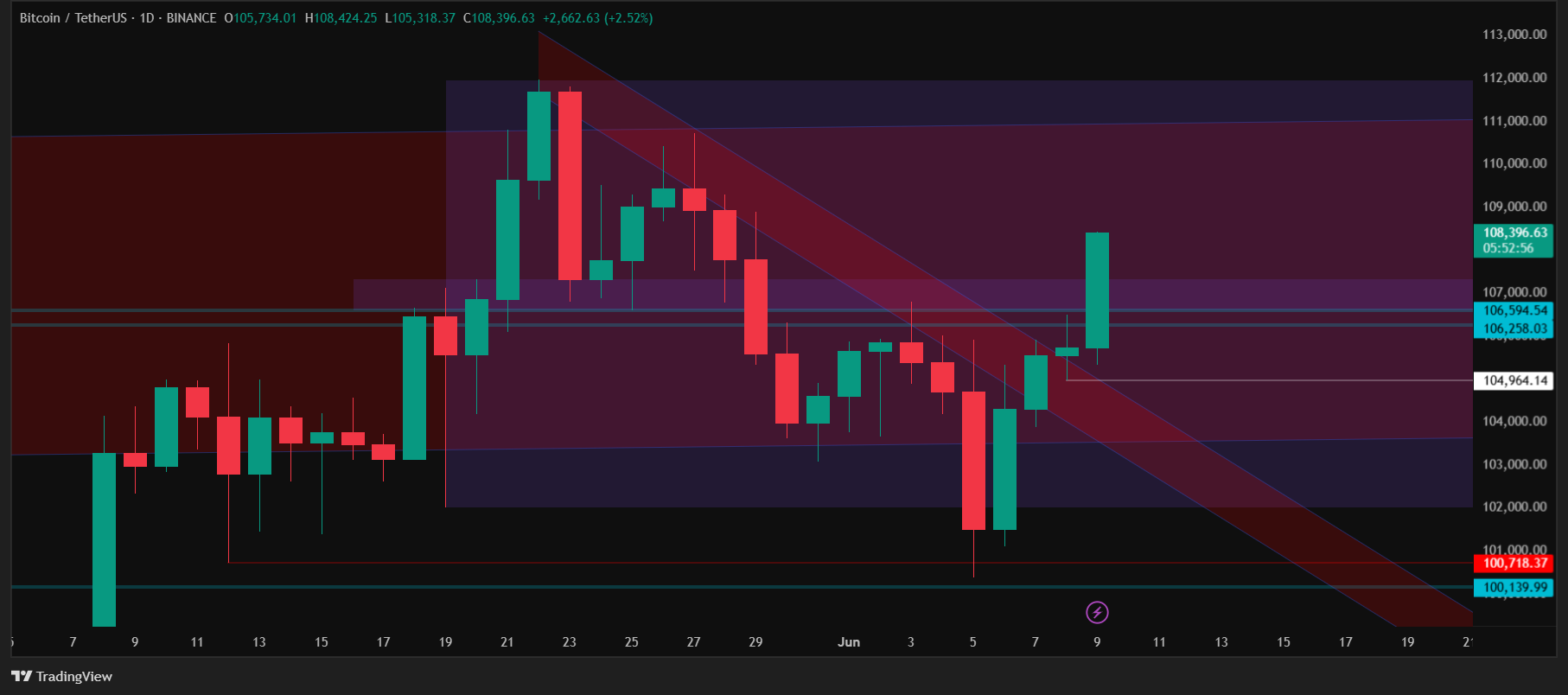
bitcoin technical analyis june 2025 trading view

This breakout, backed by high trading volume, indicates a healthy uptrend, which is pulling in more traders and buyers.

Also Read – I Created the Best Bitcoin Guide You’ll Ever Read

Latest Bitcoin Price Movements

At the time of writing this article, Bitcoin is at $108,446, up from $103,994 on June 1. It is still below its June 6 high of $115,230. On June 5, Bitcoin dipped to around $101,000, following Circle’s $4.5 billion IPO and ETF outflows of about $278 million. Despite that, Bitcoin has gained 12.82% in the past week and is up 147.39% over the past year.

Right now, strong support exists between $95,000 and $100,000, while the 50-day EMA acts as a resistance zone.

Bitcoin’s Market Cap and Supply Details

With a $2.15 trillion market cap, Bitcoin is among the world’s top assets. It has a circulating supply of 19.87M BTC, out of a total cap of 21 million BTC. This leaves around 1.3 million BTC still to be mined.

Strategy’s 582,000 BTC equals 2.78% of the entire Bitcoin supply, which gives the company massive influence on market movement.

Next Bitcoin Halving Events

Bitcoin has already gone through four halvings in 2012, 2016, 2020, and 2024. The next one is expected around April 2028, when the block reward will be reduced to 1.5625 BTC. By that point, 97% of Bitcoin’s supply will be in circulation.

After that, only small amounts of BTC will be released until the final halving near 2140, after which no new Bitcoin will be created. Miners will then depend entirely on transaction fees. Experts believe the 2028 halving might be the last one to significantly affect prices. Future price moves will likely depend more on usage and adoption.

What’s Next for Bitcoin?

The current price rally is being fueled by today’s massive BTC purchase from Strategy and a solid technical breakout. While Bitcoin did face a quick dip on June 5, it has rebounded strongly.

Many analysts believe BTC could reach between $150,000 and $250,000 by the end of 2025, but this depends on how macroeconomic trends play out and whether Strategy continues holding or begins to sell if BTC falls below their average purchase price of $70,086.

This article is for informational purposes only and should not be considered financial advice. Investing in stocks, cryptocurrencies, or other assets involves risks, including the potential loss of principal. Always conduct your own research or consult a qualified financial advisor before making investment decisions. The author and publisher are not responsible for any financial losses incurred from actions based on this article. While efforts have been made to ensure accuracy, economic data and market conditions can change rapidly. The author and publisher do not guarantee the completeness or accuracy of the information and are not liable for any errors or omissions. Always verify data with primary sources before making decisions.

7 Surprising Facts You Must Know About Tether (USDT) in 2025

Tether (USDT) does not have a fixed maximum supply of tokens that can be minted. Unlike cryptocurrencies like Bitcoin, which has a hard cap of 21 million coins, Tether’s supply is dynamic and adjusts based on market demand and the reserves held by Tether Limited.

A few weeks back, Tether (USDT) kept showing up on my feed.

I used to think of it as just another stablecoin. Kind of boring. Just sits there at $1, right? But the more I scrolled, the weirder and more interesting things got.

NameTether (USDT)
TypeStablecoin, pegged 1:1 to the U.S. dollar (~$0.99–$1.01 during volatility)
Launch DateJuly 2014 (originally launched as Realcoin)
IssuerTether Limited, a subsidiary of iFinex Inc. (based in Hong Kong)
Market Cap~$152.78 billion
Circulating Supply~152.73 billion USDT
Maximum SupplyNo fixed cap; minted/burned based on demand and reserves
Reserve Backing~84% U.S. Treasury bills, ~16% in cash, secured loans, and other investments (Q1 2025 attestation: $120B reserves vs. $118B USDT in circulation)
Blockchains SupportedEthereum, Tron, Solana, Polygon, Avalanche, Arbitrum, Optimism, Omni, and more

So I grabbed a coffee, opened way too many tabs (again), and went down the rabbit hole.
And wow — what I found actually blew my mind.

Here are the 7 things you need to know about Tether – especially with how wild things are getting in May 2025.


1. Tether Doesn’t Move Much — And That’s the Point

Tether (USDT) isn’t trying to hit $100K like Bitcoin. It’s a stablecoin, built to stay around $1 USD.
Most of the time, it does that job really well.

It wobbles between $0.99 to $1.01 in high-volatility moments, but for the most part, it stays still.
That’s why traders use it — it’s like putting your money in park while the rest of the market goes nuts.

And with the U.S. economy getting shakier in 2025, stablecoins like Tether are becoming even more important.


2. It’s the Most Traded Crypto in the World — Even More Than Bitcoin

No joke — Tether sees more trading volume than any other crypto.

On busy days, $90 to $100 billion worth of USDT changes hands, according to CoinGecko. That’s more than Bitcoin and Ethereum combined.

Why? Because Tether is the default pair on almost every crypto exchange.
If you’re buying or selling tokens on Binance, OKX, or Bitfinex, chances are you’re using USDT in between.


3. Tether’s Market Cap Just Crossed $150 Billion — And That’s a Huge Deal

This one is breaking news.

As of May 27, 2025, Tether now has a market cap over $150 billion and holds 61% of the entire stablecoin market, according to CoinMarketCap. That’s massive.

The buzz on X right now is crazy-

A $1 billion USDT mint just happened on the Tron blockchain.

People are speculating that Tether is “buying the dip” or prepping for a major market pump.

There are even rumors (not confirmed yet) that Tether might integrate with Bitcoin’s Lightning Network — which could make sending USDT almost instant and dirt cheap.

And here’s the kicker-
People are claiming Tether has now processed more transactions than Visa, and holds more U.S. Treasury bills than Germany.

That second one isn’t confirmed officially, but the idea alone is wild.


4. It Claims to Be Backed 1:1 — And It’s Showing Receipts (Kind Of)

Tether says that every USDT is backed by real-world assets — mostly U.S. Treasury Bills, plus some cash and other stuff.

In the past, this wasn’t exactly true.
In 2021, regulators found that a chunk of their reserves were in riskier assets like commercial paper. It caused a lot of backlash.

But in 2025, things are different.
According to their Q1 2025 attestation, Tether holds $120 billion in total reserves, with 84% of that in ultra-safe U.S. Treasury bills.

They’re definitely trying to be more transparent now — but the crypto crowd on X still watches their every move with a magnifying glass.


5. It’s Centralized — And That’s a Red Flag for Some

Tether is run by a private company called Tether Limited, which is part of iFinex Inc. based in Hong Kong.
They also run Bitfinex, a major crypto exchange.

So yeah, one company controls the most-used stablecoin in the world.

That goes against the “decentralized” spirit of crypto, and it’s why some people constantly bring up transparency issues, power dynamics, and “what if” scenarios.

It doesn’t help that Tether’s legal drama isn’t ancient history.


6. Yep, Tether’s Been Fined Before

Back in 2021, the New York Attorney General’s office called out Tether for misleading the public about what backed USDT.

They paid an $18.5 million fine and agreed to publish regular reports. Since then, they’ve been releasing quarterly updates, and their numbers seem to add up — at least on paper.

Still, with new rules like the EU’s MiCA regulation tightening how stablecoins are allowed to operate, Tether is under constant pressure to stay compliant globally.


7. It’s Not Just a Crypto Tool – It’s a Real-World Lifeline

This was the part that changed how I saw Tether completely.

In countries like Argentina, Nigeria, Venezuela, and Turkey, where inflation eats up savings like wildfire, people are using Tether as digital dollars.

No banks. No waiting. No crazy fees.

Just USDT sent from one wallet to another.

And it’s not just anecdotes – a 2024 Chainalysis report said Tether powers 70% of all stablecoin activity in emerging markets. That’s not a niche use case. That’s real impact.


Also Read – Why I Think America’s Debt Crisis is Driving People into Crypto in 2025?

Final Thoughts

Before I looked into Tether, I thought it was just a “parking coin” – useful but boring.
Now? I see it as one of the most important players in crypto, even if it doesn’t grab headlines like Bitcoin.

It’s massive. It’s global. It’s useful. And it’s complicated.

Yes, there are legit concerns about transparency and centralization. But there’s also no denying how deeply Tether is woven into both the crypto world and real economies across the globe.

Why I Think America’s Debt Crisis is Driving People into Crypto in 2025?

I Think America’s Debt Crisis Is Driving People Into Crypto

Right now in 2025, the United States owes $36.22 trillion — yes, trillion with a “T.” To put that into perspective, if every single person in the U.S. gave the government $100,000 today, we still wouldn’t have enough to pay it off.

That’s not even the scariest part.

Just a few days ago, on May 16, credit rating agency Moody’s dropped the U.S. government’s rating from Aaa to Aa1. And when big names like Ray Dalio (billionaire investor and founder of Bridgewater Associates) warn that the U.S. could hit $50 trillion in debt by 2035, it’s hard not to take it seriously.

“Sell America” — What Does That Even Mean?

I saw the phrase “Sell America” trending on social media. I wasn’t sure what it meant at first, but here’s what it comes down to: Investors – especially big global ones – are pulling money out of U.S. assets. They’re selling off U.S. stocks and bonds. They’re avoiding the dollar. They’re looking elsewhere.

Here’s why – The government adds $1 trillion of new debt every 3 months. Interest payments alone are exploding. In 2021, only 9% of federal revenue went to paying interest. In 2024, it doubled to 18%. By 2035, it could hit 30% of revenue. A new tax cut passed this May under President Trump is expected to add another $2 trillion to the debt over the next 10 years.

On top of that, the U.S. slapped new tariffs on European imports starting July, which could hurt trade and make things even messier. All this is pushing investors to look for safer alternatives — and crypto is one of them.

Also Read – The Very First Post You Should Read to Learn Cryptocurrency


How This Debt Mess is Making Crypto Look Like a Safe Bet?

1. Bitcoin is Becoming the “Digital Gold” Everyone Talks About

Gold has always been a safe haven. But now? People are calling Bitcoin the new gold. It’s not controlled by any government. There’s a limited supply. It’s global. It’s fast. And in times like this, those things matter. On May 21, Bitcoin hit a new all-time high – $109,000. That jump came just days after Moody’s downgraded the U.S. credit rating.

According to Binance and Coinbase, more users are buying Bitcoin and Ethereum since the downgrade. U.S. Bitcoin ETFs (like IBIT) saw $40 billion in new money in just one month. That’s not a fluke. That’s a shift.

2. The U.S. Dollar is Weakening — And That’s Pushing People Toward Crypto

A strong dollar usually keeps crypto in check. But guess what? After the credit downgrade, the dollar lost ground, and Treasury bond yields shot up — meaning the U.S. has to pay more to borrow money. This makes traditional investments less attractive. And crypto? It starts to look like a smarter alternative. Analysts are already saying Bitcoin could hit $120,000 or higher before the year ends.

3. Volatility is High — But So is Interest

Let’s be real: crypto is still volatile. After Moody’s downgrade, the S&P 500 and Dow Jones dropped sharply, and crypto bounced around too. When investors panic, they sell everything — including Bitcoin. But here’s what surprised me: Even with the volatility, crypto is attracting more attention, not less. People are talking about it, buying small amounts, exploring apps like Coinbase and Gemini, and learning how ETFs work.

4. Decentralized Finance (DeFi) is Quietly Booming

Another thing I found while digging — DeFi is back in the spotlight. People are losing faith in traditional banks and governments. They want systems that aren’t controlled by politics or bad spending decisions. In 2025: DeFi total value locked (TVL) crossed $150 billion. Platforms like Uniswap, Aave, and Curve are seeing more users. A Trump-linked firm, World Liberty Financial, invested $12 million in Ethereum, Chainlink, and Aave in late 2024, signaling even big players are jumping in.


So… Is Crypto Really the Answer?

Honestly? That depends on who you ask.

But here’s what I’ve come to believe:

Crypto is no longer just “the future” – it’s part of the present.

And moments like this – when trust in the U.S. economy starts to crack – are when crypto shines.

People want control. They want protection. They want options.

And crypto, for all its risks, checks those boxes in a way few other things do.


Quick Recap

What’s HappeningWhy It Matters
U.S. debt hits $36.22 trillionTrust in government finances is dropping
Credit rating downgraded by Moody’sMakes U.S. less attractive for global investors
“Sell America” trendInvestors pulling out of U.S. assets
Bitcoin hits $109KSeen as a hedge against debt + inflation
DeFi platforms gaining tractionPeople exploring decentralized alternatives
ETFs like IBIT seeing record inflowsMainstream adoption of crypto-based products

Also Read – The Race Is On – Solana and XRP Eye the ETF Prize

Final Thought

I’m not here to tell you to buy Bitcoin or jump on the crypto bandwagon.

I just wanted to understand what was happening — and what I found honestly surprised me.

The U.S. economy is at a turning point. And whether you’re into crypto or not, you can’t ignore the shift that’s happening.

USDC vs. RLUSD vs. USDT – Key Differences and Why They Matter

we have explained the key differences between RLUSD, USDC, and USDT.

Stablecoins are booming in May 2025, with Circle’s USDC at $61 billion, Ripple’s RLUSD at $317 million, and Tether’s USDT dominating at $141 billion.

On May 20, 2025, the U.S. Senate passed the GENIUS Act, setting new rules for stablecoins and boosting confidence in USDC, RLUSD, and USDT. For global investors, understanding these trends and differences is crucial. ‘

GENIUS Act Passes: A Stablecoin Game-Changer

On May 20, 2025, the U.S. Senate advanced the Guiding and Establishing National Innovation for U.S. Stablecoins (GENIUS) Act with a 66-32 procedural vote, surpassing the 60-vote threshold needed to move toward final passage.

Introduced by Senators Hagerty, Scott, Gillibrand, and Lummis, the bill mandates 1:1 backing with cash or Treasuries. It bans Big Tech issuance, and allows state regulation for smaller issuers (under $10 billion).

This law aims to protect consumers and keep the U.S. dollar dominant, giving stablecoins like USDC, RLUSD, and USDT a clearer legal path.

Also Read – $764.9 Million Worth of Bitcoin Just Purchased

USDC’s Strong Growth in 2025
USDC, launched by Circle and Coinbase in 2018, holds the second-largest stablecoin spot. Its market cap grew 38.6% from $44 billion in January to $61 billion by April 2025, driven by institutional trust and Circle’s IPO filing.

USDC’s price stayed stable with a 0.083% fluctuation in March, and it operates on 19 blockchains, making it ideal for trading and payments.

RLUSD’s Tough Start
Ripple’s RLUSD, launched in December 2024 on XRP Ledger and Ethereum, struggles with a $317 million market cap. Trading volume dropped 31% by May 14, 2025, showing slow adoption. Ripple’s $25 million RLUSD donation to U.S. schools and a Gemini listing haven’t gained traction, with no new tokens minted in early May.

The GENIUS Act could help RLUSD by favoring U.S.-based stablecoins, but its “clawback” feature, allowing Ripple to reclaim tokens, worries investors on X.

Please note that RLUSD and XRP are not the same. They are distinct digital assets created by Ripple, with different purposes, characteristics, and use cases. RLUSD is a U.S. dollar-backed stablecoin launched by Ripple in December 2024 on XRP Ledger and Ethereum. Its value is pegged 1:1 to the USD, designed for stability. XRP is Ripple’s native cryptocurrency, launched in 2012 on the XRP Ledger. It’s not pegged to any currency, so its price fluctuates

USDT’s Market Dominance
Tether’s USDT, launched in 2014, leads with an approx $141.7 billion market capitalization. Despite a 21% market cap drop from $83 billion to $65 billion in 2022 after the FTX collapse, USDT remains the top choice for traders due to its high liquidity and presence on exchanges like Binance. However, Tether’s transparency issues, including a 2021 $41 million fine for misleading reserve claims, raise concerns.

The GENIUS Act may pressure Tether to improve audits to maintain its edge.

USDC vs. RLUSD vs. USDT: Key Differences

In this table, we have explained the key differences between RLUSD, USDC, and USDT.

FeatureUSDCRLUSDUSDT
IssuerCircle (with Coinbase, 2018)Ripple (2024)Tether Limited (2014)
Market Cap$61B (April 2025)$317M (May 2025)$141.7B (Feb 2025)
Blockchains19 (Ethereum, Solana, Algorand, etc.)XRP Ledger, EthereumEthereum, Tron, Solana, Omni, etc.
TransparencyHigh (monthly audits, MiCA-compliant)High (real-time audits, NYDFS-approved)Low (attestations, not full audits)
RegulationStrong (U.S., EU MiCA)Strong (U.S., GENIUS Act, NYDFS)Weak (faced fines, scrutiny)
Use CaseTrading, payments, DeFiCross-border paymentsTrading, store of value, DeFi
RisksBanking crises (e.g., SVB 2023)Clawback feature, low adoptionTransparency issues, regulatory fines

Also Read – What it will take for XRP to become the next Bitcoin?

USDC leads in transparency and regulatory compliance, with its $61 billion market cap and MiCA approval making it a safe choice for institutions.

RLUSD, at $317 million, is a new player with potential boosted by the GENIUS Act, but its clawback feature and slow adoption limit its reach.

USDT dominates with $141.7 billion and unmatched liquidity, but its transparency issues persist.

The GENIUS Act, passed today, strengthens all three by enforcing 1:1 backing, though USDC and RLUSD benefit more due to their compliance focus. USDC suits global traders, RLUSD targets Ripple’s payment network, and USDT remains the go-to for high-volume trading despite risks

The Bottom Line

USDC, RLUSD, and USDT shape the 2025 stablecoin market, with USDC’s trust, RLUSD’s potential, and USDT’s liquidity. The GENIUS Act’s passage today boosts confidence but favors compliant coins like USDC and RLUSD.

Stay updated with our daily crypto news—subscribe to the notifications now!

What it will take for XRP to become the next Bitcoin?

Is Xrp the next bitcoin?

Bitcoin and XRP are two of the biggest names in the world of cryptocurrency.

Bitcoin is often called “digital gold” because people buy it to hold and protect their money.

XRP is designed to move money quickly and cheaply across borders.

Both have their advantages and disadvantages.

But will XRP ever be able to match or overtake Bitcoin? In this article, we will explore what it would take for XRP to become the next Bitcoin.


Understanding Bitcoin’s Rise

  1. Bitcoin was created in 2009 by a person or group known as Satoshi Nakamoto. It introduced a new way to send and store money without needing any banks or governments.
  2. In 2010, someone used 10,000 Bitcoins to buy two pizzas. This was the first real-world Bitcoin transaction and proved that Bitcoin could be used like regular money.
  3. By the year 2013, Bitcoin’s price crossed $1,000 for the first time as more people began to understand and invest in it.
  4. In 2017, the price of Bitcoin went up to almost $20,000. This happened because many new people started buying it and the media gave it a lot of attention.
  5. Between 2020 and 2021, big companies like Tesla bought large amounts of Bitcoin. This made the price go over $60,000 and gave Bitcoin more respect as a valuable digital asset.
  6. In 2024, Bitcoin reached a price of $100,000. This showed that people now see it as a very strong and trustworthy store of value because of its limited supply and high security.

The Story of XRP

  1. Ripple Labs launched XRP in 2012 with the goal of helping banks and companies move money across countries quickly and cheaply.
  2. Over the next few years, Ripple made deals with many banks. This allowed XRP to be used in real money transfers and increased its practical value.
  3. In the 2018 crypto boom, XRP’s price jumped to about $3.84. This showed that many people were interested in using XRP for real financial tasks.
  4. In 2020, the U.S. Securities and Exchange Commission (SEC) sued Ripple. They claimed XRP was a type of investment that was not registered properly. This caused its price to swing up and down a lot.
  5. In 2023, Ripple got a partial win in court. This gave XRP some legal clarity and helped bring back investor trust.
  6. By January 2025, XRP reached a market value of $195 billion. This was its highest ever, but it was still far smaller than Bitcoin.

Also Read – The Very First Post You Should Read to Learn Cryptocurrency

Big Hurdles for XRP to Match Bitcoin

  1. XRP would need to be worth around ten times more than its best market value of $195 billion to reach Bitcoin’s market cap of $1.743 trillion. This means the price of one XRP would need to rise to about $35.
  2. People mostly see XRP as a payment tool right now. To grow like Bitcoin, XRP must expand into other areas like decentralized finance (DeFi) and asset tokenization.
  3. XRP needs full approval from governments and regulators around the world. Legal problems have kept big financial firms from investing in it.
  4. Ripple, the company behind XRP, holds a large share of the tokens. To gain more trust, XRP needs to become more decentralized and spread out its control.
  5. The XRP community must grow larger. Developers, new projects, and regular users need to get more involved in building on the XRP Ledger.
  6. Global events like high inflation or demand for fast and cheap money transfers could help XRP become more valuable if it meets those needs.

Why Hitting $100,000 per XRP Is Unrealistic?

If XRP ever reached a price of $100,000 per coin with 58.6 billion coins in circulation, the total value of all XRP would be $5.86 quadrillion. This is more than the value of all the stock markets in the world combined. A more realistic goal for XRP would be to reach Bitcoin’s current market value of around $2 trillion. For that to happen, one XRP would need to be worth about $34.


The Different Goals of Cryptocurrencies

  1. Bitcoin and Litecoin are mainly built to act like digital gold. People use them to store value safely over time.
  2. XRP, Stellar, and Bitcoin Cash are made to allow fast and low-cost money transfers.
  3. Ethereum and Cardano are platforms that let people build apps and smart contracts that don’t need any middlemen.
  4. Monero and Zcash are focused on privacy. They let people send money in a way that hides their identity and transaction details.

Conclusion

XRP has many strengths like fast transactions, low fees, and partnerships with banks. But Bitcoin has a longer history, strong security, and a much larger community. For XRP to become the next Bitcoin, it must grow a lot in market value, offer more services, gain full legal approval, reduce Ripple’s control, and build a larger network of users and developers. Even if it never becomes bigger than Bitcoin, XRP can still play an important role in the future of digital money.

Also Read – Bitcoin Has a Limit, the Dollar Doesn’t — Why This Difference Matters for the Future of Money?

The Very First Post You Should Read to Learn Cryptocurrency

STOP Loss Calculator

If you want to start your crypto journey the right way, then it’s best to understand blockchain before diving into Bitcoin.

Blockchain is the technology that makes cryptocurrency possible.

Yes, you read that right – there is a difference between blockchain and cryptocurrency.

Governments around the world often accept blockchain more easily than they do cryptocurrency.

So, let’s first learn about blockchain.

Blockchain simply means blocks are chained where each block is a virtual container of information and is linked to the next block. You can think of each block like a sealed ball that holds data inside it.

Blockchain technology was designed to transform how we trust and share data. It is the backbone of crypto and much more. In this guide, we will learn who invented blockchain, how it became a buzz, and its aim, key benefits, and uses around the world.

Beginning of Blockchain Technology

The concept behind blockchain is to prevent corrupt practices by by enhancing transparency, traceability, and security.

Blockchain’s roots date back to 1982, when David Chaum proposed a protocol in his dissertation “Computer Systems Established, Maintained, and Trusted by Mutually Suspicious Groups.”

In 1991, physicists Stuart Haber and W. Scott Stornetta formalized the first cryptographically secured chain of blocks to timestamp digital documents, ensuring they could not be tampered with.

Their work was later cited in Satoshi Nakamoto’s Bitcoin whitepaper on October 31, 2008.

Satoshi Nakamoto—known as the father of Bitcoin—then applied these concepts to create Bitcoin, the first decentralized cryptocurrency. The Bitcoin blockchain launched on January 3, 2009. Nakamoto’s innovation removed the need for central authorities by combining the chain of blocks with proof-of-work consensus and peer-to-peer networking.

How Blockchain Became a Buzz

Blockchain stayed hidden in academic circles until December 2017, when Bitcoin’s price surged above $19,000. Suddenly, “blockchain” was in every headline.

At the same time, Ethereum (which was launched on July 2015) introduced smart contracts, showing how blockchains could run programmable applications.

A smart contract is a self-executing program on a blockchain that automatically enforces agreements when conditions are met. It removes intermediaries, speeds up processes, and ensures secure, transparent transactions—all without needing banks or lawyers.

Real-World Examples of Smart Contracts

  1. Insurance Payouts: AXA used a smart contract called Fizzy to automatically refund flight delays. If your flight is late, the contract checks flight data and sends money back without you filing a claim.
  2. Decentralized Exchanges: Platforms like Uniswap run on Ethereum using smart contracts. They let anyone trade tokens instantly without a central exchange.
  3. Supply Chain Tracking: IBM Food Trust uses smart contracts to trace food from farm to store. If a batch is recalled, all data updates automatically, improving safety.
  4. Real Estate Deals: Propy uses smart contracts to handle property sales. When the buyer pays, the contract records ownership transfer on the blockchain.

In 2015, the Linux Foundation started the Hyperledger project to build enterprise blockchain frameworks. Large companies like IBM, Walmart, and JPMorgan Chase launched pilots. By 2018–2019, stories of tokenized assets, supply chain tracking, and central bank digital currency research fueled even more attention.

The Aim of Blockchain Technology

Blockchain’s core aim is to create a decentralized, secure, and transparent system for recording and sharing data without relying on central authorities like banks or governments. Key goals include:

  • Eliminate Intermediaries: Enable peer-to-peer value transfers and record verification.
  • Ensure Trust: Provide a tamper-proof ledger verifiable by all participants.
  • Enhance Freedom: Resist censorship and control, empowering users globally.
  • Drive Efficiency: Streamline processes from payments to supply chains.

Benefits of Blockchain

Blockchain’s design delivers powerful benefits:

  • Security: Cryptography makes data nearly impossible to alter.
  • Transparency: Public blockchains let anyone view and verify records.
  • Immutability: Once recorded, data is permanent and reliable.
  • Efficiency: Removes middlemen, cutting costs and delays.
  • Global Access: Runs 24/7 worldwide for seamless cross-border use.

Also Read – What it will take for XRP to become the next Bitcoin?

Blockchain Beyond Cryptocurrency

Although Bitcoin and Ethereum were its first uses, blockchain spans many industries:

  • Finance & Tokenized Assets: Platforms can represent stocks or real estate as tokens for 24/7 trading.
  • Supply Chain: Companies track products from origin to store, improving safety and reducing fraud.
  • Healthcare: Securely share patient records and track pharmaceuticals.
  • Identity: Give people control of digital IDs for banking and online services.
  • Government: Digitize public services like land registries, licensing, and voting.
  • Intellectual Property: Record creation dates and ownership of digital art, music, and writing.

Countries Embracing Blockchain

  1. Estonia: Pioneered a national blockchain for health records, judicial data, and e‑residency.
  2. Singapore: Invests in R&D and hosts blockchain trade finance and digital asset exchanges.
  3. China: Building its state‑backed digital yuan while restricting private cryptocurrencies.
  4. United Arab Emirates (Dubai): Aims for 100% of government transactions on blockchain by 2025.
  5. United States: From refugee aid vouchers on Ethereum to IBM and Walmart supply chain pilots.
  6. Canada: Explores digital identity solutions and pilots in land registry and health data.

Also Read – Bitcoin Has a Limit, the Dollar Doesn’t — Why This Difference Matters for the Future of Money?