Figma, Inc. (FIG) Stock Price Prediction, Forecast, and Target for 2025, 2030, 2040, and 2050

Figma, Inc. (FIG) Stock Price Prediction, Forecast, and Target

Figma, Inc. (FIG), a leading cloud-based design platform, filed for its IPO on July 1, 2025, and it is trading on the NYSE under the ticker โ€œFIG”.

Figmaโ€™s IPO was officially priced at $33.00 per share on July 31, 2025, raising $1.2 billion and valuing the company at $19.3 billion.

This article explores potential price forecasts for FIG, driven by robust revenue growth and AI innovation, though tempered by competitive and regulatory risks.

Also Read – Should You Go for Figmaโ€™s IPO? โ€“ 8 Things to Consider


1. Company Overview

Figma, Inc., founded in 2012 by Dylan Field and Evan Wallace, is a San Francisco-based SaaS leader specializing in collaborative UI/UX design. Its cloud-based platform enables real-time teamwork for designers, developers, and product teams, serving clients such as Netflix, Alphabet, and Uber. Figma has built a base of approximately 450,000 customers and 4 million monthly active users. According to its S-1 filing, Figma reported $228.2 million in Q1 2025 revenue, representing a 46% year-over-year increase, along with $44.9 million in net income.

Founded In2012
FoundersDylan Field, Evan Wallace
IPO DateExpected late July/early August 2025
Ticker SymbolFIG
Stock ExchangeNYSE
SectorTechnology
IndustrySoftwareโ€”Application
SpecializationCollaborative design, UI/UX, SaaS

Figmaโ€™s trailing twelve-month revenue of $821 million and its gross margin of 91% underscore its financial strength. The companyโ€™s expansion of AI-powered features through tools like Figma Make and Figma Buzz, along with its focus on new global markets such as Brazilian Portuguese localization, positions it to compete more directly against players like Adobe and Canva.


2. The Stock Market: Fundamentally Driven

Figmaโ€™s IPO filing on July 1, 2025, comes after it abandoned a $20 billion acquisition deal with Adobe in 2023, which resulted in Figma receiving a $1 billion termination fee. Its 46% Q1 2025 revenue growth and a reported $20 billion valuation on secondary markets signal high investor interest.

Recent Financial Snapshot

YearRevenue ($M)Net Income ($M)Gross Margin (%)Free Cash Flow ($M)
202350573890N/A
2024749-73291N/A
Q1 2025228.244.99190 (est.)

Figmaโ€™s loss in 2024 reflected a one-time $732 million stock compensation expense. Despite that, the companyโ€™s free cash flow margin of more than 40% in Q1 2025 highlights strong profitability. Backers such as Sequoia and Kleiner Perkins, who hold a combined 45% stake before the IPO, are seen as key supporters of Figmaโ€™s growth story.

Valuation Multiples

MetricFigma (FIG)Adobe (ADBE)Atlassian (TEAM)
P/S Ratio24.4 (est.)11.212.8
P/E RatioN/A46.7N/A

3. Sector Overview

Figma operates within the Technology sector, specifically in the Software – Application industry, which is expected to see strong demand thanks to SaaS and AI-led innovations. The SaaS and design technology outlook for 2025 through 2030 is considered positive, supported by widespread digital transformation.

The sector benefits from steady cloud-based software growth, with annual rates around 15% according to industry researchers. Generative AI is also reshaping how design workflows function. However, antitrust regulations may impact future mergers and acquisitions in this sector, and higher interest rates could cool investor enthusiasm for growth stocks.

In recent months, the iShares Expanded Tech-Software ETF (IGV) advanced 12% in 2024, while Figmaโ€™s 46% revenue growth outperformed many peers. Even though tariffs announced by the Trump administration in 2025 created IPO delays, Figmaโ€™s decision to proceed highlights confidence in market conditions.


Also Read – Is there any difference between a sector and an industry?

4. Industry Analysis

Figmaโ€™s competitors include new AI-based design tools from startups like Lovable, which could pressure Figmaโ€™s market share. Its global operations already account for over half of revenue, and its strong net dollar retention of 132% suggests loyal and growing subscription customers. Broader market sentiment has been supported by successful SaaS IPOs, including Circleโ€™s recent sixfold gain.

Peers in the industry, such as Adobe, have struggled with products like XD, which lacked Figmaโ€™s collaboration strengths. Canva, meanwhile, has achieved a $49 billion valuation and is a significant competitive benchmark. Figmaโ€™s innovation in tools like Figma Make and Figma Sites, together with adding ServiceNow CEO Bill McDermott to its board, demonstrate its pivot to serving more enterprise customers.


5. Stock Growth and Fundamental Factors: FIG Price Prediction 2025โ€“2030

Figmaโ€™s initial public offering (IPO) took place on July 31, 2025, with shares priced at $33.00, raising $1.2 billion and valuing the company at $19.3 billion. The stock began trading on the New York Stock Exchange (NYSE) under the ticker โ€œFIGโ€, with early indications suggesting an opening price around $95 per share due to strong demand (the IPO was 40x oversubscribed).

Figmaโ€™s robust fundamentals include an annualized recurring revenue (ARR) of $912 million based on Q1 2025 revenue of $228.2 million, reflecting 46% year-over-year growth. AI feature rollouts, such as Figma Make and Agentic AI, are projected to add $100 million in revenue by 2027. The company serves over 1,000 customers generating at least $100,000 in annual recurring revenue, a 47% increase year-over-year, and continues to expand its international user base, with 50% of revenue coming from non-U.S. markets, supporting a positive outlook for sustained growth.

The companyโ€™s Q1 2025 revenue spike of 46% and its reported 13 million monthly active users illustrate strong momentum going into its public debut.


6. Three-Scenario Forecast Model

Using bear, base, and bull scenarios with assumed compound annual growth rates of 5%, 15%, and 25% respectively, and assuming a speculative $105 listing price, the potential trajectories are outlined below.

YearBear CaseBase CaseBull Case
2025$75.00$105.00$120.00
2030$95.00$160.00$220.00
2040$150.00$400.00$750.00
2050$250.00$700.00$2,000.00

Figmaโ€™s growth aligns with several major global themes. The global SaaS market could cross $1 trillion in annual spending by 2030, supported by enterprise AI adoption, which may account for 20% of Figmaโ€™s revenue by 2040. International expansion could push overseas revenues to 60% of Figmaโ€™s total sales by the end of this decade. Government contracts provide a measure of stability as Figma courts public sector opportunities.

Strategically, the company plans to deepen its AI capabilities with products like Figma Buzz aimed at marketing teams, and it may use IPO proceeds for around $500 million in acquisitions by 2030. Additional language localizations beyond Brazilian Portuguese are also planned to drive new customer acquisition.


8.Risk Factors

Figma faces competitive risks, particularly from emerging AI-based design startups that could cut into its projected market share by 5% by 2030. Valuation remains elevated, with a price-to-sales ratio around 24.4 that could see corrections if market conditions worsen. Antitrust concerns may also limit future acquisition opportunities, while global trade uncertainties like tariffs could trim IPO demand by 10%.


9. Summary Forecast Table

YearBase-Case PriceKey Drivers
2025$105.00IPO momentum, 46% revenue growth
2030$160.00AI tools, international expansion
2040$400.00Enterprise adoption, acquisitions
2050$700.00SaaS leadership, AI expansion

10. Long-Term Growth Prospects

Figmaโ€™s net dollar retention rate of 132% and a valuation nearing $20 billion point to significant growth potential. AI competition and tariff risks remain, but its focus on the enterprise market and international expansion make FIG a potentially compelling investment for the long term.

This article is for informational purposes only and should not be considered financial advice. Investing in stocks, cryptocurrencies, or other assets involves risks, including the potential loss of principal. Always conduct your own research or consult a qualified financial advisor before making investment decisions. The author and publisher are not responsible for any financial losses incurred from actions based on this article. While efforts have been made to ensure accuracy, economic data and market conditions can change rapidly. The author and publisher do not guarantee the completeness or accuracy of the information and are not liable for any errors or omissions. Always verify data with primary sources before making decisions.

Everything You Need to Know About the Dollar Index in 2025

The Dollar Index is a tool to measure the strength of the U.S. dollar against a basket of major world currencies, showing how valuable the dollar is compared to other key global currencies.

The U.S. Dollar Index, known by its ticker DXY, is one of the most important financial benchmarks in the global economy. It functions as a report card for the strength of the U.S. dollar against a carefully selected basket of major world currencies. Whether you are just starting to learn about investing, global trade, or monetary policy, understanding the Dollar Index is crucial.

This article will explain, in clear language, what the DXY is, why it moves, how trade policy and Federal Reserve interest rates affect it, and what it really means when people talk about โ€œbuying dollars.โ€

What is DXY?

The U.S. Dollar Index (DXY) tracks the value of the U.S. dollar relative to six major currencies:

  • Euro (EUR)
  • Japanese yen (JPY)
  • British pound (GBP)
  • Canadian dollar (CAD)
  • Swedish krona (SEK)
  • Swiss franc (CHF)

The euro carries the largest weight in this basket because it represents a significant portion of U.S. trade partners. The index was launched in 1973 with a base value of 100. If the DXY is at 105 today, it means the dollar is five percent stronger than it was in 1973.

In simple terms, the DXY is like a thermometer that measures the strength of the U.S. dollar compared to other globally important currencies.


What Makes the Dollar Index Move?

The DXY moves based on how many people around the world want to hold U.S. dollars. That demand can shift for many reasons:

1. U.S. Interest Rates (Federal Reserve Policy)

When the Federal Reserve raises interest rates, banks, Treasury bonds, and other U.S.-based investments start paying higher returns. That makes the dollar more attractive for global investors. Before they can invest in those higher-return assets, investors need to convert their local currency into dollars, which increases demand for dollars and lifts the Dollar Index.

2. U.S. Economic Data

When economic indicators such as GDP growth, jobs data, or consumer spending look strong, investors expect the Federal Reserve may raise rates further. That again draws money to U.S. assets, pushing up demand for dollars. If the U.S. economy shows weakness, the Fed might lower rates, which could reduce dollar demand and weaken the DXY.

3. Global Uncertainty

In times of conflict, recession, or banking panic, the dollar is often seen as a safe haven. Investors trust the dollar to protect their wealth. When uncertainty rises globally, many people buy dollars, pushing up the DXY.

4. Trade Flows

Trade also affects the Dollar Index. When the U.S. imports goods, it sends dollars abroad. If foreign exporters reinvest those dollars back into the U.S. (for example, by buying U.S. stocks or bonds), demand for the dollar stays high. But if those dollars do not return, it could weaken the dollar over time.


What Does โ€œBuying Dollarsโ€ Really Mean?

โ€œBuying dollarsโ€ simply means exchanging another currency for U.S. dollars. For instance, a Japanese investor might hold yen but wants to buy U.S. Treasury bonds. Since those bonds are priced in dollars, the investor must trade yen for dollars first.

People buy dollars for several reasons:

  • To invest in U.S. stocks, bonds, or real estate
  • To pay for American goods or services
  • To hold dollars as a safe, stable form of money

The massive global foreign exchange market makes these trades happen every day, totaling more than $7 trillion in daily transactions.


Why Do Higher U.S. Interest Rates Make the Dollar More Attractive?

Letโ€™s look closely at why the Federal Reserveโ€™s rate hikes matter so much.

When the Fed raises interest rates, returns on dollar-denominated investments go up. Global investors compare these higher U.S. returns to what they can get in their home countries. If the U.S. offers higher returns, money flows toward U.S. financial markets.

However, before investing in these assets, foreign investors must buy dollars. That surge in demand pushes the DXY higher.

In short, higher U.S. interest rates mean higher returns on U.S. assets, which attracts foreign investors, who must buy dollars to invest, which increases the dollarโ€™s value.


Why Does the U.S. Government Have to Pay Higher on Bonds When Rates Rise?

Here is another critical link to understand.

The U.S. Treasury raises money by selling bonds. These bonds pay interest, known as the coupon. When the Fed raises interest rates, it raises the entire landscape of interest rates across the economy, including what banks pay depositors and what corporations pay on loans.

If Treasury bonds still offered old, lower yields, no one would buy them because other investments would suddenly pay better returns. To stay competitive, the Treasury must offer higher coupons on newly issued bonds. That is why rising Federal Reserve rates translate directly to higher borrowing costs for the U.S. government.


How Does Trade Policy Affect the Dollar?

Trade policy can influence how many dollars leave the U.S. or come back.

  • If the U.S. sets higher tariffs, Americans may import fewer goods, meaning fewer dollars go abroad. That can help support a stronger dollar.
  • If the U.S. lowers trade barriers and imports more, dollars flow overseas. If those dollars do not return through foreign investment, the dollar could weaken.

Even talk of trade wars, tariffs, or new trade agreements can shift market expectations and move the Dollar Index quickly, because investors try to guess how future dollar flows will change.


Putting It All Together

The U.S. Dollar Index is a powerful snapshot of global trust in the dollar. It responds to:

  1. Federal Reserve interest rate decisions
  2. Economic growth and job data
  3. Global risk events and uncertainty
  4. Trade flows and trade policy

When the DXY rises, it means the dollar is gaining strength against other major currencies, making imports cheaper for Americans but potentially making U.S. exports more expensive. When the DXY falls, the dollar is weaker, which might help U.S. exporters but could increase import costs.

Higher U.S. interest rates tend to support the dollar because investors worldwide look for the best returns, and U.S. assets look more attractive. But those higher rates also force the government to pay higher interest on its bonds, raising borrowing costs. Trade policy can shift this delicate balance by influencing how many dollars circulate around the globe.

In the end, the Dollar Index is a mirror of how desirable the dollar is in the eyes of global investors, traders, and governments. It shows how confident the world is in the stability and profitability of holding dollars.

This article is for informational purposes only and should not be considered financial advice. Investing in stocks, bonds, cryptocurrencies, or other assets involves risks, including the potential loss of principal. Always conduct your own research or consult a qualified financial advisor before making investment decisions. The author and publisher are not responsible for any financial losses incurred from actions based on this article. While efforts have been made to ensure accuracy, economic data and market conditions can change rapidly. The author and publisher do not guarantee the completeness or accuracy of the information and are not liable for any errors or omissions. Always verify data with primary sources before making decisions.

Hedging Through Electricity Derivatives – Why It Matters and What Happens If You Ignore It

Hedging Through Electricity Derivatives - Why It Matters

Electricity is a unique commodity: it cannot be stored easily, it flows according to the laws of physics, and its production and delivery are subject to constant balancing and complex grid conditions.

Because of these unique features, prices in the electricity market can be extremely volatile. Even short-term spikes can dramatically impact the cost of power for industrial users, distribution companies, or generators.

Unlike most other commodities, no one truly โ€œownsโ€ electricity after it is injected into the grid. Instead, qualified participants get the right to inject or withdraw electricity, subject to grid codes and balancing rules. This structure makes hedging strategies even more critical to manage unpredictable price movements.

Why Hedge with Electricity Derivatives?

Hedging through electricity derivatives is essentially a risk management strategy. These financial contracts including futures, forwards, options, and swaps – allow participants to lock in power prices for a future period, reducing exposure to short-term market volatility.

Key reasons to hedge include:

  • Price certainty: Protects budgets from sudden spikes in power prices.
  • Cash flow stability: Smoothens power purchase costs or sales revenues over time.
  • Market competition: Supports competitive pricing for customers without risking margin erosion.
  • Planning confidence: Enables long-term operational and investment planning.
electricity derivatives market

For example, an industrial unit expecting to use 10 MW of electricity could buy a futures contract at โ‚น2500/MWh. If spot prices later rise to โ‚น5000/MWh, the futures contract saves the buyer from paying that higher rate.

How Hedging Works in Practice?

Here are common hedging tools:

  • Forwards: Bilateral agreements to buy/sell electricity at a specified price in the future. In India, these are often seen as long-term Power Purchase Agreements (PPAs).
  • Futures: Standardized contracts traded on exchanges like MCX or NSE, typically cash-settled. These provide liquidity and price transparency but have fixed specifications.
  • Options: Work like insurance – you pay a premium for the right, but not the obligation, to buy or sell at a fixed price.
  • Swaps: Agreements to exchange floating spot market prices for fixed prices over a given period, giving predictable cash flows.

Practical examples, such as a generator selling futures contracts to lock in their generation price, or an industrial buyer using options to protect against price surges while keeping the potential to benefit from lower spot prices.

Consequences of Not Hedging

Indiaโ€™s electricity derivatives market is set for a major milestone with the confirmed launch of electricity futures.

The consequences of ignoring hedging are real and can be severe. Without risk management:

  • Companies might face sharp spikes in electricity bills during peak seasons or unplanned demand surges.
  • Profit margins could collapse if costs rise but sales prices stay fixed.
  • In case of high price volatility, cash flows can become erratic, making it difficult to meet financial obligations or maintain stable operations.
  • Competitors with hedging strategies may gain an advantage by offering more predictable prices to their customers.

For example, a data center operating under a fixed-price contract might suddenly see power bills increase by 50% in a heat wave. If the data center cannot pass those costs to clients, its margins could be wiped out.

This article is for informational purposes only and should not be considered financial advice. Investing in derivatives, stocks, commodities, or other assets involves risk, including the potential loss of principal. Always do your own research or consult a qualified financial advisor before making investment decisions. The author and publisher are not responsible for any financial losses incurred from actions based on this article. While efforts have been made to ensure accuracy, market conditions can change rapidly. Always verify data with primary sources before making decisions.

Electricity Option Chain – NSE – MCX – Electricity F&O

electricity derivatives market

Indiaโ€™s electricity derivatives market is set for a major milestone with the confirmed launch of electricity futures on the National Stock Exchange (NSE) starting Julyโ€ฏ11,โ€ฏ2025, as officially announced by NSE along with a dedicated Liquidity Enhancement Scheme (LES) to attract active participation.Meanwhile, the Multi Commodity Exchange (MCX), having already received SEBI approval earlier in Juneโ€ฏ2025, is preparing to introduce its own electricity futures contracts, though its exact launch dates remain unclear, with market sources hinting at a rollout later in 2025.

What Are Electricity Futures?

Electricity futures are standardized, cashโ€‘settled contracts in which buyers and sellers agree today on the price of a specified quantity of electricity for delivery at a future date, though no physical transfer actually occurs.

In India, settlement references the Indian Energy Exchangeโ€™s Dayโ€‘Ahead Market (DAM) price, with the difference paid or received in cash at expiry.

Hedging serves as a risk management approach by employing financial instruments like futures, forwards, options, and swaps. These mechanisms enable market participants to secure electricity prices ahead of time, helping to reduce their exposure to price fluctuations and unpredictable market movements.

For example, a distribution company might buy an electricity futures contract at โ‚น3.50 per kilowattโ€‘hour in anticipation of peak summer demand, where spot prices could rise to โ‚น5.00/kWh. When the contract expires, if the DAM price reaches โ‚น5.00, the distribution company receives the difference, helping offset higher procurement costs.

In USA, NYMEX electricity futures operate similarly, using hub prices like PJM or NYISO to manage financial risk across wholesale electricity markets.

What Are Electricity Options?

Electricity options are financial derivatives that grant the buyer the right, but not the obligation, to enter into an electricity futures contract at a set strike price by a specified expiry date. Options help participants manage extreme price swings while controlling downside exposure.

For instance, a generator concerned about falling power prices could buy a put option at โ‚น4.00/kWh to guarantee a minimum selling price. If the DAM drops to โ‚น3.00/kWh, the generator exercises the put, protecting its revenues. If spot prices stay higher, the generator can let the option expire without obligation.

The NYMEX market offers options on electricity futures with multiple strike prices and associated premiums, supporting active hedging in a highly volatile commodity. Indiaโ€™s strong participation in equity options, such as Nifty options on NSE, shows similar potential if electricity options are eventually launched.

What Is Electricity Open Interest?

Open interest measures the total number of outstanding futures or options contracts that remain active and unclosed. It is a critical measure of market depth and liquidity.

For example, if one trader buys 20 futures contracts while another sells 20, open interest is 20. If 10 of these positions are later closed, open interest reduces to 10. High open interest typically signals strong participation and better price discovery.

In the U.S., NYMEX electricity markets consistently show high open interest, building confidence in robust, efficient derivatives trading โ€” a target India will hope to replicate.

Confirmed Developments: Electricity Futures

India has officially confirmed electricity futures trading on NSE to begin on Julyโ€ฏ11,โ€ฏ2025, supported by a Liquidity Enhancement Scheme to deepen market participation and ensure smooth rollout. These contracts will be financially settled, referencing the IEX DAM or, in future, a unified index if Market-Based Economic Dispatch (MBED) is introduced.

Participants in these contracts include distribution companies seeking to fix future costs, power generators aiming to stabilize revenues, large industrial consumers needing predictable pricing, and retail traders, who make up a significant portion of Indiaโ€™s derivatives activity.

MCX, which secured SEBI approval in Juneโ€ฏ2025, is also preparing to launch its electricity futures contracts, though no confirmed date has been announced. Industry sources expect MCXโ€™s launch to follow later in 2025. These futures contracts create a solid starting point for deeper risk management tools in Indiaโ€™s growing electricity sector.

Speculative: Electricity Options and Option Chain

While electricity futures are confirmed and about to begin trading, electricity options remain speculative.

Regulatory boundaries between SEBI, which regulates financial derivatives, and the Central Electricity Regulatory Commission (CERC), which oversees physical electricity markets, also need to be clearly defined. In addition, Indiaโ€™s spot electricity trading must further mature with stable price discovery before a robust options market can succeed.

By comparison, the NYMEX electricity options market has thrived thanks to a deeply liquid underlying futures market and decades of reliable hub-based spot pricing. India could follow a similar roadmap if these hurdles are systematically addressed over time.

Hypothetical Scenario: NSE and MCX Electricity Option Chain

If SEBI gives the green light to electricity options in the future, Indiaโ€™s exchanges could adopt a familiar structure based on existing equity derivatives.

Options would likely be European style, cashโ€‘settled at expiry, and sized at 1โ€ฏMWh per contract, with settlement referencing IEX DAM prices around โ‚น3.50/kWh.

A hypothetical option chain might offer strike prices ranging from โ‚น2.50 to โ‚น4.50, with โ‚น0.25 increments near the current market price and wider steps at the tails. Premiums would reflect Indiaโ€™s historically high volatility in the power sector. As in the NYMEX market, inโ€‘theโ€‘money options would command higher premiums while outโ€‘ofโ€‘theโ€‘money contracts would see lower premiums.

An illustrative option chain could look like this:

Call PremiumCall OICall VolumeStrike Price (โ‚น/kWh)Put PremiumPut OIPut Volume
1.05600802.500.0250060
0.808001002.750.0360070
0.551,2001503.000.05800100
0.351,5002003.250.101,000120
0.202,0003003.500.201,800250
0.101,6001803.750.351,200140
0.051,0001004.000.5590080
0.03700704.250.8060060
0.02500504.501.0540040

Such a structure would help manage both upward spikes from peak demand and downward moves from renewable oversupply, while concentrating liquidity at atโ€‘theโ€‘money strikes for efficiency.

Challenges and Preparation

The path to a functional electricity derivatives market in India faces several challenges. Futures markets will need time to build sufficient liquidity, without which options cannot function reliably. Coordination between SEBI and CERC will be vital to avoid regulatory conflicts. High price volatility in electricity will also require robust margining and risk controls, as applied in NYMEX electricity options.

Official Electricity Option Chain Links

As electricity options are not yet launched in India, official option chain links for NSE and MCX are currently unavailable. Once these options are approved and launched, this article will be updated with official exchange links.

ExchangeLink
NSETo be updated very soon
MCXTo be updated very soon

This article is for informational purposes only and should not be considered financial advice. Investing in stocks, cryptocurrencies, or other assets involves risks, including the potential loss of principal. Always conduct your own research or consult a qualified financial advisor before making investment decisions. The author and publisher are not responsible for any financial losses incurred from actions based on this article. While efforts have been made to ensure accuracy, economic data and market conditions can change rapidly. The author and publisher do not guarantee the completeness or accuracy of the information and are not liable for any errors or omissions. Always verify data with primary sources before making decisions.

Pine Script v6: The Ultimate Migration Guide

Pine Script v6 tutorial

Why Upgrade to Pine Script v6?

Pine Script version 6 was launched by TradingView on December 10, 2024.

It is the latest version offered by TradingView, packed with many new features, syntax changes, and breaking updates from version 5. This upgrade ensures better performance, accuracy, and more structured scripting. Understanding these changes is crucial for smooth migration from Pine Script v5 to v6.

Major Reasons to Upgrade

Pine Script v6 introduces a more robust and reliable type system, making it easier to catch and fix errors before your code runs.

It also adds new reserved keywords like varip, which are specifically designed for handling values that change only during the real-time bar, offering greater control for live strategy execution.

The update provides better control over real-time data through improvements to the request.security() function, allowing for more accurate multi-timeframe analysis.

You will also benefit from a more consistent syntax and updated functions, which help make scripts cleaner, easier to read, and less prone to bugs.

Finally, Pine Script v6 offers more readable and helpful error messages, enabling quicker debugging and reducing the time it takes to resolve issues.


Pine Script v6 vs v5 – Key Differences

FeaturePine Script v5Pine Script v6
Version Header//@version=5//@version=6
Variable DeclarationFlexible typesStricter, strongly-typed
New Keyword SupportNo varipvarip for real-time bar-only updates
Function SyntaxLooseStructured with typed declarations
security() FunctionLimitedEnhanced context & error control
Array.from & Other MethodsBasic supportNew methods like array.from()

Also Read – 5 Best AI Tools for Pine Script to Supercharge Your TradingView Strategies (2025)

Step-by-Step Pine Script v6 Migration Guide

Step 1: Update Script Version

//@version=6

Step 2: Adjust Syntax Differences

Declare types explicitly:

float myValue = close

Step 3: Migrate security() Calls

myVal = request.security("AAPL", "D", close)

New version provides better timeframe support and debugging clarity.

Step 4: Use varip for Real-Time Values

varip float myHigh = na
myHigh := high > myHigh ? high : myHigh

Step 5: Update Function Declaration Syntax

f_sum(float x, float y) =>
    x + y

Step 6: Arrays Are Smarter Now

arr = array.from(1, 2, 3)
array.push(arr, 4)

Step 7: Debug with Clearer Error Messages

You might see common errors like:

  • “no ticks” โ†’ Fix by verifying symbol/liquidity
  • type mismatch โ†’ Use strict type declarations

Pine Script v6 Features (Basic + Advanced)

Type System Enhancements

All variables now need to be declared with proper types. This reduces bugs and improves performance.

varip Keyword

Tracks values only on the real-time bar, ideal for live strategies.

Updated request.security() Syntax

Now better supports multiple series, conditional calls, and has clearer error handling.

Arrays and array.from()

Allows for dynamic creation and updates to arrays:

arr = array.from(close, close[1], close[2])

Function Declaration and Struct Usage

You must now declare types in functions. Also, struct support is now stricter and cleaner.


Common Errors in Pine Script v6 & Fixes

1. Type Error

Cannot use 'na' as float

Fix: Declare variable with a type like float x = na

2. No Ticks Error in request.security()

Fix: Avoid symbols with no recent trade data; choose more active pairs.

3. Deprecated Functions

Older plotshape() parameters might break. Rewrite using new standard.


Best Practices & Tips

When debugging your scripts, it’s best to use print() statements or create visual markers with label.new(). These tools help track variable values and logical flow directly on the chart.

Avoid hardcoding specific bar indexes in your loops or condition checks. This makes your script more dynamic and less prone to errors when market conditions or symbol data change.

Always reserve the varip keyword for tracking values that should only update on the live bar. This ensures accurate behavior in real-time trading environments without affecting historical bar calculations.


Changelog Summary for Pine Script v6

New: Pine Script v6 introduces the varip keyword, support for typed functions, and an improved security() function with better context control and error clarity.

Changed: Array handling has become more robust and feature-rich, and function declarations now require explicit type definitions, promoting safer and cleaner code.

Removed: Support for legacy loose typing has been phased out, along with certain auto-detected series handling, encouraging developers to follow more structured and predictable scripting practices.


Frequently Asked Questions

Q1: What is the latest Pine Script version in 2025?
A: Pine Script v6.

Q2: What are the biggest changes in Pine Script v6?
A: Type safety, varip, array enhancements, request.security update.

Q3: How is the syntax different in v6?
A: v6 requires type declarations and structured functions.

Q4: What are common syntax errors in v6?
A: Mostly type mismatch, missing type declarations, or deprecated method usage.

Q5: Can I still use Pine Script v5?
A: Yes, but TradingView recommends upgrading for compatibility and new features.

Q6: Where can I find the official changelog for TradingView Pine Script v6?
A: On TradingView’s Pine Script documentation

Conclusion

Pine Script v6 introduces a lot of changesโ€”both powerful and mandatory. From syntax updates to new features like varip and enhanced security() calls, adapting your v5 code is essential for keeping up. Follow this guide to avoid common errors, understand breaking changes, and leverage new functionality like array.from(), typed functions, and more.


This article is for informational purposes only. All opinions, examples, and code snippets are based on public documentation and independent analysis. Readers should verify all changes with the official Pine Script documentation before implementing them in live trading strategies.

4 Simple Steps to Start Paper Trading in TradingView in 2025

5 Simple Steps to Start Paper Trading in TradingView in 2025

If you are someone who wants to learn trading without using real money, then paper trading is the perfect choice for you.

TradingView is one of the best platforms available in 2025 for paper trading. It gives you live charts, technical tools, and a demo account to practice trading safely.

In this article, you will learn how to start paper trading in TradingView in just 4 simple steps. We will also cover how you can practice Bitcoin trading in TradingView.

What is Paper Trading?

Paper trading means practicing trading with virtual money. You can buy and sell stocks, cryptocurrencies, or forex without risking your real cash. It works just like real trading, but all the profits and losses are fake.

This is a great way to learn how the market works and test your strategies.

Also Read – What is the difference between ICT and SMC?


Step-by-Step Guide to Start Paper Trading in TradingView

Step 1: Create a Free TradingView Account

To get started, visit tradingview.com and sign up with your email ID.

You can also use your Google, Apple, X or Facebook account to create an account.

Once you verify your email, your free TradingView account will be ready.

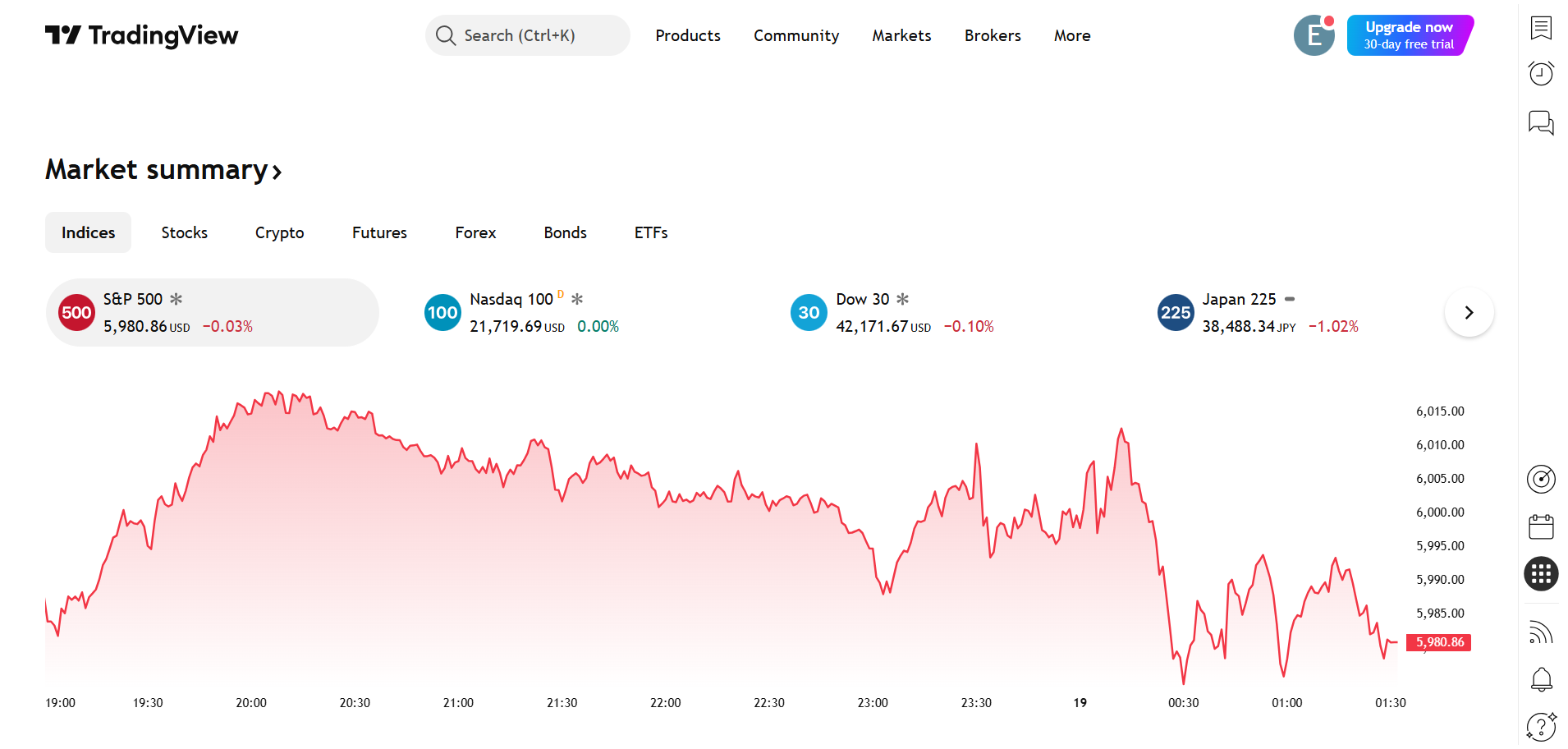
TradingView homepage after creating an account

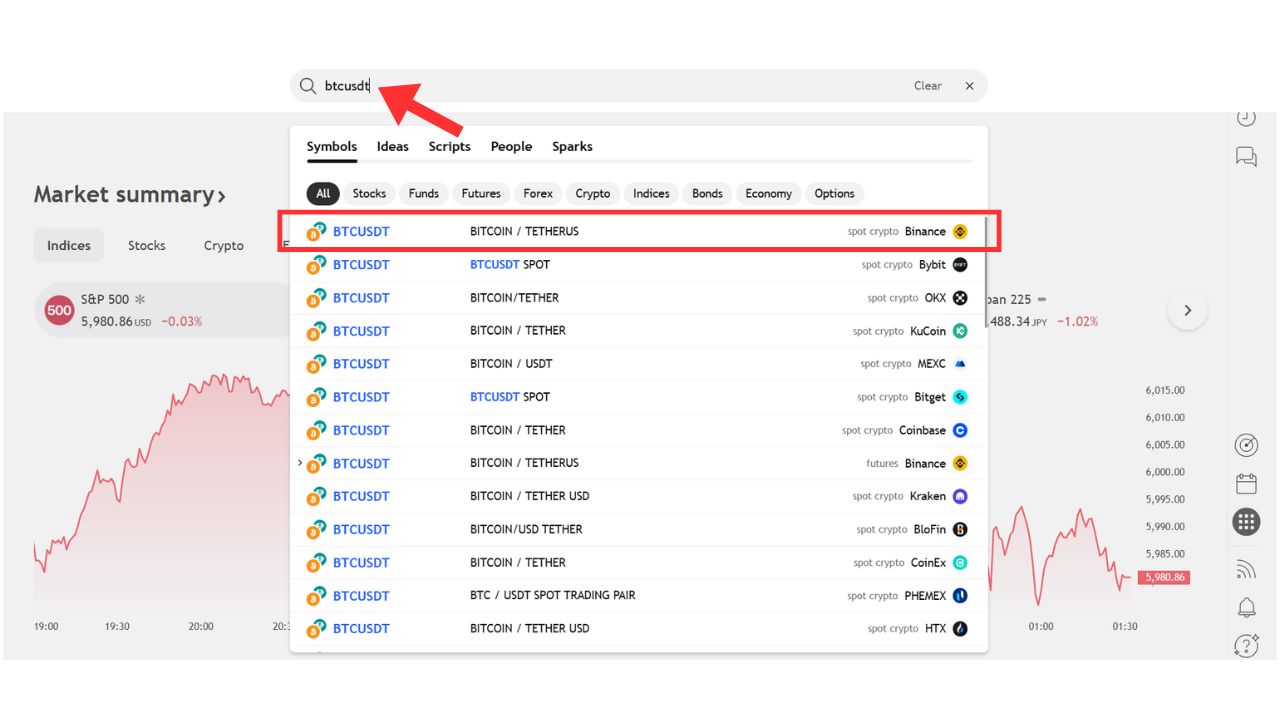
Step 2: Use the search bar to open a chart for the asset you want to trade.

After logging in, go to the search bar at the top of the screen. Type the name or symbol of the stock or cryptocurrency you want to practice trading.

For example, if you want to do paper trading in Bitcoin, type BTCUSDT, select the one from the Binance exchange, and launch the chart.

BTCUSDT Search Result on TradingView

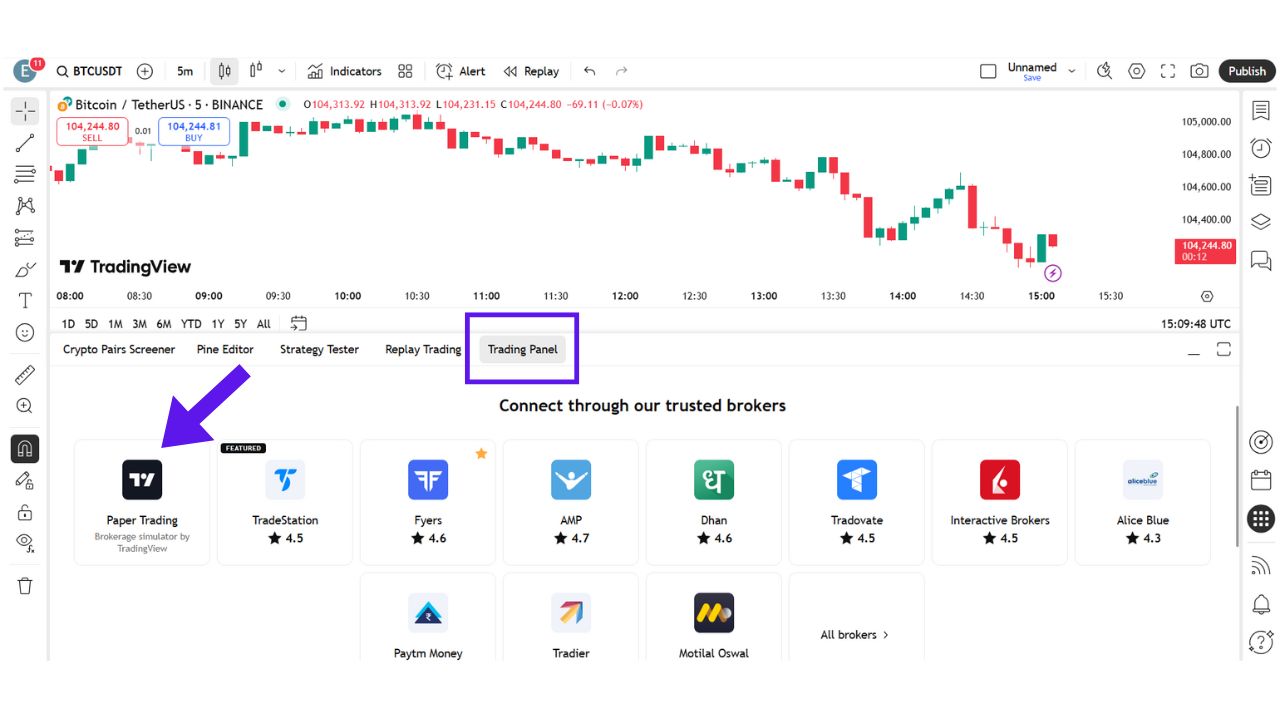
Step 3: Go to the trading panel below and connect to Paper Trading.

Go to the trading panel and connect to Paper Trading.

At the bottom of the chart screen, click on the โ€œTrading Panelโ€ tab.

You will see a few broker options. Find the one that says โ€œPaper Trading – Brokerage simulator by TradingViewโ€ and click โ€œConnect.โ€

Your paper trading account will now be active, and you will receive virtual money to practice with. Normally, TradingView gives $100,000 in fake funds for practice, but you can adjust this amount based on your needs.

Step 4: Place Your First Trade

Once your account is connected, you can place a trade.

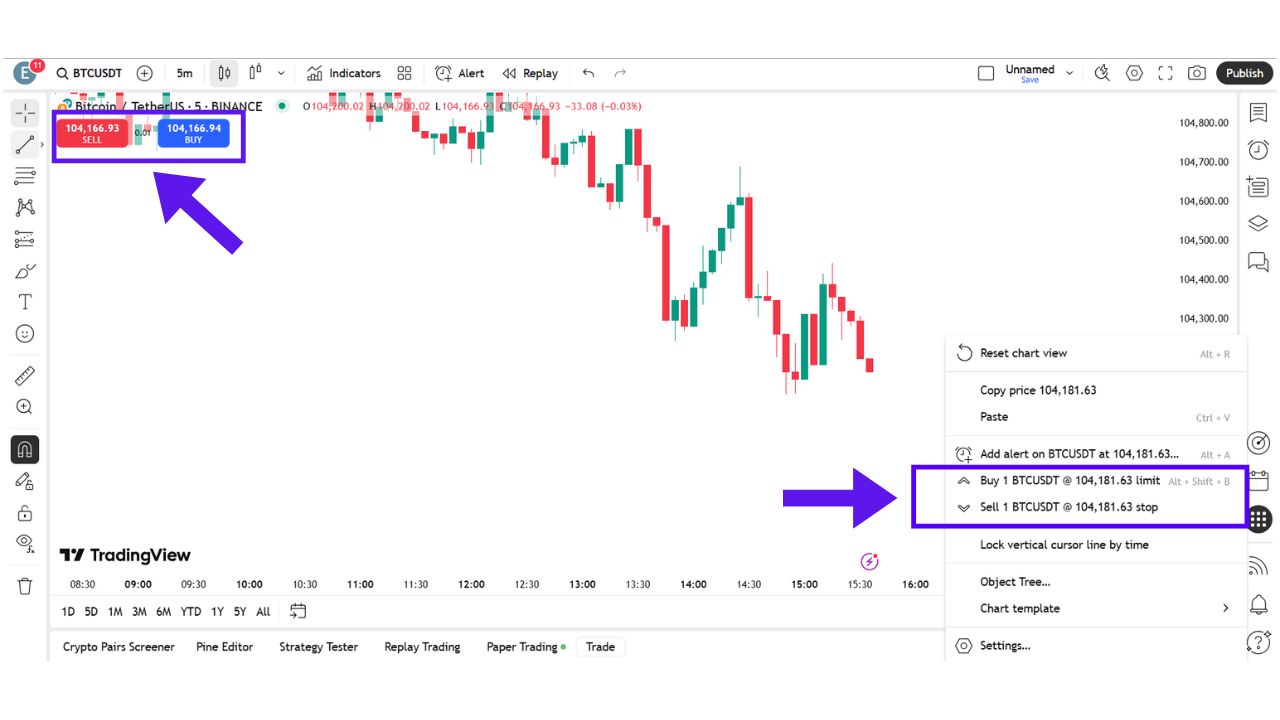
Just right-click on the chart at the price where you want to buy or sell. Choose “Buy” or “Sell,” then adjust the Buy/Sell price to your desired level. You can choose the order type as either a Limit Order or a Stop Order.

After that, click on the Buy or Sell button. Your first trade is now live using virtual money.

You can also use the red and green buttons on the top left corner of the chart for Sell and Buy orders respectively. Adjust the trade parameters within that window and click “Order.”

At the bottom of the screen under “Paper Trading,” youโ€™ll find tabs like “Positions,” “Orders,” and “History.” These tabs show your open trades, profits or losses, balance, and order history.

You can close trades from here as well, and review your past trades to see what worked and what didnโ€™t.

Also Read – Grok 3 for Trading Strategy-A Game Changer for Traders

Please watch the video here if youโ€™d like a visual guide –

Why Paper Trading is Helpful?

TradingView allows you to experience real-time price movements without using real money. You can use all the technical tools available on the platform and test your strategies.

This helps build confidence before you move to live trading. It also helps you understand how orders, stop-loss, and take-profit work in a real market situation.

The Bottom Line

Paper trading is the safest and smartest way to start your trading journey. TradingView makes it super easy for anyone to practice. Whether it is stocks, forex, or cryptocurrencies like Bitcoin, you can test everything without any risk. Just follow the steps explained in this article and youโ€™ll be ready to trade like a pro – with zero risk. Practice regularly and youโ€™ll gain the confidence you need for live trading.

This article is for educational purposes only. Trading in financial markets involves risks. Please learn properly and consult an expert before investing real money.

AIRO Group Holdings (AIRO) Stock Price Prediction, Forecast, and Target for 2025, 2030, 2040, and 2050

AIRO Group Holdings (AIRO) Stock Price Prediction, Forecast, and Target for 2025, 2030, 2040, and 2050

1. Company Overview

AIRO Group Holdings, Inc. (AIRO) is a cutting-edge aerospace and defense technology company specializing in drones, avionics, training, and electric air mobility (eVTOL).

Below is a detailed snapshot of its key attributes, followed by a brief summary of its operations and significance.

Key Company Details

Company NameAIRO Group Holdings, Inc.
SectorIndustrials
IndustryAerospace & Defense / Advanced Technology
IPO Year2025
Stock Exchange ListedNASDAQ Global Market
Founded ByNot publicly specified
Established In2020
SpecializationDrones, Avionics, Training, Electric Air Mobility

Founded in 2020 and headquartered in Albuquerque, New Mexico, with operations in Montreal, Quebec, Stรธvring, Denmark, and Washington, D.C., AIRO Group Holdings, Inc. develops advanced aerospace and defense technologies. The company went public on June 13, 2025, pricing its initial public offering (IPO) of 6,000,000 shares at $10.00 per share, raising $60 million in gross proceeds. AIROโ€™s business spans four segments: Drones (AIRO Drone, Sky-Watch), Avionics (Aspen Avionics), Training (Agile Defense, CDI), and Electric Air Mobility (Jaunt). With $86.94 million in 2024 revenue and a focus on urban air mobility and military applications, AIRO is poised to capitalize on the growing aerospace and defense market.

2. The Stock Market: Fundamentally Driven

The stock market is fundamentally driven by corporate performance, macroeconomic conditions, and industry trends. For AIRO, key fundamentals include revenue growth, segment synergies, debt repayment, and market penetration in drones and eVTOL. Its 2024 revenue of $86.94 million, up 101% year-over-year, reflects strong demand for its technologies.

Macro factors such as U.S. defense spending, tariff policies (e.g., a 90-day tariff pause on non-Chinese imports in 2025), and the $163 billion urban air mobility market by 2030 influence AIROโ€™s stock performance. Long-term growth depends on AIROโ€™s ability to execute its growth initiatives and navigate competitive and regulatory challenges.


3. Sector Overview

Understanding the Sector

AIRO operates within the Industrials sector, which includes aerospace, defense, manufacturing, and transportation firms. This sector drives economic growth through infrastructure and technological advancements. AIROโ€™s focus on drones and eVTOL aligns it with the aerospace and defense subsector, a high-growth area fueled by military modernization and urban air mobility.

Fundamental Factors Affecting the Sector

The Industrials sector is shaped by:

  • Government Spending: U.S. defense budgets and NATO contracts drive demand for AIROโ€™s drone and training segments.
  • Trade Policies: The 2025 tariff pause on non-Chinese imports supports AIROโ€™s U.S.-based operations.
  • Technological Innovation: Advances in autonomy and eVTOL technologies create market opportunities.

Growth and Development in Recent Years

The Industrials sector has seen robust growth, particularly in aerospace and defense. AIROโ€™s IPO on June 13, 2025, coincided with a 10% S&P 500 surge, reflecting a favorable market backdrop. The sector benefited from increased defense spending and urban air mobility investments, with peers like Joby Aviation and Archer Aviation also gaining traction. AIROโ€™s 101% revenue growth to $86.94 million in 2024 and partnerships with public-sector clients underscore its alignment with sector trends.


4. Industry Analysis: Aerospace & Defense / Advanced Technology

Within the Industrials sector, AIRO competes in the Aerospace & Defense / Advanced Technology industry, focusing on drones, avionics, training, and electric air mobility. This industry is characterized by high R&D costs, long development cycles, and competition from firms like Boeing, Lockheed Martin, and eVTOL startups. AIROโ€™s international footprint and segment synergies provide a competitive edge.

Fundamental Factors Impacting the Industry

The industry is influenced by:

  • Customer Concentration: AIROโ€™s reliance on two major clients poses revenue risks.
  • Competition: Established players and eVTOL startups challenge market share in the $163 billion urban air mobility market by 2030.
  • Regulatory Approvals: FAA and TCCA certifications are critical for eVTOL commercialization.

Recent Growth and Developments

The Aerospace & Defense industry is experiencing rapid growth, driven by drone proliferation and eVTOL development. AIROโ€™s IPO, priced at $10 per share on June 13, 2025, raised $60 million, below the initial $14-$16 range, reflecting cautious investor sentiment. The stock opened at $13.62, indicating strong initial demand. Strategic moves, like Aspen Avionicsโ€™ partnership with Electronics International and Jauntโ€™s quarter-scale air taxi demonstrator, enhance AIROโ€™s portfolio. Industry peers like Archer Aviation are also scaling eVTOL production, signaling a competitive but expanding market.

Also Read – Is there any difference between a sector and an industry?


5. Stock Growth and Fundamental Factors

AIROโ€™s stock debuted on June 13, 2025, at $10 per share, raising $60 million through 6,000,000 shares, with an additional 900,000 shares available for over-allotments. The stock opened at $13.62, a 36.2% premium, reflecting investor enthusiasm and a target of $25 by some traders. AIROโ€™s 2024 revenue of $86.94 million (up 101%) and $47 million net loss highlight growth potential tempered by profitability challenges.

The companyโ€™s debt-free strategy post-IPO, using proceeds to repay debt and fund growth, strengthens its balance sheet. However, customer concentration and competition pose risks. AIROโ€™s stock growth aligns with industry trends toward drones and eVTOL, but execution will be critical.


Also Read – Circle Internet Financial Stock Price Prediction, Forecast & Target for 2025, 2030, 2040 & 2050

6. Speculative Targets: Technical Analysis Insights

Technical analysis provides speculative insights into AIROโ€™s stock price movements. As of June 13, 2025, AIRO trades at ~$13.62 (opening price post-IPO). Key indicators include:

  • Moving Averages: Limited post-IPO data; the 50-day moving average is expected to form above the IPO price, signaling early bullish momentum.
  • Support and Resistance: Support is near $10 (IPO price), with resistance around $15 (post-IPO high) and $25 (trader target).
  • Relative Strength Index (RSI): An estimated RSI of ~65 (based on opening surge) suggests bullish but not overbought momentum.

Speculative Price Targets

Using a generalized growth model based on historical market trends and AIROโ€™s fundamentals, we estimate price targets from the current price of $13.62, assuming a 10% annual growth rate (aligned with S&P 500 averages). A range of 5% (conservative) to 15% (optimistic) accounts for varying scenarios, as requested:

  • 2025 (0.5 years, by Dec 31, 2025):
    • Median Price (10% growth annualized): $13.62 ร— (1.10)^0.5 โ‰ˆ $14.29
    • Lower Bound (5% growth): $13.62 ร— (1.05)^0.5 โ‰ˆ $13.95
    • Upper Bound (15% growth): $13.62 ร— (1.15)^0.5 โ‰ˆ $14.63
  • 2030 (5 years):
    • Median Price (10% growth): $13.62 ร— (1.10)^5 โ‰ˆ $21.94
    • Lower Bound (5% growth): $13.62 ร— (1.05)^5 โ‰ˆ $17.39
    • Upper Bound (15% growth): $13.62 ร— (1.15)^5 โ‰ˆ $27.35
  • 2040 (15 years):
    • Median Price (10% growth): $13.62 ร— (1.10)^15 โ‰ˆ $56.92
    • Lower Bound (5% growth): $13.62 ร— (1.05)^15 โ‰ˆ $28.28
    • Upper Bound (15% growth): $13.62 ร— (1.15)^15 โ‰ˆ $110.58
  • 2050 (25 years):
    • Median Price (10% growth): $13.62 ร— (1.10)^25 โ‰ˆ $147.62
    • Lower Bound (5% growth): $13.62 ร— (1.05)^25 โ‰ˆ $46.17
    • Upper Bound (15% growth): $13.62 ร— (1.15)^25 โ‰ˆ $446.62

These targets assume AIRO achieves profitability and captures market share in drones and eVTOL. The 2025 target reflects post-IPO momentum and trader optimism (e.g., $25 target). Long-term risks include competition, regulatory delays, and economic volatility. Technical indicators suggest short-term upside, but 2040 and 2050 projections are highly speculative due to market uncertainties.


7. Long-Term Growth Prospects

AIROโ€™s long-term growth prospects are promising but high-risk, driven by its diversified portfolio across drones, avionics, training, and eVTOL. Its 2024 revenue of $86.94 million (up 101%) and $60 million IPO proceeds provide capital for growth initiatives, debt repayment, and R&D. Strategic partnerships, like Aspen Avionicsโ€™ collaboration with Electronics International, and Jauntโ€™s eVTOL advancements position AIRO for the $163 billion urban air mobility market by 2030.

X posts highlight oversubscription and bullish sentiment, with traders targeting $25+. However, a $47 million 2024 net loss, customer concentration, and competition from established players like Boeing and eVTOL startups pose challenges. If AIRO achieves regulatory approvals, scales production, and diversifies its client base, it could deliver significant returns, but execution risks and market volatility warrant caution.


8. Conclusion

AIRO Group Holdings, Inc. is a dynamic player in the Industrials sector, leading the Aerospace & Defense / Advanced Technology industry with its innovative drone, avionics, training, and eVTOL solutions. Its IPO on June 13, 2025, priced at $10 per share, raised $60 million, with a strong opening at $13.62 reflecting investor confidence. Speculative price targets for 2025 ($14.29), 2030 ($21.94), 2040 ($56.92), and 2050 ($147.62) highlight growth potential, but a $47 million loss, customer concentration, and competitive pressures introduce risks. Investors should balance AIROโ€™s strong revenue growth, strategic partnerships, and market opportunities against execution challenges, making it a high-risk, high-reward long-term investment.

This article is for informational purposes only and should not be considered financial advice. Investing in stocks, cryptocurrencies, or other assets involves risks, including the potential loss of principal. Always conduct your own research or consult a qualified financial advisor before making investment decisions. The author and publisher are not responsible for any financial losses incurred from actions based on this article. While efforts have been made to ensure accuracy, economic data and market conditions can change rapidly. The author and publisher do not guarantee the completeness or accuracy of the information and are not liable for any errors or omissions. Always verify data with primary sources before making decisions.

6 Must-Know Things About DeFi in 2025

DeFi, or Decentralized Finance, is a system of financial tools and services built on blockchain technology, primarily Ethereum, that operates without traditional banks or middlemen.

Mini Glossary

Blockchain: A decentralized, secure ledger of digital transactions
Smart Contract: Self-executing code that carries out financial operations
Crypto Wallet: A tool for storing and interacting with digital assets
Token: A platformโ€™s native asset used for governance, rewards, or trading
Liquidity Pool: A reserve of tokens used to facilitate decentralized trading

1. DeFi lets you use financial services without needing a traditional bank.

What is Defi in Simple Terms?

The full form of DeFi is Decentralized Finance, which means financial activities are not controlled by any central authority or institution.

DeFi allows you to lend, borrow, trade, or save using blockchain networks, primarily Ethereum. It mimics traditional banking functions but removes central authorities. Instead of a bank managing your money, DeFi platforms rely on smart contracts which are self-executing code that operates transparently and without human intervention.


2. DeFi is built on blockchain, which replaces trust in people with trust in code.

DeFi operates on blockchain which is a decentralized, tamper-proof ledger. Every transaction is recorded publicly and permanently. This eliminates the need for banks or brokers to verify transactions.

Smart contracts run automatically, enabling functions like lending or token swapping with speed and accuracy.

The result is a trustless system, where trust shifts from institutions to transparent, verifiable code which is a key driver behind DeFiโ€™s adoption in 2025.


3. You only need a crypto wallet to access DeFi platforms and services.

To access DeFi, a crypto wallet is essential. This wallet stores your digital assets and connects directly with DeFi platforms like Uniswap, Aave, and Curve.

No KYC, no forms – just your wallet and internet.

But with great power comes great responsibility: If you lose your private key (a unique password-like code), you lose access to your funds permanently. Thereโ€™s no reset button.


4. DeFi tokens allow you to participate, earn rewards, and share in platform success.

Most DeFi platforms, like Uniswap (UNI), Aave (AAVE), and Compound (COMP), have their own tokens.

A token is a digital asset created on a blockchain, like Ethereum, that acts like a “coin” or “ticket” specific to a platform. Unlike cryptocurrencies like Bitcoin, tokens are built on existing blockchains and serve unique roles within their ecosystem.

These tokens do three main things:

  • Governance: Let you vote on platform changes, like updating rules or fees, giving you a say in how the platform runs.
  • Rewards: Earn interest or fees by staking (locking up) tokens or providing liquidity (lending assets) to the platform.
  • Speculation: Potential to gain from rising token prices if the platform grows in popularity.

For example, holding UNI tokens for Uniswap might let you vote on trading fees, earn a share of those fees, or profit if UNIโ€™s value increases.


5. While DeFi offers high returns, it also involves serious risks.

DeFi offers exciting opportunities for earning high returns through:

  • Staking: Lock your tokens to earn interest.
  • Liquidity Pools: Provide assets to platforms like Uniswap and earn trading fees.
  • Yield Farming: Move assets across platforms to chase the highest returns.

However, these rewards come with significant risks:

  • Smart Contract Bugs: Code flaws can lead to losses.
  • Platform Hacks: Security breaches may compromise funds.
  • Market Volatility: Prices can swing wildly, affecting your investment.
  • Regulatory Crackdowns: Governments may impose strict rules or bans.

6. DeFi platforms are like money LEGOs, allowing you to stack and combine services.

DeFi platforms are like LEGO blocks for money – simple pieces you can stack together. You can use one platform to borrow money and another to trade, all in one go.

As of June 2025, people have put over $150 billion into DeFi. New tech, like Arbitrum, makes DeFi faster and cheaper by fixing Ethereumโ€™s high costs.

This easy-to-use system is turning DeFi from basic tools into a big world of financial possibilities.


The Bottom Line

These six pillars offer a strong foundation – covering 80% of what truly matters in DeFi. Itโ€™s a financial system powered by blockchain, governed by communities, accessed through wallets, and designed to be open, permissionless, and transparent.

This article is for informational purposes only and should not be considered financial advice. Investing in stocks, cryptocurrencies, or other assets involves risks, including the potential loss of principal. Always conduct your own research or consult a qualified financial advisor before making investment decisions. The author and publisher are not responsible for any financial losses incurred from actions based on this article. While efforts have been made to ensure accuracy, economic data and market conditions can change rapidly. The author and publisher do not guarantee the completeness or accuracy of the information and are not liable for any errors or omissions. Always verify data with primary sources before making decisions.

8 Important Facts About Stablecoins You Need to Know in 2025

Stablecoins are cryptocurrencies built to hold steady, pegged to assets like the U.S. dollar, euro, gold, or other cryptos.

Stablecoins play an essential role in the cryptocurrency ecosystem. They offer a sense of stability in a space often marked by sharp price swings and also present advantages over traditional fiat currencies. With the global crypto market now valued at more than $3.5 trillion, stablecoins like USD Coin (USDC) are becoming central to everything from payments and decentralized finance (DeFi) to promoting financial inclusion.

This article explores 8 critical aspects of stablecoins. It breaks down their definition, explains why they are needed alongside Bitcoin and fiat currencies like the USD, highlights their benefits, and provides a current list of major stablecoins.

1. What Are Stablecoins, and How Do They Maintain Stability?

Stablecoins are cryptocurrencies designed to keep a consistent value by being tied to traditional assets like the U.S. dollar, the euro, gold, or even other cryptocurrencies. Unlike Bitcoin, which saw a 15% price drop in a recent month according to CoinGecko, stablecoins such as Tether (USDT) and USDC are pegged 1:1 to the U.S. dollar, meaning that 1 USDC is roughly equal to $1. These digital assets blend the benefits of blockchain technology with the reliability of traditional currencies, making them suitable for daily transactions, savings, and DeFi use.

They maintain their stability using different methods. Fiat-backed stablecoins, like USDC, hold reserves in actual U.S. dollars stored in audited bank accounts. Crypto-backed stablecoins, such as DAI, are supported by extra collateral in cryptocurrencies like Ethereum, managed by smart contracts. Then there are algorithmic stablecoins like Ethena USDe, which use automatic supply adjustments to keep their value stable. Together, these mechanisms help stablecoins stand apart from Bitcoin’s unpredictability and fiat’s slower systems.

2. Why Are Stablecoins Necessary When Bitcoin and USD Exist?

Stablecoins fill in the gaps left by both Bitcoin and traditional currencies like the USD. While Bitcoin is a revolutionary asset, its price often swings by 12% to 18% within a single month. This makes it unreliable for everyday purchases. For example, it recently dropped 15% in one month. Stablecoins, like USDC, stay steady at $1, enabling dependable payments. In fact, stablecoins handled $27.6 trillion in transactions last year, surpassing Visa and Mastercard combined, according to Chainalysis.

Bitcoin also falls short in cross-border payments, where transaction fees can spike to $10 or even $50, and confirmation times are slow. USDC, on networks like Solana, processes transfers for less than a cent and in just seconds. In countries like Nigeria and India, where remittances are crucial, usage of stablecoins has surged by 200%, showcasing their value where Bitcoin cannot compete.

When compared to USD, bank transfers can take 1 to 5 days and cost $10 to $40. Stablecoins settle in seconds and cost much less. In regions like Turkey, where the lira dropped 28% in value, access to U.S. dollars is limited. However, people are using stablecoins instead. In Turkey alone, stablecoin activity now makes up 4.5% of the countryโ€™s GDP. While banks are only open during set hours, stablecoins work 24/7.

Additionally, U.S. dollars cannot be used in DeFi platforms that offer returns of 5% to 10%, but stablecoins like USDC are at the heart of DeFiโ€™s $2.5 trillion total value locked. Traders also use stablecoins as a safe zone during market downturns to preserve their capital without moving back to fiat. In short, stablecoins go beyond what Bitcoin and USD offer by delivering speed, stability, and ease of use.

3. How Do Stablecoins Differ from Bitcoin and USD?

Each of theseโ€”stablecoins, Bitcoin, and USDโ€”plays a unique role in the world of finance. Stablecoins such as USDC keep a steady value of $1 and avoid the 10% to 20% swings seen in Bitcoin, which recently dropped 15% in one month. While Bitcoin, with a market cap of $1.2 trillion, is mainly used as a store of value or speculative asset, and USD is backed by government institutions, stablecoins operate on blockchain and are built for real-world applications like payments and remittances.

Their technical designs also differ. USDC keeps U.S. dollar reserves in audited accounts. DAI uses other cryptocurrencies as collateral. Ethena USDe controls supply through algorithms. Bitcoinโ€™s price is driven by market demand and supply, and USD depends on the central banking system. Transaction costs also set them apart. Bitcoin fees range from $1 to $50 and can take time to confirm. USD transfers via banks can cost $10 to $40 and take days. On the other hand, USDC on Solana settles almost instantly for less than a cent.

Access is another key factor. Traditional banking is required to use USD, which leaves many people outโ€”especially in underserved areas. Stablecoins are available globally, around the clock, with just a smartphone and internet access. They blend Bitcoinโ€™s innovation with the reliability of the dollar, offering something more practical and inclusive.

4. What Types of Stablecoins Are Available?

Stablecoins fall into four major types, each using a different method to keep their value stable. Fiat-backed stablecoins like USDC and USDT are tied to the U.S. dollar or euro and supported by reserves in bank accounts. Theyโ€™re centralized and reliable for everyday payments and trading.

Crypto-backed stablecoins, such as DAI, are pegged to the dollar but supported by cryptocurrency like Ethereum. These rely on decentralized smart contracts and are popular in DeFi.

Commodity-backed stablecoins are tied to assets like gold or silver. Examples include Tether Gold (XAUt), which appeals to investors who want digital access to physical commodities.

Algorithmic stablecoins like Ethena USDe adjust their supply using software rules rather than backing assets. They carry more risk, as seen in TerraUSDโ€™s $45 billion collapse a few years ago. Still, each type offers unique advantages, from handling remittances to powering decentralized finance.

5. What Is the Current State of the Stablecoin Market?

Today, stablecoins have become a significant part of the cryptocurrency landscape. According to recent data from CoinGecko, they have a combined market cap of $254 billion, making up 7.1% of the total $3.5 trillion crypto marketโ€”a 60% increase from the year before.

Tether (USDT) leads the pack with $157.6 billion, followed by USDC at $61 billion. Together, they represent over 90% of the stablecoin market. Growth is especially strong in developing nations, where local currencies struggle and access to U.S. dollars is limited. In Turkey, for instance, stablecoin activity makes up 4.5% of GDP, and Nigeria has seen usage grow by 200%, driven by the depreciation of the local currency.

New U.S. laws like the GENIUS Act are adding credibility to the market by requiring more transparency. USDC benefits from these regulations due to its frequent audits, while USDT faces criticism for a lack of financial clarity. Still, stablecoins are not without issues. Chainalysis reports that they accounted for $24 billionโ€”or 60%โ€”of all crypto-related illicit transactions last year. On X, users note that USDT dominates in Asia, USDC is preferred in the U.S., and banks such as Citi are exploring ways to issue their own stablecoins to address the dollarโ€™s shortcomings.

6. Which Stablecoins Exist in the Market Today?

Around 200 stablecoins are active as June 2025. However, only a handful see widespread use. Below is a categorized list based:

Fiat-Backed Stablecoins (Pegged to fiat currencies, backed by reserves):

  • Tether (USDT): $157.6 billion, USD-pegged, on Ethereum, Solana, Tron; widely used, transparency concerns.
  • USD Coin (USDC): $61 billion, USD-pegged, Circle-issued; audited, U.S.-regulated.
  • Binance USD (BUSD): ~$17 billion, USD-pegged, Binance/Paxos, NYDFS-regulated.
  • Pax Dollar (USDP): USD-pegged, Paxos, audited.
  • TrueUSD (TUSD): USD-pegged, TrustToken, transparent.
  • PayPal USD (PYUSD): USD-pegged, PayPal-issued.
  • First Digital USD (FDUSD): USD-pegged, transaction-focused.
  • Ripple USD (RLUSD): USD-pegged, Ripple-issued, launched 2024.
  • HeLa USD (HLUSD): USD-pegged, HeLa, Australian-backed, DeFi.
  • STASIS EURO (EURS): Euro-pegged, STASIS.
  • Tether EURt (EURt): Euro-pegged, Tether.
  • Tether CNHt (CNHt): Yuan-pegged, Tether, niche.
  • Tether MXNt (MXNt): Peso-pegged, Tether, Latin America.
  • Global Dollar (USDG): USD-pegged, KuCoin-listed.
  • Usual USD (USD0): $1.2 billion, Usual Protocol, Treasury-backed.
  • USDtb: Ethena-issued, BlackRock BUIDL-backed, recent launch.
  • USD1: World Liberty Financial, USD-pegged, emerging (limited data; X posts note Trump affiliation).
  • Anchored USD (AUSD): USD-pegged, DeFi.
  • eUSD: Lybra Finance, USD-pegged, DeFi.
  • Gemini Dollar (GUSD): Gemini-issued, NYDFS-regulated.
  • EURA: Angle Protocol, euro-pegged, DeFi.
  • Celo Dollar (cUSD): Celo blockchain, USD-pegged, mobile-first.
  • Celo Euro (cEUR): Celo, euro-pegged.
  • XSGD: StraitsX, SGD-pegged, Southeast Asia.
  • IDRT: Rupiah Token, IDR-pegged, Indonesia.
  • GYEN: GMO-Z.com, yen-pegged, niche.
  • ZUSD: Z.com, USD-pegged, small.
  • BRLA: BRLA Digital, BRL-pegged, Brazil.
  • AEUR: Anchored Coins, euro-pegged.
  • BGBP: Binance, GBP-pegged, UK.
  • USDK: OKLink, USD-pegged, niche.

Crypto-Backed Stablecoins (USD-pegged, backed by cryptocurrency collateral):

  • Dai (DAI): $5.36 billion, MakerDAO, Ethereum-backed.
  • Liquity USD (LUSD): Liquity, Ethereum-backed.
  • sUSD: Synthetix, crypto-collateralized.
  • Magic Internet Money (MIM): Abracadabra, multi-chain.
  • FRAX: Frax Finance, partially crypto-backed.
  • VAI: Venus Protocol, Binance Smart Chain.
  • USDX: Kava blockchain, DeFi.
  • aUSD: Acala, Polkadot ecosystem.
  • crvUSD: Curve Finance, lending-focused.

Commodity-Backed Stablecoins (Pegged to gold or silver):

  • Tether Gold (XAUt): Tether, 1 token = 1 ounce gold.
  • Pax Gold (PAXG): Paxos, audited gold reserves.
  • Digix Gold (DGX): Digix, gold-pegged, niche.
  • Perth Mint Gold Token (PMGT): Australian mint-backed.
  • AurusGOLD (AWG): Gold-pegged, small.

Algorithmic Stablecoins (Maintained by algorithms, no collateral):

  • Ethena USDe: Ethena, USD-pegged, delta-neutral.
  • Ampleforth (AMPL): Supply-adjusting, not USD-pegged.
  • Frax Share (FXS): Partially algorithmic, FRAX ecosystem.
  • TerraUSD Classic (USTC): Niche, post-2022 collapse.
  • Reserve (RSV): Reserve Protocol, emerging markets.
  • Beanstalk (BEAN): USD-pegged, DeFi.
  • USDD: Tron-based, algorithmic, small.
  • CUSD (Carbon): Algorithmic, eco-focused.

7. Why Are Stablecoins Gaining Widespread Adoption?

The growing popularity of stablecoins can be linked to how effectively they solve problems found in Bitcoin and fiat currencies. Their steady value makes them ideal for transactions and DeFi, unlike Bitcoin, which is too volatile to function as a regular payment method.

Compared to USD, stablecoins cost much less to useโ€”just a fraction of a cent versus $10 to $40 for bank wiresโ€”and they settle in seconds rather than days. In DeFi, they are foundational, helping secure $2.5 trillion in total value locked and offering yields of 5% to 10% through platforms like Compound.

In countries like Turkey and Nigeria, where national currencies have lost a lot of value, stablecoins provide a reliable digital option when U.S. dollars are hard to come by. Major players like PayPal and Visa are integrating stablecoins like PYUSD and USDC into their systems, signaling a major shift toward mainstream use.

8. What Are the Challenges and Future Prospects for Stablecoins?

Despite their benefits, stablecoins still face hurdles. Not all issuers provide the same level of transparency. For instance, USDT has been criticized for incomplete audits, while USDC earns trust through regular attestations.

New regulations, such as the GENIUS Act in the U.S. and fresh rules in the EU, could tighten oversight. This may create obstacles that fiat currencies like the USD donโ€™t have to face. Thereโ€™s also the risk of losing their dollar pegโ€”USDT once fell to 92 centsโ€”and algorithmic models carry even higher risk, as the TerraUSD incident revealed.

Stablecoins are also used in illegal activities due to their stability, accounting for $24 billion in crypto crime last year, according to Chainalysis. That said, their role in digital finance is only growing stronger. With a $254 billion market cap and $27.6 trillion in transactions last year, they have clearly proven their value. Large banks such as JPMorgan and Citi are now exploring how to create their own stablecoins to offer faster and cheaper alternatives to fiat. Meanwhile, DeFi continues to expand, with stablecoins powering key innovations. As inflation and currency issues persist in emerging markets, stablecoins are becoming even more important.

The Bottom Line

Stablecoins like USDC are now an essential part of the cryptocurrency world. They offer the kind of stability, speed, and access that Bitcoin and traditional fiat currencies often fail to provide. With a market cap of $254 billion and nearly 200 options – from giants like USDT to niche coins like XSGD – stablecoins are deeply involved in payments, DeFi, and financial inclusion.

This article is for informational purposes only and should not be considered financial advice. Investing in stocks, cryptocurrencies, or other assets involves risks, including the potential loss of principal. Always conduct your own research or consult a qualified financial advisor before making investment decisions. The author and publisher are not responsible for any financial losses incurred from actions based on this article. While efforts have been made to ensure accuracy, economic data and market conditions can change rapidly. The author and publisher do not guarantee the completeness or accuracy of the information and are not liable for any errors or omissions. Always verify data with primary sources before making decisions.
eToro Group Ltd. (ETOR) Stock Price Prediction, Forecast, and Target for 2025, 2030, 2040, and 2050

eToro Group Ltd. is a fintech trailblazer within the Financials sector, leading the Capital Markets / Fintech industry with its innovative social trading platform and robust cryptocurrency offerings.

1. Company Overview

eToro Group Ltd. (ETOR) is a leading social trading platform that enables retail investors to access cryptocurrencies, stocks, and other asset classes using its innovative CopyTrader feature.

The following is a comprehensive overview of its key characteristics, followed by a concise summary of its operations and relevance.

Company NameeToro Group Ltd.
SectorFinancials
IndustryCapital Markets / Fintech
IPO Year2025
Stock Exchange ListedNASDAQ
Founded ByYoni Assia, Ronen Assia, David Ring
Established In2007 (as RetailFX)
SpecializationSocial Trading, Cryptocurrency Trading, Multi-Asset Investing

Founded in 2007 by Yoni Assia, Ronen Assia, and David Ring, eToro Group Ltd. is headquartered in Bnei Brak, Israel. The company operates globally with a presence in Cyprus, the United Kingdom, the United States, Australia, Germany, and the UAE. On May 14, 2025, eToro went public on NASDAQ with a valuation of $5.5 billion, raising $620 million through its IPO. Its platform facilitates trading in cryptocurrencies (including Bitcoin, Ethereum, and Bitcoin Cash in the U.S.), stocks, ETFs, commodities, and derivatives. As of September 2024, it serves more than 38 million registered users and has 3.5 million funded accounts. Features such as CopyTraderโ„ข, eToro Academy, and AI-powered tools significantly enhance user experience. Additionally, the company’s post-IPO expansion in the U.S. crypto market has reinforced its position in the digital asset sector.

2. The Stock Market: Fundamentally Driven

Stock markets are primarily influenced by corporate earnings, macroeconomic factors, and industry-specific developments. In the case of eToro, essential growth drivers include the expansion of its user base, trading volume trends, cryptocurrency-related revenues, and adherence to regulatory frameworks. For Q1 2025, eToro posted an earnings per share (EPS) of $0.69, exceeding analysts’ expectations of $0.61. Its net contribution grew by 8% year-over-year, reaching $217 million, supported by a 14% increase in funded accounts, which totaled 3.58 million. Macroeconomic elements such as cryptocurrency volatility, regulatory shifts in the U.S. (including a 2024 SEC settlement that limited its crypto offerings), and global interest rate trends directly impact ETOR’s stock performance. Sustained long-term success will depend on how well eToro diversifies its income streams while continuing to lead in the social trading space.

3. Sector Overview: Financials

Understanding the Sector

eToro operates in the broader Financials sector, encompassing institutions like banks, brokers, payment processors, and fintech companies. This sector plays a pivotal role in global economic activity by enabling capital flow and investment. eToroโ€™s focus on social trading and cryptocurrencies places it within the fast-evolving fintech subsector, which is being driven by increasing adoption of digital assets and cutting-edge technology.

Fundamental Factors Affecting the Sector

Several elements influence the Financials sector:

  • Regulatory Environment: Developments such as the 2024 SEC settlement, which limited eToroโ€™s U.S. crypto offerings to Bitcoin, Ethereum, and Bitcoin Cash, significantly affect business operations.
  • Cryptocurrency Market: Fluctuations in the prices of Bitcoin and other altcoins directly influence trading volumes and revenue.
  • Retail Investor Trends: The rising popularity of digital assets and social trading continues to attract more users to platforms like eToro.

Growth and Development in Recent Years

The Financials sector has seen considerable growth, particularly within fintech and cryptocurrency. eToroโ€™s IPO on May 14, 2025, marked a milestone, with shares jumping 29% to close at $67, highlighting strong investor confidence. The “Fintech Spring” of 2025 also saw other major developments, such as Coinbase entering the S&P 500 and Chime preparing for its IPO. eToro’s reported revenue of $12.6 billion in 2024 – with 96% attributed to crypto – demonstrates the sector’s momentum, although the company is actively working to diversify its offerings into stocks and ETFs. Additionally, improved U.S.-China trade relations in 2025 have created a more favorable landscape for fintech companies.

4. Industry Analysis: Capital Markets / Fintech

Within the Financials sector, eToro operates in the Capital Markets / Fintech industry. This space is marked by innovation, a strong emphasis on user experience, and competitive pressures from companies like Robinhood, SoFi, and Webull. eToro differentiates itself through unique features such as CopyTrader, AI-driven sentiment analysis, and a community-oriented approach to investing.

Fundamental Factors Impacting the Industry

Key drivers shaping the industry include:

  • Crypto Revenue Volatility: In 2024, eToroโ€™s crypto revenue tripled to $12 million. However, by Q1 2025, crypto made up only 37% of total revenue, down from 43% the previous year, indicating the market’s volatility.
  • Competition: Platforms like Robinhood, with its commission-free trading, and Webull, known for advanced charting tools, present stiff competition.
  • Technological Innovation: Continued advancements in AI and blockchain technology enhance user engagement and platform efficiency.

Recent Growth and Developments

The fintech space continues to expand rapidly. eToro’s user base reached 38 million, and assets under management (AUM) stood at $14.8 billion in Q1 2025. Following its IPO, eToro increased its U.S. crypto offerings (within the limits of SEC guidelines) and reintroduced trading for Cardano (ADA), boosting user engagement. Acquisitions such as Firmo and Delta in 2019 have enhanced its AI-powered trading tools. Other industry players like Coinbase and Robinhood are also branching into wealth management, signaling a shift towards more holistic fintech ecosystems.

Also Read – I Created the Best Bitcoin Guide Youโ€™ll Ever Read

5. Stock Growth and Fundamental Factors

eToroโ€™s stock performance since its IPO has been impressive. From its initial price of $52 on May 14, 2025, the stock climbed 29% to reach $67, placing its market cap at $5.4 billion. By June 10, 2025, ETOR was trading at $74.30, showing a 10.58% gain on the day and a 23.99% rise for the week. This momentum was fueled by favorable analyst ratings from Jefferies ($80 price target) and Goldman Sachs ($76 price target). The Q1 2025 results showcased a net contribution increase of 8% to $217 million and a 14% jump in funded accounts, thanks largely to growing crypto interest and technological enhancements like AI-powered tools. Still, the company faces risks, including regulatory challenges such as the 2024 Philippines SEC advisory and its heavy reliance on crypto, which made up 96% of 2024 revenue. Despite these risks, eToroโ€™s stock growth mirrors broader industry trends in retail investing and digital assets. To sustain this growth, expanding into non-crypto areas will be essential.

6. Speculative Targets: Technical Analysis Insights

Technical analysis offers speculative guidance on potential price movements for eToroโ€™s stock. As of June 10, 2025, ETOR was trading at $74.30, within a 52-week range of $57.50 to $79.96. Key technical indicators are as follows:

  • Moving Averages: The 50-day moving average sits above the 200-day average, indicating bullish momentum, particularly supported by the 15.51% gain recorded on June 6, 2025.
  • Support and Resistance: The nearest support level is around $62.57 (the low from June 6), while resistance is at the $80 mark, which also serves as a psychological barrier and an analyst target.
  • Relative Strength Index (RSI): With recent volatility, the RSI is estimated at around 60, suggesting neutral-to-positive momentum. Continued user growth could push it higher.

Speculative Price Targets

Based on historical trends and eToroโ€™s current fundamentals, projections from the current price of $74.30 are modeled assuming a 10% annual growth rate. A conservative 5% and an optimistic 15% scenario are also considered:

2025 (0.5 years, by December 31, 2025)

  • Median Price (10% growth): $77.97
  • Lower Bound (5% growth): $76.12
  • Upper Bound (15% growth): $79.83

2030 (5 years)

  • Median Price (10% growth): $119.67
  • Lower Bound (5% growth): $94.87
  • Upper Bound (15% growth): $149.29

2040 (15 years)

  • Median Price (10% growth): $310.43
  • Lower Bound (5% growth): $154.24
  • Upper Bound (15% growth): $602.86

2050 (25 years)

  • Median Price (10% growth): $804.93
  • Lower Bound (5% growth): $251.92
  • Upper Bound (15% growth): $2,432.40

These estimates assume continued user growth and diversification beyond cryptocurrencies. The 2025 target is based on current momentum, though near-term volatility may limit gains. Projections for 2040 and 2050 are speculative, given the unpredictability of long-term market dynamics.

7. Long-Term Growth Prospects

eToroโ€™s future growth outlook remains strong, supported by its 38 million users, $14.8 billion in AUM, and standout features like CopyTraderโ„ข and AI-powered tools. The Q1 2025 performance-with a $0.69 EPS beating expectations and a 21% AUM increase -reflects solid fundamentals. Key growth initiatives include expanded U.S. crypto offerings (albeit limited to Bitcoin, Ethereum, and Bitcoin Cash) and the reintroduction of Cardano (ADA) trading. Analysts are optimistic: Citizens JMP targets $85, while Goldman Sachs maintains a $76 estimate, crediting eToroโ€™s unique social trading model. Nevertheless, challenges remain. In 2024, 96% of revenue came from crypto, exposing the company to market volatility and regulatory scrutiny, such as advisories from the Philippines SEC. Rivals like Robinhood and Webull also intensify competition. For eToro to become a more stable long-term investment, it must broaden its product offerings into areas like stocks, ETFs, custody solutions, and wealth management while carefully navigating global regulations.

8. Conclusion

eToro Group Ltd. stands out as a fintech leader in the Financials sector, particularly within the Capital Markets / Fintech industry. Its IPO success, robust Q1 2025 results, and growing user base highlight its upward trajectory. Speculative price targets for 2025 ($77.95), 2030 ($119.58), 2040 ($310.39), and 2050 ($804.74) reflect its growth potential. However, significant reliance on crypto revenue and evolving regulatory landscapes present clear risks. Investors should weigh the companyโ€™s strengthsโ€”including its global footprint, innovative features, and active user communityโ€”against these challenges. While it offers a compelling long-term opportunity, cautious optimism is advised, particularly regarding its crypto exposure.

This article is for informational purposes only and should not be considered financial advice. Investing in stocks, cryptocurrencies, or other assets involves risks, including the potential loss of principal. Always conduct your own research or consult a qualified financial advisor before making investment decisions. The author and publisher are not responsible for any financial losses incurred from actions based on this article. While efforts have been made to ensure accuracy, economic data and market conditions can change rapidly. The author and publisher do not guarantee the completeness or accuracy of the information and are not liable for any errors or omissions. Always verify data with primary sources before making decisions.