CRCL’s USDC & FI’s FIUSD – The Stablecoin Business Model Everyone Should Understand

CRCL's technical analysis

Circle Internet Group (NYSE: CRCL) is seeing a breakout year, with its stock up over 750% since its June 5, 2025 IPO, fueled by the explosive growth of its USDC stablecoin and a new strategic partnership with payments giant Fiserv (NYSE: FI). On June 23, 2025, Fiserv announced a major integration deal with Circle to bring both USDC and its own upcoming stablecoin, FIUSD, to millions of merchants and banks. The partnership could potentially shake up the payments industry long dominated by Visa and Mastercard.

Also Read – The Very First Post You Should Read to Learn Cryptocurrency

How Stablecoins Like USDC and FIUSD Operate?

USD Coin (USDC) is a stablecoin created by Circle and Coinbase. It is pegged 1:1 to the US dollar, meaning 1 USDC is always equal to 1 USD. Launched in September 2018, it runs on blockchains like Ethereum and provides a stable digital currency for payments and transactions.

Stablecoins like USDC (Circle) and FIUSD (Fiserv’s forthcoming stablecoin) are digital currencies pegged 1:1 to the U.S. dollar, backed by reserves like cash or short-term Treasury bonds. Here’s how it works:

  • Deposit and Mint: You send $1 to Circle or Fiserv, and they issue 1 USDC or FIUSD token, fully backed by secure assets.
  • Invest and Earn: The issuer invests your dollar in low-risk assets, earning 4–5% annualized interest. This interest is their profit.
  • Transact Cheaply: You use USDC or FIUSD for payments, remittances, or DeFi on blockchains like Solana or Ethereum, with fees as low as 0.1–0.5%, compared to Visa’s 2–3%.
  • Transparency: Circle provides monthly attestations by Grant Thornton to verify USDC’s reserves. Fiserv, a regulated fintech, commits to similar oversight for FIUSD.

As of June 24, 2025, USDC’s market cap is $61.9 billion, holding 27% of the $225 billion stablecoin market, behind Tether’s USDT ($102 billion, per CoinMarketCap). Circle’s stock hit $298.99 on June 23, 2025, valuing the company at $63.9 billion, up from $6.9 billion at its June 5, 2025 IPO. Fiserv, with an $94.5 billion market cap, is now adopting this model with FIUSD, set to launch by December 2025.

Also Read – 4 Reasons Circle (CRCL) Stock is Crashing – Will It Hit $200 Next?


CRCL-Fiserv Partnership – Stablecoins Go Mainstream

CRCL latest news

On June 23, 2025, Circle and Fiserv, Inc. announced a partnership to integrate USDC and FIUSD into Fiserv’s network of 10,000 financial institutions and 6 million merchant locations. This deal, reported by Bloomberg, is a turning point for stablecoin adoption:

  • USDC Access: Fiserv’s clients can use USDC for real-time, low-cost payments via Circle’s Circle Payments Network, slashing costs for cross-border transfers or merchant settlements.
  • FIUSD Launch: Fiserv’s FIUSD, built on Circle’s infrastructure and Solana’s blockchain, will launch by December 2025 and be interoperable with USDC, enabling seamless transactions.
  • Massive Scale: Fiserv processes $5 trillion in transactions annually, giving USDC and FIUSD access to millions of users, from community banks to global retailers.
  • Regulatory Trust: Circle’s New York BitLicense and Fiserv’s AML/KYC compliance align with the GENIUS Act, which mandates reserve audits and consumer protections.

The announcement drove CRCL’s stock up 9.6% to $263.45 and Fiserv’s by 4.3% to $170.21 on June 23, 2025 (Yahoo Finance).


Disrupting Visa and Mastercard – A Cheaper, Faster Alternative

Visa and Mastercard process over $20 trillion annually but charge merchants 2–3% per transaction, totaling $100 billion+ in fees yearly. USDC and FIUSD offer a disruptive alternative –

  • Low Fees: Stablecoin transactions cost 0.1–0.5% on blockchains like Solana. For example, a $1,000 sale via USDC costs a merchant $1–$5, versus $20–$30 with Visa (based on my analysis of blockchain fees).
  • Instant Settlements: Unlike card networks’ 1–3-day delays, stablecoins settle in seconds, 24/7, ideal for merchants and consumers.
  • Global Reach: USDC and FIUSD enable borderless payments without 1–2% currency conversion fees, supporting use cases like remittances.

The CRCL-Fiserv partnership could bring USDC and FIUSD to 6 million merchants, rivaling card networks. A retailer using Fiserv’s platform could accept USDC at checkout, saving thousands annually. As Circle’s CEO Jeremy Allaire tweeted on June 23, 2025,

“USDC is digital cash for the internet age – fast, cheap, global.”


Stablecoins vs. Banks – Simpler, But Riskier

Stablecoins operate like a “debit card bank” with fewer rules than traditional banking:

  • No Lending: The GENIUS Act prohibits stablecoin issuers from lending reserves, unlike banks that use deposits for loans. Circle and Fiserv earn only from interest, simplifying the model but capping revenue.
  • Lighter Regulation: Circle’s BitLicense and Fiserv’s fintech compliance provide oversight, but stablecoins lack FDIC insurance, leaving users vulnerable if reserves are mismanaged.

However, crypto’s history raises red flags. Collapses like FTX, Celsius (2022), and Terraform Labs’ UST ($40 billion loss) show the sector’s volatility. While USDC’s audited reserves and Fiserv’s regulated status reduce risks, a market crash or reserve mismanagement could spark panic.

My Insight: Reviewing SEC filings and CoinMarketCap data, I found USDC’s reserves are fully backed, unlike Terra’s failed UST, but users must stay vigilant about audits.

Also Read – I Created the Best Bitcoin Guide You’ll Ever Read


Is the Stablecoin Model Trustworthy?

Skeptics question whether stablecoins are a scam. Here’s a balanced view:

Concerns

  • Profit Asymmetry: Issuers keep the interest, while users bear risks like hacks or insolvency, as seen in BlockFi’s 2022 bankruptcy.
  • Crypto Failures: Scams like Bitconnect (2018) and Terra/Luna (2022) fuel distrust. A reserve failure could disrupt USDC or FIUSD.
  • No Insurance: Stablecoin holdings aren’t FDIC-insured, unlike bank deposits.

Reassurances

  • Transparency: Circle’s monthly attestations and Fiserv’s regulated status ensure accountability, unlike Tether’s past opacity.
  • Regulatory Progress: The GENIUS Act mandates audits and protections, boosting trust.
  • Proven Utility: USDC powers $2 trillion in annual transactions (CoinMarketCap), from remittances to DeFi. Fiserv’s adoption signals institutional confidence.
  • No Leverage: USDC and FIUSD are 1:1 backed, reducing collapse risks compared to algorithmic stablecoins.

The model isn’t a scam but requires due diligence. Check audits and understand risks before using stablecoins.


Fiserv (NYSE: FI)-Company Overview

AspectDetails
Company NameFiserv, Inc. (NYSE: FI)
Founded1984
HeadquartersMilwaukee, Wisconsin
Revenue (2024)$19.1 billion
Market Cap~$94.5 billion (June 2025)
Key ServicesCore processing, digital banking, payment solutions
Network10,000 financial institutions, 6 million merchant locations
Key PartnershipsCircle (USDC/FIUSD), Paxos, PayPal (PYUSD), Visa, Mastercard
Regulatory StatusCompliant with AML/KYC

This article is for informational purposes only and should not be considered financial advice. Investing in stocks, cryptocurrencies, or other assets involves risks, including the potential loss of principal. Always conduct your own research or consult a qualified financial advisor before making investment decisions. The author and publisher are not responsible for any financial losses incurred from actions based on this article. While efforts have been made to ensure accuracy, economic data and market conditions can change rapidly. The author and publisher do not guarantee the completeness or accuracy of the information and are not liable for any errors or omissions. Always verify data with primary sources before making decisions.

First Up 25%, Then Down 12% – Is Circle (CRCL) Stock Headed for a Drop to $200?

Why is NEGG stock falling?

Circle Internet Group Inc. (NASDAQ: CRCL) thrilled markets on Monday, closing up 9.64% at $263.45, a gain of $23.17 from the previous session. The stock surged nearly 25% intraday, touching a high of $298.99, before swiftly retreating 12% from its peak. With pre-market trading pointing to a modest – 1.27% dip at 260.10, one question remains to be answered that Is a correction toward $200 inevitable?

Latest Article – 4 Reasons Circle (CRCL) Stock is Crashing

Fiserv Partnership Ignites Rally

The day’s dramatic move was catalyzed by Fiserv’s (NASDAQ: FI) announcement of a strategic partnership with Circle to develop stablecoin-powered financial tools. The fintech giant also revealed plans to launch its own stablecoin, FIUSD, by year-end – leveraging Circle’s infrastructure alongside Paxos.

Also Read – CRCL’s USDC & FI’s FIUSD – The Stablecoin Business Model Everyone Should Understand

This news comes on the heels of the U.S. Senate passing a federal regulatory framework for stablecoins, a move expected to mainstream digital dollar alternatives and provide legal certainty for companies like Circle. The one-two punch of regulatory clarity and enterprise adoption sent CRCL shares soaring.

CRCL’s 750% Run Since IPO

Since its IPO on June 5, 2025, at $31 per share, CRCL has delivered a jaw-dropping +749.84% return – crushing the S&P 500’s modest 2.44% year-to-date gain. The company’s reach spans stablecoin issuance (via USDC), AI infrastructure, and early-stage tech investing, drawing attention from retail traders and institutional funds alike.

Market Cap$63.9 Billion
Trailing P/E3,020
Price/Sales (TTM)31.02
Price/Book (MRQ)78.70
EV/Revenue30.59
EV/EBITDA197.04

These metrics suggest premium pricing, even by high-growth tech standards, and indicate heightened downside risk if growth expectations are not met.

Technical Outlook: Is Volatility Here to Stay?

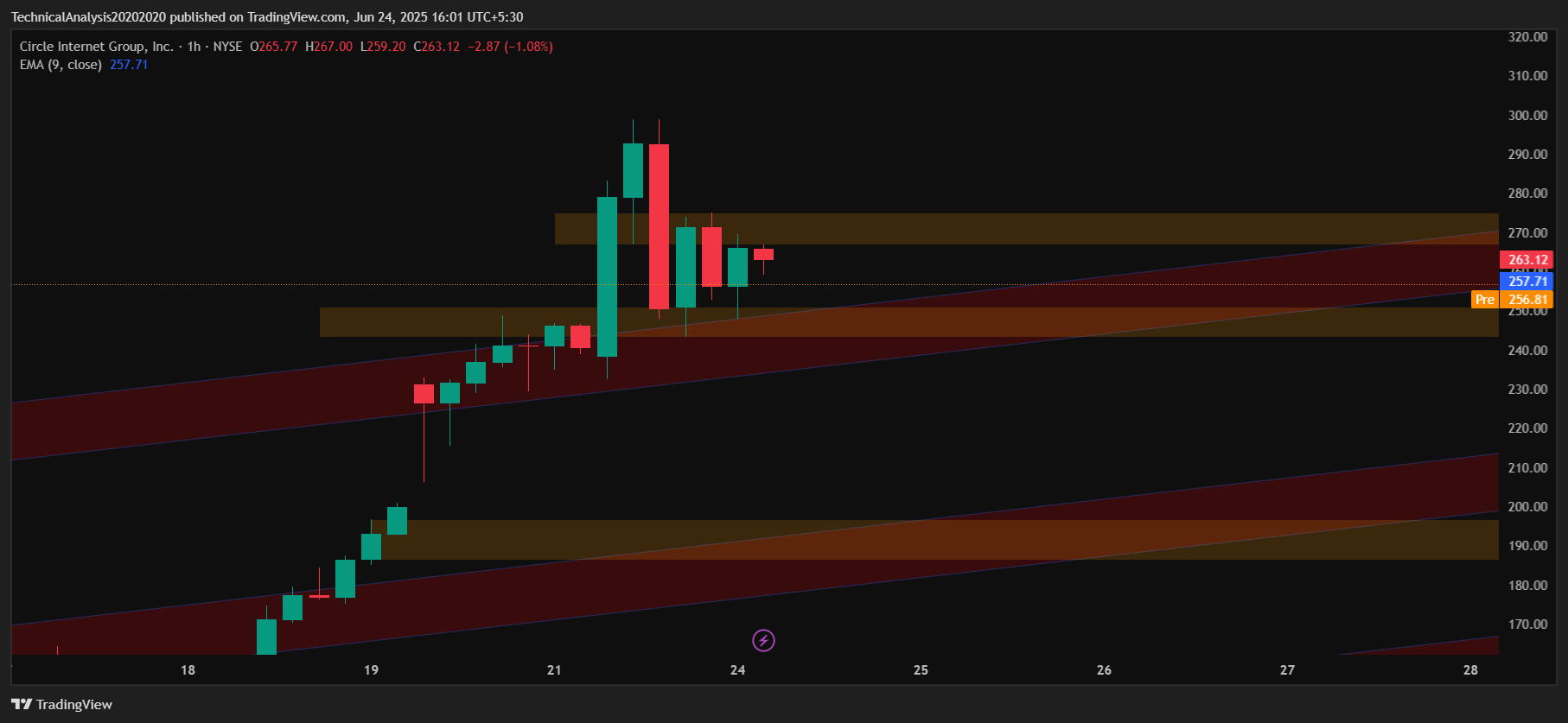
CRCL candlestick chart by TradingView

Monday’s trading range, from $232.48 to $298.99, underscored the volatility dominating CRCL. The inability to hold above $295 suggests heavy profit-taking near resistance.

Currently, CRCL is range-bound between $250 and $270. If the crucial support level of $250 is breached, the stock may crash with a high probability, potentially falling toward $200.

Conversely, if CRCL breaks and sustains above the $270 zone, it may resume its upward rally.

This analysis is based on technical analysis using candlestick chart price action.

However, the fundamentals tell a different story. With such an elevated P/E ratio, the stock appears overheated and may require a correction to slow down and trade closer to its mean valuation.

Also Read – USDC vs. RLUSD vs. USDT – Key Differences and Why They Matter

CRCL vs. S&P 500: A Performance Breakdown

PeriodCRCL ReturnS&P 500 Return
YTD+749.84%+2.44%
1-Year+749.84%+10.26%
3-Year+749.84%+58.74%
5-Year+749.84%+92.42%

The stock has dramatically outpaced the broader market, but history shows such parabolic moves often correct sharply.

What’s Next for Circle?

Despite short-term volatility, Circle’s fundamentals remain solid. It remains the primary issuer behind USDC, the second-largest stablecoin, and is expanding aggressively into institutional and fintech partnerships. The Fiserv deal and the anticipated FIUSD stablecoin launch further cement Circle’s role in the digital finance space.

Also Read – 6 Must-Know Things About DeFi in 2025

Still, the elevated valuation and fast-paced gains introduce caution for new entrants.

Investors should monitor:

  • Key Support Zones: $210–$190 could provide a technical floor.
  • Catalysts: More partnerships or global adoption of USDC may reignite buying.
  • Macro Sentiment: Crypto and fintech sector moves will influence the stock.

This article is for informational purposes only and should not be considered financial advice. Investing in stocks, cryptocurrencies, or other assets involves risks, including the potential loss of principal. Always conduct your own research or consult a qualified financial advisor before making investment decisions. The author and publisher are not responsible for any financial losses incurred from actions based on this article. While efforts have been made to ensure accuracy, economic data and market conditions can change rapidly. The author and publisher do not guarantee the completeness or accuracy of the information and are not liable for any errors or omissions. Always verify data with primary sources before making decisions

CRCL Stock Soars Over 33% as Stablecoin Market Cap Hits $252 Billion After Genius Act Passage

Why is NEGG stock falling?

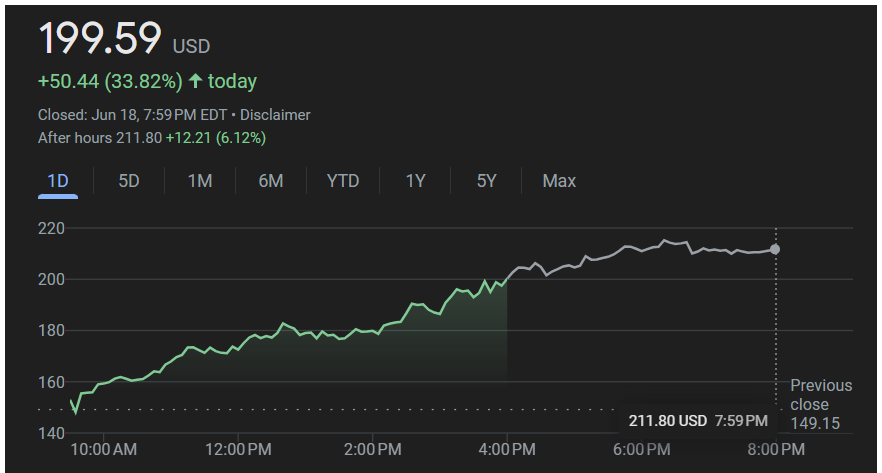
On Wednesday, Circle Internet Group Inc (NYSE: CRCL), the parent company behind the USDC stablecoin, saw its stock skyrocket by 33.82%, closing at $199.59, up $50.44 from the previous close of $149.15. The rally continued into after-hours trading, with the stock hitting $211.80, marking another 6.12% gain and sending bullish signals across the crypto finance sector.

This surge came shortly after the U.S. Senate passed the Genius Act, a new federal framework regulating stablecoins like USDC. The bill is being seen as a landmark victory for the crypto industry, offering long-awaited clarity for institutions and investors interested in dollar-backed digital assets.

Stablecoin Market Cap Hits $252 Billion

The passing of the Genius Act has pushed the total market cap of stablecoins to $252 billion, as investors welcomed the legal clarity and legitimacy the new regulation brings. USDC, Circle’s flagship stablecoin, plays a major role in this market.

With Circle’s direct exposure to this growing ecosystem, the company’s valuation has jumped to $48 billion, reflecting heightened investor confidence.


Stock Performance Snapshot

crcl price chart google
Time PeriodReturn
1 Day+33.82%
5 Days+70.90%
All Time+189.26%

The day’s price action was notable. CRCL opened at $153.22, hit a low of $148.00, and rallied to an intraday high of $200.90 — a new 52-week high. The stock then settled at $199.59 and surged again in after-hours trading.

Company Overview

DetailInfo
NameCircle Internet Group Inc
TickerNYSE: CRCL
Founded2013
FounderJeremy Allaire, Sean Neville
SectorFinancial Technology
IndustryBlockchain & Digital Payments
HeadquartersBoston, Massachusetts, U.S.

Fundamentals

MetricValue
Market Cap$48 Billion
P/E Ratio (TTM)2,494.8802
EPS (TTM)$0.0801
52-Week High$200.90
52-Week Low$64.00

Technical Outlook

On the charts, CRCL stock broke a strong resistance level of $165.60 with a large bullish candle on Tuesday. The momentum continued Wednesday with strong volume and pre-market gap-up to $211.80. This price action confirms a strong uptrend, and unless there is major selling pressure, the rally may continue toward the next resistance zone of $225–$230.

Key support levels now rest at $170 and $165, which may act as buying zones if the stock sees any pullback.


Final Thoughts

CRCL is currently riding a powerful wave of regulatory clarity and investor sentiment, backed by its direct link to the exploding stablecoin market. With USDC adoption likely to grow further, and institutional interest expected to rise, Circle’s stock may continue to gain momentum in the short to medium term.

Investors are now closely watching Circle’s performance ahead of its next earnings date on August 13, 2025, and how it capitalizes on this policy-driven tailwind.


This article is for informational purposes only and should not be considered financial advice. Investing in stocks, cryptocurrencies, or other assets involves risks, including the potential loss of principal. Always conduct your own research or consult a qualified financial advisor before making investment decisions. The author and publisher are not responsible for any financial losses incurred from actions based on this article. While efforts have been made to ensure accuracy, economic data and market conditions can change rapidly. The author and publisher do not guarantee the completeness or accuracy of the information and are not liable for any errors or omissions. Always verify data with primary sources before making decisions.

Why Cathie Wood’s Big Bet on Circle’s IPO Has Everyone Talking?

Cathie Wood’s ARK Invest, known for bold tech bets.

On June 5, 2025, Circle Internet Group, the company behind the popular USDC stablecoin, officially went public on the New York Stock Exchange under the ticker “CRCL.”

Expectations were already high, but Circle surprised everyone by pricing its IPO at $31 per share, above the expected range of $27 to $28. That gave the company a valuation of about $6.8 billion. Not only that, Circle increased the number of shares offered to 34 million, allowing it to raise $1.05 billion – a clear sign that demand was strong.

What really grabbed headlines, though, was news that Cathie Wood’s ARK Invest would be buying up to $150 million worth of shares. Given Wood’s reputation for backing major tech disruptors, this move could be a game-changer for both Circle and the broader crypto space.


Cathie Wood’s Bold Investment Style

Cathie Wood isn’t new to making big, forward-looking bets. She built her career around spotting disruptive innovations before the rest of the world caught on. Born in 1955 in Los Angeles, she graduated from the University of Southern California in 1981 with top honors in finance and economics. Early in her career, she worked at big names like Capital Group and Jennison Associates, sharpening her skills as an economist and fund manager.

In 2014, she co-founded ARK Invest, a firm focused on groundbreaking technologies like AI, blockchain, genomics, and robotics.

Her most famous call? Tesla. She started buying the stock back in 2014 when it was trading around $50 (adjusted for splits). When Tesla exploded in value, ARK’s flagship fund posted a 153% return in 2020, making it one of the top performers globally. She was also one of the earliest institutional voices backing Bitcoin, with ARK investing in the Grayscale Bitcoin Trust as far back as 2015.

Also Read – I Created the Best Bitcoin Guide You’ll Ever Read

Even with some rough patches – including a $7.1 billion loss between 2014 and 2023 – Wood’s influence is undeniable. As of mid-2025, her estimated net worth stands at $250 million, and she’s publicly stated that 25% of her personal wealth is in Bitcoin.


IPO Pricing Shows Big Investor Confidence

Circle’s IPO pricing tells a story of its own. Starting out with a target range of $24 to $26, the final price came in at $31. That’s a bold move, especially in today’s market.

The total offering includes 14.8 million shares from Circle itself and another 19.2 million shares from existing investors. With that, the company’s total valuation reaches around $6.8 billion, and even more when you include future stock options, hitting $8.1 billion on a fully diluted basis.

This strong showing highlights the growing confidence investors have in crypto infrastructure companies – especially those tied to real-world use cases like stablecoins.


Is Cathie Wood’s Backing Just About Money — or Is It a Signal?

Cathie Wood’s planned $150 million purchase in the IPO isn’t just about numbers – it’s a stamp of approval. Given her history with game-changers like Tesla and Bitcoin, her support for Circle speaks volumes. It’s not just about the company’s current performance – it’s about where she believes the industry is heading.

ARK Invest has been increasing its exposure to blockchain tech, and Circle fits perfectly into that theme. Add in the fact that BlackRock is also buying about 10% of the IPO shares, and you’ve got the makings of a mainstream moment for crypto. Big names getting behind Circle might just convince more institutions to jump in.


What This Means for Circle – and for Crypto as a Whole?

Circle’s stablecoin USDC now boasts a $62 billion market cap, and it’s been growing steadily — up 40% in 2025 alone. That makes it the second-largest stablecoin in the world, behind Tether. The money raised through the IPO will likely go toward expanding internationally, investing in regulatory compliance, and developing tokenized financial products – tools that could help crypto gain even more ground in traditional finance.

Also Read – USDC vs. RLUSD vs. USDT – Key Differences and Why They Matter

The higher-than-expected IPO price and upsized offering send a clear message – investors believe Circle can help bridge the gap between crypto and traditional finance. And with legislative tailwinds like the U.S. GENIUS Act (which supports stablecoin regulation and adoption), the timing might be just right.


Risks You Shouldn’t Ignore

Of course, not everything is smooth sailing for Circle, even with all the buzz surrounding its IPO and Cathie Wood’s major investment. Beneath the optimism, there are a few red flags that investors shouldn’t ignore. Circle’s net income fell sharply from $268 million in 2023 to $156 million in 2024, raising eyebrows about the company’s ability to sustain profitability. What’s more concerning is that distribution costs are rising faster than revenue. If this trend continues, Circle’s profit margins could come under real pressure.

The company’s most recent earnings, for the quarter ending March 31, 2025, show mixed signals. On the surface, things look promising—Circle reported $64.8 million in net income on $579 million in revenue, reflecting a solid 33% increase in net income year-over-year. But dig deeper, and the challenges become clear. Distribution and transaction costs during the same period shot up by 68.2%, far outpacing the 55.1% rise in revenue, most of which came from interest earned on U.S. Treasuries backing the USDC stablecoin. That kind of imbalance between income and operating expenses could be a sign of growing inefficiencies.

Cathie Wood’s involvement, while exciting, also comes with its own baggage. Her ARK Invest funds have a history of sharp ups and downs. After posting eye-popping gains in 2020, many of her flagship ETFs faced steep losses post-2021. That track record, while bold and visionary, also adds a layer of volatility that some investors may be cautious about.

Then there’s the regulatory environment. Even though the GENIUS Act has brought some clarity to the U.S. stance on stablecoins, crypto regulations are still a moving target both at home and globally. Lawmakers continue to debate how digital assets should be governed, and Circle will need to tread carefully to avoid getting caught in any crossfire.


Are Stablecoins Entering a New Era?

Circle’s debut on the public market is more than just another crypto company going public. With a higher share price, more shares offered, and a valuation of nearly $7 billion, this IPO signals that Wall Street is paying attention to stablecoins in a big way.

Cathie Wood’s $150 million investment adds fuel to that momentum. Her involvement doesn’t just bring capital – it brings credibility, especially in a space that’s still trying to win mainstream trust. Given her past bets on Tesla and Bitcoin, many will be watching closely to see if her Circle investment becomes another success story.

This article is for informational purposes only and should not be considered financial advice. Investing in stocks, cryptocurrencies, or other assets involves risks, including the potential loss of principal. Always conduct your own research or consult a qualified financial advisor before making investment decisions. The author and publisher are not responsible for any financial losses incurred from actions based on this article. While efforts have been made to ensure accuracy, economic data and market conditions can change rapidly. The author and publisher do not guarantee the completeness or accuracy of the information and are not liable for any errors or omissions. Always verify data with primary sources before making decisions.

Circle IPO Price Prediction – What’s Next for CRCL’s $624M Debut?

With strong investor interest, searches for Circle Internet Group IPO price prediction is surging.

Circle Internet Group is the company behind the popular USDC stablecoin.

On May 27, 2025, the company filed for an IPO under the ticker symbol CRCL. The shares will be listed on the New York Stock Exchange (NYSE) and are expected to start trading on June 5, 2025. Circle is planning to raise up to $624 million by offering 24 million shares, each priced between $24 and $26. If this IPO goes as planned, the company’s value could reach between $5.2 billion and $6.71 billion.

Also Read – Why Circle’s $624M IPO Could Redefine Crypto’s Future?

Strong Demand for Circle’s IPO

Many investors are showing strong interest in this IPO. Bloomberg even reported that it is oversubscribed, meaning more people want to buy the shares than what’s available.

Big investors like Cathie Wood’s ARK Invest are also joining in. They plan to buy up to $150 million worth of shares.

As a result, many people are now searching online for price predictions and trying to guess where the stock might go after it starts trading.


Short-Term Price Prediction

Right after the listing in June 2025, CRCL shares could go up quickly.

If the IPO starts at $24–$26, the price might jump to $30–$35 within a few weeks. This would be a 15% to 35% gain.

One big reason is the GENIUS Act, a new U.S. law that supports stablecoins like USDC. If this Act becomes law by the end of June, it could bring more trust and use to USDC, which would help the CRCL stock. But if the Act is delayed or if the overall stock market is weak, the price might stay around $28–$30 instead.

Also Read – USDC vs. RLUSD vs. USDT – Key Differences and Why They Matter


Mid-Term Price Prediction

Looking 6 to 12 months ahead, CRCL could rise even more. Experts at J.P. Morgan believe the stablecoin market might grow to $500–$750 billion in the near future.

If Circle gains more users and beats its main rival Tether, the share price could reach $40–$50 by mid-2026. This depends on USDC continuing to grow, since it already has $60 billion in circulation. But there are risks too. If the GENIUS Act is changed or if new rules ban interest-earning stablecoins, the stock might only rise to $28–$32.

Also, Circle depends a lot on Coinbase, which brings in 54% of its revenue. This could hurt profits if that partnership changes.

Also Read – 7 Surprising Facts You Must Know About Tether (USDT) in 2025


Long-Term Price Prediction

In the long run, from 2027 to 2030, the future looks big for CRCL. Citigroup thinks the stablecoin market could reach $1.6 trillion by 2030. If Circle keeps growing and competes well with Tether, the CRCL stock could rise to $60–$80. Circle already has a user network that reaches 600 million people, and if it gets a trust charter license, it would become even more trusted.

But Circle will face more competition. Big banks like Bank of America might launch their own stablecoins. Also, the world economy and new rules could slow down Circle’s growth, keeping the stock at $40–$50.

People on social media have mixed feelings—some are excited, while others worry about Circle’s profits.

Key Factors That Could Affect CRCL’s Stock Price

  • One important factor is regulation. If the GENIUS Act passes, USDC might become more widely used. But if it’s delayed or changed, the stock might not grow much.
  • Next is market sentiment. Right now, Bitcoin prices are high, and U.S. leaders like Trump are showing support for crypto. This is good for Circle.
  • Competition is another big factor. Circle must beat other stablecoins like Tether and watch out for new ones from banks.
  • Lastly, Circle’s financial results matter. In 2024, it earned $1.68 billion and had $285 million EBITDA, which is a sign of good business. But its net income fell by 42% to $155 million, which could worry investors.

The Bottom Line

These predictions are not guarantees. Stock prices after an IPO can be unpredictable. They depend on many things like market trends, new laws, and how well the company performs.

If you are planning to invest in the CRCL IPO, keep a close eye on the June 5 listing, updates about the GENIUS Act, and the performance of USDC in the market. And before investing your money, it’s always a good idea to talk to a financial advisor and understand your own risk tolerance.

USDC vs. RLUSD vs. USDT – Key Differences and Why They Matter

we have explained the key differences between RLUSD, USDC, and USDT.

Stablecoins are booming in May 2025, with Circle’s USDC at $61 billion, Ripple’s RLUSD at $317 million, and Tether’s USDT dominating at $141 billion.

On May 20, 2025, the U.S. Senate passed the GENIUS Act, setting new rules for stablecoins and boosting confidence in USDC, RLUSD, and USDT. For global investors, understanding these trends and differences is crucial. ‘

GENIUS Act Passes: A Stablecoin Game-Changer

On May 20, 2025, the U.S. Senate advanced the Guiding and Establishing National Innovation for U.S. Stablecoins (GENIUS) Act with a 66-32 procedural vote, surpassing the 60-vote threshold needed to move toward final passage.

Introduced by Senators Hagerty, Scott, Gillibrand, and Lummis, the bill mandates 1:1 backing with cash or Treasuries. It bans Big Tech issuance, and allows state regulation for smaller issuers (under $10 billion).

This law aims to protect consumers and keep the U.S. dollar dominant, giving stablecoins like USDC, RLUSD, and USDT a clearer legal path.

Also Read – $764.9 Million Worth of Bitcoin Just Purchased

USDC’s Strong Growth in 2025
USDC, launched by Circle and Coinbase in 2018, holds the second-largest stablecoin spot. Its market cap grew 38.6% from $44 billion in January to $61 billion by April 2025, driven by institutional trust and Circle’s IPO filing.

USDC’s price stayed stable with a 0.083% fluctuation in March, and it operates on 19 blockchains, making it ideal for trading and payments.

RLUSD’s Tough Start
Ripple’s RLUSD, launched in December 2024 on XRP Ledger and Ethereum, struggles with a $317 million market cap. Trading volume dropped 31% by May 14, 2025, showing slow adoption. Ripple’s $25 million RLUSD donation to U.S. schools and a Gemini listing haven’t gained traction, with no new tokens minted in early May.

The GENIUS Act could help RLUSD by favoring U.S.-based stablecoins, but its “clawback” feature, allowing Ripple to reclaim tokens, worries investors on X.

Please note that RLUSD and XRP are not the same. They are distinct digital assets created by Ripple, with different purposes, characteristics, and use cases. RLUSD is a U.S. dollar-backed stablecoin launched by Ripple in December 2024 on XRP Ledger and Ethereum. Its value is pegged 1:1 to the USD, designed for stability. XRP is Ripple’s native cryptocurrency, launched in 2012 on the XRP Ledger. It’s not pegged to any currency, so its price fluctuates

USDT’s Market Dominance
Tether’s USDT, launched in 2014, leads with an approx $141.7 billion market capitalization. Despite a 21% market cap drop from $83 billion to $65 billion in 2022 after the FTX collapse, USDT remains the top choice for traders due to its high liquidity and presence on exchanges like Binance. However, Tether’s transparency issues, including a 2021 $41 million fine for misleading reserve claims, raise concerns.

The GENIUS Act may pressure Tether to improve audits to maintain its edge.

USDC vs. RLUSD vs. USDT: Key Differences

In this table, we have explained the key differences between RLUSD, USDC, and USDT.

FeatureUSDCRLUSDUSDT
IssuerCircle (with Coinbase, 2018)Ripple (2024)Tether Limited (2014)
Market Cap$61B (April 2025)$317M (May 2025)$141.7B (Feb 2025)
Blockchains19 (Ethereum, Solana, Algorand, etc.)XRP Ledger, EthereumEthereum, Tron, Solana, Omni, etc.
TransparencyHigh (monthly audits, MiCA-compliant)High (real-time audits, NYDFS-approved)Low (attestations, not full audits)
RegulationStrong (U.S., EU MiCA)Strong (U.S., GENIUS Act, NYDFS)Weak (faced fines, scrutiny)
Use CaseTrading, payments, DeFiCross-border paymentsTrading, store of value, DeFi
RisksBanking crises (e.g., SVB 2023)Clawback feature, low adoptionTransparency issues, regulatory fines

Also Read – What it will take for XRP to become the next Bitcoin?

USDC leads in transparency and regulatory compliance, with its $61 billion market cap and MiCA approval making it a safe choice for institutions.

RLUSD, at $317 million, is a new player with potential boosted by the GENIUS Act, but its clawback feature and slow adoption limit its reach.

USDT dominates with $141.7 billion and unmatched liquidity, but its transparency issues persist.

The GENIUS Act, passed today, strengthens all three by enforcing 1:1 backing, though USDC and RLUSD benefit more due to their compliance focus. USDC suits global traders, RLUSD targets Ripple’s payment network, and USDT remains the go-to for high-volume trading despite risks

The Bottom Line

USDC, RLUSD, and USDT shape the 2025 stablecoin market, with USDC’s trust, RLUSD’s potential, and USDT’s liquidity. The GENIUS Act’s passage today boosts confidence but favors compliant coins like USDC and RLUSD.

Stay updated with our daily crypto news—subscribe to the notifications now!