Top 10 Circle / USDC News Stories for November 2025

Top 10 Circle/USDC News Stories for November 2025

As November 2025 kicks in, the stablecoin space is heating up with big moves and regulatory shifts. At the centre is Circle, issuer of USDC, making strong plays in transparency, cross-border payments, and adoption of stablecoins in mainstream finance.

Also Read – Circle Internet Group Monthly Outlook- November 2025 Technical Analysis

Here are the ten top stories so far, from newest to oldest, summarised for you.


1. Circle Eyes EU MiCA Compliance Boost with New Reserve Disclosures

Circle announced enhanced transparency for its USDC reserves in light of the incoming Markets in Crypto-Assets (MiCA) regulations in Europe. The firm said over 99% of USDC is backed by short-term U.S. Treasuries and cash equivalents. A new dashboard will provide real-time attestations of the reserves. The move follows increased scrutiny from European regulators and is aimed at easing USDCโ€™s broader use on European DeFi platforms.

Also Read – Important Facts to Know About USDC in 2025


2. USDC Surpasses $35 Billion in Circulation Amid BlackRock ETF Speculation

Circle reported that USDCโ€™s total supply has reached a record $35.2 billion, driven by institutional inflows tied to rumours of a BlackRock-backed USDC ETF.

Analysts say the surge reflects growing confidence in stablecoins as a bridge between traditional finance and crypto. Circleโ€™s CEO, Jeremy Allaire, hinted at โ€œexciting collaborationsโ€ in a social audio session. Trading volumes on major exchanges spiked by about 15% overnight.


3. Circle Partners with Visa for Cross-Border USDC Remittances in Asia

In a landmark collaboration, Circle announced a deal with Visa to enable cross-border remittances using USDC in Southeast Asia. The integration aims to simplify instant, low-cost transfers via Visaโ€™s global network, targeting the approx. $700 billion regional remittance market.

Pilot programs in the Philippines and Indonesia have already processed over $10 million in transactions. Circle emphasised that blockchain rails give cost and speed advantages over traditional systems.


4. Regulatory Green Light: Circle Secures Full U.S. Banking Charter Push

At the beginning of November, Circle submitted formal applications for a national trust bank charter under the Office of the Comptroller of the Currency (OCC) in the U.S. The move signals its ambition to operate as a full-fledged bank โ€“ which would significantly enhance USDCโ€™s utility in payments and custody.

Regulatory insiders predict approval could come by Q1 2026, and this could accelerate USDCโ€™s integration into mainstream payment infrastructure.


5. USDC Yield Program Launches with 5% APY for Institutional Holders

Though announced at the end of October, the impact carried strongly into November. Circle launched a yield-bearing USDC variant offering 5% APR (backed by Treasury yields) for institutional holders. Over $2 billion in assets were reported to have shifted within the first 24 hours.

DeFi protocols such as Aave quickly integrated the new variant, boosting total value locked across chains. The move drew comparisons with rival stablecoins but emphasised Circleโ€™s transparency & regulatory posture.


6. Circle Acquires Stake in Solana-Based Stablecoin Competitor

Circle quietly took a minority stake (~$50 million) in a Solana-native stablecoin project, aimed at expanding USDCโ€™s multi-chain presence and countering Ethereumโ€™s dominance. Early testnet builds launched in November, with full mainnet support expected mid-month. The strategy reflects Circleโ€™s multi-chain ambition and desire to secure compatibility across evolving blockchain ecosystems.


7. USDC Integrates with Apple Pay for Seamless Crypto On-Ramps

Circle rolled out USDC top-ups via Apple Pay in the U.S. and EU, making stablecoin entry as easy as digital wallet reloads. According to Circle metrics, over 100,000 new users were onboarded via this channel. Privacy advocates raised questions about KYC implications, but the convenience boost appears strong. The rollout carried into early November and is expected to expand further.


8. Market Jitters: USDC Holds Steady During Bitcoin Dip

Amid an 8% drop in Bitcoin last week, USDC proved its stability by maintaining its peg with zero de-peg events. Circle published a stress-test report attributing the steady peg to diversified reserves.

Traders moved into USDC pairs for safety, pushing daily volumes past $20 billion – a trend that has exhibited carryover strength into November.


9. Circle Ventures Invests $100M in Web3 Payments Startups

Circleโ€™s VC arm announced a $100 million injection into five early-stage firms building USDC-native payment and treasury solutions. Featured projects include a blockchain invoicing platform for SMEs and a privacy-focused mixer.

These investments underline Circleโ€™s long-term vision for USDC to power broader โ€œinternet financeโ€ infrastructure. Portfolio companies are set to demo at Novemberโ€™s crypto dev conference in Bangkok.


10. Global Expansion: USDC Goes Live on TON Blockchain

Closing the pre-November slate, Circle announced that USDC is now live on the TON (The Open Network), the blockchain tied to Telegram. The integration unlocks access to ~900 million users within the TON ecosystem. Initial transfers reached about 500,000 within hours. Circle highlighted sub-second settlement speeds. Early November metrics show about 20% month-on-month growth in USDC flows on TON.

Also Read – The Very First Post You Should Read to Learn Cryptocurrency


What It All Means

Together these developments show that Circle is doubling down on three big pillars:

  1. Transparency & Regulation: With reserve disclosures, bank charter moves and multi-chain rollout, Circle is putting regulatory compliance front-and-centre.
  2. Adoption & Payments: From Visa remittances to Apple Pay on-ramps and blockchain expansions, USDC is increasingly positioned as a global payments rail, not just a trading asset.
  3. Ecosystem & Infrastructure: Investments in Web3 payments, multi-chain support and strategic stakes in other stablecoin rails illustrate Circleโ€™s drive to build an infrastructure platform around USDC, not merely issue a coin.

For industry watchers this means we may be entering a phase where stablecoins move from speculative crypto-assets into backbone infrastructure of global finance. That shift brings opportunities but also regulatory and operational risks: reserve mismanagement, regulatory clamp-downs or interoperability failures remain potential flashpoints.


Outlook for the Rest of November

With this momentum, keep an eye on:

  • Whether the bank charter application is approved and how quickly Circle acts on it.
  • Institutional product launches (like an ETF or large-scale treasury use of USDC).
  • New cross-border payment flows especially in Asia/Africa.
  • Reserve disclosures and audit results in light of increasing regulatory focus on stablecoins.
  • Any peg stress events or large-scale redemptions which could test USDCโ€™s stability further.

This article is for informational purposes only and should not be considered financial advice. Investing in stocks, cryptocurrencies, or other assets involves risks, including the potential loss of principal. Always conduct your own research or consult a qualified financial advisor before making investment decisions. The author and publisher are not responsible for any financial losses incurred from actions based on this article. While efforts have been made to ensure accuracy, economic data and market conditions can change rapidly. The author and publisher do not guarantee the completeness or accuracy of the information and are not liable for any errors or omissions. Always verify data with primary sources before making decisions.


How the Lenskart IPO Is Testing Investorsโ€™ Logic? – A $8 Billion Tag on Thin Profits?

lenskart ipo - profit logic

The Indian eyewear brand Lenskart is about to go public and many people online are raising their eyebrows. The company has fixed its IPO price band between โ‚น382 and โ‚น402 per share and is targeting a valuation of around โ‚น69,000-โ‚น70,000 crore (about US $7.9 billion). Netizens are shocked because the valuation works out to over 230โ€“240 times its earnings (P/E) for FY25.

To simplify, investors would be paying โ‚น235 for every โ‚น1 the company earned in profit last year. For perspective, thatโ€™s the kind of multiple you expect from a fast-scaling tech disruptor, not a retail eyewear brand.

So the big question is – is this huge price tag really justified, or are we seeing a hype-driven listing?

While the majority of Lenskartโ€™s business still comes from India, the company has made a strategic push into the United States. It currently operates physical stores in California, Texas, New York, and New Jersey, with more outlets planned for Chicago, Florida, and the East Coast.

The idea is to attract young working professionals who want fashionable eyewear at accessible pricesโ€”an approach that mirrors Warby Parkerโ€™s model, but with an Indian supply chain advantage. Lenskartโ€™s early U.S. performance has been modest -itโ€™s building brand awareness and customer trust, not chasing short-term profits. In other words, itโ€™s laying the foundation rather than generating strong financial returns yet.

The Reality Behind FY25 Profits

Lenskart reported a net profit of โ‚น297 crore in FY25, marking its first profitable year. But that number needs context – itโ€™s not entirely from regular business activities.

Non-Cash Gains Skew the Numbers

Out of the โ‚น297 crore profit, โ‚น167.2 crore came from a non-cash gain related to its Owndays acquisition. This gain was a paper adjustment arising from the revaluation of assets after acquiring Owndays. It didnโ€™t come from actual eyewear sales or operations. These kinds of gains can make the income statement look stronger than the underlying business really is.

When you exclude this one-time item, Lenskartโ€™s normalized profit falls to โ‚น130.1 crore, leaving a thin 1.96% net margin, compared to the reported 4.24%. This means that the bulk of the companyโ€™s profits in FY25 were accounting-based, not operational. The timing of such adjustments helped Lenskart report a profit on paper, but they donโ€™t reflect sustainable earnings power.

What Happens If We Only Count Operational Profits?

If investors value Lenskart solely on its operational profit of โ‚น130.1 crore, the price-to-earnings (P/E) ratio shoots up dramatically – well beyond 500ร—.

In simpler terms, investors would be paying more than โ‚น500 for every โ‚น1 the company actually earns from its core business. Thatโ€™s an extremely steep multiple even by global growth standards, especially for a retail business with low margins and high competition.

Also Read – Circle Internet Group Monthly Outlook- November 2025 Technical Analysis


The Valuation Debate – Paying for โ€œVision,โ€ Not Value

At a P/E of 235ร—, Lenskartโ€™s valuation already looks high. But if you only count the normalized profits (excluding accounting gains), the effective P/E skyrockets. This suggests investors are not buying into current performance – theyโ€™re paying for the promise of what Lenskart might achieve in the future.

Adding to the concern is the IPO structure itself. Most of the issue is an Offer for Sale (OFS), where existing investors and promoters will sell their shares. That means the company isnโ€™t raising new capitalโ€”itโ€™s more of an exit opportunity for early backers at inflated prices.

For U.S. investors familiar with listings like Warby Parker, Allbirds, or even Peloton, this might feel like dรฉjร  vu: strong branding, huge ambitions, but weak fundamentals.


The Indian Parallel: Paytm, Nykaa, and Zomato

Weโ€™ve seen this play out before in India. IPOs like Paytm, Nykaa, and Zomato all debuted with massive hype and aggressive valuations. But soon after listing, reality set in – their share prices fell sharply once investors realized earnings didnโ€™t match the lofty promises.

Lenskartโ€™s IPO appears to echo that same storyline. Itโ€™s a consumer brand with undeniable potential, yet its financials donโ€™t justify the steep valuation itโ€™s seeking. The big question isnโ€™t whether Lenskart has vision – itโ€™s whether that vision is profitable.

Grey Market Premium

According to a recent report by The Economic Times, Lenskartโ€™s IPO is drawing strong interest in the unlisted market. On Day 2, the issue was subscribed 2ร—, signaling healthy investor appetite. The companyโ€™s shares were last quoted with a grey market premium (GMP) of โ‚น85, suggesting that investors expect a solid debut.

Based on the upper price band of โ‚น402, this GMP translates to an estimated listing price of around โ‚น487 per share – an expected gain of roughly 21.14%.

In simple terms, early investors in the grey market are betting that Lenskart will list at a premium despite valuation concerns. However, such optimism could be short-lived if post-listing numbers fail to justify the high price.

This article is for informational purposes only and should not be considered financial advice. Investing in stocks, cryptocurrencies, or other assets involves risks, including the potential loss of principal. Always conduct your own research or consult a qualified financial advisor before making investment decisions. The author and publisher are not responsible for any financial losses incurred from actions based on this article. While efforts have been made to ensure accuracy, economic data and market conditions can change rapidly. The author and publisher do not guarantee the completeness or accuracy of the information and are not liable for any errors or omissions. Always verify data with primary sources before making decisions.
Tesla Monthly Outlook โ€“ November 2025 | Technical Analysis, Forecast & Price Prediction

โ€ฏIMACโ€ฏHoldings issues secured $210,000 promissory note for $150,000 purchase as part of shortโ€‘term financing arrangement.

Tesla Inc. has been one of the most closely watched stocks this year, and November 2025 brings a new wave of technical activity as the stock continues to trade near the upper end of its range.

In this monthly analysis, weโ€™ll explore Teslaโ€™s current chart setup, key technical levels, market sentiment, and the potential forecast for the coming weeks.


Major News & Events Impacting Price

Teslaโ€™s stock performance in recent months has been shaped by several notable developments. The companyโ€™s Q3 earnings beat market expectations on margins, though production figures hinted at a temporary slowdown due to ongoing factory upgrades. EV sector sentiment remains upbeat, supported by growing global demand for electric vehicles and regulatory incentives in major markets.

Additionally, Teslaโ€™s expanding presence in AI-driven autonomous systems has attracted strong investor attention, while the broader tech sectorโ€™s rebound has lifted sentiment across growth names. A series of positive reports on Teslaโ€™s energy storage business and new charging infrastructure partnerships have also provided medium-term optimism.

However, increased competition from Chinese EV makers and potential U.S. trade restrictions on battery components have created short-term uncertainty. Overall, these mixed developments have made Teslaโ€™s chart behavior highly sensitive to investor mood shifts.


Fundamental Snapshot

MetricValue
EPS (TTM)4.86
Market Cap$1.45 Trillion
P/E Ratio82.5
Trailing P/E83.2
Forward P/E59.7
Outstanding Shares3.19 Billion
Stock Implied Volatility47.8%

Tesla continues to maintain premium valuations relative to its peers, reflecting high growth expectations from investors. Its forward P/E ratio has moderated compared to the trailing metric, signaling potential earnings expansion in upcoming quarters.


Technical Overview

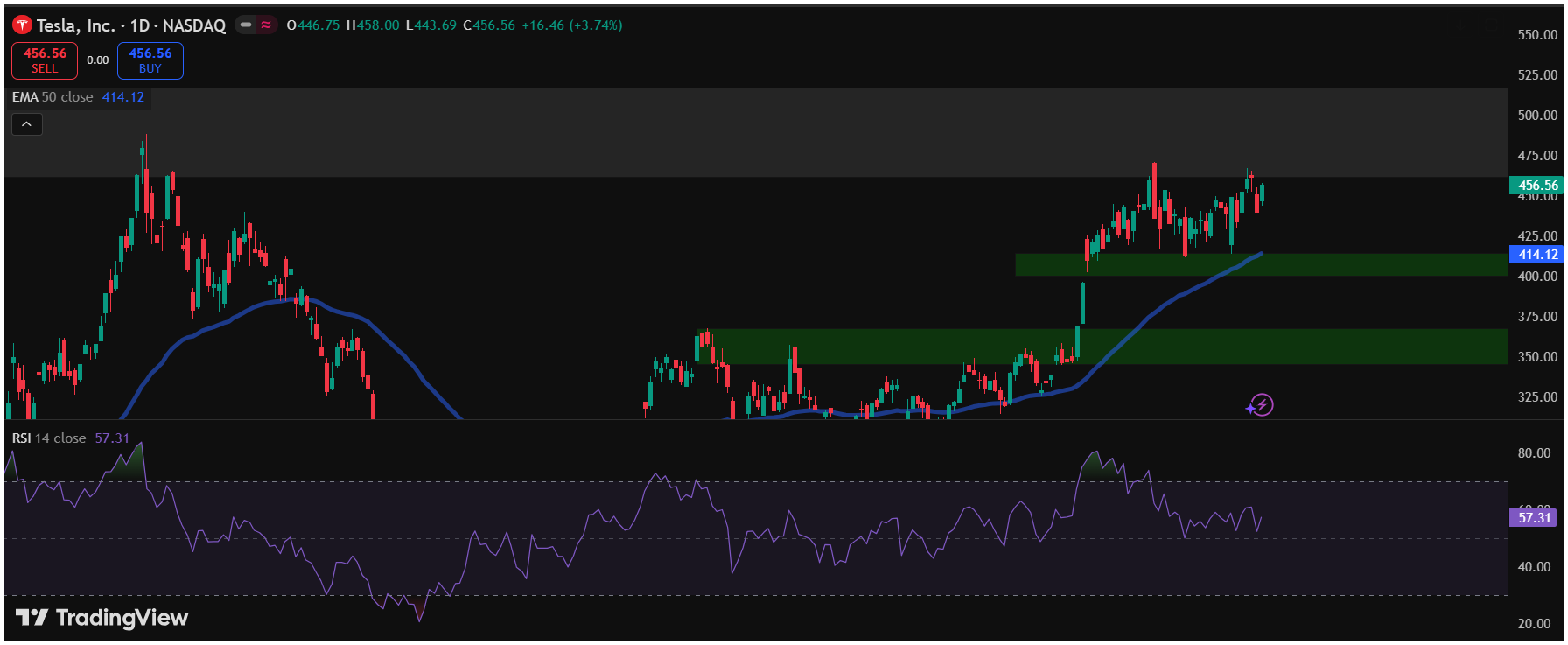
Teslaโ€™s stock is currently trading in a range between $461 and $488, where it faces immediate resistance near the $488 level and visible support around $414โ€“$400. The 50-day EMA stands at $414, while the 200-day EMA sits much lower at $349.21, reflecting a strong bullish structure but with rising chances of a pullback.

On the weekly timeframe, RSI reading of 69.03 suggests that Tesla is nearing overbought territory, hinting at a potential pause or short-term retracement.

The candlestick setup indicates that the price might correct toward the $361 zone, aligning with the monthly 9 EMA, which could serve as a strong dynamic support zone.

Currently, in the daily chart, Tesla is hovering near the highs of its existing range. This signals exhaustion in near-term momentum, and traders may await a healthy retracement before expecting a renewed breakout attempt.

Also Read – Amazon post-earnings technical analysis โ€“ November 2025 review and what comes next


Price Forecast & Target

From a price action perspective, Tesla could see a retracement toward $345โ€“$367 in the short term before resuming its next leg higher. This potential dip may serve as a re-accumulation phase, allowing larger market participants to enter at more favorable levels.

If the stock sustains above $414โ€“$420, the broader outlook remains bullish with possible upside targets near $515โ€“$530 by mid-December.

Conversely, a breakdown below $400 could expose it to a deeper test toward the $349โ€“$361 support region.

This analysis reflects a technical forecast rather than a trading recommendation.


Market & Investor Sentiment

Investor sentiment around Tesla remains strong despite overextended technical readings. Social media discussions on Reddit and X continue to reflect optimism about Teslaโ€™s long-term leadership in EV and AI segments.

Institutional investors, too, have shown steady interest, though many appear to be waiting for lower entries after recent rallies.

Analyst commentary from major banks like JPMorgan and Goldman Sachs remains mixed – with neutral short-term ratings but a bullish tilt for the next 12โ€“18 months.

Also Read – Circle Internet Group Monthly Outlook- November 2025 Technical Analysis


Long-Term Outlook

In the long-term view, Teslaโ€™s chart structure and expanding market presence indicate sustained bullish bias. The companyโ€™s innovation edge, expanding energy division, and dominance in autonomous technology continue to support a strong multi-year narrative.

However, the near-term volatility and high valuation levels suggest that investors should anticipate periodic corrections. Such retracements are likely part of Teslaโ€™s natural price discovery process and could provide more favorable accumulation zones for patient long-term investors.

This article is for informational purposes only and should not be considered financial advice. Investing in stocks, cryptocurrencies, or other assets involves risks, including the potential loss of principal. Always conduct your own research or consult a qualified financial advisor before making investment decisions. The author and publisher are not responsible for any financial losses incurred from actions based on this article. While efforts have been made to ensure accuracy, economic data and market conditions can change rapidly. The author and publisher do not guarantee the completeness or accuracy of the information and are not liable for any errors or omissions. Always verify data with primary sources before making decisions.
Circle Internet Group Monthly Outlook- November 2025 Technical Analysis

CRCL's technical analysis

Circle Internet Group has remained one of the most closely watched stocks in the fintech and crypto-related segment since its much-anticipated listing. As the issuer of the USDC stablecoin, Circle sits at the intersection of blockchain finance and traditional markets. November 2025 brings a mix of consolidation and uncertainty, making this monthโ€™s technical analysis crucial for investors and traders.

Also Read – USDC vs. RLUSD vs. USDT โ€“ Key Differences and Why They Matter

Company Overview

Circle Internet Group operates as a blockchain-based financial technology company known primarily for issuing the USD Coin (USDC), a widely used stablecoin pegged to the US dollar. The companyโ€™s business model revolves around reserve management, transaction services, and infrastructure for digital payments. It has grown rapidly alongside the crypto sectorโ€™s expansion, though it remains heavily influenced by regulatory shifts and macroeconomic conditions.

As of the latest data, Circle holds a market capitalization of around 30 billion dollars with revenue nearing 2 billion dollars in trailing twelve months. The company is not yet profitable, but its strategic position in digital finance continues to attract significant institutional and retail attention.

Technical Overview and Price Action

The stock has shown considerable volatility since its IPO, trading within wide ranges that attract both short-term traders and long-term investors.

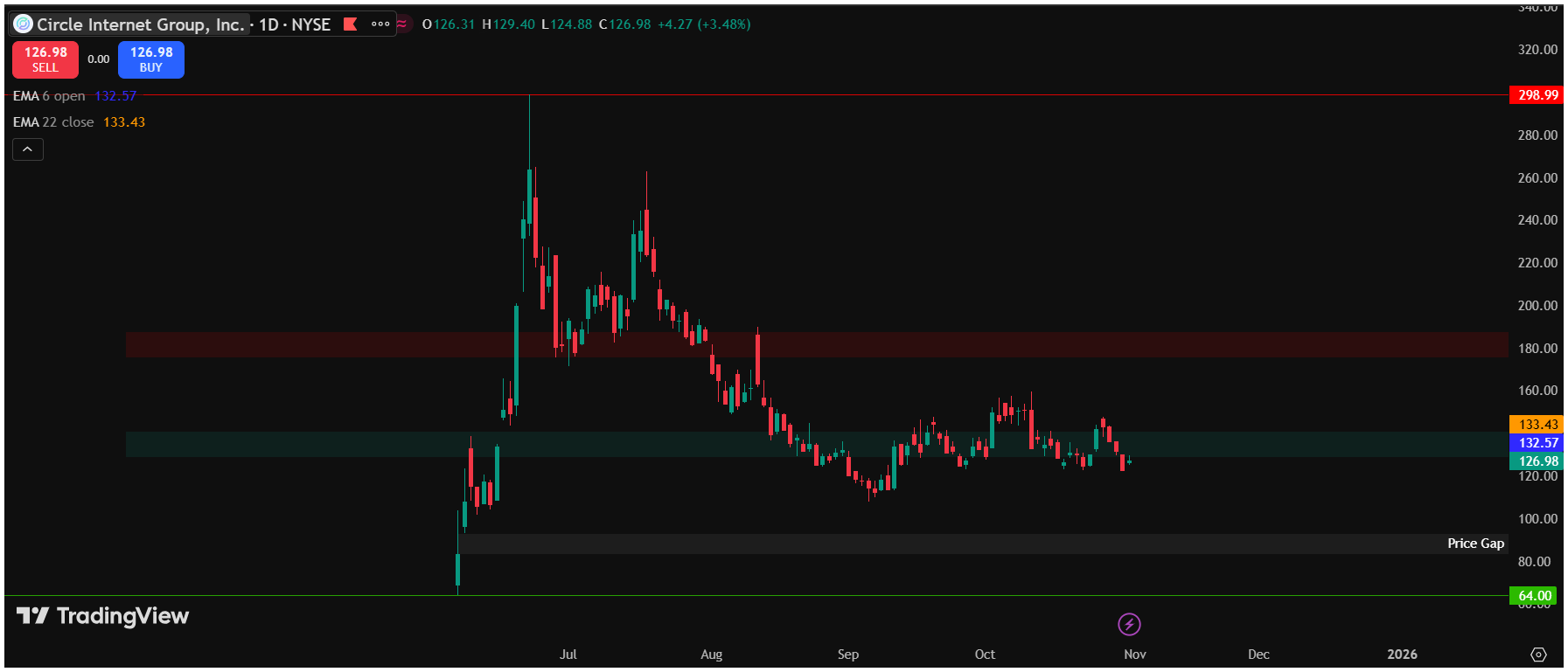
During October 2025, Circleโ€™s price hovered between 128 and 140 dollars, signaling indecision among market participants. The candlestick structure on the monthly chart reflects a balanced sentiment, creating a 50-50 situation for the near term.

There is a visible price gap between 92.95 and 83.23 dollars, which may act as a strong support zone on the downside. Historically, such gaps tend to attract price action either for a retest or to form a base for recovery. While the current structure remains ambiguous, the broader overview suggests that the price could see an upward move after either touching the gap zone or consolidating above the current range.

If the price sustains above 135 dollars for an extended period, the next target could extend toward 175 dollars, which stands as a major resistance zone. Failure to hold above 135 could result in the price revisiting lower support areas, including the gap region.

The Relative Strength Index (RSI) [44.93] and volume patterns indicate moderate momentum without clear dominance from either bulls or bears.

Also Read – Amazon post-earnings technical analysis โ€“ November 2025 review and what comes next

Major News & Events Impacting Price

Over the past few months, several key developments have influenced Circle Internet Groupโ€™s stock performance and investor sentiment heading into November 2025.

Sector Momentum: Overall blockchain and fintech sentiment has improved due to regulatory advancements, supporting Circleโ€™s long-term positioning.

Stablecoin Regulation Progress: The U.S. Senate continued discussions on the long-awaited stablecoin bill, which directly affects Circleโ€™s core business model. This legislative clarity has kept investors optimistic about USDCโ€™s long-term adoption.

Institutional Expansion: Circle announced new partnerships with several financial institutions, expanding its presence in cross-border settlement and digital payments infrastructure.

Earnings Update: The companyโ€™s last quarterly results showed consistent revenue growth, though profitability remains elusive. Revenue from interest earned on USDC reserves continues to play a significant role.

Market Volatility in Crypto Sector: Broader crypto market swings during October have influenced sentiment toward Circle, as USDC circulation volume often mirrors overall crypto activity.

Rising Competition: New entrants in the stablecoin and blockchain payments segment have intensified competition, slightly weighing on short-term investor sentiment.

Institutional Accumulation Signals: Several market trackers have indicated potential accumulation by large funds, suggesting growing long-term confidence in the stock.

Macroeconomic Conditions: Falling U.S. interest rates have mixed implications for Circle – beneficial for liquidity but potentially reducing its interest income from reserves.

Investor Coverage Initiation: Multiple investment banks began coverage on Circle, with mixed ratings ranging from โ€œHoldโ€ to โ€œOutperform,โ€ reflecting both opportunity and risk.

Integration with Payment Networks: Circleโ€™s progress in integrating USDC payments with mainstream payment rails has been viewed as a positive development.

Also Read – I Created the Best Bitcoin Guide Youโ€™ll Ever Read

Market Sentiment and Investor View

Sentiment around Circle remains divided. On one hand, short-term traders see opportunity in volatility; on the other, long-term investors continue to show confidence in Circleโ€™s future due to its strong market position in stablecoin issuance. The recent regulatory clarity around digital assets has helped improve the medium-term outlook, although macroeconomic uncertainty still influences investor confidence.

From an investorโ€™s perspective, Circle remains bullish in the long term. The companyโ€™s ecosystem growth and partnerships within blockchain finance are viewed positively. However, this optimism must be balanced with caution, as technical indicators show possible pullbacks before any strong breakout. The current phase could also represent a period of accumulation where larger investors, or what traders call โ€œbig bulls,โ€ might be seeking discounted entry levels before a potential next leg upward.

This article is for informational purposes only and should not be considered financial advice. Investing in stocks, cryptocurrencies, or other assets involves risks, including the potential loss of principal. Always conduct your own research or consult a qualified financial advisor before making investment decisions. The author and publisher are not responsible for any financial losses incurred from actions based on this article. While efforts have been made to ensure accuracy, economic data and market conditions can change rapidly. The author and publisher do not guarantee the completeness or accuracy of the information and are not liable for any errors or omissions. Always verify data with primary sources before making decisions.
Amazon post-earnings technical analysis – November 2025 review and what comes next

amzn LATEST TECHNICAL ANALYSIS AND EARNINGS NEWS

Amazon (NASDAQ: AMZN) reported third-quarter results for the period ended September 30, 2025. Revenue came in at $180.2 billion, up about 13% year-over-year, and EPS was $1.95, comfortably above expectations. The quarter was driven by a strong Amazon Web Services showing with roughly 20% year-over-year growth.

The market cheered the print and Amazon stock opened with a big gap higher, rising roughly 12โ€“13% on the earnings reaction.


1. Introduction & company snapshot

Company profile. Amazon is a global e-commerce and cloud computing company. Its core businesses are online retail, third-party marketplace services, subscription services (Prime), digital advertising, and Amazon Web Services (AWS), the companyโ€™s cloud platform. Amazon operates across consumer retail, cloud, digital media, logistics, and advertising.

Primary sector: Technology / Consumer Discretionary with large exposure to cloud computing and digital advertising.

Recent performance (context). Over the last quarter Amazon lagged some peers but showed accelerating cloud growth in this report. The earnings beat and strong AWS growth produced the sharp post-earnings gap up of about 12โ€“13% which pushed the stock to fresh highs. That gap is the immediate context for the technical read below.

Latest news highlights (top items).

  • Q3 revenue $180.2B and EPS $1.95.
  • AWS grew about 20% year over year.
  • Company signaled materially higher capital expenditures tied to AI and data center expansion.
  • Amazon disclosed workforce reductions of about 14,000 corporate roles as part of cost actions.
  • Management gave a Q4 revenue guide range that investors will monitor for sustainability of the momentum.

Analyst sentiment- The immediate analyst reaction was broadly positive. Several firms raised estimates and price targets after the AWS beat and the AI investment signal. That shift is one reason the market moved aggressively higher. Specific recent price target moves differ by firm so check the broker notes you follow for exact numbers.


2. Fundamental analysis – company financial health

Key financials (Q3 2025).

  • Revenue: $180.2 billion.
  • EPS: $1.95.
  • AWS contribution: fastest cloud growth since 2022 at about 20% y/y.

Valuation notes. Amazonโ€™s market cap expanded meaningfully on the rally. With an earnings beat and higher profitability this quarter the trailing and forward P/E will change quickly as analyst estimates update. For actionable valuation comparisons use the latest consensus EPS and shares outstanding from the IR site or your data provider.

Special holdings. Not applicable in the sense of material crypto treasuries. Amazonโ€™s earnings are driven by its operating businesses and investment gains including some non-operating gains disclosed in the release.


3. Technical analysis – what the charts are saying

Below I fold your technical observations into a structured TA narrative with cleaned grammar and clarity.

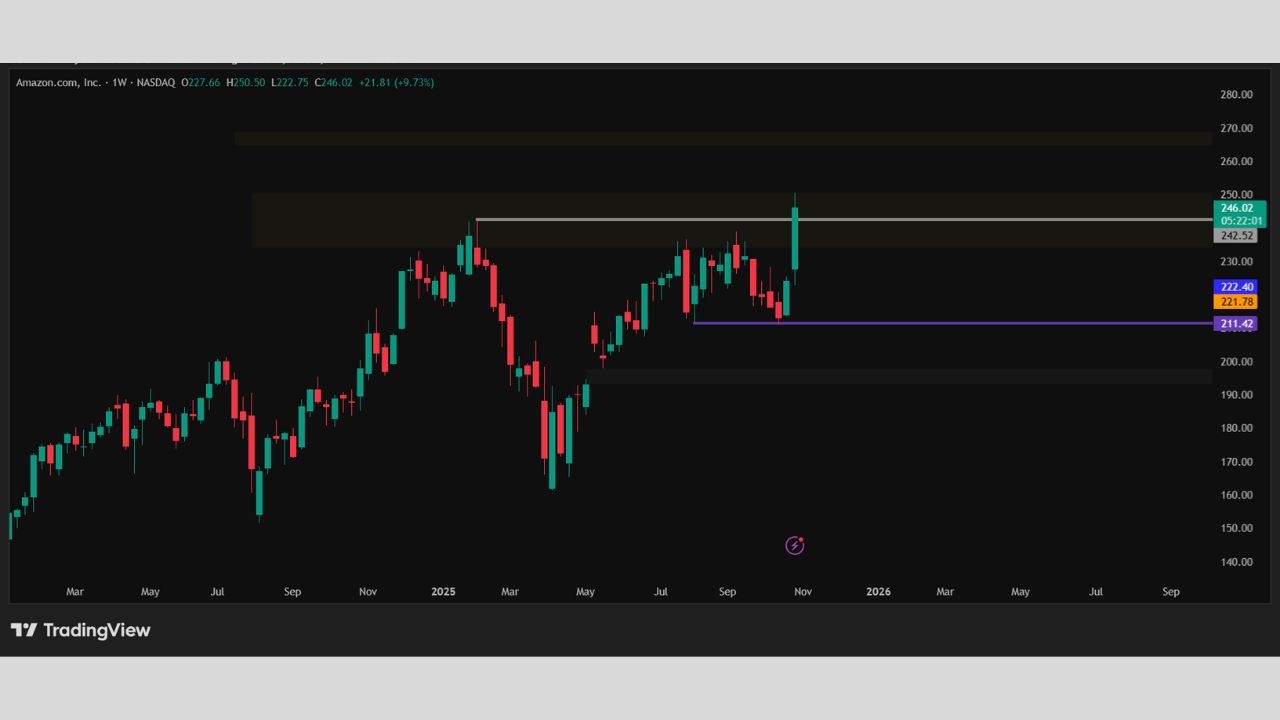
Monthly trend (big picture). The monthly chart shows a strong uptrend that accelerated after this earnings beat and gap higher. The new all-time highs mean prior resistance levels are now the reference for support on any retracement. The long term trend is bullish while also structurally vulnerable to sharp mean reversion because large gaps and vertical moves often attract profit taking.

Short term (daily / weekly). The weekly RSI is 64.84, which is below the overbought threshold but indicates firm bullish momentum. Weekly momentum is positive. The daily action after the gap shows a rapid run higher with thin consolidation. That type of move often creates โ€œretail frothโ€ near the highs which can fail without a healthy pullback.

Key levels to watch

  • Immediate resistance: 264โ€“268. This is the near term supply zone to watch on any rally.
  • Gap zone: 193โ€“197. Gaps often act as magnets and support or resistance. The 193โ€“197 gap is a logical area where price may revisit.
  • Support band: 170โ€“178 is identified as strong support.
  • Retracement target range you proposed: 206โ€“189 as the zone where the price may retrace to allow โ€œbig bullsโ€ to build positions at more efficient prices.

These levels create a short term map: if price holds above the 193โ€“197 gap and reclaims 206 quickly then bullish momentum can resume. If the gap fills and 170โ€“178 remains intact then the long term uptrend stays valid. If 170 breaks then the risk profile shifts materially.

50 EMA / 200 EMA relationship. After a gap that takes price to new highs the 50 EMA will trail above the 200 EMA and remain bullish until a crossing occurs. Monitor any acceleration of moving averages as a confirmation or a warning sign.

Volume. The earnings session saw high volume and conviction. Future volume on pullbacks will tell whether the move is a healthy consolidation or a distribution. Higher volume on down moves would warn that the run may be topping.

Chart patterns. The rapid breakout to ATH with little resistance suggests a spike top risk and a higher probability of at least a moderate retracement. Look for reversal candlestick patterns and increased selling volume near resistance to signal weakness.

Also Read – Fed Interest Rates vs Gold Prices


4. Market sentiment & volatility

Social media and retail sentiment. After the beat social chatter turned exuberant on X and Reddit. That elevated retail enthusiasm increases the chance of a short term pullback as newer buyers chase the move.

Investor sentiment & macro. The broader market is sensitive to AI and cloud narratives. Positive AI signals and durable cloud growth create a favorable macro tailwind for Amazon relative to broader cyclicals.

Implied volatility. IV spiked into earnings and usually declines afterward. Elevated option IV means the market expects bigger moves in the near term. Traders using options should account for premium decay if IV compresses from here.


5. Forecast & conclusion – September outlook and trade-map

Probabilities and scenario framing.

  • Base case (highest probability given current structure). A pullback into the 206โ€“189 zone to clear retail froth and let institutional buyers scale in.
  • Bull case. Price holds above the 193โ€“197 gap and reclaims 264โ€“268 resistance. Continued AWS strength and positive guidance push price higher.
  • Bear case. The gap fills and price breaks 170โ€“178 support. That would invalidate the near term bullish thesis and open larger downside.

Targets and watchlist. Use the support and resistance zones above as intra-month targets. Watch volume and day-session price action immediately after the gap. Pay attention to management language on capex and AI. Continued robust AWS updates are the single largest fundamental tailwind for a sustained rally.

Final verdict for September. Given the sharp gap up and the retail froth around the highs it is reasonable to expect a retracement into the 206โ€“189 zone in November before the bulls can establish a stronger and more sustainable base. This is a probability view not a certainty.


This analysis is for educational purposes only. It is not investment advice. We do not provide buy or sell recommendations. The analysis may be incorrect. Always do your own due diligence and consult a licensed financial professional before acting.


This article is for informational purposes only and should not be considered financial advice. Investing in stocks, cryptocurrencies, or other assets involves risks, including the potential loss of principal. Always conduct your own research or consult a qualified financial advisor before making investment decisions. The author and publisher are not responsible for any financial losses incurred from actions based on this article. While efforts have been made to ensure accuracy, economic data and market conditions can change rapidly. The author and publisher do not guarantee the completeness or accuracy of the information and are not liable for any errors or omissions. Always verify data with primary sources before making decisions.

At What Time Will the Fed Release Its Decision on Interest Rates?

The Federal Reserve (Fed) meeting decision is coming today, Wednesday, October 29, 2025.

The most anticipated moment for global markets is here. The U.S. Federal Reserve (Fed) will soon release its latest decision on interest rates, concluding its two-day Federal Open Market Committee (FOMC) meeting.

Traders, investors, and economists around the world are on edge, as this announcement will set the tone for the next phase of global monetary policy.

When Will the Fed Announce Its Interest Rate Decision?

Mark your trading calendars and set your alarms because the timing is crucial.

  • Interest Rate Decision: The FOMC statementโ€”which includes the decision on the Federal Funds Rate, the key benchmark for short-term interest ratesโ€”will be released at 2:00 PM Eastern Daylight Time (EDT) on Wednesday, October 29, 2025.
  • Press Conference by Chair Jerome Powell: At 2:30 PM EDT, Fed Chair Jerome Powell will hold his post-meeting press conference. This half-hour session often triggers the most intense market reactions, as Powellโ€™s tone and comments give clues about the Fedโ€™s future directionโ€”whether it leans toward further rate cuts or rate hikes in the coming months.
Following the announcement, Fed Chair Jerome Powell will hold a press conference to discuss the decision and the central bank's economic outlook.

Analysts and the CME FedWatch Tool currently indicate strong expectations for a 25 basis point (bps) rate cut, which would bring the target range to 3.75%โ€“4.00%.


Why This Decision Matters Globally?

Many wonder why a single decision made in Washington, D.C. can ripple through every major economy.

The reason lies in the U.S. dollarโ€™s role as the worldโ€™s reserve currency and the Fedโ€™s control over its base interest rate.

Hereโ€™s how the decision affects the world:

1. Global Borrowing Costs

When the Fed raises rates, borrowing in U.S. dollars becomes more expensive for foreign governments and corporations. A rate cut does the oppositeโ€”it reduces global financing costs, often sparking investment and credit growth in emerging markets.

2. Currency and Capital Flows

A rate cut usually weakens the dollar, prompting investors to move funds toward higher-yielding emerging markets. A rate hike, on the other hand, strengthens the dollar and draws capital back to the U.S., often leading to declines in other major currencies.

3. Commodity Prices

Commodities like gold, oil, and copper are priced in U.S. dollars. When the dollar weakens after a rate cut, commodity prices tend to rise since it becomes cheaper for other countries to buy them. Conversely, a stronger dollar from a rate hike can suppress global commodity demand.

Also Read – Fed Interest Rates vs Gold Prices

This article is for informational purposes only and should not be considered financial advice. Investing in stocks, cryptocurrencies, or other assets involves risks, including the potential loss of principal. Always conduct your own research or consult a qualified financial advisor before making investment decisions. The author and publisher are not responsible for any financial losses incurred from actions based on this article. While efforts have been made to ensure accuracy, economic data and market conditions can change rapidly. The author and publisher do not guarantee the completeness or accuracy of the information and are not liable for any errors or omissions. Always verify data with primary sources before making decisions.
What If a Company Issues More Than Authorized Capital?

Authorized Capital

Authorized capital, also called authorized share capital or nominal capital, is the maximum amount of equity a company is legally permitted to issue.

It is recorded in the companyโ€™s Memorandum of Association when the firm is incorporated. The authorized figure is a ceiling, not an indication that the capital has already been raised. A company may initially issue only a fraction of the authorized amount as paid up capital and leave the balance unissued as headroom for future fundraises, stock grants, or corporate actions.

The practical effect of the number is simple. If a company needs more equity than the paid up capital allows, it can issue new shares only up to the authorized limit. To go beyond that limit the company must follow a formal process to increase its authorized capital. That process typically involves board action, shareholder approval, and regulatory filings. The requirement creates transparency and forces public record of any planned expansion of the equity base.

Why the limit exists?

Authorized capital exists for several overlapping reasons that together create checks and balances around share issuance. First, it protects investors by giving them a clear view of how much the equity base can expand. Second, it prevents management from unilaterally issuing unlimited shares that could dilute existing owners and distort control. Third, it creates a formal path to increase capital that triggers corporate governance steps and external scrutiny. Finally, in many jurisdictions registration fees, stamp duty and other government charges are calculated with reference to authorized capital, which discourages companies from setting an artificially high ceiling without a real business reason.

Those controls are especially important because the potential for misuse of share issuance is real and varied. The next section lays out how equity issuance can be abused and why the authorized-capital limit is an essential guardrail.

How equity issuance can be abused?

One problem that the authorized-capital limit helps prevent is uncontrolled dilution of existing shareholders. Imagine a company with 10,000 outstanding shares where an investor holds 5,000 shares and therefore 50 percent of the voting power. If management were able to issue 20,000 new shares without constraint or shareholder consent, the original investorโ€™s stake would fall to 5,000 of 30,000 shares, or roughly 16.7 percent. That dramatic loss of ownership and voting influence can happen quickly if there is no legal ceiling or if the process to issue new stock is weak. The result is a shift in control and an immediate change in the value proposition for the original investors.

A related risk is a backdoor or hostile takeover engineered through selective share issuance. Issuing new shares to a friendly party can be a way to install a new controlling block without the broader shareholder body having a proper say. For example, a promoter group that wants to replace the board could arrange for a tranche of fresh equity to be subscribed by a related investor. If that stock issue is large enough, it can make the new subscriber the dominant shareholder and change the board through normal governance mechanisms while effectively bypassing prior owners.

Issuing shares at an unusually low price to related parties is another form of abuse. If management can create a large number of new shares and allocate them to insiders at a discount to market value, the insiders capture immediate value and the existing shareholders see the book and market value of their holdings diluted. This transaction shifts wealth from the public or outside investors to those on the inside and often raises questions about fairness, conflicts of interest, and disclosure.

Companies without strict limits can also be tempted to create an appearance of larger capital than truly exists. That can take the form of issuing shares that are not properly paid up or recording capital that misleads lenders and potential investors about the firmโ€™s real equity base. The effect is to distort credit decisions and investor expectations. Financial statements and filings are meant to be reliable. When share capital is used to create a misleading picture of strength or liquidity, the damage can go beyond individual shareholders to creditors and the wider market that relies on accurate disclosures.

Because these abuses are possible, jurisdictions require formal steps to issue new shares beyond ordinary board authority. Share issuance that materially affects ownership should be visible to shareholders and regulators. That visibility creates friction. Friction means management must get approvals, make public disclosures, and in many cases offer shares to existing shareholders first. Those processes reduce the likelihood that share issuance will be used as a stealth mechanism to transfer control or value to insiders.

What happens if a company issues more than its authorized capital?

Issuing shares beyond the authorized limit is a legal breach in most jurisdictions. Such an act is typically treated as ultra vires, meaning beyond the powers of the company as defined by its constitutional documents. When shares have been issued in excess of the authorized capital the issuance can be declared void or voidable. Investors who received those shares may find their title insecure. Regulators may impose penalties on the company and on officers who authorized the transaction. Existing shareholders can sue for relief and seek to have the improper issuance set aside or ratified after the fact only through proper procedures.

Remediation is possible in many cases, but it usually involves formalizing the position through post-facto shareholder approval, amending the Memorandum of Association, and filing required disclosures with corporate registries and securities regulators. In extreme cases of deliberate deception or fraud, directors and officers may face civil liability and, where laws provide, criminal charges. Beyond legal penalties, such an episode typically damages the companyโ€™s reputation with investors and lenders and makes future capital raising more difficult and costly.

Why authorized capital still matters in modern markets?

Some observers assume the concept is archaic given the range of financing tools available today. But authorized capital remains a practical governance mechanism. It forces an explicit decision when a company wants to expand its equity base. That explicit decision comes with a record. For listed companies it also triggers securities-law disclosures and, in many markets, preemptive rights that require giving existing shareholders the opportunity to buy new shares before outsiders do. Those layers of protection are designed to keep markets fair and to make dilution a transparent, debated corporate decision rather than a private move by management.

From the perspective of founders and executives, leaving headroom under the authorized cap is sensible. It preserves flexibility to grant employee stock options, to make acquisitions paid for with stock, or to raise capital quickly when conditions are favorable. From the perspective of outside investors, knowing the authorized ceiling and the companyโ€™s track record on share issuance provides an important input to any valuation or ownership decision.

How far IPOs typically are from their maximum authorized capital?

When a company lists via an IPO it commonly uses only a portion of its authorized capital. The pattern is straightforward. Before listing most firms have issued a portion of the authorized shares as paid-up capital to founders, early investors, and employees. At IPO the company issues a new tranche to public investors and leaves the remainder unissued to preserve flexibility. That unissued portion acts as strategic headroom for future equity compensation plans, rights issues, follow-on offerings, or acquisitions.

As a hypothetical example, a firm with an authorized capital of $50 million might have $20 million in issued and paid-up equity before the IPO. The IPO might add $10 million more, leaving $20 million unissued. The company thus uses 60 percent of the authorized ceiling and retains 40 percent as a buffer. The precise split varies widely by company size, industry, jurisdiction and strategic plan. The key takeaway is that most IPOs do not max out the authorized capital; they treat it as a governance and planning tool.

Conclusion

Authorized capital is more than a technical filing line. It is an institutional brake on unilateral equity expansion and a transparency mechanism that protects investors, creditors and the market. The cap and the formal process to increase it make abusive equity tactics harder to execute and easier to detect. For investors and founders alike, the authorized-capital figure and how much of it is already issued reveal a companyโ€™s governance posture and its room to maneuver in future capital markets.

This article is for informational purposes only and should not be considered financial advice. Investing in stocks, cryptocurrencies, or other assets involves risks, including the potential loss of principal. Always conduct your own research or consult a qualified financial advisor before making investment decisions. The author and publisher are not responsible for any financial losses incurred from actions based on this article. While efforts have been made to ensure accuracy, economic data and market conditions can change rapidly. The author and publisher do not guarantee the completeness or accuracy of the information and are not liable for any errors or omissions. Always verify data with primary sources before making decisions

Top 10 Stocks That Could Benefit from Trumpโ€™s $15 Billion Farm Bailout

Trump's $15 Billion Farmer Bailout - 10 Ag Stocks Primed for a Harvest of Gains

President Donald Trump’s promised $10 to $15 billion bailout for U.S. farmers, designed to ease the pain of his trade war with China, has faced delays due to the ongoing government shutdown. The announcement, expected this week, missed its deadline. However, the package could still roll out soon. The plan aims to inject liquidity into the agricultural sector, especially soybean producers and other commodity growers hit by reduced exports and rising production costs.

Despite the delay, anticipation has already lifted agricultural stocks. Shares of Archer-Daniels-Midland and Corteva Agriscience moved higher, while the VanEck Agribusiness ETF gained 1.2 percent amid broader market uncertainty.


Economic Backdrop

Farm production costs are projected to reach around 467.4 billion dollars in 2025, which is an increase of about 12 billion dollars from last year. Rising input prices and trade disruptions have pressured farmersโ€™ profit margins. The bailout, funded partly by tariff revenues, is similar to the 28 billion dollars in aid released during Trumpโ€™s first term. That earlier plan had stabilized the sector and pushed agricultural stocks higher for a while.

Analysts believe the current bailout could provide a five to eight percent boost to agricultural stocks if the funds are released before the end of the month. Joe Glauber, former USDA chief economist, described the move as more than just relief. He said it is also a spending stimulus for the entire agricultural ecosystem.


Also Read – The Majority of Money, Not People, Drives Market Momentum

Top Agricultural Stocks Expected to Benefit

Archer-Daniels-Midland (ADM)

This soybean processing company could see its margins widen as government aid prevents farmers from dumping crops at low prices. The stock rose 1.5 percent and has a forward price-to-earnings ratio of 11.2 with a dividend yield of 3.4 percent.

Bunge Global (BG)

Bunge, a major grain trader, could benefit as stabilized exports from supported farms boost trading volumes. The companyโ€™s shares rose 1.8 percent with a forward price-to-earnings ratio of 9.8 and a dividend yield of 3.3 percent.

Corteva (CTVA)

Corteva, a leader in seeds and crop protection, stands to gain from deregulation and higher demand for inputs. The stock rose 2.1 percent and has a forward price-to-earnings ratio of 15.4 with a dividend yield of 1.0 percent.

Deere & Co. (DE)

Deere, a leading farm equipment manufacturer, could see a rise in sales as farmers reinvest their bailout funds into machinery. The stock rose 1.3 percent and has a forward price-to-earnings ratio of 14.2 with a dividend yield of 1.6 percent.

Nutrien (NTR)

Nutrien, a top fertilizer producer, could see a jump in demand as more acreage receives subsidies. The companyโ€™s shares rose 0.9 percent with a forward price-to-earnings ratio of 10.1 and a dividend yield of 3.7 percent.

FMC Corporation (FMC)

FMC, a chemical producer, could benefit from intensified planting as aid reduces cost pressures on farmers. Its shares rose 1.1 percent with a forward price-to-earnings ratio of 11.8 and a dividend yield of 6.2 percent.

The Mosaic Company (MOS)

The Mosaic Company, a phosphate supplier, could gain from the need for balanced nutrients in bailout-backed farms. The stock rose 0.7 percent with a forward price-to-earnings ratio of 9.2 and a dividend yield of 2.8 percent.

CF Industries (CF)

CF Industries, which specializes in nitrogen-based fertilizers, could benefit directly from a recovery in corn and soybean planting. The stock rose 1.0 percent and has a forward price-to-earnings ratio of 12.3 with a dividend yield of 2.5 percent.

Tyson Foods (TSN)

Tyson Foods could profit from lower feed costs as the bailout stabilizes grain prices. The companyโ€™s shares rose 0.6 percent and have a forward price-to-earnings ratio of 13.6 with a dividend yield of 3.6 percent.

Scotts Miracle-Gro (SMG)

Scotts Miracle-Gro could experience an indirect benefit as healthier farm operations increase demand for turf and specialty fertilizers. The stock rose 1.4 percent with a forward price-to-earnings ratio of 14.1 and a dividend yield of 4.2 percent.

These companies have deep ties to the Midwest, where soybean losses exceed five billion dollars annually due to Chinaโ€™s retaliatory tariffs.


Also Read – Everything You Need to Know About the Dollar Index in 2025

How the Bailout Works?

The proposed bailout is modeled after the 2018 Market Facilitation Program, which provided direct payments to farmers who suffered export losses. Soybean growers, whose exports to China have fallen by nearly half, are expected to be the main beneficiaries.

The specific allocation between soybean, corn, and dairy producers is still undecided. However, the initiative reflects Washingtonโ€™s effort to support rural communities ahead of midterm elections. Past examples show similar moves have lifted agricultural stocks. After the 2018 program was announced, Archer-Daniels-Midland rose seven percent, and Deere gained ten percent due to increased machinery orders.

Despite potential benefits, some farmers remain cautious. Iowa soybean grower Mark Smith said it feels like a Band-Aid on a broken arm, adding that without trade deals, the aid only delays deeper financial pain.


Policy Implications

The Trump administrationโ€™s broader agricultural policy could further influence these outcomes.

Biotech deregulation may accelerate approval of genetically modified seeds developed by companies like Corteva. Lower corporate taxes could enhance profit margins across the agricultural supply chain.

Additionally, tariff-funded subsidies may offset short-term trade disruptions, giving temporary support to the sector.


Challenges and Risks

The government shutdown, now in its third week, has halted USDA operations and delayed the release of aid. If the situation continues, disbursements may not start until November, which could reduce the short-term boost to the market.

Another major risk is the potential escalation of tariffs. Trumpโ€™s proposal of a 60 percent tariff on Chinese goods could further damage exports and undercut the very relief this bailout seeks to provide.

This article is for informational purposes only and should not be considered financial advice. Investing in stocks, cryptocurrencies, or other assets involves risks, including the potential loss of principal. Always conduct your own research or consult a qualified financial advisor before making investment decisions. The author and publisher are not responsible for any financial losses incurred from actions based on this article. While efforts have been made to ensure accuracy, economic data and market conditions can change rapidly. The author and publisher do not guarantee the completeness or accuracy of the information and are not liable for any errors or omissions. Always verify data with primary sources before making decisions

OpenAI IPO Details – Everything You Need to Know

OpenAI IPO

In the rapidly evolving world of artificial intelligence, few companies have captured the global imagination like OpenAI.

Founded with a mission to ensure AI benefits all of humanity, OpenAI is on the cusp of a transformative moment. As whispers of a potential initial public offering (IPO) grow louder amid blockbuster partnerships and sky-high valuations, investors are buzzing about what a public debut could mean for the future of tech. This article dives deep into OpenAI’s IPO prospects, spotlighting its groundbreaking collaboration with NVIDIA – the powerhouse behind the AI chip revolution – and unpacking the latest developments that could propel this ChatGPT creator to Wall Street stardom.

Basic Company Information

OpenAI was established in December 2015 as a non-profit research organization in San Francisco, California. Co-founded by tech visionaries including Elon Musk, Sam Altman (current CEO), Greg Brockman, Ilya Sutskever, and Wojciech Zaremba, the company started with a $1 billion pledge from its founders and early backers. Today, it employs over 1,000 people and has evolved into a hybrid structure: a non-profit parent overseeing a capped-profit subsidiary.

This unique setup balances ethical AI development with commercial growth, though recent restructurings are paving the way for more traditional for-profit operations.

Also Read – I Created the Best Bitcoin Guide Youโ€™ll Ever Read

What the Company Does?

At its core, OpenAI develops advanced artificial intelligence models and tools that push the boundaries of human-like reasoning and creativity.

Its flagship product, ChatGPT, launched in late 2022, revolutionized conversational AI, enabling everything from casual chats to complex problem-solving. Beyond consumer-facing apps, OpenAI powers enterprise solutions like DALL-E for image generation, Whisper for speech recognition, and APIs integrated into products from Microsoft Copilot to custom business workflows.

The company’s focus on “artificial general intelligence” (AGI) – AI that can outperform humans at most economically valuable work – drives innovations in healthcare diagnostics, code generation, and scientific research.

Which Sector It Belongs To?

OpenAI operates squarely in the technology sector, with a sharp emphasis on software and digital services.

OpenAI - Sector

What Industry It Operates In?

Within the tech sector, OpenAI is a leader in the artificial intelligence (AI) and machine learning industry. This niche encompasses generative AI, natural language processing, and large language models (LLMs), fueling applications across entertainment, finance, education, and more. The industry’s explosive growth – projected to hit $1.8 trillion by 2030 – stems from AI’s role in automating tasks, enhancing decision-making, and unlocking new efficiencies.

Main Peers or Competitors

OpenAI faces fierce competition from a roster of AI heavyweights. Key rivals include:

  • Anthropic: Backed by Amazon, creators of the Claude AI model, valued at $183 billion as of mid-2025.
  • xAI: Elon Musk’s venture behind Grok, targeting a $200 billion valuation in ongoing talks.
  • Google DeepMind: Google’s AI arm, powering Gemini models with vast data resources.
  • Meta AI: Focused on open-source Llama models, leveraging Facebook’s social data.
  • Cohere and Stability AI: Specialized players in enterprise search and image generation, respectively.

These competitors are vying for talent, compute power, and market share in a high-stakes AI arms race.

Introduction to the NVIDIA-OpenAI Partnership: Fueling the AI Revolution

No discussion of OpenAI’s trajectory is complete without highlighting its pivotal alliance with NVIDIA, the undisputed king of AI hardware. What began as a symbiotic relationship – OpenAI relying on NVIDIA’s GPUs to train massive models – has escalated into a game-changing $100 billion strategic partnership announced on September 22, 2025. NVIDIA, led by CEO Jensen Huang, will invest up to $100 billion in OpenAI, securing a significant equity stake while committing to supply advanced chips for a colossal data center buildout.

This deal, dubbed the “biggest AI infrastructure project in history,” aims to deploy at least 10 gigawatts of NVIDIA-powered compute capacityโ€”equivalent to 4โ€“5 million GPUs and enough energy to power over 8 million U.S. households. The first sites are slated to go online in late 2026, supporting OpenAI’s “Stargate” initiative for next-generation AI models. Negotiations, involving late-night calls between CEOs Sam Altman and Jensen Huang, underscore the urgency: OpenAI needs unprecedented scale to stay ahead, while NVIDIA locks in a key customer amid chip shortages.

This partnership is not just about hardware; it is a bet on AI’s economic dominance. It complements OpenAI’s ties with Microsoft (over $13 billion invested) and SoftBank, but NVIDIA’s role is uniquely foundationalโ€”its CUDA software and Blackwell/RTX GPUs optimize models like the newly open-sourced gpt-oss-120b and gpt-oss-20b.

OpenAI IPO Detail Table

While OpenAI has not yet filed for an IPO, recent restructurings – including a preliminary Microsoft deal for a public benefit corporation (PBC) conversion – signal readiness for a 2026 debut. Speculation points to a massive offering, potentially rivaling the largest tech IPOs.

Below is a projected overview based on current funding rounds, valuations, and analyst estimates (as of September 2025).

Note: These are forward-looking and subject to SEC filings.

AspectDetails
IPO DateExpected Q2โ€“Q3 2026 (post-restructuring; no official filing yet)
IPO Pricing$70โ€“$90 per share (based on $500B valuation and ~5.5Bโ€“7B shares outstanding est.)
IPO Listing DateLate 2026 (NASDAQ debut anticipated)
IPO Ticker SymbolOPAI (proposed; unofficial)
IPO Valuation$450Bโ€“$500B (up from $300B post-March 2025 funding; could hit $1T post-NVIDIA deal)

IPO Summary

If OpenAI proceeds with its IPO, it could raise $40โ€“$50 billion in fresh capital – the largest tech IPO ever-dwarfing Saudi Aramco’s $29.4 billion debut.

This would involve offering 500-700 million shares, a mix of primary (fresh) issuance to fund AI infrastructure like Stargate and secondary sales allowing early investors and employees to cash out. The structure leans toward a fresh issue of shares with an Offer for Sale (OFS) component. Proceeds would accelerate compute ambitions, with CFO Sarah Friar noting needs up to $500 billion for gigawatt-scale builds. At a $500 billion valuation, this could value shares at premiums seen in peers like NVIDIA, but risks include regulatory scrutiny from FTC probes and Elon Musk’s ongoing lawsuit over mission drift.

Who Could Be the Underwriters of OpenAI IPO?

As OpenAI has not filed S-1 paperwork, underwriters remain unconfirmed, but industry insiders point to a powerhouse syndicate led by Goldman Sachs and Morgan Stanley, with JPMorgan Chase as co-managers – firms that handled mega-IPOs like Uber and Airbnb.

Microsoft’s influence could bring in Bank of America, while SoftBank ties favor Citigroup. These banks would handle roadshows, pricing, and allocation, earning fees of 1โ€“2% on the deal.

Also Read – The Majority of Money, Not People, Drives Market Momentum

Key Developments Around OpenAI’s IPO Path

OpenAI’s journey to potential public status has been anything but linear. In March 2025, it shattered records with a $40 billion funding round led by SoftBank, ballooning valuation to $300 billion and annualized revenue to $10 billion (up from $3.7 billion in 2024).

By August, employee tender offers eyed $500 billion, amid talks with Microsoft to rework their pact – unlocking IPO eligibility while preserving Azure exclusivity.

Challenges abound: regulatory probes in California and Delaware question the non-profit’s control, while Musk’s lawsuit alleges fraud. Yet positives dominate – 700 million weekly ChatGPT users, open-sourcing models with NVIDIA, and Stargate’s $500 billion ecosystem with Oracle and MGX.

Why OpenAI’s IPO Could Redefine Investing?

An OpenAI public debut is not just a stock play; it is a vote on AI’s role in society.

With NVIDIA’s muscle, Microsoft’s backing, and revenue exploding, this could be the most anticipated listing since Facebook’s 2012 splash. For investors, indirect exposure via NVDA or MSFT offers a bridge, but the real action awaits OPAI’s ticker light-up.

This article is for informational purposes only and should not be considered financial advice. Investing in stocks, cryptocurrencies, or other assets involves risks, including the potential loss of principal. Always conduct your own research or consult a qualified financial advisor before making investment decisions. The author and publisher are not responsible for any financial losses incurred from actions based on this article. While efforts have been made to ensure accuracy, economic data and market conditions can change rapidly. The author and publisher do not guarantee the completeness or accuracy of the information and are not liable for any errors or omissions. Always verify data with primary sources before making decisions.
The Majority of Money, Not People, Drives Market Momentum

market trends are not driven by the crowd of people but by the crowd of money

In financial markets, it may seem that prices and momentum are shaped by the sheer number of participants trading every day.

But the true engine behind market trends is not the majority of people, rather the majority of money. Demand, supply, and price movements depend on the flow and weight of capital, not on how many individuals are involved.

Why Money Matters More than People?

Every buy or sell order in the market is not equal. A small retail investor purchasing 10 shares exerts far less influence than an institutional investor executing trades worth billions. Think of it in simple terms:

  • If 1,000 small traders each buy $100 worth of a stock, the total demand equals $100,000.
  • But if a hedge fund executive buys $100 million worth of the same stock, their single order outweighs the combined impact of thousands of individual investors trading much smaller amounts.

Thus, the market does not measure participation by number of people but by the volume of money moving in and out of assets.

Institutions as Momentum Drivers

Major institutional players such as mutual funds, hedge funds, pension funds, and sovereign wealth funds control enormous pools of capital. Their trading decisions – shifting allocation between asset classes, sectors, or specific stocks – create waves that retail traders often ride after the move has already begun.

When an institution decides to build or exit a large position, it alters visible supply and demand. This shift pulls prices strongly in one direction, creating momentum. Retail traders amplify moves only marginally compared to institutional capital.

The Illusion of the Crowd

At first glance, markets like crypto or retail-heavy penny stocks seem to reflect the behavior of large crowds of small traders. However, even here, the largest holders – so-called โ€œwhalesโ€ – exert outsized influence. A few wallets selling millions in crypto can crash prices more severely than thousands of small trades.

This underscores the principle – money concentration outweighs participation numbers.

Also Read – I Created the Best Bitcoin Guide Youโ€™ll Ever Read

Real Demand and Supply

Market textbooks define supply as the willingness of sellers to sell, and demand as the willingness of buyers to buy at a price level.

But in practice, willingness without capital is powerless. True demand shows up only when substantial money flows into an asset. Likewise, true supply becomes visible when large capital decides to exit.

Therefore:

  • High demand = majority of capital flows into buying
  • High supply = majority of capital flows into selling
  • Momentum = imbalance in capital allocation, not imbalance in headcount

You’ll want to read this next – What is IBZ and ISZ in Trading? โ€“ Important Points to Know

Practical Implications for Traders

  1. Follow the money, not the crowd. Looking at institutional flows, volume analysis, and open interest gives more reliable signals than social media chatter.
  2. Understand market psychology at scale. Retail psychology matters in building sentiment, but only big capital decides how far and how fast markets move.

The Bottom Line

Market movements are not democratic – they are capitalistic. One trader with a billion dollars exerts more influence than a million traders with a single dollar each. True demand and supply are expressed not by the majority of traders but by the majority of money. For investors and traders seeking to understand momentum, the most valuable question is not โ€œHow many people are buying?โ€ but โ€œHow much capital is buying?โ€

This article is for informational purposes only and should not be considered financial advice. Investing in stocks, cryptocurrencies, or other assets involves risks, including the potential loss of principal. Always conduct your own research or consult a qualified financial advisor before making investment decisions. The author and publisher are not responsible for any financial losses incurred from actions based on this article. While efforts have been made to ensure accuracy, economic data and market conditions can change rapidly. The author and publisher do not guarantee the completeness or accuracy of the information and are not liable for any errors or omissions. Always verify data with primary sources before making decisions.