
Massive 250% Dividend Declared by This Delivery Giant!

BLUE DART Q4 RESULTS DIVIDEND 2026

In a major win for shareholders, India’s premier logistics and express delivery powerhouse, Blue Dart Express Limited, has announced a substantial reward following its latest board meeting.

As the company continues to dominate the e-commerce and B2B surface delivery space, it is passing on its success directly to its investors.

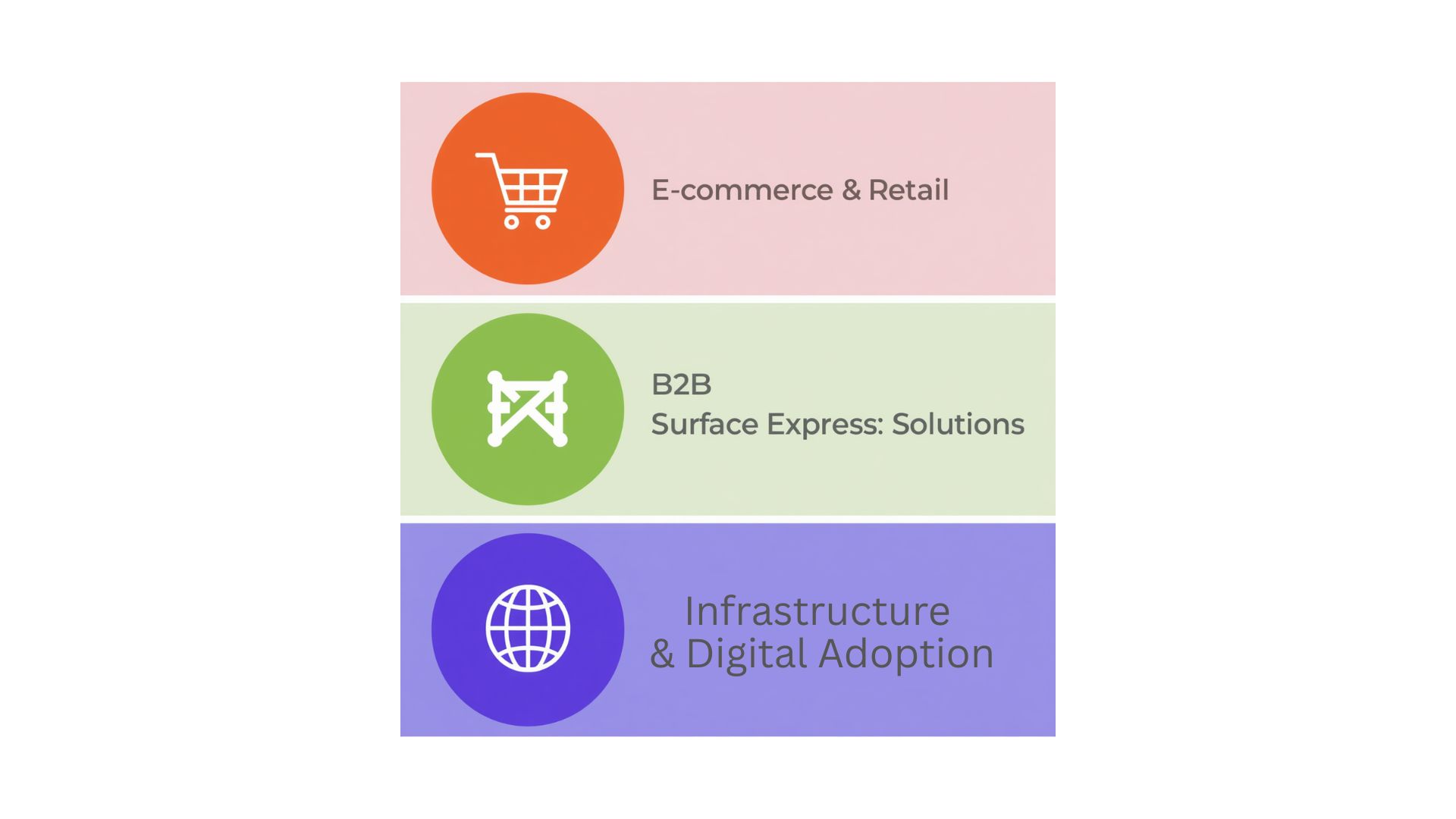
Circle 1: A shopping cart icon labeled "E-commerce & Retail."Circle 2: A manufacturing icon labeled "B2B Surface Express Solutions."Circle 3: A digital globe icon labeled "Infrastructure & Digital Adoption."

The Big Announcement – A 250% Payout

According to the official Board Meeting Outcome released on May 9, 2026, the Board of Directors has recommended a dividend of ₹25 per equity share.

With a face value of ₹10 per share, this translates to a massive 250% dividend. This move underscores the company’s commitment to delivering value, not just parcels, to its stakeholders.

Also Read – Is NSE a Government Company? – The Surprising Truth Behind India’s Biggest IPO Hype

Financial Performance Highlights

The dividend comes on the back of a resilient financial performance for the year ended March 31, 2026. Key figures from the Press Release include:

  • Revenue from Operations: ₹6,141 crore (a steady climb from ₹5,720 crore in the previous year).
  • Consolidated Net Profit: ₹239.69 crore for the full fiscal year.
  • Growth Drivers: Strong momentum in the e-commerce and retail segments, alongside disciplined operational execution.

Know the Record Date and Approval Status

Investors eager to see this cash in their accounts should note the following:

  1. Approval: The ₹25 dividend is currently a recommendation by the Board and is subject to the approval of shareholders at the upcoming Annual General Meeting (AGM).
  2. Record Date: While the company has confirmed the dividend amount in its May 9th filing, the specific Record Date – which determines which shareholders are eligible for the payout – will be announced in the formal AGM notice soon.

The Road Ahead for Blue Dart

Balfour Manuel, Managing Director of Blue Dart Express Limited, expressed optimism about India’s expanding consumption base and infrastructure development.

The company plans to continue investing in its integrated air and ground network and digital capabilities to maintain its competitive edge in the time-definite logistics market.


Is NSE a Government Company? – The Surprising Truth Behind India’s Biggest IPO Hype

The National Stock Exchange of India Ltd is not a government company. It is a privately owned, institutionally controlled, and SEBI-regulated market infrastructure institution that operates at the core of India’s financial system.

The question “Is the NSE a government company?” has become increasingly common as discussions around the National Stock Exchange of India Ltd IPO gain momentum in 2026.

Many investors assume it is government-owned due to its name and national importance. However, the reality is more nuanced.

The short answer: No, the NSE is not a government company.

But the full structure, ownership, and control story is far more interesting – and critical for investors to understand before the upcoming IPO.

The National Stock Exchange of India Ltd is a professionally managed company, and it has 0% promoter holding.

Also Read – Why Do Some Companies Have Zero Promoter Holding in India?

It operates as a private Market Infrastructure Institution (MII), not a government-owned enterprise.

Despite its “National” name and its role in India’s financial system, it is not owned or controlled by the Government of India.

Instead, it is owned by a mix of:

  • Public sector institutions
  • Private banks and financial institutions
  • Global institutional investors
  • Insurance and pension funds

Why People Think NSE Is a Government Company?

There are three major reasons for this confusion:

1. The “National” Branding

The word “National” often leads people to assume government ownership. But in this case, it refers to its nationwide role in capital markets, not ownership.

2. Government-Origin Influence

The exchange was established in the early 1990s following recommendations from a government-appointed committee. This gives it a semi-public perception, even though ownership is private.

3. Systemic Importance

The NSE is the backbone of India’s equity and derivatives markets. Because it is so critical to financial stability, many assume government control exists.

In reality, influence comes from regulation – not ownership.


Who Actually Owns NSE?

The ownership structure is a diversified mix of institutions. Key stakeholders include:

Public Sector Institutions

  • Life Insurance Corporation of India
  • State Bank of India
  • Stock Holding Corporation of India

Private Banks & Financial Institutions

  • HDFC Bank
  • IDBI Bank

Global Institutional Investors

  • Temasek Holdings
  • Morgan Stanley
  • Canada Pension Plan Investment Board

Indian Private Investment Firms

  • Premji Invest

This structure makes NSE neither government-controlled nor purely private in the startup sense.

It is a hybrid institutional ecosystem.


The Regulatory Reality – SEBI’s Control, Not Ownership

Even though NSE is privately owned, it does not operate independently of oversight.

It is heavily regulated by the Securities and Exchange Board of India (SEBI), which ensures transparency and systemic stability.

SEBI does not own NSE, but it governs:

  • Listing rules
  • Trading systems
  • Investor protection frameworks
  • Market infrastructure compliance

This creates a system where NSE is privately owned but publicly accountable.


SBI’s Role and Exposure in NSE

One of the most important institutional stakeholders is the State Bank of India.

Recent disclosures and reports indicate that SBI and its subsidiary, SBI Caps together hold a significant stake in NSE, with valuations previously estimated at around ₹43,500 crore.

Additionally, Moneycontrol recently quoted the SBI Chairman confirming that the bank may partially dilute its stake during the upcoming NSE IPO. This is a key signal that India’s largest public sector bank views the IPO as a liquidity event rather than a strategic exit.

In its latest quarterly results, SBI reported a net profit of approximately ₹19,684 crore compared to ₹18,643 crore in the same period last year.

Net interest income also increased to around ₹44,380 crore, although margins showed slight compression.

Also Read – SBI Earned ₹80,032 Crore in FY26 – But 3 Numbers in Its Results Should Make Investors Nervous


NSE IPO 2026 – Why It Matters So Much?

The upcoming IPO of the National Stock Exchange of India Ltd is expected to be one of the biggest financial events in India’s market history.

A large consortium of investment banks has reportedly been appointed to manage the listing process. Several global and domestic institutional investors are also expected to reduce their stakes as part of the public offering.

This IPO has been in discussion for years, but regulatory settlements and structural clarity are now bringing it closer to reality.


3 Shocking Realities Investors are Missing in SBI’s Q4 2026 Results

SBI posted a standalone net profit of ₹80,032 crore for FY2025-26, up from ₹70,900 crore last year — a solid 12.9% jump. The board declared a dividend of ₹17.35 per share (1735%), with a record date of May 16, 2026. Capital adequacy stands at a healthy 15.40% under Basel III. Gross NPA ratio improved to 1.49% from 1.82% a year ago. On the surface, this is a bank firing on most cylinders.

State Bank of India just declared its highest-ever annual profit. The headline looks clean. The dividend is generous.

But buried inside 36 pages of audited financials filed on May 8, 2026, are three data points that every SBI shareholder should read carefully before feeling comfortable.

SBI posted a standalone net profit of ₹80,032 crore for FY2025-26, up from ₹70,900 crore last year – a solid 12.9% jump.

The board declared a dividend of ₹17.35 per share (1735%), with a record date of May 16, 2026.

Capital adequacy stands at a healthy 15.40% under Basel III. Gross NPA ratio improved to 1.49% from 1.82% a year ago. On the surface, this is a bank firing on most cylinders.

Now for the three things worth a closer look.

1. Advances Grew 17% – But So Did Total Debt

SBI’s loan book (advances) jumped from ₹41.63 lakh crore to ₹48.77 lakh crore – nearly ₹7.14 lakh crore in new lending in a single year. That’s aggressive growth. At the same time, borrowings surged from ₹5.63 lakh crore to ₹7.31 lakh crore – a 30% jump in just twelve months.

The total debts-to-total-assets ratio moved from 8.44% to 9.59%. Not alarming on its own. But the direction of travel matters. When India’s largest bank borrows significantly more to lend significantly more, the question isn’t whether the loans are good today – it’s what happens if the credit cycle turns.


2. The Yes Bank Profit Won’t Repeat

SBI booked ₹4,593 crore as an “exceptional item” in FY26 – the profit from selling its 13.18% stake in Yes Bank in September 2025 at ₹21.50 per share. This is real money, but it’s a one-time event. Strip it out and the underlying profit growth looks somewhat less impressive.

Investors anchoring to FY26 headline profit as a base for FY27 expectations should note that no equivalent windfall is currently visible on the horizon. The bank’s core operating profit for Q4 actually came in at ₹27,704 crore – lower than both Q3 FY26 and Q4 FY25.


3. ₹1,60,914 Crore Sitting in a Shadow Account

Perhaps the most overlooked disclosure in SBI’s results is the Advance Under Collection Account (AUCA) – fully provided accounts moved off the main balance sheet.

The number as of March 31, 2026: ₹1,60,914 crore.

Of this, ₹25,528 crore is more than 10 years old. Another ₹86,157 crore is between 5–10 years old. These are loans that SBI has essentially written off internally but not formally erased. The bank’s Provision Coverage Ratio including AUCA is 91.97% – which sounds reassuring – but the sheer size of this pool (larger than the GDP of many Indian states) is a reminder of how much historical stress the balance sheet carries.

Also Read – Is NSE a Government Company? – The Surprising Truth Behind India’s Biggest IPO Hype


The stock market often rewards the headline. Long-term investors read the footnotes.

What is the dividend of SBI in 2026?

SBI has declared a dividend of ₹17.35 per equity share, which is 1735% of the face value.

On which date will SBI’s dividend be credited?

The dividend payment will be credited on June 4, 2026.

Multi Commodity Exchange Announces q4 FY 2026 Results

MCX Financial Results 2026: Key Highlights, Dividend, and Profit Growth Analysis

The Board of Directors of Multi Commodity Exchange of India Limited met on Friday, May 08, 2026, to approve the audited financial results for the quarter and the full financial year that ended on March 31, 2026.

During this meeting, the board recommended a final dividend of ₹8 per equity share, which has a face value of ₹2 each. This dividend proposal is now awaiting the final approval of the shareholders at the upcoming 24th Annual General Meeting of the company.

Also Read – State Bank of India Declares Massive 1735% Dividend for Shareholders

The specific dates for the meeting and the dividend payment will be shared by the company at a later time.

Consolidated Revenue and Profit Performance

The consolidated financial performance of the company showed growth across major metrics for the full financial year. For the year ended March 31, 2026, the total income reached ₹2,429.05 crores, which is an increase of ₹1,220.19 crores or 100.94% compared to the ₹1,208.86 crores reported in the previous fiscal year.

The net profit for the full year stood at ₹1,331.55 crores, representing a rise of ₹771.51 crores or 137.76% from the ₹560.04 crores earned in the prior year.

Looking at the quarterly performance, the total income for the quarter ended March 31, 2026, was ₹925.33 crores. This is an increase of ₹228.22 crores or 32.74% from the ₹697.11 crores recorded in the preceding quarter ended December 31, 2025.

When compared to the same quarter in the previous year, where income was ₹320.49 crores, the total income rose by ₹604.84 crores or 188.72%. Net profit for the final quarter was ₹529.77 crores, which is an increase of ₹128.65 crores or 32.07% over the ₹401.12 crores reported in the December quarter.

On a year-on-year basis, the net profit grew by ₹394.31 crores or 291.10% from the ₹135.46 crores recorded in the quarter ended March 31, 2025.

Operational Expenses and Statutory Contributions

The company reported total expenses of ₹733.82 crores for the full year ended March 31, 2026, compared to ₹511.55 crores in the previous year.

For the final quarter of the year, expenses were ₹242.10 crores, reflecting an increase from the ₹192.40 crores spent in the previous quarter and the ₹152.96 crores spent in the same quarter of the previous year. A portion of these costs includes employee benefits, which amounted to ₹180.11 crores for the full year. The company also accounted for an expense of ₹0.10 crore related to increased obligations for gratuity and leave encashment following the notification of new Labour Codes by the Government of India.

In terms of regulatory and statutory requirements, the company provided ₹40.56 crores as an exchange contribution to the Core Settlement Guarantee Fund during the final quarter. The total Core Settlement Guarantee Fund corpus as of March 31, 2026, stood at ₹1,367.29 crores.

Additionally, a subsidiary of the company contributed ₹1.00 crore to the Settlement Guarantee Fund as a financial disincentive due to market disruptions that occurred on December 23, 2025, and January 28, 2026, as mandated by the Securities and Exchange Board of India.

Corporate Governance and Internal Audit

The board also approved the re-appointment of M/s. Mittal & Associates as the internal auditors for the company for the 2026-27 financial year. This firm, which was established in 1977, specializes in internal audits for capital market entities.

In financial terminology, an internal audit is an independent process used to review a company’s internal controls and operations to ensure accuracy and compliance. The company continues to operate within a single business segment, which is the commodity exchange business, meaning all its financial reporting is consolidated under this one area of operation.

Company Background

Multi Commodity Exchange of India Limited operates in the financial services sector within the commodity exchange industry. It provides a platform for the nationwide online trading of commodity derivatives, facilitating price discovery and risk management. The company was listed on the stock exchanges in 2012 and operates on a large scale as a key infrastructure provider in the Indian financial markets, supported by its subsidiary, the Multi Commodity Exchange Clearing Corporation Limited.

BKT Tires Hits ₹10,800 Crore Milestone: Balkrishna Industries Announces Final Dividend and Massive ₹2,000 Crore Expansion Plan

Balkrishna Industries Limited – stock latest audited financial results news

Balkrishna Industries Limited held a meeting of its Board of Directors on Friday, May 8, 2026, to approve the audited financial results for the quarter and the full financial year ended March 31, 2026. The company reported a consolidated revenue from operations of ₹10,823.08 crore for the full fiscal year, compared to ₹10,446.95 crore in the previous year.

Alongside these results, the Board recommended a final dividend of ₹4 per equity share, which is 200% on the face value of ₹2 per share. This recommendation is subject to the approval of shareholders at the upcoming 64th Annual General Meeting.

Quarterly Performance and Comparative Analysis

In the fourth quarter ended March 31, 2026, the company achieved a consolidated revenue from operations of ₹2,932.82 crore. When compared to the previous quarter ended December 31, 2025, which saw revenues of ₹2,736.79 crore, this represents an absolute Quarter-on-Quarter increase of ₹196.03 crore, or 7.16%. On a Year-on-Year basis, the revenue of ₹2,932.82 crore rose by ₹180.44 crore from the ₹2,752.38 crore reported in the same quarter of the previous year, marking a 6.56% increase.

The consolidated profit for the period in the fourth quarter stood at ₹299.46 crore. This is a decrease of ₹82.69 crore, or 21.64%, from the ₹382.15 crore earned in the preceding quarter. Compared to the ₹368.55 crore profit in the quarter ended March 31, 2025, the current profit shows a Year-on-Year decline of ₹69.09 crore, or 18.75%.

Also Read – State Bank of India Declares Massive 1735% Dividend for Shareholders

Full Year Financial Review

For the entire financial year ended March 31, 2026, Balkrishna Industries reported a consolidated profit of ₹1,243.10 crore. This represents a decrease of ₹411.86 crore, or 24.89%, compared to the ₹1,654.96 crore profit recorded in the previous financial year. The total income for the year was ₹10,985.74 crore, a slight decrease of ₹89.17 crore from the ₹11,074.91 crore reported in the prior fiscal year, representing a decline of 0.81%. Total expenses for the year were ₹8,798.35 crore, down from ₹9,431.23 crore in the previous year, an absolute decrease of ₹632.88 crore or 6.71%.

Operational Updates and Capacity Expansion

The company provided updates on its ongoing capital projects, noting that its carbon black capacity expansion is expected to reach completion in the first quarter of the 2026-27 financial year. Projects involving Passenger Car Radial Tyres and additional Off-Highway Tyres facilities are currently progressing according to their original schedules. To further support infrastructure development and capacity across On-Road and Off-Road tyre categories, as well as AI-enabled automation and sustainability initiatives, the Board has approved an additional capital expenditure of ₹2,000 crore.

Board Decisions and Corporate Governance

The Board approved the re-appointment of Vipul Shah as a Whole Time Director, designated as Director and Company Secretary, for a five-year term starting February 11, 2027. Additionally, the Board approved the appointment of Deloitte Haskins & Sells LLP as a Joint Statutory Auditor for a period of five consecutive years, beginning from the conclusion of the 64th Annual General Meeting. During the final quarter of the year, the company issued 75,000 listed unsecured non-convertible debentures with a face value of ₹1 lakh each, aggregating to ₹750 crore on a private placement basis.

Company Background

Balkrishna Industries Limited, widely known by its brand BKT, operates in the tyre industry within the auto components sector. Established in 1961, the company specializes in the manufacture of Off-Highway Tyres used in segments such as agriculture, industry, mining, and earthmoving. Balkrishna Industries Limited is a large-scale global player with its equity shares listed on the BSE Limited and the National Stock Exchange of India Limited.

State Bank of India Declares Massive 1735% Dividend for Shareholders

MCX Financial Results 2026: Key Highlights, Dividend, and Profit Growth Analysis

The Central Board of the State Bank of India, during its meeting held on Friday, May 8, 2026, has declared a dividend of ₹17.35 per equity share for the financial year ended March 31, 2026. This dividend payout represents 1735% of the face value of each fully paid-up equity share, which stands at ₹1.

Record Date and Eligibility for Shareholders

To determine which shareholders are eligible to receive this payment, the bank has established Saturday, May 16, 2026, as the official record date.

A record date is a specific date set by a company to finalize the list of shareholders who are documented on its books as owners of the stock, thereby qualifying them to receive the declared dividend. Only those investors who hold the bank’s shares by the close of business on this date will be entitled to the payout.

Also Read – SBI Earned ₹80,032 Crore in FY26 – But 3 Numbers in Its Results Should Make Investors Nervous

Details of Book Closure and Payment Timeline

Following the record date, the State Bank of India will initiate a book closure period starting from Sunday, May 17, 2026, through Tuesday, May 19, 2026. Both the start and end dates are included in this period.

Book closure is a process where a company temporarily suspends the transfer of shares in its records to facilitate the accurate processing of dividend payments to the identified eligible members.

The bank has scheduled the actual dividend payment date for Thursday, June 4, 2026.

About State Bank of India

State Bank of India is a prominent entity in the banking and financial services sector, operating as a public sector bank. Headquartered in Mumbai, it manages a vast scale of operations both within India and internationally. As a central pillar of the Indian financial industry, it provides a wide range of banking products and services to retail, corporate, and institutional clients.

Shipping Corporation of India Reports Financial Results for Fiscal Year 2025-26

The Shipping Corporation of India Limited – stock latest AUDITED FINANCIAL RESULTS news

The Shipping Corporation of India Limited has officially announced its audited financial results for the quarter and the full financial year ended March 31, 2026.

Following a meeting of the Board of Directors held on May 8, 2026, the company reported a significant increase in its annual performance. For the full financial year 2025-26, the company achieved a standalone profit after tax of ₹1,326.25 crore, which represents a 62.91% increase compared to the ₹814.10 crore profit recorded in the previous financial year.

Shipping Corporation of India Dividend q4 2026

The Board has also recommended a final dividend of ₹1 per equity share of face value of ₹10 each, amounting to a 10% dividend payout, which is subject to shareholder approval at the upcoming Annual General Meeting.

Quarterly Performance and Sequential Growth

During the fourth quarter of the financial year, the company recorded a standalone profit after tax of ₹413.76 crore. When compared to the preceding quarter ended December 31, 2025, where the profit was ₹393.37 crore, this represents a quarter-on-quarter increase of ₹20.39 crore, or 5.18%.

The total income for the quarter stood at ₹1,657.30 crore, showing a slight decrease of ₹8.84 crore, or 0.53%, from the ₹1,666.14 crore reported in the third quarter.

Revenue from operations for the period was ₹1,512.73 crore, while other income saw a substantial rise to ₹144.57 crore from ₹54.92 crore in the previous quarter.

Also Read –Netripples Software Limited Announces Financial Results for Quarter and Year Ended March 31, 2026

Year-on-Year Comparisons and Annual Totals

On a year-on-year basis, the fourth-quarter profit of ₹413.76 crore shows a significant rise of 140.32% over the ₹172.17 crore profit reported in the same quarter of the previous year.

Total income for the quarter also grew by ₹257.82 crore, an 18.42% increase from the ₹1,399.48 crore earned in the quarter ended March 31, 2025.

For the entire financial year 2025-26, the total income reached ₹6,218.36 crore, marking a 7.48% growth over the ₹5,785.37 crore recorded in the 2024-25 fiscal year. The earnings per equity share for the full year improved to ₹28.47 from ₹17.48 in the prior year.

Segment Wise Revenue and Operations

The company operates through four primary segments: Liner, Bulk Carrier, Tanker, and Technical and Offshore. The Tanker segment remained the largest contributor to the revenue, generating ₹1,074.46 crore during the final quarter and ₹3,942.23 crore for the full year. The Bulk Carrier segment contributed ₹217.83 crore to the quarterly revenue, while the Liner and Technical and Offshore segments accounted for ₹164.67 crore and ₹72.37 crore, respectively.

In terms of segment results, the Tanker division reported a profit of ₹362.71 crore before tax and interest for the quarter, while the Bulk Carrier segment turned around from a loss in the previous quarter to a profit of ₹19.25 crore.

Consolidated Financial Overview

On a consolidated basis, which includes the performance of subsidiaries like Inland and Coastal Shipping Limited and SCI Bharat IFSC Limited, as well as joint ventures, the company reported an annual profit after tax of ₹1,422.81 crore for the fiscal year 2025-26. This is a substantial increase from the ₹843.58 crore reported in the previous year.

The consolidated total income for the year was ₹6,226.78 crore. For the quarter ended March 31, 2026, the consolidated profit after tax was ₹404.60 crore, compared to ₹185.14 crore in the corresponding quarter of the previous year.

Geopolitical and Administrative Updates

The company provided updates regarding maritime disruptions in the Middle East that occurred in February 2026.

Four vessels—Desh Garima, Desh Suraksha, Desh Vibhor, and Desh Vaibhav—faced restricted movement through the Strait of Hormuz due to heightened security risks. While one vessel, Desh Garima, reached Mumbai in April 2026, the others awaited clearance as of the reporting date. Management noted that freight revenue for these vessels has been recognized based on the percentage of voyage completion and stated that the disruption does not have a material impact on the financial statements.

Additionally, the company noted that the strategic disinvestment process initiated by the Government of India remains in progress.

Also Read – Does money go to the company when you buy shares from the stock exchange?

Company Background

The Shipping Corporation of India Limited is a Government of India Enterprise and a Navratna company. It operates in the shipping sector, providing a wide range of services including the transportation of goods and passengers. Established in 1950 and listed on the major Indian stock exchanges, the company manages a diverse fleet of tankers, bulk carriers, and container vessels. As a significant player in the Indian maritime industry, it maintains a large scale of operations both domestically and internationally, catering to various energy and trade requirements.

Netripples Software Limited Announces Financial Results for Quarter and Year Ended March 31, 2026

Balkrishna Industries Limited – stock latest audited financial results news

Netripples Software Limited has released its standalone unaudited financial results for the fourth quarter and the full financial year ending March 31, 2026.

The company’s Board of Directors approved the results during a meeting held on May 8, 2026. The figures highlight an increase in annual revenue and a growth in annual net profit, despite a loss recorded in the final quarter.

Quarterly Revenue and Income Performance

For the quarter ended March 31, 2026, Netripples Software Limited reported total revenue from operations of ₹2.02 crore. This represents a Quarter-on-Quarter (QoQ) absolute increase of ₹0.44 crore compared to the preceding quarter ended December 31, 2025, which saw revenue of ₹1.58 crore. This change indicates a growth of 27.85%.

On a Year-on-Year (YoY) basis, revenue saw a marginal absolute decrease of ₹0.01 crore from the ₹2.03 crore reported in the quarter ended March 31, 2025, reflecting a decline of 0.49%.

Total income for the quarter remained at ₹2.02 crore as no other income was reported.

Review of Quarterly Expenses and Profitability

Total expenses for the quarter ended March 31, 2026, amounted to ₹2.09 crore. This total includes employee benefits of ₹4.25 lakhs, depreciation and amortization of ₹3.50 lakhs, and other expenses of ₹2.01 crore.

The company recorded a net loss of ₹7.20 lakhs for the quarter.

This is a shift from the preceding quarter ended December 31, 2025, which had a net profit of ₹3.92 lakhs, resulting in a QoQ absolute decrease in profit of ₹11.12 lakhs or 283.67%.

Compared to the net loss of ₹0.84 lakhs in the same quarter of the previous year, the loss widened by an absolute ₹6.36 lakhs, a YoY increase in loss of 757.14%.

Full Year Financial Performance Comparison

For the full financial year ended March 31, 2026, Netripples Software Limited reported total revenue of ₹7.18 crore.

When compared to the ₹6.27 crore recorded in the previous financial year ended March 31, 2025, the company achieved an absolute Year-to-Year (FY-to-FY) increase of ₹0.91 crore, or a growth of 14.51%. Total annual expenses were ₹7.15 crore, up from ₹6.25 crore in the prior year.

The net profit for the full year 2026 stood at ₹2.72 lakhs, compared to ₹2.10 lakhs in the previous year. This reflects an absolute annual profit increase of ₹0.62 lakhs, representing a growth of 29.52%.

Assets, Liabilities, and Cash Flow Position

The company reported total assets of ₹10.23 crore as of March 31, 2026. Current assets made up ₹10.10 crore of this amount, with inventories valued at ₹9.80 crore.

Non-current assets, consisting of property, plant, and equipment, were reported at ₹12.80 lakhs.

Total liabilities stood at ₹3.41 crore, and the paid-up equity share capital was unchanged at ₹6.82 crore.

According to the cash flow statement, net cash flows from operating activities were ₹2.72 lakhs, with cash and cash equivalents ending the period at ₹7.49 lakhs.

Explaining Financial Concepts

In financial reporting, revenue from operations is the total amount of money a company receives from its primary business activities.

Net profit or loss is the final amount remaining after all operating costs, interest, and taxes have been paid.

A Year-on-Year (YoY) comparison looks at the same quarter across different years, while a Quarter-on-Quarter (QoQ) comparison looks at consecutive periods within the same or adjacent years.

Company Background and Scale

Netripples Software Limited is an information technology company that specializes in software development, particularly for the healthcare and medical sectors. Headquartered in Hyderabad, the company has been active since 1993. It operates as a small-to-medium scale enterprise providing various technology and software solutions to its clients.

Does money go to the company when you buy shares from the stock exchange?

where does the money I put to buy a stock go and how does a company make use of the fund I put in?

If you’ve ever bought a stock and wondered – “wait, where did my money actually go?” – you’re asking exactly the right question.

Most beginners assume the company receives their money. The reality is a little more interesting.

The short answer is: no, the company generally does not get your money when you buy shares on the stock exchange.

Here’s why.


The Stock Market Has Two Very Different Phases

Think of the stock market not as one single place, but as a system with two distinct phases. Understanding this is the key to everything.

Phase 1 – The Primary Market

This is the phase where a company actually receives money from investors. It happens through a process called an IPO (Initial Public Offering) — the very first time a company offers its shares to the public.

When a company launches an IPO (and it’s not an OFS – Offer for Sale, where existing shareholders are selling), it is essentially saying: “We’re selling shares to raise funds.” Investors buy those freshly created shares, and that money lands directly in the company’s bank account. The company then uses it for operations, expansion, hiring, paying off debt – whatever it needs.

This is the one moment where buying a share means the company directly benefits from your money. It’s a direct transaction: company on one side, investor on the other.

Phase 2 – The Secondary Market

This is where the confusion starts for most beginners – because this is where almost all everyday stock trading happens.

Once a company has done its IPO, those shares are now out in the world, held by investors. Those shares are now listed on the stock exchange – NSE, BSE, NYSE, or wherever.

Who gets the money when you buy a share on the stock exchange?

When you log into your trading app and buy a stock, you are almost always buying from one of these existing investors, not from the company itself.

The person selling it to you – another investor – gets the money. The company is simply watching from the sidelines. It doesn’t receive a single rupee from this transaction.

The stock exchange here is just a facilitator – a giant, highly efficient marketplace that connects buyers and sellers. It doesn’t create new ownership; it just transfers existing ownership from one person to another.

Also Read – Does the share price go up because company profits are added to it?


When you sell a stock, where does the money come from?

When you decide to sell your shares, the money comes from a new investor who wants to buy what you’re selling. They pay you, you hand over the shares, and the company is again completely uninvolved.

It’s a continuous chain:

  • Early investor buys in IPO – company gets money
  • Early investor sells on exchange – new investor pays them
  • New investor sells later – another new investor pays them …and so on

The company’s shares keep changing hands, but the company only ever saw money from that very first transaction.


One Exception Worth Knowing – Share Buybacks

There is one scenario where the company does pay you money for your shares — it’s called a Share Buyback.

Sometimes, a company decides it wants to repurchase its own shares from the market. It does this for various reasons – perhaps it believes its stock is undervalued, or it wants to return extra cash to shareholders. There are two common ways this happens: in an open market buyback, the company simply buys shares at the prevailing market price, just like any other investor would. In a tender offer buyback, the company approaches shareholders directly and offers to buy their shares at a fixed price, which is usually above the current market price – giving investors an incentive to participate.

Either way, the money flows from the company’s treasury to you. This is one of the few times the company actively steps into the market as a buyer rather than watching from the sidelines.


So What Do You Actually Own After Buying Shares?

Even though your money went to a previous investor and not to the company, you are now a part-owner of that company. This is what a share represents – a small slice of ownership.

As a shareholder, you’re entitled to:

  • A share of the company’s profits, if they pay dividends
  • Voting rights on major company decisions
  • A proportional claim on the company’s assets if it ever shuts down

The company may not have received your money, but your stake in the company is completely real.


A Simple Way to Think About It

Imagine a friend starts a bakery and sells you 10% of it for ₹10,000. That money goes to them to buy ovens and ingredients – that’s the primary market.

A year later, you want to sell your 10% stake. You find another person who pays you ₹15,000 for it. The bakery owner was never part of that deal – that’s the secondary market.

The stock exchange works exactly like this, just at a massive scale with millions of buyers and sellers every single day.


Quick Recap

SituationWhere does your money go?
Buying in an IPO Directly to the company
Buying on the stock exchangeTo the investor selling you the shares
Company does a share buyback Company pays money to you

Most of the time, when someone asks

“does the company get the money when I buy its stock?”

– the honest answer is no.

But you still become a real owner. And that ownership is what makes stocks valuable in the first place.

This article is for informational purposes only and should not be considered financial advice. Investing in stocks, cryptocurrencies, or other assets involves risks, including the potential loss of principal. Always conduct your own research or consult a qualified financial advisor before making investment decisions. The author and publisher are not responsible for any financial losses incurred from actions based on this article. While efforts have been made to ensure accuracy, economic data and market conditions can change rapidly. The author and publisher do not guarantee the completeness or accuracy of the information and are not liable for any errors or omissions. Always verify data with primary sources before making decisions.

Does the share price go up because company profits are added to it?

Does the share price go up because company profits are added to it?

This is a major confusion that beginners face. We think of the relationship between a stock and the company in a way that is completely opposite to reality. And it is not our fault – the way most people explain the stock market makes it sound like a simple profit-sharing machine. But it is not.

Shares are priced like marks on a paper

Shares are priced like people are giving marks to them – marks based on both present performance and future expected performance.

Think of it like a student being graded not just on last year’s results, but also on how much potential the teacher thinks the student has going forward.

If a company earns a profit, the share price goes up – not because the profits are added to it – but based on the perception that the company has done well and will do even better in the future.

The keyword here is perception. It is an opinion held by thousands of investors simultaneously, and that collective opinion is what moves the price.

Company performance and share price are relative in the stock market.

This is why two companies with the same profit can have very different stock price movements on the same day.

The market is always asking: “Was this good enough? And what does it tell us about tomorrow?”

Also Read – Does money go to the company when you buy shares from the stock exchange?

Then where do the profits actually go?

Now you may think – what about the profits? If they are not going into the share price, where are they going?

Yes, profits are added – but in the balance sheet, under an account called retained earnings. This is essentially the company’s savings account. When a company earns a net profit and does not make any major investment or announce a dividend, those profits sit in retained earnings.

Retained Earnings = Net Profit − Dividends Paid.

It is the portion of profit that the company keeps for itself – to reinvest, repay debt, or build a cash reserve. It shows up on the balance sheet under shareholders’ equity, not in the share price directly.

Now, if the company decides to share some of this profit with shareholders, it announces a dividend. This reduces retained earnings and rewards investors with a cash payout. Alternatively, a company may use profits to buy back its own shares from the market – called a buyback – which can indirectly push the share price up by reducing the number of shares in circulation.

So what actually moves the share price?

The share price moves based on demand and supply — and demand is driven by expectation. When more people want to buy a stock than sell it, the price rises. When more want to sell, it falls. Profits are one of the key factors that shape that expectation — but they are not the only one.

Other factors that influence share price include the overall market mood, interest rates, sector performance, global events, and management commentary. This is why a war breaking out in some part of the world can pull down an otherwise healthy company’s stock — even if the company itself did nothing wrong.

Also Read – What Does FY Mean? – Explained (Full Guide)

But what if the stock falls even on good results?

This is where it gets really interesting — and counterintuitive. Sometimes the share price goes down even when the company shows good results. Investors mainly cite the following reasons when this happens:

  • The results did not come as expected. The market does not react to profits in isolation — it reacts to how those profits compare to what analysts were expecting. If the street was expecting ₹500 crore in profit and the company reports ₹420 crore, it is still a profit — but it is a disappointment. The stock will likely fall.
  • Weak management commentary about the future. Sometimes the numbers are fine, but what the CEO says on the earnings call is not. If management signals slower growth ahead, rising input costs, or increased competition, investors reprice the stock immediately based on that revised future outlook.
  • The market had already priced in the good news. This is perhaps the most fascinating reason. If a company’s results were widely expected to be good, smart money had already bought in weeks ago. By the time the results drop, there is no new reason to buy — and the stock may actually fall as early investors exit to book their profits. This is called “buy the rumour, sell the news.”

Imagine a company whose stock has already risen 20% in the two months leading up to its results because everyone expected a strong quarter. The results come out — and they are indeed strong. But since the good news was already baked into the price, there is no upside surprise left. Investors who bought early now sell to lock in their gains, and the stock drops 5% on the same day it announced record profits.

And what happens when results beat expectations?

The price could have gone much higher if the results came in better than expected. That would have led to an even bigger jump in the share price – because the market loves a positive surprise far more than a result it already saw coming.

This is why companies sometimes intentionally set conservative guidance – so the actual results appear to “beat” expectations and trigger a sharper price rally. It is a well-known game between management and the market.

So the next time you see a company post profits and the stock barely moves – or even falls – you will know exactly why. The stock market is not a bank account where profits get deposited into the share price. It is a forward-looking mechanism that runs entirely on expectations, perception, and surprise.

This article is for informational purposes only and should not be considered financial advice. Investing in stocks, cryptocurrencies, or other assets involves risks, including the potential loss of principal. Always conduct your own research or consult a qualified financial advisor before making investment decisions. The author and publisher are not responsible for any financial losses incurred from actions based on this article. While efforts have been made to ensure accuracy, economic data and market conditions can change rapidly. The author and publisher do not guarantee the completeness or accuracy of the information and are not liable for any errors or omissions. Always verify data with primary sources before making decisions.