
IMACโ€ฏHoldings, Inc. Issues Secured Promissory Note of $210,000 to Raise $150,000

โ€ฏIMACโ€ฏHoldings issues secured $210,000 promissory note for $150,000 purchase as part of shortโ€‘term financing arrangement.

Medicalโ€‘services and technology companyโ€ฏIMACโ€ฏHoldings,โ€ฏInc. today reported that it entered into a secured financing agreement on Novemberโ€ฏ14,โ€ฏ2025. Under the terms, the company issued a promissory note (the โ€œNoteโ€) for an aggregate principal amount of $210,000 in exchange for an aggregate purchase price of $150,000 from the lender.

The Note is secured, meaning it is backed by the companyโ€™s assets under a separate Guaranty, Security and Pledge Agreement and an Intellectual Property Security Agreement. It matures on Februaryโ€ฏ13,โ€ฏ2026, and the company may prepay any portion of the outstanding principal at any time without penalty.

Also Read – Manhattan Bridge Capital authorises up to 100,000โ€‘share buyโ€‘back programme

Although the Note accrues no interest under ordinary conditions, if an Event of Default occurs it bears an interest rate of 14.0% per annum, calculated on a 365โ€‘day year and actual days elapsed. Events of Default include the company failing to pay principal when due, insolvency or bankruptcy proceedings, breach of covenants or representations, or other material adverse events.

Among several negative covenants, the company agreed not to incur additional indebtedness or liens, not to make dividends or distributions outside the ordinary course, and not to effect certain corporate reorganizations or asset transfers without the lenderโ€™s consent until the Note is paid in full.

This arrangement creates a new direct financial obligation for IMAC Holdings. In broad terms, when a company issues debt – especially one secured by its assets – it can impact its flexibility, because it must abide by the covenants and repayment terms. For investors and other stakeholders, it may indicate the company is seeking immediate financing rather than raising equity, and it may reflect underlying liquidity needs or operational plans.

From an educational viewpoint, this financing highlights how companies can bridge shortโ€‘term funding gaps by issuing a promissory note and using their assets as collateral. The structure means the lender has rights to certain company assets if repayment obligations are not met. It also illustrates the tradeโ€‘off: obtaining funds quickly but accepting stricter restrictions and possible higher cost in default scenarios.

Company Profile

IMACโ€ฏHoldings,โ€ฏInc. operates in the specialty outpatient services industry (SICโ€ฏ8093). Incorporated in Delaware, it previously operated under the name IMAC Holdings LLC before converting to a corporation in 2018. The company provides aesthetic and medical spa solutions and technologyโ€‘enabled services, generating revenue from offering nonโ€‘surgical treatments, device supplies, and service contracts.

This article is for informational purposes only and should not be considered financial advice. Investing in stocks, cryptocurrencies, or other assets involves risks, including the potential loss of principal. Always conduct your own research or consult a qualified financial advisor before making investment decisions. The author and publisher are not responsible for any financial losses incurred from actions based on this article. While efforts have been made to ensure accuracy, economic data and market conditions can change rapidly. The author and publisher do not guarantee the completeness or accuracy of the information and are not liable for any errors or omissions. Always verify data with primary sources before making decisions.

Manhattan Bridge Capital authorises up to 100,000โ€‘share buyโ€‘back programme

Manhattan Bridge Capital authorizes up to 100,000 share repurchase programme to address stock price decline and signal confidence.

On 20โ€ฏNovemberโ€ฏ2025, Manhattan Bridge Capital, Inc. announced that its board of directors has authorised a share repurchase programme under which the Company may purchase up to 100,000 shares of its common stock during the next 12โ€ฏmonths.

In the filing with the U.S. Securities and Exchange Commission (SEC), the Company noted that repurchases may be carried out via openโ€‘market transactions, privately negotiated purchases or other means at the Companyโ€™s discretion and that the programme does not obligate the Company to make any purchases. The programme will expire in 12โ€ฏmonths unless earlier terminated or modified by the board.

In its press release the Company explained that its board views the recent โ€œdramatic declineโ€ in the Companyโ€™s stock price as an opportunity for repurchasing shares. The CEO and Chairman of the Board, Assaf Ran, stated that the Companyโ€™s โ€œextraordinary low leverage, the unusual personal commitment of our management, together with our impressive performances and track record even in troubled timesโ€ support the decision to implement the repurchase programme and reflect confidence in the business and its future prospects.

Also Read – American Strategic Investment Co. Pushes Portfolio Strategy Amid Balance-Sheet Reset

A share buyโ€‘back programme is often used by companies to signal belief in their own value. This means the company can use its cash or borrow money to buy back its own shares. By doing this, there are fewer shares available, so each remaining shareholder owns a slightly bigger piece of the company, and it may also help support or raise the stock price. The Company emphasised that the programme may be terminated, increased or decreased at its discretion.

While the announcement did not include a target price or timeframe for actual purchases beyond the 12โ€‘month window, it did provide some context regarding the business fundamentals.

Manhattan Bridge Capital highlighted its low leverage (meaning the ratio of its debt to equity or assets is relatively low)

Manhattan Bridge Capital highlighted its low leverage, meaning it has relatively little debt compared to its equity or assets and its experience navigating challenging market conditions. It also noted that the share prices had declined significantly, prompting management to view the moment as a favourable entry opportunity.

The filing also reiterated cautionary statements about forwardโ€‘looking statements, noting that actual results may differ materially due to factors including competition, interestโ€‘rate fluctuations, loan origination constraints, borrower default risks, collateral valuation risks, and the possible inability to extend or renew credit facilities or redeem senior secured notes due Aprilโ€ฏ22,โ€ฏ2026.

Company Profile

Manhattan Bridge Capital, Inc., organised as a realโ€‘estate investment trust (REIT) operating in the secured lending space, was incorporated in New York and is headquartered at 60โ€ฏCutterโ€ฏMillโ€ฏRoad, Suiteโ€ฏ205, Great Neck, Newโ€ฏYork. The company provides shortโ€‘term secured, nonโ€‘banking loans – often called โ€œhardโ€moneyโ€ loans – to realโ€‘estate investors engaged in acquisition, renovation, rehabilitation or improvement of properties in the Newโ€ฏYork metropolitan area (including Newโ€ฏJersey and Connecticut) and in Florida. It generates revenue primarily by charging interest and fees on these shortโ€‘term secured loans and by leveraging its loan portfolio to support returns to its shareholders.

This article is for informational purposes only and should not be considered financial advice. Investing in stocks, cryptocurrencies, or other assets involves risks, including the potential loss of principal. Always conduct your own research or consult a qualified financial advisor before making investment decisions. The author and publisher are not responsible for any financial losses incurred from actions based on this article. While efforts have been made to ensure accuracy, economic data and market conditions can change rapidly. The author and publisher do not guarantee the completeness or accuracy of the information and are not liable for any errors or omissions. Always verify data with primary sources before making decisions.

American Strategic Investment Co. Pushes Portfolio Strategy Amid Balance-Sheet Reset

American Strategic Investment Co. LATEST NEWS - November 2025

American Strategic Investment Co. released its financial results for the quarter ended September 30, 2025 and outlined a series of strategic steps aimed at strengthening its balance sheet, extending lease commitments, and streamlining operating costs. The company continues to reposition its real estate portfolio in response to shifting market conditions and upcoming debt maturities.

Quarterly performance

The company reported revenue of 12.3 million dollars for the third quarter, compared with 15.4 million dollars in the same period last year. It also recorded a net gain of 35.8 million dollars attributable to common stockholders. This gain was driven largely by a non-cash benefit of 44.3 million dollars tied to the foreclosure of the property at 1140 Avenue of the Americas.

Adjusted EBITDA for the quarter stood at 1.9 million dollars, down from 4.1 million dollars a year earlier. Cash net operating income totaled 5.3 million dollars compared with 7.0 million dollars in the prior year.

The company also reported improved lease stability. The weighted-average remaining lease term increased to 6.2 years compared with 5.9 years in the previous quarter. This shift was supported by a significant lease renewal at 196 Orchard Street in Manhattan. At the end of the quarter fifty six percent of leases extended beyond 2030 and only eight percent of annualized straight-line rent was scheduled to expire in the near term.

Also Read – JPMorgan Offers New Callable Structured Notes Linked to Tech and Small-Cap Indexes โ€“ What Investors Should Know?

Portfolio actions and liabilities

A major strategic event for the quarter was the agreement to proceed with a consensual foreclosure on 1140 Avenue of the Americas. The company expects this transaction to close in the fourth quarter of 2025. Once completed it will eliminate a 99 million dollar mortgage obligation scheduled to mature in July 2026.

In addition the company is actively marketing two other properties, 123 William Street and 196 Orchard Street. The company stated that if market conditions permit, the net proceeds from these sales would be used to retire debt and support future reinvestment opportunities.

American Strategic Investment Co. also announced a change in its independent registered public accounting firm. For the fiscal year ending December 31, 2025 the company has engaged CBIZ CPAs. This change is part of an effort to reduce professional service expenses and lower recurring general and administrative costs.

Outlook and considerations

The company noted that its forward-looking statements remain subject to macroeconomic and geopolitical uncertainties. These include global conflicts such as Russia-Ukraine and Israel-Hamas, inflationary pressure, elevated interest rates, property market volatility, and potential risks associated with planned asset sales or debt restructuring. The company also continues to evaluate the impact of its decision to terminate its REIT status, which it believes may offer greater flexibility for future acquisition and investment activities.


Company Profile

American Strategic Investment Co. is a New York-based commercial real estate investment company that focuses on owning and managing income-producing properties across high-density urban markets. The company operates within the real estate sector and the commercial property investment industry. It entered the public markets in 2014 through its initial public offering under the name New York City REIT before transitioning to its current identity. Its portfolio primarily features office and mixed-use properties concentrated in Manhattan, and its strategy emphasizes long-term lease stability, disciplined asset management, and the pursuit of value-enhancing acquisitions and dispositions. The company generates revenue by leasing space to tenants across a range of professional, medical, retail, and specialty categories while actively working to strengthen its balance sheet and improve overall portfolio performance.

This article is for informational purposes only and should not be considered financial advice. Investing in stocks, cryptocurrencies, or other assets involves risks, including the potential loss of principal. Always conduct your own research or consult a qualified financial advisor before making investment decisions. The author and publisher are not responsible for any financial losses incurred from actions based on this article. While efforts have been made to ensure accuracy, economic data and market conditions can change rapidly. The author and publisher do not guarantee the completeness or accuracy of the information and are not liable for any errors or omissions. Always verify data with primary sources before making decisions.
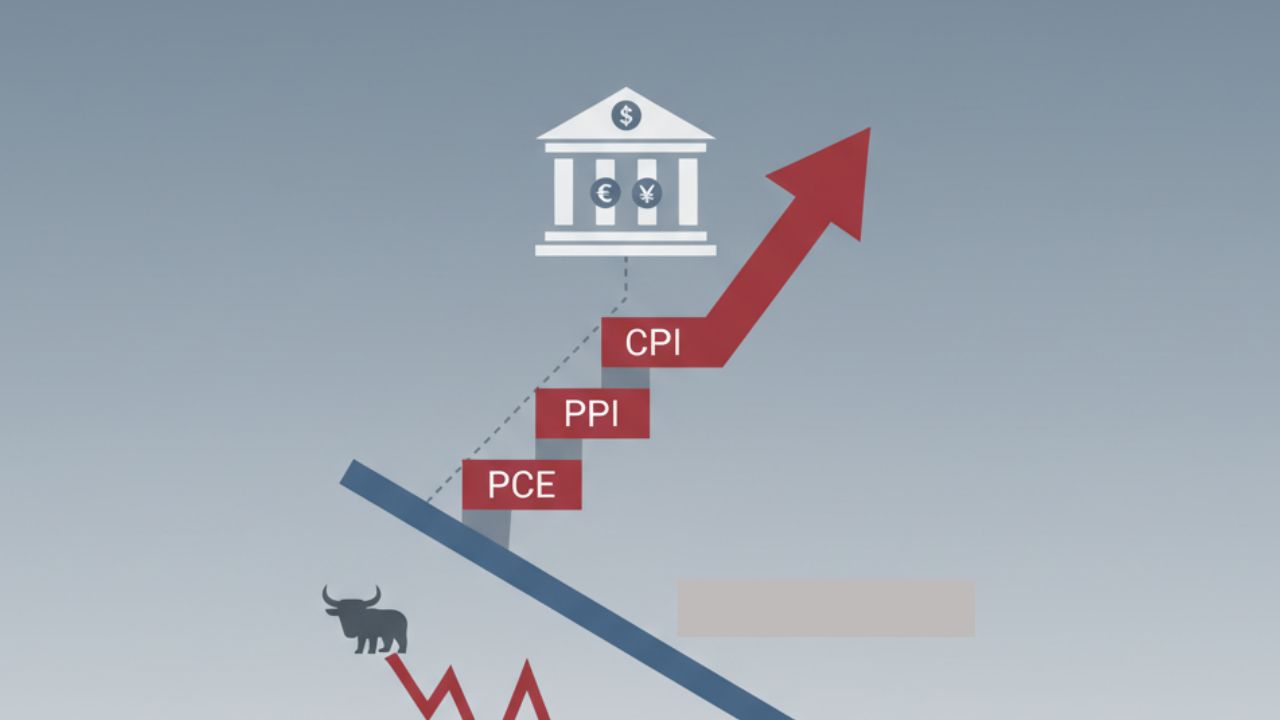
JPMorgan Offers New Callable Structured Notes Linked to Tech and Small-Cap Indexes – What Investors Should Know?

JPMorgan Chase Launches Auto-Callable Notes Tied to Tech and Small-Cap Performance

JPMorgan Chase has launched a new set of complex investment notes that promise attractive returns but also carry significant risks. These Auto Callable Accelerated Barrier Notes are linked to the Nasdaq-100 Technology Sector Index and the Russell 2000 Index. The product is designed for investors who are willing to take on equity-linked risk in exchange for the chance to earn a higher return than traditional fixed-income investments.

The notes do not pay interest. Instead, investors earn money only if certain market conditions are met on scheduled review dates. If both indexes are at or above their initial levels on any early review date, the notes are automatically called and the investor receives a fixed premium along with the full principal. The premium increases with each review date, which may look appealing for someone seeking enhanced yield in a rising market.

The structure becomes more complicated at maturity. If the notes are not called early and both indexes remain above a defined barrier level, the investor receives only the principal back. If both indexes rise above their initial levels, the investor can earn leveraged upside based on the weaker of the two indexes. But if either index closes below the barrier, the return becomes negative and the investorโ€™s loss matches the decline of the weaker index. In a severe downturn the loss can be substantial.

Products like these are sold as yield-enhancing opportunities, but they come with important trade-offs. The automatic call feature limits potential upside because the notes terminate early if markets make moderate gains. Investors also face the risk of losing principal in a market decline. Liquidity is limited because the notes are not listed on an exchange, and the price in the secondary market may be well below the original issue price. The investor also depends on the credit strength of JPMorgan Chase, since the product is not principal protected.

Although offerings of this type are common among large banks, they are not simple investments. They require investors to understand how barriers, leverage, and call features affect outcomes.

For most long-term investors, straightforward index funds or bonds may be easier to evaluate. However, investors who are comfortable with structured products and want targeted market exposure might find the new notes worth considering after reviewing the risk disclosures carefully.

This article is for informational purposes only and should not be considered financial advice. Investing in stocks, cryptocurrencies, or other assets involves risks, including the potential loss of principal. Always conduct your own research or consult a qualified financial advisor before making investment decisions. The author and publisher are not responsible for any financial losses incurred from actions based on this article. While efforts have been made to ensure accuracy, economic data and market conditions can change rapidly. The author and publisher do not guarantee the completeness or accuracy of the information and are not liable for any errors or omissions. Always verify data with primary sources before making decisions.

Inflation Explained – The Core Measures and Their Effect on the Stock Market

A Central Guide to Inflation - Understanding CPI, PPI, PCE, and Their Impact on the Stock Market

Inflation is one of the most discussed topics in economics because it directly affects our daily lives and the financial markets. From grocery prices to rent to fuel, inflation tells us how fast the cost of living is rising. But inflation also shapes how investors behave, how central banks act, and how the stock market moves. Economists use several key indicators like CPI, PPI, PCE, and others to understand how prices are changing across the economy.

This article will help you understand how these measures work, how they connect, and why they matter for the stock market.

What Is Inflation?

Inflation means the general increase in the prices of goods and services over time. When inflation rises, each unit of money buys fewer goods and services. A little inflation is normal and even healthy for an economy because it shows that people are spending and businesses are growing. However, when inflation rises too quickly, it reduces purchasing power and affects savings, wages, and investments. In the financial market, this change directly impacts how investors value companies and make decisions.

The Consumer Price Index (CPI)

The Consumer Price Index, or CPI, is one of the most popular measures of inflation. It tracks the average change in prices paid by consumers for a fixed basket of goods and services. This basket includes everyday items like food, clothing, housing, transportation, and healthcare. When the CPI rises, it means consumers are paying more for the same goods. Investors closely watch CPI data because a sharp rise can lead to higher interest rates. When rates go up, borrowing becomes expensive, which can reduce corporate profits and push stock prices lower.

The Producer Price Index (PPI)

The Producer Price Index, or PPI, focuses on price changes at the wholesale or producer level. It measures how much manufacturers and suppliers are charging retailers before the products reach consumers. When PPI increases, it signals that businesses are facing higher production costs. These costs often pass down to consumers later, causing CPI to rise. In market terms, a rising PPI can indicate inflationary pressure building up in the economy, which might make the Federal Reserve more likely to raise interest rates. Traders use PPI data to predict how future inflation might affect corporate margins and market direction.

The Personal Consumption Expenditures (PCE) Index

The PCE Index is another important inflation measure, widely used by the Federal Reserve in the United States. It reflects the average price changes of goods and services that households actually purchase, but with a broader scope than CPI. PCE adjusts more dynamically to changes in consumer behavior. For example, if beef prices rise sharply and people start buying chicken instead, PCE captures that switch, while CPI does not adjust as quickly. Since the Fed uses PCE as its preferred inflation gauge, its data often moves the markets instantly after release. A lower PCE reading usually boosts investor confidence, as it reduces the chances of immediate rate hikes.

The Wholesale Price Index (WPI)

The Wholesale Price Index, or WPI, measures price changes in goods at the wholesale stage before they reach the retail market. It covers commodities like food grains, metals, and fuel. WPI is especially important in countries like India, where wholesale prices often move faster than retail prices. Rising WPI may signal cost pressures on industries, which could hurt profit margins and affect stock valuations, particularly in manufacturing and raw material sectors.

Core Inflation

Core inflation removes volatile components like food and energy prices to show a clearer long-term inflation trend. These two categories can change sharply due to weather, political events, or supply issues. By excluding them, core inflation helps central banks understand the underlying or persistent part of inflation. For investors, stable or falling core inflation is usually a positive signal, as it suggests that price pressures are cooling and the central bank may keep rates steady or even cut them.

The GDP Deflator

The GDP Deflator measures the change in prices of all goods and services produced within an economy. Unlike CPI or PCE, it includes investment goods, government spending, and exports, giving a complete picture of inflation across the whole economy. It is broader and more comprehensive but updated less frequently. Analysts use it to compare nominal GDP (which includes inflation) with real GDP (which does not). A rising GDP Deflator suggests strong inflationary trends that might influence policy decisions and, in turn, market liquidity.

How These Measures Affect the Stock Market?

All these inflation indicators – CPI, PPI, PCE, WPI, Core Inflation, and the GDP Deflator – work together to shape market expectations. When inflation is high, central banks may raise interest rates to control it. Higher rates reduce liquidity in the financial system and make borrowing more expensive, often leading to stock market corrections. On the other hand, when inflation cools down, the market usually rallies because investors expect lower rates and higher future earnings.

Some sectors benefit during inflationary periods. For example, energy and commodity stocks often rise because their product prices increase. Meanwhile, technology and growth stocks usually underperform when inflation and rates are high, as their future earnings become less attractive in a high-yield environment.

How Inflation Hurts Stocks? – The relationship between inflation and stock prices follows a clear cause-and-effect path. When inflation starts to rise, producers face higher input costs, which push up wholesale prices measured by PPI or WPI. These higher costs gradually reach consumers, increasing CPI and PCE. As inflation stays high, central banks like the Federal Reserve respond by raising interest rates to slow down spending and borrowing. Higher interest rates make loans, mortgages, and business financing more expensive. This reduces corporate profits and consumer demand. Lower profits and weaker economic growth lead to declining investor confidence, triggering sell-offs in the stock market. Therefore, rising inflation indirectly causes market downturns through reduced earnings, tighter monetary policy, and shifting investor sentiment.

Also Read – Fed Interest Rates vs Gold Prices

Why It Matters

Understanding inflation helps investors make smarter decisions. Inflation data affects everything from bond yields to currency strength to equity valuations. Traders often adjust their portfolios based on upcoming CPI or PCE releases because these reports can cause strong short-term market reactions. Long-term investors use inflation trends to assess how their assets might perform in different economic cycles.

The Bottom Line

Inflation is not just about rising prices – itโ€™s about how the value of money changes over time and how that change shapes market behavior. The CPI tells us what consumers are paying, the PPI and WPI show what producers are charging, the PCE reveals how people are actually spending, Core Inflation highlights the stable trend, and the GDP Deflator provides the broadest view. Together, these measures help investors and policymakers understand the economyโ€™s direction. By keeping an eye on all of them, you can better understand how inflation trends influence interest rates, corporate profits, and the overall stock market performance.

This article is for informational purposes only and should not be considered financial advice. Investing in stocks, cryptocurrencies, or other assets involves risks, including the potential loss of principal. Always conduct your own research or consult a qualified financial advisor before making investment decisions. The author and publisher are not responsible for any financial losses incurred from actions based on this article. While efforts have been made to ensure accuracy, economic data and market conditions can change rapidly. The author and publisher do not guarantee the completeness or accuracy of the information and are not liable for any errors or omissions. Always verify data with primary sources before making decisions.

Understanding Open Interest and Its Connection with Price Movement

In futures trading, for every new contract created, thereโ€™s one buyer (long) and one seller (short). Thatโ€™s what forms 1 unit of open interest.

In futures and options trading, one of the most misunderstood terms is Open Interest. Many new traders look only at price movements, but smart traders also track open interest because it tells us how much interest or participation is building in a particular trend.

To truly understand market psychology, it is important to know what open interest means and how it interacts with price changes.


What Is Open Interest?

Open Interest, often written as OI, refers to the total number of active contracts that have not yet been settled.

Each contract involves two sides – one buyer who is going long and one seller who is going short.

So, when a new futures contract is created, both a long and a short position are formed at the same time. That means technically the number of bulls and bears is always equal in open interest.

However, what matters is not who is right at the moment but which side is stronger and more confident about the direction of the market. This confidence is what gets reflected through the price trend and the changes in open interest.

Also Read – What is Delta Based Open Interest?


The Role of โ€œInterestโ€ in Open Interest

The key word here is โ€œInterest.โ€

When open interest rises, it means more traders are entering the market and showing interest in that particular price move.

It is not just about the number of contracts, but about how many participants believe in the ongoing trend strongly enough to take new positions.

If the open interest is going up, it means new money is flowing into the market. More people want to participate. This adds strength to the current trend – whether it is upward or downward.


When Price and Open Interest Both Rise

Now imagine that the price of a futures contract is rising [When traders believe that the underlying assetโ€™s price (say gold, crude oil, or Nifty) will go up in the future, they rush to buy futures contracts now. This extra demand lifts the futures price.] and the open interest is also increasing.

What does that tell us? It means that more traders are opening new positions because they believe the price will continue to move higher.

In simple terms, bulls are getting stronger. They see the uptrend as a confirmation that the market may go even higher, so they want to lock in the current price.

By entering long positions in the futures market, they ensure that even if the asset price rises further, they have already secured a position at a relatively cheaper rate.

This rising open interest confirms that the buying conviction is strong and that the trend has real participation behind it, not just temporary movement.

The Other Side of the Coin – Short Sellers

But for every long position in the market, there is a short position. That means for every trader who believes prices will rise, there is another who believes prices will fall.

So, open interest alone does not tell us which side is winning. It only tells us that more people are becoming involved.

However, when we combine open interest with price movement, we can start to see the real story. If the price continues to rise despite equal numbers of long and short positions, it means bulls are overpowering the bears. The short sellers are getting squeezed, and their losses are adding more fuel to the upward momentum.


What Happens During a Downtrend?

The same logic applies during a fall in price. When the price is dropping and open interest is rising, it means more traders are entering the market expecting further decline. In that case, it is the bears who are showing conviction. They believe that the trend is strong enough to continue lower, so they take short positions confidently.

Just like in a rising market where bulls dominate, in this case, bears dominate the sentiment.

Rising open interest during a falling price indicates that traders are actively betting on the downside and that the selling pressure is supported by real participation, not just panic.


Falling Open Interest and Its Implications

If open interest starts to fall while the price is moving either up or down, it means traders are closing their positions.

The enthusiasm for that trend is weakening. If the price is rising but open interest is falling, it could mean that the rally is losing strength. Traders who were long may be taking profits, and fewer new participants are entering.

Similarly, if the price is falling and open interest drops, it means shorts are covering their positions, possibly expecting a reversal soon.

In short, falling open interest means lack of conviction, while rising open interest shows growing confidence in the current direction.


Let us connect the dots step by step. When traders expect prices to move in a particular direction, they enter new contracts. These new contracts increase open interest. As demand for these contracts rises, it influences the market price. If more buyers are eager, the price goes up. If more sellers are dominant, the price goes down. As the price continues to move in the same direction and open interest also rises, it confirms that new participants agree with that trend. The flow of fresh money strengthens momentum and extends the movement further. This is the causal effect of rising open interest on price trends – participation leads to momentum, and momentum attracts more participation, creating a reinforcing cycle until conviction begins to fade.


Final Understanding

So, to sum it up, open interest is not just a number. It is a reflection of how interested traders are in the current price direction.

When open interest rises along with price, bulls are in control and believe in further gains.

When open interest rises with a falling price, bears are confident and expect more downside.

Even though the number of long and short positions is always equal, it is the price action that reveals which side is dominating.

Understanding this relationship between price and open interest helps traders see the conviction behind every move, rather than just following the surface-level price change.

This article is for informational purposes only and should not be considered financial advice. Investing in stocks, cryptocurrencies, or other assets involves risks, including the potential loss of principal. Always conduct your own research or consult a qualified financial advisor before making investment decisions. The author and publisher are not responsible for any financial losses incurred from actions based on this article. While efforts have been made to ensure accuracy, economic data and market conditions can change rapidly. The author and publisher do not guarantee the completeness or accuracy of the information and are not liable for any errors or omissions. Always verify data with primary sources before making decisions.

How Central Banks Keep the Money Flowing Smoothly?

The recent large use of the U.S. central bankโ€™s standing repo facility and injections of roughly tens of billions of dollars in early November 2025 are reported by Reuters and by coverage noting a $29.4 billion infusion and record SRF usage.

Most people do not see what happens behind the scenes when money moves in an economy.

Central banks do more than issue currency. They also make sure banks have enough short-term cash to do their daily work. When the system faces a cash shortage the central bank can step in. This article explains how that works in simple words for readers who are not experts.

What is liquidity and Why it matters?

Liquidity means how easily cash moves in the financial system.

  • High liquidity means banks can lend and businesses can borrow without trouble.
  • Low liquidity means cash is hard to find.

When cash becomes scarce short-term interest rates can rise fast. Higher rates make borrowing expensive. That can slow down business activity. It can also cause worry in markets. If the problem grows it can stop lending and cause a wider financial problem.

The main tools central banks use

One common tool is a repo operation. In a repo the central bank lends cash to a bank for a short time. The bank gives government bonds or similar securities as collateral. After a short time the bank pays back the cash and gets its securities back. This is a temporary way to add cash to the banking system.

A related tool is called reverse repo. In a reverse repo the central bank takes cash out of the system. Banks lend cash to the central bank and earn a small return. Reverse repo helps manage excess cash and keeps short-term rates from falling too low.

Standing facilities are ready made windows the central bank can use every day. These are useful when banks face surprise shortages or when markets are volatile. Standing facilities make the response fast and predictable.

How the Process Works?

When banks need short-term cash they borrow in money markets. If many banks need cash at the same time the supply of cash falls. This shortage pushes up short-term borrowing costs. As borrowing gets expensive banks may stop lending to each other. They may also reduce lending to businesses and households. That is the start of a chain reaction that can slow economic activity.

To stop this chain the central bank injects liquidity. It does this through repo operations open market bond purchases swap auctions or standing repo facilities. When the central bank lends cash the supply of money in the system rises. More cash brings short-term rates down. Banks feel safer. They return to normal lending. Businesses get credit. Markets calm down. This is the simple causal path from a central bank action to a stable market.

Repo and Reverse Repo in simple terms

Repo means repurchase agreement. A bank sells a government bond to the central bank and agrees to buy it back soon. The central bank gives cash in return. This is like a short-term loan secured by the bond.

Reverse repo is the opposite. A bank gives cash to the central bank and receives a bond. The bank gets its cash back later with a small return. Reverse repo drains the extra cash from the market.

Both tools help to control short-term interest rates. When a central bank wants to ease stress it injects cash with repo operations. When it wants to cool down excessive cash it uses reverse repo.

Real examples from recent news

A recent example comes from the United States. The central bank there used its standing repo facility to add tens of billions of dollars of short term cash to the banking system during a period of heavy month end and market stress. This action helped lower short-term repo rates and gave banks the cash they needed to manage reserves. The move was temporary and meant to calm short-term funding pressures while the central bank watched how conditions evolved.

India also saw large liquidity measures. The countryโ€™s central bank announced a package of operations in early 2025 to add durable liquidity. These steps included buying government bonds running variable tenor repo operations and holding foreign exchange swap auctions. The goal was to ease a noticeable liquidity shortfall in the banking system. As a result banks had more rupee cash to meet daily needs and market functioning improved.

Also Read – Fed Interest Rates vs Gold Prices

Why these moves matter to ordinary people

These operations may sound technical but they affect everyone. When banks have enough short-term cash they continue to lend to businesses and households. That keeps jobs safe and helps companies invest and grow. Stable short-term interest rates mean loans and mortgages do not suddenly become much more expensive.

If central banks did not act a small cash shortage could become a larger problem. Banks might stop lending. Markets could become volatile. Businesses might delay investment and hiring. Consumers could face higher borrowing costs. By acting quickly central banks try to prevent these negative outcomes.

The limits and the balance central banks face

Central banks do not add cash without thinking. Too much liquidity for a long time can fuel inflation. That is why many of these operations are temporary. Central banks monitor markets and use other tools such as reserve requirements and policy rates to keep a balance. The aim is to provide enough short term cash to avoid a freeze while avoiding excess liquidity that would harm price stability.

Final thoughts

The basic idea is simple. Central banks watch the flow of cash in the financial system. When cash runs low they lend through repo or similar tools to restore balance. When there is too much cash they use reverse repo to remove it. These quiet actions keep the economy functioning and protect people from sudden shocks.

Understanding this process helps readers see why central banks act even when the news seems calm. These steps are not about changing long term policy in most cases. They are targeted actions to ensure that the system has what it needs to operate smoothly.

If you want I can make this article SEO friendly. I can also tailor it for social posts or a simple script for a short video.

This article is for informational purposes only and should not be considered financial advice. Investing in stocks, cryptocurrencies, or other assets involves risks, including the potential loss of principal. Always conduct your own research or consult a qualified financial advisor before making investment decisions. The author and publisher are not responsible for any financial losses incurred from actions based on this article. While efforts have been made to ensure accuracy, economic data and market conditions can change rapidly. The author and publisher do not guarantee the completeness or accuracy of the information and are not liable for any errors or omissions. Always verify data with primary sources before making decisions.

Enterprise Value Explained for a Beginner

Understanding Enterprise Value: The Complete Picture of a Company's Worth

Enterprise value shows what it would cost to buy the whole business by accounting for debt and cash, while market capitalisation shows only the value of the companyโ€™s equity based on its share price and shares outstanding.

Enterprise value is often the better method for comparing companies because it includes obligations and resources that equity-only market cap ignores.โ€‹

What is enterprise value?

Enterprise value is a companyโ€™s total value to all capital providers, calculated as

Enterprise Value = Marketย Cap + Totalย Debt โˆ’ Cashย andย Cashย Equivalents

Debt is added because a buyer must assume or repay it, and cash is subtracted because the acquirer gets that cash at closing, lowering the effective purchase price of the business.

EV is widely used in mergers and acquisitions because it reflects the approximate price to acquire the operating business irrespective of how it is financed today.โ€‹

Market capitalisation in plain words

Market capitalisation is the current share price multiplied by total shares outstanding, so it reflects only what equity holders are worth at todayโ€™s market price.

It is a quick way to size a company but it ignores the balance sheetโ€™s debt burden and cash cushion, which can dramatically change the economics of owning the whole business. Because market cap is equity-only, it can mislead comparisons between firms with very different leverage or cash levels.โ€‹

Enterprise Value vs Market Capitalisation

AspectEnterprise valueMarket capitalisation
What it measuresValue of the operating business owed to both debt and equity holdersโ€‹Value of equity only based on share price times sharesโ€‹
Includes debt?Yes, adds total debtโ€‹No, excludes debtโ€‹
Includes cash?Subtracts cash and equivalentsโ€‹No, excludes cashโ€‹
Perspectiveโ€œWhole companyโ€ value, independent of financing structure for comparison purposesโ€‹Equity-holder perspective onlyโ€‹
Common usesM&A pricing, EV/EBITDA and EV/Sales comparablesโ€‹Quick size ranking, equity-focused ratios like P/E โ€‹
Can it be negative?Yes, if cash exceeds debt plus market capโ€‹No, cannot be negative by definitionโ€‹

Also Read – What is the P/E ratio in simple terms? โ€“ 6 Important Points To Know

Why add debt and subtract cash?

Debt increases EV because an acquirer must take responsibility for repaying lenders, so the โ€œall-inโ€ cost of owning the business rises by that amount.

Cash decreases EV because the buyer receives the targetโ€™s cash at closing, which offsets part of the purchase price and lowers the net cost to own the business. This is why EV is often closer to a true takeover price than market cap alone.โ€‹

Scenarios and causal effects

  • High debt, low cash: Suppose two companies have the same market cap, but one carries heavy debt and little cash; EV will be much higher for the leveraged firm because EV\text{EV}EV rises with debt, signaling a larger all-in obligation for a buyer and often a higher risk profile. In such cases, valuation multiples like EV/EBITDA can expose how leverage changes the โ€œtrue costโ€ of cash flows vs a debt-free peer even when market caps look similar.โ€‹
  • Large cash pile, little or no debt: A company with substantial net cash will have EV below market cap, and in extreme cases EV can even turn negative when cash exceeds debt plus market cap, indicating the market values the operating business at less than its cash holdings. This situation can occur in cash-rich sectors or after asset sales, and it calls for deeper analysis of why the market discounts the operations so steeply.โ€‹
  • Share price jumps, balance sheet unchanged: If the share price rises, market cap rises one-for-one, so EV rises too, but only by the change in market cap because net debt is the same, keeping the difference between EV and market cap unchanged in the short term. This shows how EV and market cap can move together on price action, while their gap reflects balance sheet structure.โ€‹
  • Debt paydown from free cash flow: When a company uses cash to reduce debt, net debt falls, so EV\text{EV}EV declines even if market cap has not yet reacted, compressing EV-based multiples like EV/EBITDA and potentially setting up an equity re-rating if operating performance is steady. EVโ€™s sensitivity to net debt makes balance sheet progress visible in valuation even before the stock price catches up.โ€‹
  • Debt-funded buybacks: Issuing debt to repurchase shares can lift the share price and market cap, but EV often rises more because debt increases and cash decreases, pushing EV\text{EV}EV higher by the net change in debt minus cash. This illustrates that financial engineering can boost equity value while making the whole enterprise more leveraged, which EV will reveal directly.โ€‹
  • Acquisition using cash and new debt: For the acquirer, taking on debt and spending cash to buy a target increases EV because debt goes up and cash goes down, while for the target, EV approximates the price a buyer must pay regardless of how that price is financed. EVโ€™s โ€œcapital-structure neutralโ€ lens lets analysts compare pre- and post-deal business value without confusing equity-only effects.โ€‹
  • Two similar hotels, different leverage: If Hotel A has a lower market cap than Hotel B but carries significant debt, its EV can exceed Bโ€™s EV, making B the cheaper whole-business purchase despite Aโ€™s lower equity price, as illustrated in classic comparisons of like-for-like assets. Investors using EV/EBITDA on both hotels would see the leveraged one screen more expensively once debt is considered, even if market caps suggest the opposite.โ€‹

How professionals use EV?

EV enables apples-to-apples comparisons across firms with different debt and cash by pairing it with operating metrics like EBITDA and revenue in ratios such as EV/EBITDA and EV/Sales. Because it aims to reflect the business value independent of todayโ€™s financing mix, EV is a primary tool in comparable company analysis and M&A valuation work.โ€‹

Practical takeaways

Always check EV alongside market cap so you see both the equity marketโ€™s view and the all-in value including debt and cash.

Use EV-based multiples to compare companies with different leverage, and remember that big cash balances lower EV while big debts raise it, sometimes flipping conclusions you would draw from market cap alone.

Negative EV usually flags a large net cash position and a market thatโ€™s discounting the operating business, which merits deeper due diligence rather than a snap judgment.

For M&A, EV is closer to what a buyer actually pays for operations, so it belongs at the center of any whole-business valuation discussion.โ€‹

This article is for informational purposes only and should not be considered financial advice. Investing in stocks, cryptocurrencies, or other assets involves risks, including the potential loss of principal. Always conduct your own research or consult a qualified financial advisor before making investment decisions. The author and publisher are not responsible for any financial losses incurred from actions based on this article. While efforts have been made to ensure accuracy, economic data and market conditions can change rapidly. The author and publisher do not guarantee the completeness or accuracy of the information and are not liable for any errors or omissions. Always verify data with primary sources before making decisions.
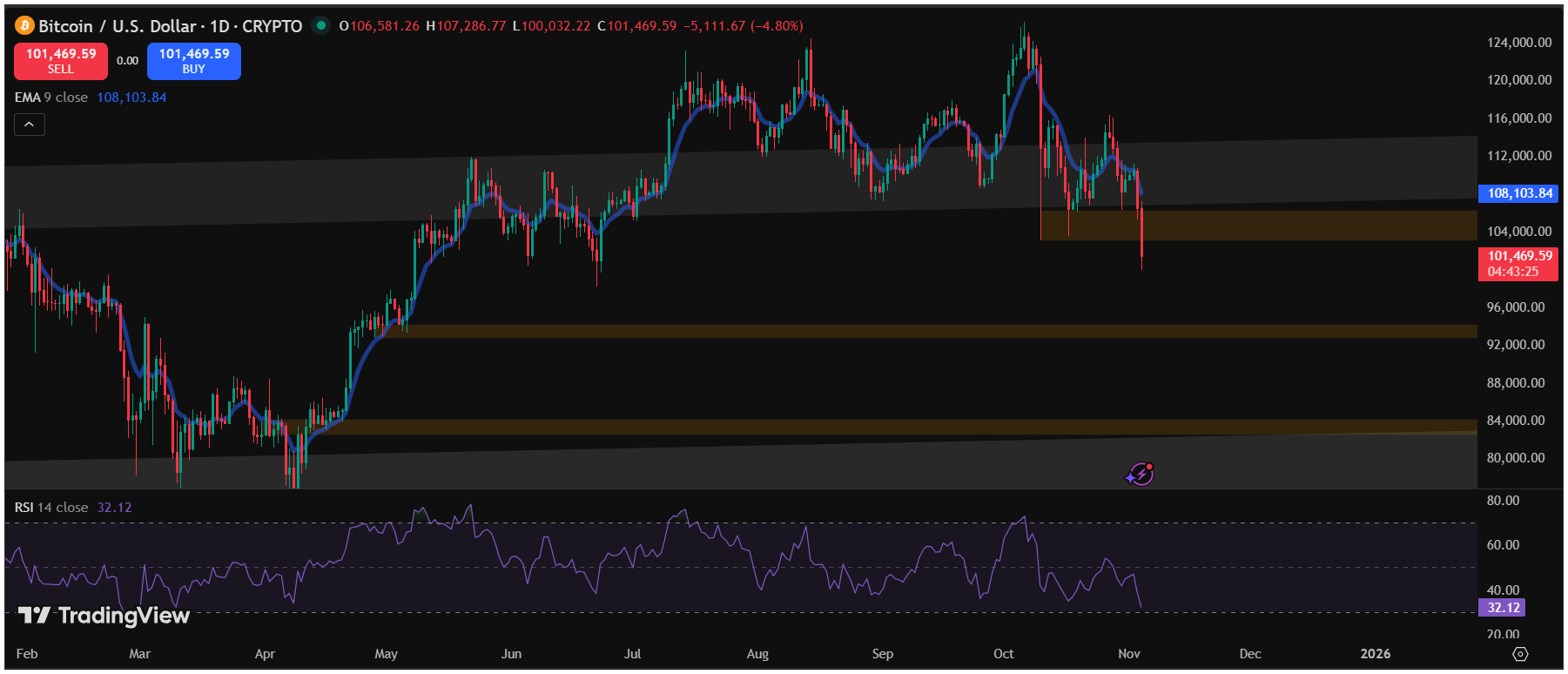
From All-Time High to 20% Down โ€“ 5 Real Reasons Behind Bitcoinโ€™s Sudden Fall

why is bitcoin dropping

Bitcoin is trading around $100,032 after many months since June 2025. It is currently tumbling from its all-time high. From a peak of roughly $1,260,230, the price has fallen about 20.75% at the time of writing.

Letโ€™s look at five major reasons behind this drop โ€” and whatโ€™s really happening beneath the charts and headlines.


1. Institutional Demand Weakening

One strong reason is that big investors and institutions are stepping back. Spot Bitcoin ETFs have recorded significant outflows recently. Sales from such funds mean fewer big-money buyers backing Bitcoin, which takes away a key support.

When the โ€œbig guysโ€ reduce exposure, that creates fear among smaller investors and can trigger a cascade of selling.


2. Macro-/Monetary Policy Headwinds

Another major reason is the stance of the central banks and global economic conditions. The Federal Reserve (Fed) signalled that further rate cuts arenโ€™t guaranteed, and the U.S. dollar is firming. That makes risky assets like Bitcoin less attractive.

Also, macro uncertainty – trade tensions, inflation concerns – adds risk-off mood to markets. When people are worried, they shift out of speculative assets.

Also Read – Circle Internet Group Monthly Outlook- November 2025 Technical Analysis


3. Technical Breakdown

On the technical side, Bitcoin is trading well below the 9 EMA across major timeframes like monthly, weekly, and daily – signaling strong bearish momentum. If selling dominance continues, Bitcoin may crash further toward the $84,000โ€“$82,500 zone, which acts as the next major support area. In the short term, support lies around $93,000โ€“$94,000, while resistance levels are seen near $103,000 and $106,000. The RSI on the daily timeframe is around 32, indicating an oversold zone, which aligns with the short-term support area.


4. Profit-Taking After a Big Rally

Bitcoinโ€™s recent run up created a lot of gains for holders. With prices high and some uncertainty creeping in, many of them chose to book profits – that is sell to lock in gains. This sort of behaviour often comes after strong rallies.

When lots of people do this around the same time, it adds to downward pressure.


5. Leveraged Positions & Liquidations

Finally: there were large liquidations of leveraged positions (traders using borrowed money to bet). When price starts dropping and leveraged bets go bust, those forced sells push price down further.

This is like a domino effect: a drop triggers liquidations which trigger more drop.


Conclusion

So in short: Bitcoinโ€™s drop is not due to one factor but a mix of weaker institutional demand, less favourable macro/monetary backdrop, chart breakdowns, profit-taking, and leveraged liquidations.

Also Read – 3 Important Differences Between Cryptography and Blockchain

This article is for informational purposes only and should not be considered financial advice. Investing in stocks, cryptocurrencies, or other assets involves risks, including the potential loss of principal. Always conduct your own research or consult a qualified financial advisor before making investment decisions. The author and publisher are not responsible for any financial losses incurred from actions based on this article. While efforts have been made to ensure accuracy, economic data and market conditions can change rapidly. The author and publisher do not guarantee the completeness or accuracy of the information and are not liable for any errors or omissions. Always verify data with primary sources before making decisions.
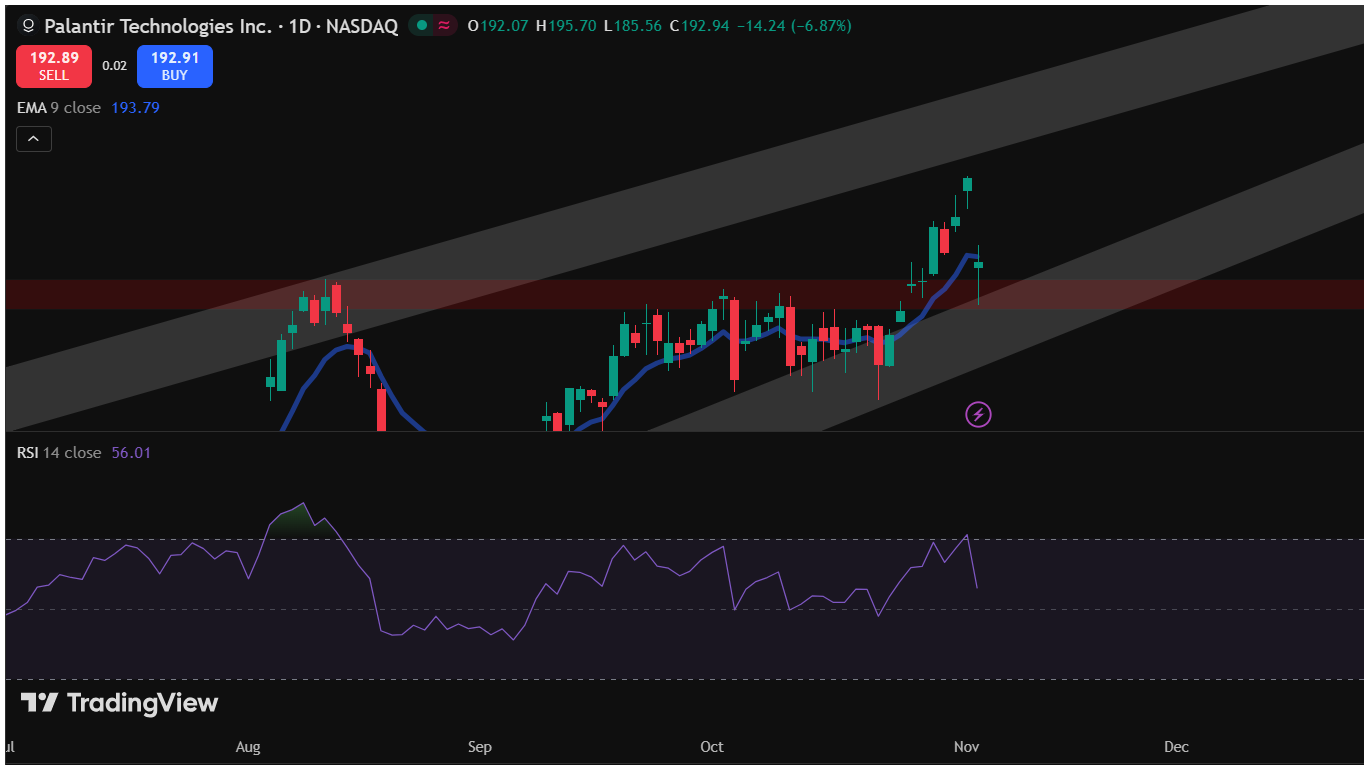
6 Reasons Palantir (PLTR) Is Soaring โ€“ Technical Analysis for November 2025

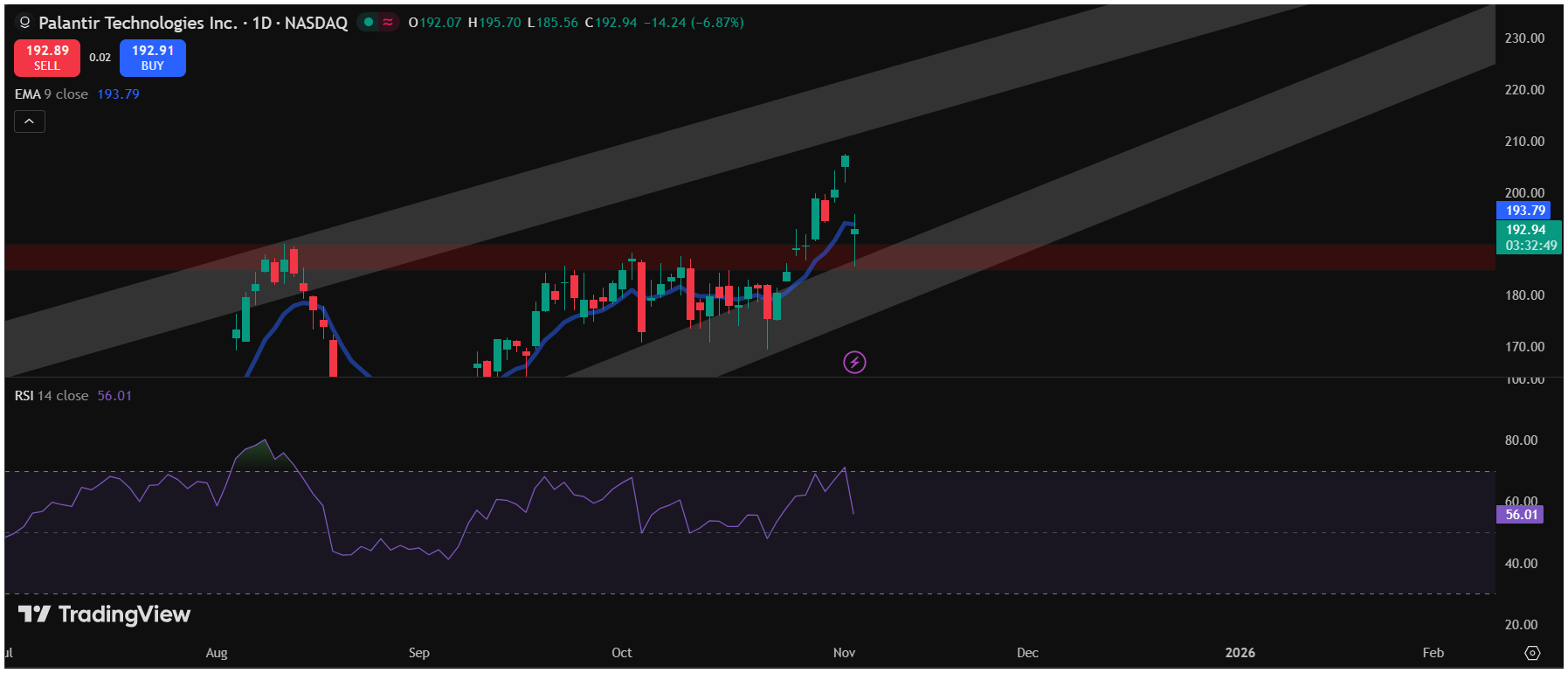
PLTR stock chart - daily time frame

Palantir Technologies (ticker: PLTR) has been on a powerful upward run, drawing strong attention from both retail and institutional investors. The stockโ€™s rally isnโ€™t just a product of hype – itโ€™s backed by solid business developments, expanding contracts, and a decisive technical breakout.

Letโ€™s break down the six major reasons why Palantir is soaring in November 2025, with both fundamental and technical insights.


1. Revenue Explosion in U.S. Commercial Business

Palantirโ€™s U.S. commercial segment jumped 121% year-over-year to US$397 million, with a 29% sequential growth. Moreover, the companyโ€™s remaining performance obligations (RPO) surged by 66% to US$2.6 billion, signaling a robust pipeline of future revenue.


2. Q2 2025 Revenue Up 48% and Full-Year Outlook Raised

Palantirโ€™s Q2 results stunned the market with 48% year-over-year growth, pushing quarterly revenue past US$1 billion. The company also raised its full-year revenue outlook to US$4.14โ€“4.15 billion, up from the previous guidance of around US$3.91 billion.


3. U.S. Army Enterprise Agreement Worth Up to US$10 Billion

A massive win came when Palantir secured a U.S. Army enterprise contract valued up to US$10 billion over 10 years. This agreement consolidates several previous deals into a single, scalable framework.

4. Strategic Partnership in Nuclear Energy Sector

Palantir recently partnered with The Nuclear Company to develop and deploy NOS, an AI-driven real-time software system designed for nuclear plant construction and operations. The announcement pushed PLTR shares to record highs.


5. NATO Acquisition of Palantirโ€™s Maven Smart System

In a major milestone, NATO acquired Palantirโ€™s Maven Smart System, an advanced AI platform designed for defense intelligence and decision-making. The deal was completed in just six months, which is unusually fast for defense procurement.


6. Technical Breakout Above the 184โ€“190 Resistance Zone

Beyond the fundamentals, technical indicators confirm bullish momentum. PLTR has broken out above the 184โ€“190 resistance zone, which had previously acted as a strong supply area. Post-breakout, the stock has sustained higher highs and strong volume confirmation, signaling institutional buying.

PLTR - Daily TF

The breakout above the 184โ€“190 range represents a shift from accumulation to expansion.

Also Read – 3 Important Differences Between Cryptography and Blockchain

Technical Analysis for November 2025

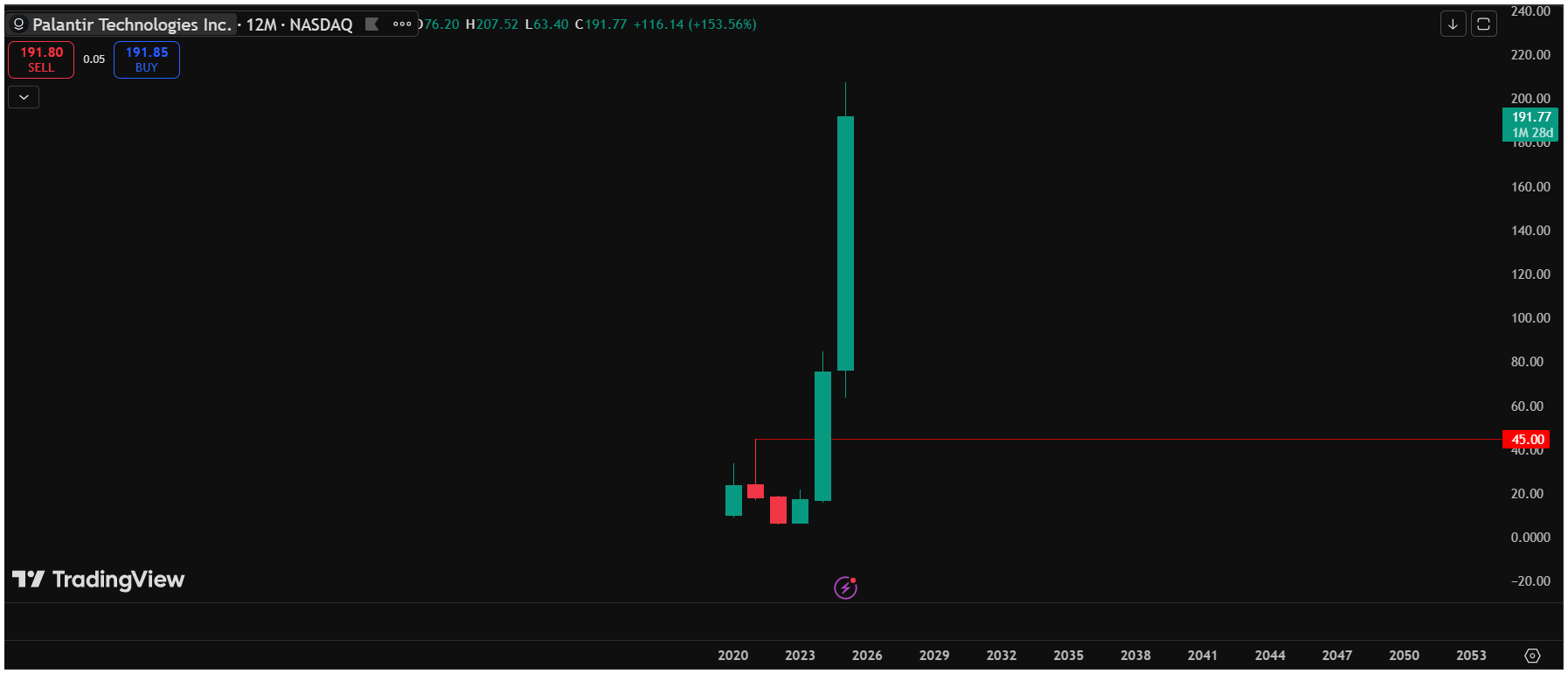
Palantir has been in a strong bull run since 2023, and the long-term chart continues to reflect this steady momentum.

PLTR Yearly Chart

If we analyze the yearly trend, itโ€™s clear that the stock has maintained higher highs and higher lows, supported by sustained institutional demand. However, for the ongoing rally to stay healthy, a retracement may be necessary – allowing bulls to accumulate at more efficient buying zones below current levels.


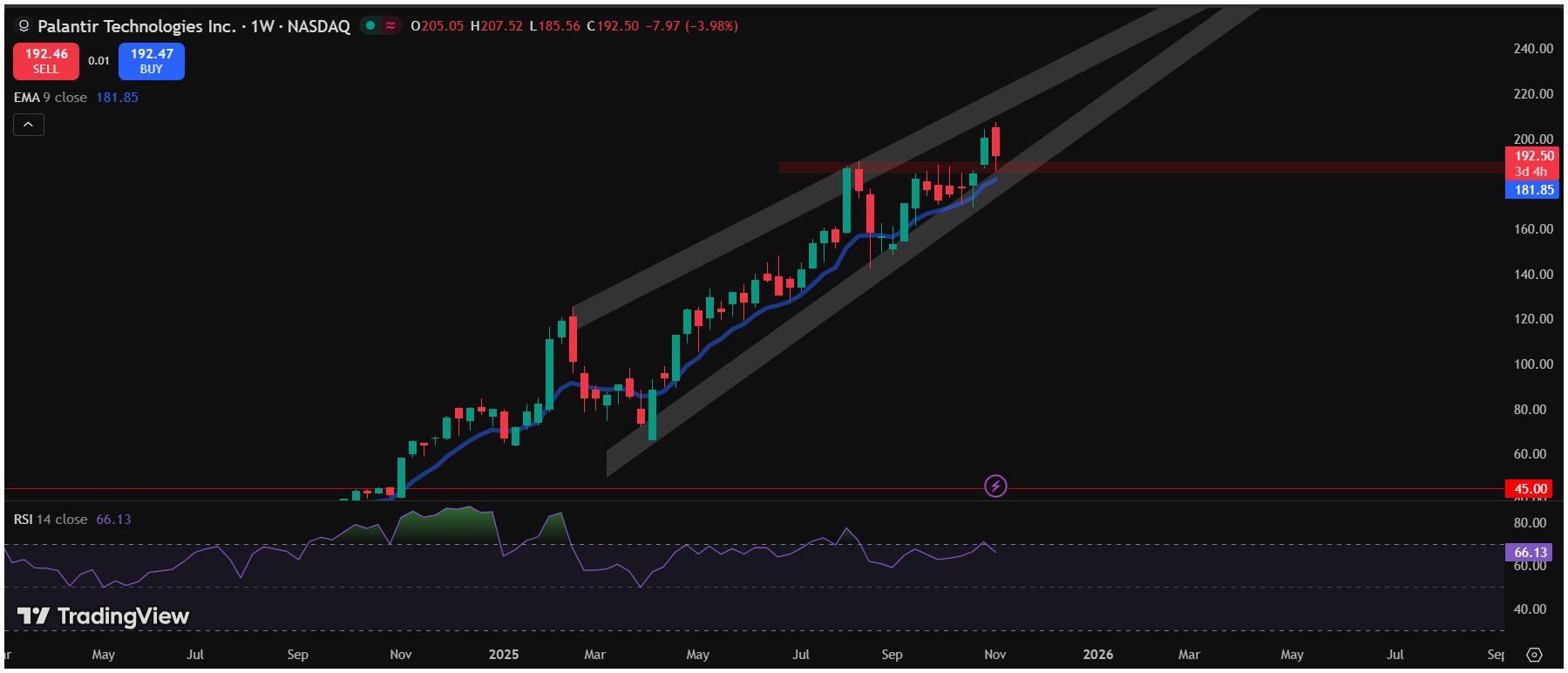
  • Timeframe: 1 Week (Weekly Candles)

Palantirโ€™s price action shows a clear long-term uptrend within a rising parallel channel. Both the upper and lower boundaries of this channel have been well respected for several months, confirming a disciplined bullish structure.

  • The current weekly candle shows some bearish pressure near the upper boundary, signaling mild profit booking or short-term exhaustion. Despite the pause, the broader trend remains decisively upward.

As of writing, PLTR is trading above the 9 EMA on the weekly timeframe.

In summary, Palantir continues to trade within a structurally bullish channel, but minor corrections are expected as part of normal trend behavior.


Support & Resistance Levels

Level TypeZone (USD)Technical Context
Immediate Resistance$205โ€“$210Upper trendline + recent rejection zone
Immediate Support$180โ€“$185Midline support + EMA confluence
Major Channel Support$160โ€“$165Lower channel trendline (long-term support)

These levels indicate that any retracement toward $180โ€“$185 could present a high-probability accumulation area, as it aligns with both the mid-channel and the dynamic EMA zone.

A weekly close below the EMA could trigger a short-term correction, possibly toward the midline of the channel around $180.

Also Read – Circle Internet Group Monthly Outlook- November 2025 Technical Analysis

This article is for informational purposes only and should not be considered financial advice. Investing in stocks, cryptocurrencies, or other assets involves risks, including the potential loss of principal. Always conduct your own research or consult a qualified financial advisor before making investment decisions. The author and publisher are not responsible for any financial losses incurred from actions based on this article. While efforts have been made to ensure accuracy, economic data and market conditions can change rapidly. The author and publisher do not guarantee the completeness or accuracy of the information and are not liable for any errors or omissions. Always verify data with primary sources before making decisions.