With over 3 years of experience in financial markets, we focus on simplifying global and Indian markets through clear, practical insights. Our expertise also extends to the evolving landscape of digital finance, including blockchain, stablecoins, and decentralized finance (DeFi).
The U.S. financial markets are heating up fast as we step into 2025, with two powerful trends leading the charge—cryptocurrency ETFs and artificial intelligence (AI) stocks. Backed by fresh data and shifting market dynamics, these sectors are making headlines. Here’s what you need to know if you’re looking to ride the wave and make smart investment choices.
Crypto ETFs: Catching the Digital Wave
Crypto ETFs are on fire right now, thanks to the 2024 approval of spot Bitcoin and Ethereum ETFs. By May 2025, Bitcoin ETFs alone have gathered a massive $108 billion in assets. BlackRock’s iShares Bitcoin Trust (IBIT) stands out, pulling in $33 billion in inflows just in 2024. With Bitcoin now hitting a $2 trillion market cap, it’s become the sixth most valuable asset globally. Yet, compared to traditional markets, it still has plenty of room to grow.
Posts across social media show that there’s a supply crunch brewing—more than 1 million BTC is locked in ETFs, and sovereign purchases are drying up liquidity. According to analysts at VanEck, Bitcoin could hit $180,000 by early 2025. Ethereum might even cross the $6,000 mark. Still, experts warn that altcoin ETFs, like Solana and XRP, may not attract the same level of interest. These are expected to pull in around $3-8 billion, far less than Bitcoin.
If you’re thinking of investing, it’s best to limit your crypto exposure to just 5-10% of your portfolio. That way, you can take part in the growth without getting overwhelmed by the risk and volatility that crypto often brings.
AI Stocks: Fueling the Future
AI stocks are still one of the strongest players in the market. Nvidia is leading the way with a 69% jump in sales, all thanks to massive demand for its AI chips. Broadcom and Palantir are also making waves, providing the tech and software needed to support AI’s rapid expansion.
But it’s not all smooth sailing. As of May 2025, the S&P 500 tech sector is down 1.7% year-to-date. Nvidia is down 3.3%, with U.S.-China tensions and supply chain issues creating hurdles. Surprisingly, industrial and utility companies like Vertiv are stepping into the spotlight. They’re playing a key role in building the infrastructure needed to support AI’s growing demand for data centers.
Big firms like Amazon and Microsoft are expected to spend $75 to $100 billion this year on AI infrastructure. This could benefit sectors that often go unnoticed. AI-focused ETFs like the Roundhill Generative AI & Technology ETF (CHAT) are up 31% in 2024, giving investors a simple way to tap into the AI boom without picking individual stocks.
Market Dynamics: Tariffs, Rates, and Uncertainty
After breaking more than 50 records in 2024, the S&P 500 hit a speed bump in 2025. It entered correction territory in March, soon after former President Trump announced steep new tariffs—50% on EU imports and 46% on goods from Vietnam. The index closed at 5,560.83 on April 30, showing a slight gain of 0.58% for the day but still down for the year.
Q1 earnings looked solid, with growth at 13.6%, beating the 8% forecast. But there’s a cloud over the rest of the year—about 56% of companies have shared guidance below market expectations. On the interest rate front, the Federal Reserve’s latest update shows they’re planning just two rate cuts in 2025, down from the three they mentioned earlier. The federal funds rate now stands between 4.25% and 4.50%. Meanwhile, Treasury yields are moving up as inflation sticks close to 3.8%.
What Should Investors Do Next?
As inflation fears rise because of tariffs, it might be smart to look at dividend-paying ETFs like the Vanguard Dividend Appreciation ETF (VIG). TIPS ETFs like the iShares TIPS Bond ETF (TIP) can also help protect your money from inflation. If rates go lower, small-cap stocks and housing-related companies could see a boost. Financials might benefit too, especially if deregulation picks up—watch for funds like the Financial Select Sector SPDR Fund (XLF).
The key message? Stay diversified. Index funds like SPY give you broad exposure to the market without having to guess which sector will win. And don’t go it alone—talk to a financial advisor before making big moves in this fast-changing market.
Disclaimer: All investments come with risks. Always do your own research and talk to a qualified financial advisor before investing.
With over 3 years of experience in financial markets, we focus on simplifying global and Indian markets through clear, practical insights. Our expertise also extends to the evolving landscape of digital finance, including blockchain, stablecoins, and decentralized finance (DeFi).
If you’re new to trading, the term “OI spurt” might seem like jargon from a complex world. Don’t worry—let’s break it down into simple, digestible pieces so you can understand and use it effectively in your trading journey.
Table of Contents
What “OI Spurts” Means?
The term spurt means a sudden or quick increase.
An “OI spurt” refers to a sudden, sharp increase in Open Interest (OI) for a stock’s futures or options contracts. It’s like a flashing neon sign in the market, signaling that traders are placing aggressive new bets on where a stock’s price is headed next. This surge in activity often hints at potential volatility or significant price movements, making it a key indicator for traders to watch.
Understanding the Key Terms
Open Interest (OI) Open Interest (OI) is the total number of active, unsettled futures or options contracts for a stock. These contracts represent “live bets” that traders have placed on the stock’s future price, which haven’t yet been closed, exercised, or expired. When traders open new positions—whether buying or selling a contract—OI increases. When they close their positions (e.g., by offsetting or exercising the contract), OI decreases. In essence, OI shows how many contracts are still “in play” in the market, reflecting the level of trader commitment.
Spurts A “spurt” is a rapid, explosive increase, like water bursting from a hose or a runner sprinting off the starting line. In trading, an OI spurt occurs when the number of open contracts jumps dramatically—typically by 20% to 50% or more—within a short timeframe, such as a few hours or a single trading day. Unlike gradual increases over weeks, an OI spurt is sudden and significant, grabbing the attention of traders looking for market action.
In short: An OI spurt is a rapid surge in active futures or options contracts, indicating fresh bets on a stock’s future price movement.
Why OI Spurts Matter?
OI spurts act like a market alarm, alerting traders to a wave of new activity. They often suggest that big players—like institutional investors, hedge funds, or large traders—are entering the market with strong conviction, opening substantial new positions. This influx of activity can lead to increased volatility and the potential for significant price swings.
While an OI spurt doesn’t guarantee a price move, it’s a clue that something big might be brewing, especially when paired with other market signals like price trends or news events.
How to Read OI Spurts?
To make sense of an OI spurt, follow these three straightforward steps:
Step 1: Confirm the Spurt First, verify that the OI increase qualifies as a “spurt.” Look for:
Magnitude: A sharp rise in OI, typically 20–100% in a single day. For highly liquid stocks, even a 10–20% jump can be notable, while less liquid stocks may need a larger surge (e.g., 50%+) to stand out.
Timeframe: The increase happens quickly—within hours or a single trading session, not spread over days or weeks.
Step 2: Combine with Price Action OI alone doesn’t tell you whether the price will go up or down. You need to pair it with the stock’s price movement to understand trader sentiment:
OI ↑ + Stock Price ↑: Traders are opening new long positions, betting the stock price will rise (bullish sentiment).
OI ↑ + Stock Price ↓: Traders are opening new short positions, betting the stock price will fall (bearish sentiment).
OI ↓ (No Spurt): Traders are closing existing positions, which is less significant for predicting future price moves.
Step 3: Add Volume for Confirmation Trading volume—the total number of shares or contracts traded in a day—helps confirm the strength of an OI spurt:
High Volume + OI Spurt: Indicates strong new interest and a reliable signal of potential price movement.
Low Volume + OI Spurt: May be less impactful but can still be significant if driven by major news (e.g., earnings reports, mergers) or in less liquid stocks. Always check for external factors like market events or company announcements to validate the spurt’s importance.
OI Spurts vs. Volume: Don’t Mix Them Up!
It’s easy to confuse OI with trading volume, but they’re distinct:
Volume: Measures the total number of shares or contracts traded in a day (e.g., 1 million shares traded). Think of it as “how many pizzas were sold at a shop today.”
Open Interest (OI): Counts the number of contracts still open at the end of the day (e.g., 50,000 unsettled futures or options contracts). It’s like “how many pizza orders are still active and haven’t been delivered or canceled.” An OI spurt is a sudden spike in these “active orders,” signaling fresh market activity, whereas volume reflects the overall trading frenzy in a day.
Tips for Beginners
OI spurts are powerful, but they’re not a standalone signal. Here’s how to use them wisely:
Never trade on OI alone. Always cross-check with:
Price trend: Is the stock rising, falling, or consolidating?
News and events: Look for catalysts like earnings reports, mergers, sector trends, or macroeconomic events (e.g., RBI policy changes in India).
Market context: OI spurts during major events (e.g., budget announcements) are more significant than those on quiet days.
Focus on large-cap stocks like Reliance Industries, Infosys, or HDFC Bank. These stocks have higher trading volume and more reliable OI data compared to smaller, less liquid stocks.
Start with near-the-money (NTM) or at-the-money (ATM) options, as these typically have higher OI and liquidity, making spurts easier to interpret.
Use end-of-day OI data for clearer signals. Intraday OI can be noisy and less reliable due to fluctuating activity.
Leverage free tools to track OI:
NSE India’s Option Chain: Shows real-time OI for options and futures (nseindia.com).
Moneycontrol: Offers OI data and market news (moneycontrol.com).
Trading platforms: Tools like Zerodha’s Kite or Sensibull provide user-friendly OI visuals for Indian markets.
The Bottom Line
An OI spurt is a surge in active futures or options contracts, signaling heightened trader interest and potential for volatility in a stock’s price. For new traders, spotting OI spurts and combining them with price action, trading volume, and news can unlock valuable insights into market sentiment. However, it’s not a magic crystal ball—it’s one tool in your trading toolbox. Pair it with technical analysis (e.g., support/resistance levels) and fundamental research (e.g., company performance) to make informed decisions. With practice, you’ll learn to decode OI spurts and use them to navigate the exciting, fast-paced world of trading.
With over 3 years of experience in financial markets, we focus on simplifying global and Indian markets through clear, practical insights. Our expertise also extends to the evolving landscape of digital finance, including blockchain, stablecoins, and decentralized finance (DeFi).
The long-time JPMorgan Chase chairman and CEO, Jamie Dimon (CEO since 2005), has been one of the finance world’s most outspoken critics of Bitcoin.
A Wall Street legend worth about $2.5 billion, he’s alternated between harsh warnings and grudging acceptance. Over the past decade, Dimon’s public comments on Bitcoin have spanned from calling it a “fraud” to allowing his bank’s clients to buy it. Below is a year-by-year look at his major statements and how those remarks helped shape the conversation around crypto.
In early 2014, amid Bitcoin’s first boom, Dimon warned that the currency would struggle without government backing. Interviewed on CNBC, he famously said:
“It’s a terrible store of value. It could be replicated over and over… It doesn’t have the standing of a government,” Dimon said.
He went on to suggest that much of Bitcoin’s usage was tied to illicit activity and predicted regulators would clamp down. In other words, Dimon saw Bitcoin as speculative and unsustainable. His blunt language helped cement the narrative among traditional bankers that digital currencies were risky oddities, not serious money.
2015: “Bitcoin Will Not Survive”
By late 2015, Dimon doubled down on his critique. Speaking at a high-profile global forum, he declared that no decentralized currency could last. In his view, governments would eventually crush any money outside their control:
“This is my personal opinion, there will be no real, non-controlled currency in the world. There is no government that’s going to put up with it for long… there will be no currency that gets around government controls,” he said.
In short, he predicted Bitcoin “will not survive” in its pure form. Even so, he acknowledged the underlying blockchain technology had uses (saying it might be used to move U.S. dollars). But for Bitcoin itself, he saw a bleak future: a novelty destined to be stamped out by policy.
2017 (September): Fraud and Tulip Mania
Bitcoin’s meteoric rise in 2017 brought fresh ire from Dimon. In September 2017, he labeled it a fraud worse than a famous bubble. Speaking to reporters, Dimon quipped that the currency was “worse than tulip bulbs,” referring to the 17th-century market mania, and insisted he would sack any trader at JPMorgan who dabbled in it:
“Bitcoin is worse than tulip bulbs… It’s a fraud. It won’t end well,” Dimon said. He added that anyone “stupid enough to buy [bitcoin]” would “pay the price for it one day”.
These remarks went viral. They captured his combative tone – calling investors “stupid” and promising firings – and helped fuel a media narrative of Bitcoin being dangerous and unsound. (Ironically, Bitcoin continued to soar in price after these attacks, showing that market sentiment often ignored his warnings.)
2017 (October): “God Bless the Blockchain”
Just weeks later, Dimon appeared to soften his tone – at least about the technology. In mid-October 2017, JP Morgan itself launched a blockchain payments platform, and Dimon publicly lauded blockchain while still downplaying Bitcoin. He told CNBC:
“I could care less about bitcoin… The blockchain is a technology which is a good technology. We actually use it… God bless the blockchain. Cryptocurrencies, digital currencies, I think are also fine… If it can be done digitally with the blockchain, so be it,” he said.
This marked a subtle shift: Dimon distinguished between Bitcoin and its underlying tech. He said he didn’t personally care about Bitcoin’s price (“I don’t care,” he later repeated), but he praised distributed ledgers. In practice, JPMorgan began investing in blockchain research (while strictly forbidding its traders from touching Bitcoin).
2018: Regret (and Continued Disinterest)
In early 2018, after his blunt 2017 criticism, Dimon walked back one of his lines – but only slightly. He told Fox Business’s Maria Bartiromo that he regretted calling Bitcoin a “fraud,” yet he still wasn’t really interested in it:
“The blockchain is real… [Bitcoin] was always what the governments are gonna feel about bitcoin as it gets really big… I have a different opinion than other people. I’m not interested that much in the subject at all,” Dimon said.
In other words, he apologized for the tone but maintained skepticism. He stressed that banks had to follow regulations (unlike crypto). His stance in 2018 was effectively: Blockchain is useful and here to stay, but he personally wouldn’t invest in Bitcoin. This nuanced position indicated he saw value in DLT technology while remaining cold on crypto as an asset.
2021: Bitcoin is “Worthless” (But Watch for Regulation)
Fast forward to late 2021, when Bitcoin again hit record highs. Dimon continued to warn against retail investors treating it as serious money. At an Institute of International Finance conference, he predicted governments would step in and said bluntly:
“I personally think that bitcoin is worthless,” Dimon said. “No matter what anyone thinks about it, government is going to regulate it… they are going to regulate it for (anti-money laundering) purposes, for tax,”.
His message: Bitcoin has no intrinsic value and must face much tighter oversight. Still, around this time JPMorgan quietly began easing its stance. The bank announced in 2021 that it would allow its wealth-advisors to trade certain crypto funds for clients (even as Dimon publicly called it “worthless”). Thus, privately the bank was shifting, even if Dimon’s public line remained mostly negative.
2023: Senate Hearing – “I’d Close It Down”
By 2023, regulatory scrutiny of crypto had intensified (following the collapse of Terra, FTX, etc.), and Dimon was back in the news for anti-crypto comments. During a Senate Banking Committee hearing in December 2023, he told Senator Elizabeth Warren that Bitcoin’s only use case was illicit:
“I’ve always been deeply opposed to crypto, bitcoin, etc. … The only true use case for it is criminals, drug traffickers… money launderers, tax avoidance,” Dimon said. “If I was the government, I’d close it down.”.
His statement drew headlines. Again he painted Bitcoin as mainly a tool for crime. At the same time, he argued that because crypto operated outside traditional finance, it lacked safeguards. These comments underscored that even in late 2023, Dimon saw crypto as a threat more than an opportunity. (Notably, his remarks came just as optimism about a U.S. spot Bitcoin ETF had suddenly sent prices higher – showing that market dynamics can buck even high-profile criticism.)
2024: “Pet Rock” and Ponzi-Like Criticism
At the 2024 Davos World Economic Forum, Dimon offered a particularly colorful critique. According to reports, he likened Bitcoin to a “pet rock” – a useless fad – and suggested it resembled a Ponzi scheme. As CoinTelegraph summarized:
“In 2024, at the World Economic Forum in Switzerland, [Dimon] likened Bitcoin to a ‘pet rock’… and also suggested Bitcoin lacked intrinsic value, implying it functioned like a Ponzi scheme.”
These remarks reinforced his narrative that Bitcoin itself offers little real utility. By this point, even as many large institutions began to hedge into crypto, Dimon remained a vocal skeptic – albeit slightly more resigned to the fact that major players (and clients) were embracing it.
2025: JPMorgan Opens Crypto Access and Dimon Opposes U.S. Bitcoin Stockpile
On May 19, 2025, at JPMorgan’s annual Investor Day in New York City, Jamie Dimon announced that the bank would allow customers to buy Bitcoin through exchange-traded funds (ETFs). He told shareholders:
“We are going to allow you to buy [bitcoin],” Dimon said, adding, “We’re not going to custody it. We’re going to put it in statements for clients.”
This marked a significant shift for a bank whose CEO had once vowed to “fire” any employee dealing with crypto in 2017. Dimon clarified that JPMorgan would facilitate Bitcoin trading via ETFs but not hold the coins itself, reflecting a cautious approach. Despite the move, he remained skeptical, stating he is “not a fan” of Bitcoin due to its use in illicit activities like money laundering, sex trafficking, and terrorism.
He acknowledged client demand with a pragmatic analogy: “I don’t think you should smoke, but I defend your right to smoke. I defend your right to buy Bitcoin. Go at it.” This concession—comparing Bitcoin to smoking (unhealthy but legal)—showed Dimon prioritizing investor choice over personal reservations.
Just days later, on May 30, 2025, at the Reagan National Economic Forum in Simi Valley, California, Dimon doubled down on his skepticism, opposing President Donald Trump’s March 2025 executive order proposing a U.S. strategic Bitcoin reserve. He argued for prioritizing military resources over digital assets, stating:
“We shouldn’t be stockpiling bitcoins,” Dimon said. “We should be stockpiling guns, bullets, tanks, planes, drones, you know, rare earths… If there’s a war in the South China Sea, we’ve got missiles for seven days.”
This remark underscored Dimon’s view that Bitcoin lacks strategic value for national interests, reinforcing his consistent critique of its utility despite JPMorgan’s client-facing crypto services.
Over the years, Jamie Dimon’s comments have often made headlines. His strong warnings about Bitcoin shaped the way many people in the mainstream viewed it — as a risky bubble. But despite his words, the crypto market mostly ignored him.
Take late 2023 for example — while Dimon was calling for a ban on Bitcoin, optimism about a possible Bitcoin ETF was pushing prices up again. Big players like BlackRock and Fidelity started showing serious interest, and that began to change the old idea of Bitcoin being an outsider asset.
Now in 2025, analysts see Dimon’s recent shift as a sign that things are changing. JPMorgan allowing its clients to trade Bitcoin through ETFs was seen as a big moment by crypto fans. On social media platforms like X, many people in the crypto space celebrated the move as proof that Wall Street’s attitude is finally softening. Still, just days later, Dimon made it clear he’s not fully on board-speaking out against the idea of the U.S. holding a Bitcoin reserve. It’s clear he’s trying to balance what his clients want with his own belief that Bitcoin doesn’t really have any deep or lasting value.
Impact on Perception
Dimon’s tough talk arguably helped fuel skepticism among banks and some investors for years. Each time he railed against Bitcoin, it made headlines and may have steered more cautious players away from crypto. But in practice, his effect on prices was mixed. Many Bitcoin holders pointed out that the coin often rallied despite (or even because of) his criticism.
In 2025, JPMorgan’s decision to offer Bitcoin ETF access, even as Dimon opposed a national Bitcoin reserve, shows how much sentiment has shifted. In short, Jamie Dimon’s shift from calling Bitcoin a “fraud” and “pet rock” to allowing client trades in 2025, while dismissing its strategic value, reflects Wall Street’s evolving view on crypto.
This article is for informational purposes only and does not constitute financial advice. Readers should exercise proper care, verify information with primary sources, and consult financial advisors before making investment decisions. We are open to corrections and encourage feedback to ensure accuracy.
With over 3 years of experience in financial markets, we focus on simplifying global and Indian markets through clear, practical insights. Our expertise also extends to the evolving landscape of digital finance, including blockchain, stablecoins, and decentralized finance (DeFi).
I still remember the first time I heard about Bitcoin. I thought it was something too technical. It felt like I was trying to understand a new language without a dictionary. So I made a decision. I would create the clearest and most beginner-friendly Bitcoin guide ever – the kind I wish someone had handed me back then.
This is that guide.
What is Bitcoin?
Bitcoin is the world’s first cryptocurrency. That means it’s a form of digital money. But it’s not just any digital money. It’s the first one that runs on a public blockchain network — a global system that no single company or person owns.
With Bitcoin, you can send or receive money from anyone in the world using just a computer and an internet connection. You don’t need a bank, a payment app, or anyone in the middle to make it happen.
What Does “Cryptocurrency” Really Mean?
The word cryptocurrency comes from two parts:
Crypto = short for cryptography, which means using codes to keep information safe.
Currency = money.
So, cryptocurrency is digital money that uses cryptography to stay secure.
Bitcoin is the world’s first public digital payments system. When we say “public,” we simply mean that anyone can use it and no single person or company controls it.
Think about the internet — it’s a public system for sharing information, websites, and emails. No one owns the internet, and anyone can use it. That’s what makes it powerful.
But when it comes to sending money, we’ve never had a public system for that — except for cash. Cash, like coins and paper money, is also public. You can hand it to anyone. But there’s a problem — it only works if you’re face-to-face.
Before Bitcoin, if you wanted to send money over the internet, you had to go through banks or apps — systems that are privately owned and controlled.
Bitcoin changes that. It brings us the first public payments system that works online — open to all, owned by none.
What Makes Bitcoin So Special?
No middleman needed: You don’t need a bank to send money.
Anyone can use it: No matter your nationality, religion, or credit score — you can create a Bitcoin wallet for free.
Global access: You can send or receive Bitcoin from anywhere in the world.
Works like a public ledger: The Bitcoin network has a public record called the blockchain. It keeps track of who owns what, and anyone can view it.
The Problem With Today’s Private Infrastructure
You may be wondering — why do we even need something like Bitcoin?
Here’s the truth. Most of the systems we use today for money and communication are private. They are owned by large companies or run by governments. And that comes with some serious risks:
Hacking & data leaks:
In 2017, a breach at Equifax exposed the personal data of 143 million Americans.
The SWIFT network, which banks use to move money, has been used by hackers to steal hundreds of millions of dollars.
The biggest electronic bank robbery in history — $1.8 billion — happened at an Indian bank using fake SWIFT messages.
Internet of Things (IoT) vulnerabilities:
Devices like baby monitors, cars, and even pacemakers have been hacked because they rely on private servers.
In 2016, hackers used 1.2 million internet-connected devices to take down major news websites across Europe and North America.
What’s the common issue here? Single points of failure. If one server or one company goes down or gets hacked — everything breaks.
Bitcoin helps reduce this risk.
Bitcoin: The Internet of Money
Just like the internet removed gatekeepers from media (TV and newspapers), Bitcoin removes gatekeepers from money.
No need to “ask permission” from a bank.
No risk of one company controlling who can pay or get paid.
No worries about your payments being blocked or reversed without reason.
Bitcoin lets you be your own bank.
But Is Bitcoin Perfect?
Let’s be honest. Bitcoin isn’t perfect. Just like the first version of email in 1972 wasn’t perfect either.
Here are a few things to keep in mind:
It’s not accepted everywhere yet.
Prices in shops are usually not quoted in Bitcoin.
It’s not always stable in value — prices can go up or down a lot.
But here’s the key point: it works. And it works without banks or middlemen. That alone makes it a huge innovation in computer science and money.
Why Public Blockchains Matter
We should care about public infrastructure because it gives freedom, fairness, and access.
Private companies are getting bigger and more powerful. If we rely only on them, we’re at risk when things go wrong.
That’s why building and improving systems like Bitcoin is important:
They don’t depend on one company.
They don’t shut people out based on where they live or how much money they have.
They belong to everyone — like the internet.
What’s Next?
Bitcoin is just the beginning.
If we can replace private payment systems, maybe we can:
Build better systems for communication.
Secure our devices better.
Create tools that work for everyone, not just the powerful.
It’s still early. The technology needs to grow and improve. But it’s our best shot at making digital tools that are safe, fair, and open to all.
What Does “Cryptocurrency” Really Mean?
The word cryptocurrency comes from two parts:
Crypto = short for cryptography, which means using codes to keep information safe.
Currency = money.
So, cryptocurrency is digital money that uses cryptography to stay secure.
Bitcoin is the first and most famous example.
Final Thoughts
Bitcoin is not just digital money. It’s a public system for moving value across the internet. It’s open, global, and belongs to everyone. It’s not perfect — but it’s working. And just like the early days of the internet, the people who understand and support it now will be the ones shaping the future.
With over 3 years of experience in financial markets, we focus on simplifying global and Indian markets through clear, practical insights. Our expertise also extends to the evolving landscape of digital finance, including blockchain, stablecoins, and decentralized finance (DeFi).
Online trading is becoming more and more popular in India. Many new traders are exploring platforms like Olymp Trade to invest in forex, stocks, and other financial instruments. But a big question that often comes up is – Is Olymp Trade SEBI registered?
In this article, we’ll explain Olymp Trade’s regulatory status, whether it follows Indian laws, and what Indian traders need to know before opening an account.
What is Olymp Trade?
Olymp Trade is an international online trading platform that started in 2014. It is based in St. Vincent and the Grenadines. This platform allows users to trade in various financial products like forex, stocks, commodities, cryptocurrencies, and fixed-time trades (FTTs).
Is Olymp Trade SEBI Registered?
In India, SEBI (Securities and Exchange Board of India) is the main body that looks after the stock and trading markets. SEBI works under the Ministry of Finance and makes sure that trading in India is done in a safe and legal way.
For any platform to legally offer trading services to Indian users, it must be registered with SEBI. However, Olymp Trade is not registered with SEBI. It is regulated by the IFC, which is an international body that handles dispute resolution and makes sure brokers follow certain rules.
While the IFC is respected globally, it is not officially recognized by the Indian government. This means Olymp Trade operates in a kind of legal grey area in India. If any issue or dispute arises, Indian courts might not be able to help, which could be risky for Indian users.
Online trading and forex trading are not banned in India, but they are strictly regulated by SEBI and the Reserve Bank of India (RBI) under the Foreign Exchange Management Act (FEMA), 1999.
What Is the Role of FIU-IND in Regulating Trading Platforms?
The Financial Intelligence Unit-India, or FIU-IND, works under the Ministry of Finance. Its main job is to keep an eye on financial transactions and make sure people are not using money for illegal activities like money laundering or funding terrorism. This is done under a law called the Prevention of Money Laundering Act (PMLA), which came into effect in 2002. While SEBI looks after India’s stock markets and trading activities related to shares and securities, FIU-IND mainly keeps an eye on financial platforms to make sure they are not being used for money laundering or funding illegal activities like terrorism.
FIU-IND’s oversight is primarily anti-money laundering (AML) and counter-terrorism financing (CFT) compliance.
FIU-IND asks these platforms to register as something called “reporting entities.” This means they must follow strict rules like verifying the identity of users (KYC – Know Your Customer), reporting financial transactions regularly, and keeping an eye on any suspicious activity. By doing this, FIU-IND makes sure that the money used on these platforms is not being misused.
By the end of December 2023, 28 crypto platforms such as CoinDCX, WazirX, Mudrex, and Binance had already registered with FIU-IND as reporting entities. These platforms are now required to follow the rules under the PMLA guidelines. They need to have strong KYC processes, send regular updates about user transactions, and take extra precautions if they see anything unusual or risky happening on their platforms.
However, it’s important to note that FIU-IND’s focus so far has mostly been on crypto exchanges. There’s no proof that forex trading platforms like Olymp Trade have been approved or registered with FIU-IND. Even though FIU-IND could technically keep a check on foreign trading platforms that deal with Indian users, there hasn’t been any clear action or approval for platforms like Olymp Trade.
So, while FIU-IND plays an important role in regulating digital financial activity in India, especially in the crypto space, it has not officially approved or monitored forex trading platforms like Olymp Trade as of now.
SEBI v/s FIU-IND
SEBI, or the Securities and Exchange Board of India, is the main authority that looks after the stock market and related trading activities in India. It ensures that everything happens in a fair and transparent manner. SEBI regulates forex trading but only on recognized Indian exchanges and only in currency pairs that include the Indian Rupee. It also makes sure brokers follow proper rules like keeping customer funds in separate accounts and sticking to safe trading practices. Well-known platforms such as Zerodha, 5Paisa, and Upstox are all registered with SEBI and follow these guidelines.
On the other hand, FIU-IND, which stands for the Financial Intelligence Unit-India, works more in the background to monitor how money flows through different platforms. Its main job is to fight against money laundering and the use of money for illegal activities. FIU-IND focuses mostly on crypto exchanges and foreign platforms that handle large transactions or deal in virtual digital assets. Platforms like CoinDCX and Binance have registered with FIU-IND as required under the rules, but forex trading platforms like Olymp Trade have not received any such approval from FIU-IND.
The key difference is that SEBI is a market regulator that controls how trading should happen in India, while FIU-IND is more like a watchdog that monitors the flow of money and checks for illegal financial activities. FIU-IND does not directly regulate trading platforms like SEBI does, but it ensures that any platform dealing with money follows rules related to anti-money laundering and the prevention of terrorist financing.
Olymp Trade’s Regulation and Safety
Even though Olymp Trade is not registered with SEBI, it is regulated by IFC and VFSC, which gives it some international recognition. The IFC even provides a compensation fund of up to €20,000 per trader if there’s any dispute or fraud.
Olymp Trade has won awards for good customer service and has strong online security. It supports different payment methods like bank cards, e-wallets, and even cryptocurrencies. You can also try their demo account with $10,000 virtual money to practice trading.
But still, since it is not SEBI-registered, Indian traders will not get the same level of safety and protection as they would from Indian brokers like Zerodha, 5Paisa, or Motilal Oswal. These SEBI-registered brokers keep clients’ funds in separate accounts, go through audits, and are much more transparent.
How to Trade Legally in India
If you are interested in online trading and want to stay safe and legal, follow these steps:
Choose a SEBI-Registered Broker: Use trusted platforms like Zerodha, 5Paisa, or Fyers that follow Indian rules.
Trade INR-Based Currency Pairs: Stick to pairs like USD/INR, EUR/INR, etc., and trade only on approved Indian exchanges.
Check Authorization: Visit the official RBI and SEBI websites (www.rbi.org.in or www.sebi.gov.in) to confirm if the broker is legal.
Educate Yourself: Learn about the market, trends, and risks through the free materials given by SEBI-registered brokers.
Avoid Unregulated Platforms: Stay away from platforms listed on the RBI’s Alert List to avoid legal and financial troubles.
Conclusion
Olymp Trade is not SEBI-registered and operates in a legal grey area. While it’s not officially banned, its name on the RBI’s Alert List and its offerings of non-INR currency pairs raise serious concerns.
Indian traders should think carefully about the risks of using an unregulated platform. Even though it looks attractive because of low costs and easy-to-use features, the lack of legal protection can be dangerous.
For safer and legal trading, it’s always better to go with SEBI-registered brokers. They follow Indian laws, offer better protection, and are more reliable in case of any issues.
Before using Olymp Trade or any trading platform, make sure to do proper research. If needed, talk to a financial advisor. Always trade responsibly to protect your money and avoid any legal problems.
The information provided in this article is for informational purposes only and does not constitute financial, investment, or legal advice. While efforts have been made to ensure the accuracy of the information, it may not be exhaustive, and regulatory frameworks or platform statuses may change. This article is not an inducement, recommendation, or endorsement to engage in trading or investment activities with Olymp Trade or any other platform. Readers are strongly advised to consult a qualified financial advisor and legal advisor before making any financial or investment decisions. The author and publisher are not responsible for any losses or damages arising from actions taken based on this article.
With over 3 years of experience in financial markets, we focus on simplifying global and Indian markets through clear, practical insights. Our expertise also extends to the evolving landscape of digital finance, including blockchain, stablecoins, and decentralized finance (DeFi).
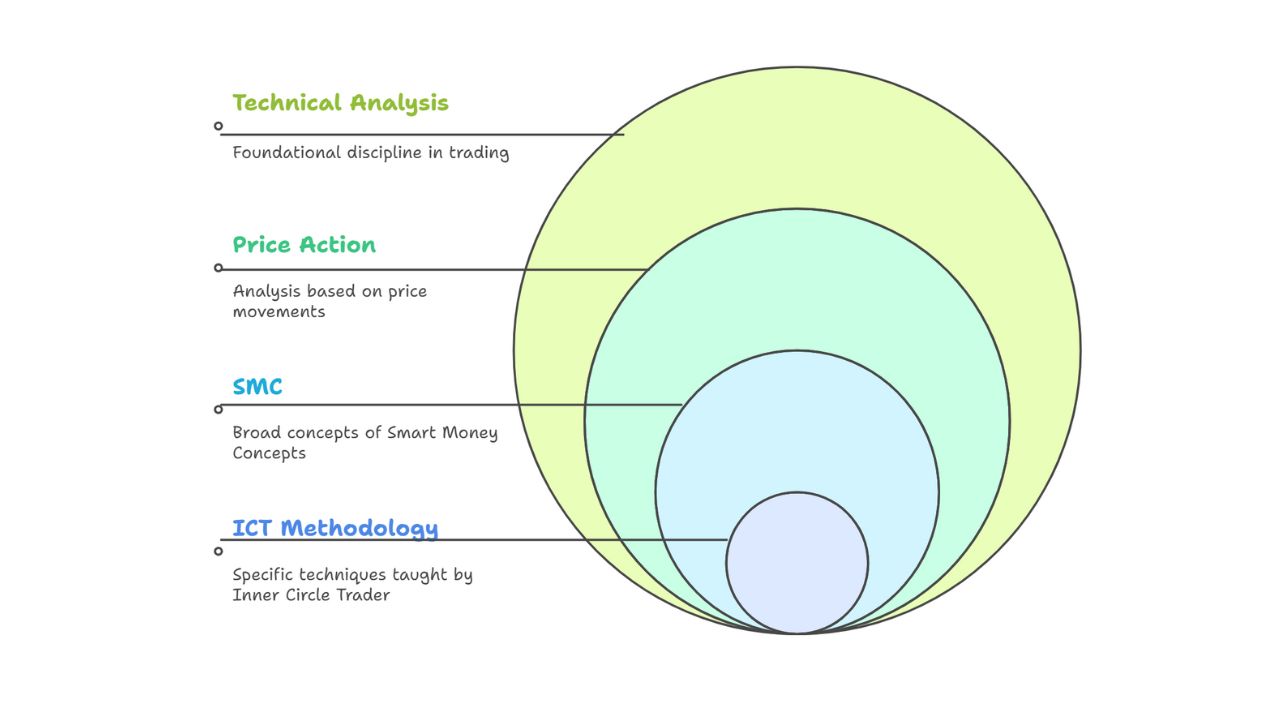
Technical Analysis is the foundation of trading analysis. It mainly includes two types of methods:
Price action analysis
Indicator-based analysis.
When we talk about price action, there are many styles and strategies. One popular concept is called SMC.
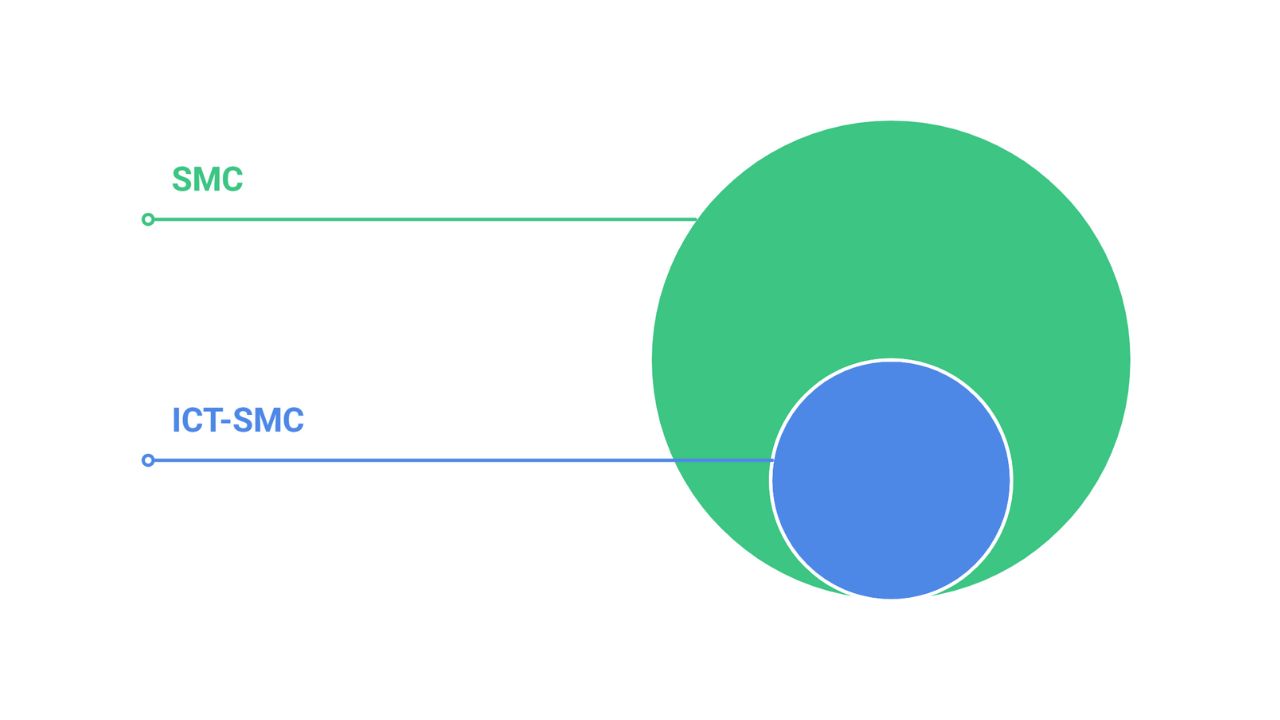
Now, SMC is a broad concept that includes many different methods. One of the most well-known styles within SMC is taught by Michael J. Huddleston, and it’s commonly referred to as ICT-SMC.
What is SMC?
SMC stands for Smart Money Concept.
It is a style of trading that focuses on how big players like banks, hedge funds, and institutions trade in the market. These big players are called smart money because they have more money, more information, and better tools than regular traders.
Technical analysis, the core discipline of studying price charts, can broadly be divided into two categories: indicator-based methods and price action analysis.
Within price action, trading approaches can be further classified into two distinct but complementary perspectives: macro and micro.
Macro price action refers to the traditional, big-picture view. It focuses on well-known elements like support and resistance zones, trend lines, and classic candlestick patterns.
On the other hand, micro price action explores the finer, more detailed movements of the market-what’s happening ‘under the hood.’ This is where advanced methods like Smart Money Concepts (SMC) come into play. This is the more advanced layer of analysis that seeks to understand the ‘why’ behind the market’s movements. It’s about looking beyond surface-level patterns to uncover the institutional logic driving price behavior.
Core concepts in this micro view include identifying liquidity pools, market structure shifts (MSS), and order blocks. A trader using this perspective understands that a resistance zone isn’t just a ceiling – it’s often a liquidity pool where retail traders have clustered their stop-losses and sell orders. Smart money is incentivized to ‘sweep’ this liquidity before initiating the true directional move.
For example, instead of reversing immediately from resistance, price may first move slightly above that level to trigger stop-losses – this action, known as a liquidity sweep, often precedes a sharp reversal. This confirms institutional intent and shows how smart money exploits retail positioning.
By combining a macro understanding of market direction with a micro view of institutional behavior, traders can build stronger strategies that align with the flow of smart money.
What is ICT?
ICT is the acronym for the YouTube channel of Michael J. Huddleston, who has been a trading mentor for many years.
The full name of the channel is The Inner Circle Trader.
He created and taught his own smart money concepts that are popular today. His detailed teachings are called ICT-SMC because they are his version of the Smart Money Concept.
He teaches through YouTube, mentorships, and free content. Many advanced traders follow his strategies, and some other educators even teach his concepts under different names.
However, when people say ‘ICT,’ they’re usually referring to Michael J. Huddleston himself rather than just his YouTube channel. For example, if someone says ‘ICT has uploaded a new video,’ they simply mean that Michael J. Huddleston has posted a new video on his YouTube channel called The Inner Circle Trader.
ICT vs SMC – The Difference Every Trader Should Know
Think of SMC as the entire “fruits” category, while ICT-SMC is like “mangoes” – a specific type within that bigger group.
Just like a mango is definitely a fruit, but you wouldn’t call every fruit a mango, ICT-SMC falls under the broader SMC umbrella, but SMC may include much more than just SMC by ICT.
Here’s the thing – although the idea is somewhat controversial, the Smart Money Concept existed long before ICT (Inner Circle Trader) came along.
Traders have been studying institutional behavior, market structure, and how ‘smart money’ moves for decades. They’ve analyzed things like accumulation zones, distribution patterns, and how big players manipulate retail traders.
ICT took these foundational ideas and built a unique framework around them. He identified specific components within the chart and named them—such as order blocks, fair value gaps, liquidity grabs, Judas swings, and market structure shifts. Over time, his detailed approach became widely followed. In fact, it became so popular that many people started referring to his entire method as ‘SMC.’ However, that’s not entirely accurate, as SMC is a broader concept, and ICT’s style is just one interpretation within it.
So when someone says they trade “SMC,” they might mean ICT’s specific approach, or they could be using any number of smart money strategies.
It’s like saying you eat “fruit” – you could mean mangoes, but you could also mean apples, oranges, or anything else in that category.
The Bottom Line
Point
SMC (Smart Money Concept)
ICT-SMC (SMC by The Inner Circle Trader)
What it is
A trading concept or method
A style of SMC taught by Michael J. Huddleston
Creator
Not specific – used by many educators
Michael J. Huddleston (ICT)
Depth of Learning
General idea of smart money behavior
More detailed with logic, rules, and framework
Learning Style
Simple and easy to learn
Detailed, long-term learning approach
While this article has been written with proper care and attention to detail, we remain open to updating and correcting any information if errors are brought to our attention or come to our notice. The trading community’s feedback is valuable, and we encourage readers to point out any inaccuracies so we can maintain the quality and reliability of our content. Trading involves significant risk, and this information is for educational purposes only.
With over 3 years of experience in financial markets, we focus on simplifying global and Indian markets through clear, practical insights. Our expertise also extends to the evolving landscape of digital finance, including blockchain, stablecoins, and decentralized finance (DeFi).
JD Vance took the stage at the Bitcoin 2025 Conference in Las Vegas yesterday with a message that couldn’t be clearer: America is going all-in on crypto. “We want our fellow Americans to know that crypto and digital assets, particularly Bitcoin, are part of the mainstream economy and are here to stay,” the Vice President told the crowd.
The Trump administration isn’t just talking about crypto anymore—they’re betting big on it. There was that private dinner for people who bought Trump’s $TRUMP meme coin, and just recently the Labor Department quietly pulled back guidance that warned against putting cryptocurrency in 401(k) plans.
But here’s what’s keeping some people up at night: What happens if someone steals America’s Bitcoin?
The Big Bitcoin Bet
The administration wants to create what they’re calling a U.S. Bitcoin reserve. We’re talking about potentially billions of dollars in digital currency that would belong to American taxpayers. Trump Media is already planning to raise $2.5 billion just to buy Bitcoin, showing how serious they are about this.
Vance spent most of his speech talking about how crypto could change everything—protecting people from inflation, giving them financial freedom, stopping banks from cutting off customers for political reasons. He called it a “once-in-a-generation opportunity” and compared Bitcoin to digital gold.
The problem? Bitcoin hit $108,000 during the conference, but it was down to $17,000 just three years ago. That’s not exactly the stability you’d expect from something that’s supposed to anchor part of America’s financial system.
This gets to the heart of what makes crypto so controversial. Regular money is backed by governments. Gold has industrial uses and thousands of years of history as valuable. Bitcoin? It’s backed by… well, that’s where things get complicated.
Bitcoin supporters say its value comes from scarcity—there will only ever be 21 million coins—and its usefulness for transactions that can’t be controlled by banks or governments. Vance and others call it “digital gold” and argue it protects against inflation or “de-banking,” where financial institutions cut people off for their political views.
But critics look at Bitcoin’s wild price swings and see pure speculation. They argue that without any physical backing or government guarantee, Bitcoin’s value is basically “nothing but belief and hot air.” When the price can swing from $17,000 to $108,000 in three years, is that really a stable store of value, or just gambling?
The question matters a lot more when we’re talking about putting taxpayer money into it.
When Digital Money Disappears
Here’s where things get scary. Remember Mt. Gox? Back in 2014, hackers made off with 850,000 Bitcoins—worth about $450 million at the time. Most people never got their money back. Just this year, someone stole $1.4 billion worth of Ethereum from Bybit.
The thing about crypto theft is that it’s not like robbing a bank. When physical money gets stolen, there’s usually some way to track it down. With cryptocurrency, once it’s gone, it’s often gone for good. The whole system is designed to be anonymous and decentralized, which makes it nearly impossible to trace.
So what happens if hackers target a national Bitcoin reserve? Who pays when billions in taxpayer money vanishes into the digital void?
Vance didn’t address this in his speech. In fact, none of the crypto boosters seem to want to talk about it.
The Wild West Problem
Right now, crypto operates in what experts call a regulatory gray zone. Unlike stocks or traditional investments, there’s no real oversight. Last year alone, people lost $3.7 billion to crypto scams—everything from fake coins to “rug pulls,” where developers create a cryptocurrency, get people to invest, then disappear with the money.
Vance promised to fire regulators who’ve been trying to crack down on crypto, calling their efforts “Operation Choke Point 2.0.” But he didn’t explain how the government plans to protect investors from fraud without any regulation.
About 17% of American adults have tried crypto, according to Pew Research, mostly young men. The administration wants that number to grow by making it easier to put crypto in retirement accounts. But without better protections, more people could end up losing their savings.
The Real Questions Nobody’s Answering
Vance owns between $250,000 and $500,000 worth of Bitcoin himself, according to his 2024 financial disclosure. So he’s got skin in the game. The question is whether his enthusiasm is clouding his judgment about the risks.
There are ways to make crypto safer. You can use something called multisignature wallets that require multiple people to approve transactions. You can keep most of the money in “cold storage”—basically offline where hackers can’t reach it. You can do regular security audits.
But all of that requires the kind of coordination and oversight that goes against everything crypto was supposed to represent. And it still doesn’t solve the fundamental problem: if someone figures out how to steal government Bitcoin, there’s no FDIC insurance, no bank guarantee, no way to get it back.
What This Means for You?
The crypto industry is celebrating right now. The Trump administration is rolling back rules, embracing digital currencies, and promising to make America the “crypto capital of the planet.” Wall Street is taking notice, and Bitcoin prices are soaring.
But if you’re a taxpayer, you might want to ask some questions. Like: How exactly is the government planning to secure billions of dollars in Bitcoin? What happens if it gets stolen? And who’s going to be on the hook when things go wrong?
Crypto enthusiasts will tell you that digital currencies represent the future of money—freedom from government control, protection from inflation, access to a global financial system. They might be right.
But they might also be wrong. And if they are, it could cost all of us a lot more than we bargained for.
This article is for informational purposes only and does not constitute financial, investment, or legal advice. The author and publisher are not responsible for any financial losses or damages resulting from actions taken based on this article. Cryptocurrency investments carry significant risks, including the potential for total loss, and may not be suitable for all investors.
With over 3 years of experience in financial markets, we focus on simplifying global and Indian markets through clear, practical insights. Our expertise also extends to the evolving landscape of digital finance, including blockchain, stablecoins, and decentralized finance (DeFi).
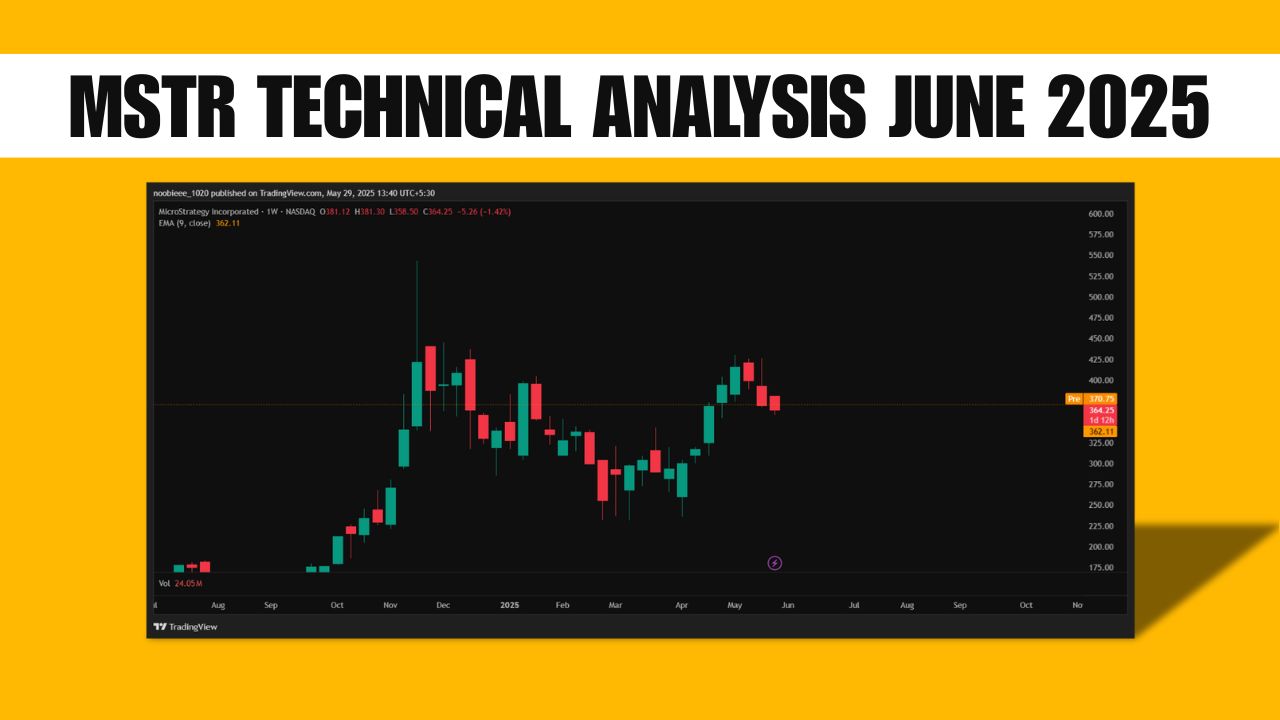
In this article, we will conduct chart analysis for MSTR for the month of June 2025. We will also discuss the top 10 latest news stories related to MSTR that may act as catalysts for MicroStrategy’s stock momentum in June.
Before we proceed further, please note that the content here is purely speculative in nature and does not guarantee the exact movement of the stock. The content posted here about MSTR stock price prediction for June 2025 represents the author’s opinion only and discusses possibilities and scenarios that may or may not occur.
Please do not consider this a buying or selling recommendation. We have no such intention whatsoever.
So let’s begin.
First, let’s talk about the top 10 latest news stories about MicroStrategy that may contribute to investor sentiment and market action.
Top 10 Latest Updates on Strategy (MSTR)
Here are the top 10 latest news items related to MicroStrategy (MSTR) stock analysis for June 2025:
MicroStrategy Boosts Bitcoin Holdings with $427M Purchase: On May 27, 2025, MicroStrategy acquired 4,020 BTC for $427.1 million, increasing its total Bitcoin holdings to 580,250 BTC, valued at approximately $40.6 billion, reinforcing its Bitcoin treasury strategy.
MSTR Stock Declines Amid Market Volatility: On May 24, 2025, MSTR shares fell 7.5% to close at $369.51, marking a third consecutive day of losses, driven by rising U.S. Treasury yields and tariff uncertainties impacting investor sentiment.
Class Action Lawsuit Filed Against MicroStrategy: On May 19, 2025, a class action lawsuit was filed against MicroStrategy and its executives, alleging misleading statements about its Bitcoin strategy and a $5.91 billion unrealized Q1 loss, with a lead plaintiff deadline of July 15, 2025.
MicroStrategy Outperforms Bitcoin and Major Indices: On May 27, 2025, reports noted that MSTR stock outperformed Bitcoin by 63% over the past three months, surpassing major market indices and the Magnificent 7 stockselderly population, adding to MSTR’s appeal as a Bitcoin proxy.
Analyst Predicts S&P 500 Eligibility for MicroStrategy: On May 11, 2025, analyst Jeff Walton suggested that MicroStrategy’s strong Q2 earnings could qualify it for S&P 500 inclusion, potentially driving significant capital inflows into MSTR and Bitcoin.
MicroStrategy’s $2B Bitcoin Acquisition Pushes Stock to 24-Year High: On May 20, 2025, MicroStrategy’s purchase of 27,200 BTC for $2.03 billion drove its stock to a 24-year high, reflecting strong market support for its Bitcoin-focused strategy.
MicroStrategy Acquires 7,390 BTC for $765M: On May 19, 2025, MicroStrategy added 7,390 BTC to its holdings, valued at nearly $765 million, amid Bitcoin’s rally above $100,000, though the purchase coincided with news of a class-action lawsuit.
Michael Saylor’s Bold Bitcoin Prediction: On May 15, 2025, Michael Saylor, Strategy’s chairman, predicted Bitcoin could reach $13 million by 2045, with MSTR potentially becoming a $10 trillion company, highlighting its long-term vision.
MicroStrategy’s AI-Driven Stock Offerings: On May 7, 2025, Michael Saylor revealed that AI was used to design the company’s 10% Series A Perpetual Strife Preferred Stock (STRF) and 8% Series A Perpetual Strike Preferred Stock (STRK), showcasing innovative financial strategies.
MicroStrategy’s $1.34B Bitcoin Purchase: On May 13, 2025, MicroStrategy acquired 13,390 BTC for $1.34 billion, bringing its total holdings to 568,840 BTC, with its stock surging amid bullish crypto sentiment and a U.S.-China trade deal announcement.
Now let us move straight to the technical analysis of the MSTR chart and discuss price predictions for June 2025. Along with that, we will also discuss key support and resistance zones for MSTR stock that may act as significant points of interest for MicroStrategy’s stock momentum.
As they say, a picture is worth a thousand words, so here is the chart of MSTR sourced from TradingView. As you can see, some lines and zones are drawn with geometric analysis. What is most important are the FTC magical zones, which serve as our secret sauce for technical analysis.
We will also discuss price action related to other technical analysis tools.
Includes 847,000 Class A Common Shares, 678,970 STRK Shares, 104,423 STRF Shares (specific total unavailable)
This article is for informational purposes only and does not constitute financial advice. Always conduct your own research or consult a qualified financial advisor before making investment decisions. Past performance is not indicative of future results.
With over 3 years of experience in financial markets, we focus on simplifying global and Indian markets through clear, practical insights. Our expertise also extends to the evolving landscape of digital finance, including blockchain, stablecoins, and decentralized finance (DeFi).
On May 28, 2025, GameStop (GME) stunned markets in two very different ways.
First, the company announced that it had purchased 4,710 Bitcoins at an average price of $108,837 each, committing $512.6 million to its first major cryptocurrency investment.
Then, in an almost immediate reversal of sentiment, GME shares plunged 9%.
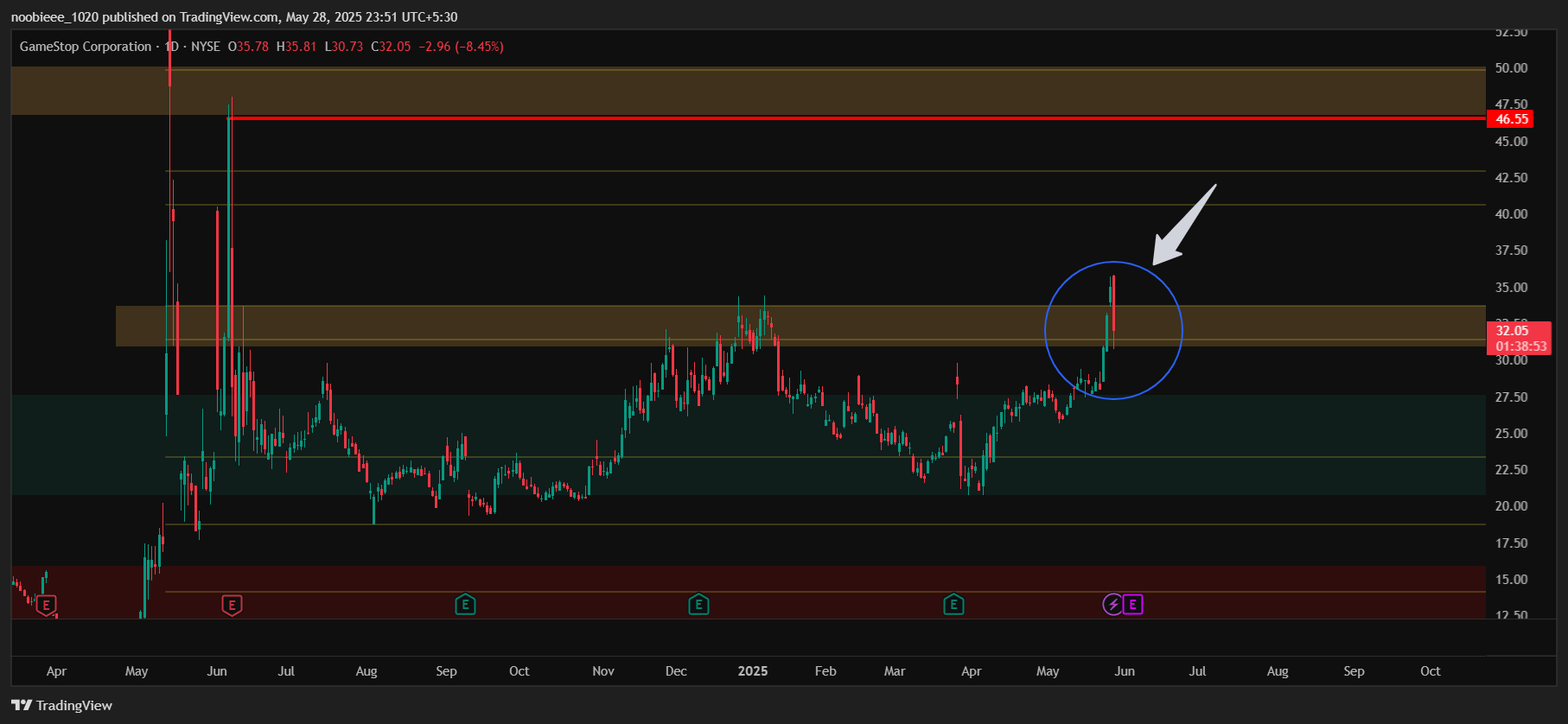
The stock opened that day at $35.785, climbed as high as $37.405, then tumbled to $30.77. A $6.63 swing in one trading session is huge for any company, but it’s especially wild for GameStop. With its roughly $12.75 billion market cap, the stock has become a magnet for meme-stock activity.
This fresh episode of volatility shows how retail-driven momentum often matters more than traditional financial metrics when it comes to GameStop’s stock price.
GameStop’s Current Situation
GameStop’s core retail business has been under pressure for years. Revenue dropped to $3.8 billion in early 2025 from $9.47 billion in 2010, and the company closed 960 stores in 2024 alone, with more closures expected this year.
Against this backdrop, jumping into Bitcoin looks like a bold play to stay relevant. It mirrors what MicroStrategy has done under Michael Saylor, and word is that CEO Ryan Cohen has been in talks with Saylor himself. Those conversations may have inspired GameStop’s crypto play, adding a new layer of excitement for investors who follow both stocks and crypto.
Now we will predict the price of GameStop for June 2025. But before making the price prediction, please be mindful that these price targets are speculative in nature.
Also, the technical analysis done here is only for educational and informational purposes. It is not meant to induce anyone to take a trade based on this chart analysis.
This price forecast for GME is simply the author’s personal opinion and speculation based on available technical analysis tools. So take it only for reference.
Always do your own research or consult a qualified advisor before making investment decisions.
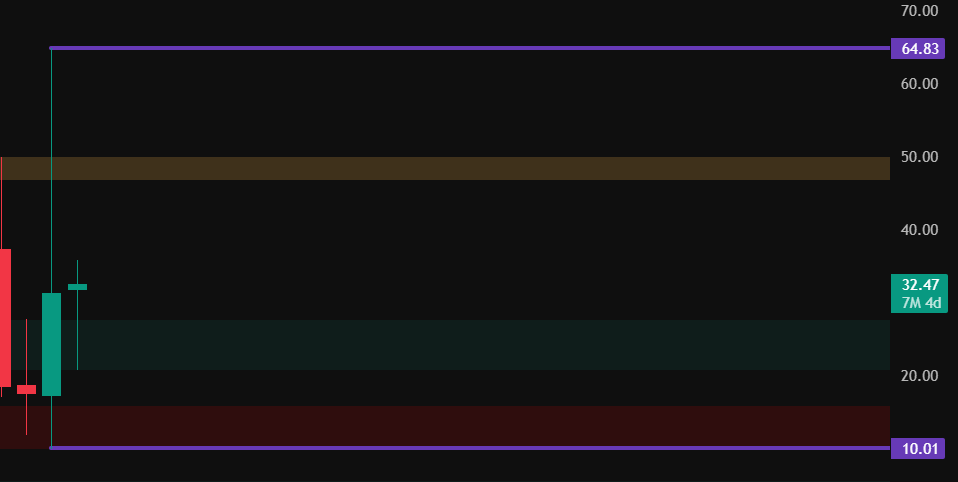
If we look at the yearly chart of GME, the price in 2025 is still within last year’s trading range. The stock is currently trading between a high of $64.83 and a low of $10.01.
The Bottom Line
In June 2025, we may see GME stock touching the $46.50 mark with some decent pullbacks.
But overall, the verdict by FeelTheCandlesticks is bullish for the month of June 2025.
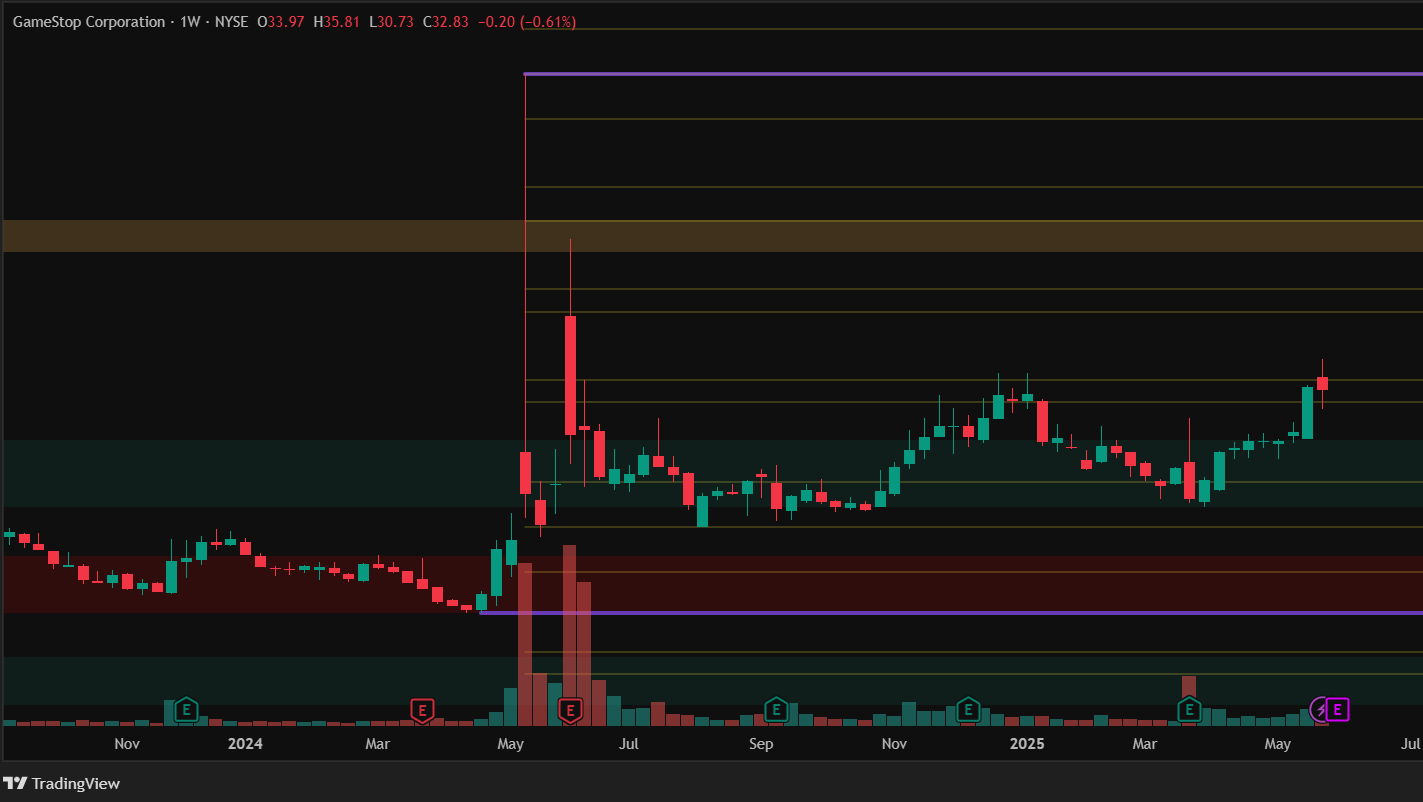
The 9% drop on May 28 seems to be a correction despite the bullish news, as the stock had already rallied in earlier trading sessions.
The price has also tested the 9-day EMA, and it has already pulled back to the FTC special SR zone (the golden zone in the picture). So there seems to be a very high probability that the price might rally upward in the coming days. The GME stock may continue to follow positive fundamental news.
Disclaimer: The information provided here is for educational and informational purposes only and does not constitute financial or investment advice. Trading and investing involve risk, and past performance is not indicative of future results. Always conduct your own research and consider consulting with a qualified financial advisor or professional before making any investment decisions.
With over 3 years of experience in financial markets, we focus on simplifying global and Indian markets through clear, practical insights. Our expertise also extends to the evolving landscape of digital finance, including blockchain, stablecoins, and decentralized finance (DeFi).
Circle Internet Group is the company behind the popular USDC stablecoin.
On May 27, 2025, the company filed for an IPO under the ticker symbol CRCL. The shares will be listed on the New York Stock Exchange (NYSE) and are expected to start trading on June 5, 2025. Circle is planning to raise up to $624 million by offering 24 million shares, each priced between $24 and $26. If this IPO goes as planned, the company’s value could reach between $5.2 billion and $6.71 billion.
Many investors are showing strong interest in this IPO. Bloomberg even reported that it is oversubscribed, meaning more people want to buy the shares than what’s available.
Big investors like Cathie Wood’s ARK Invest are also joining in. They plan to buy up to $150 million worth of shares.
As a result, many people are now searching online for price predictions and trying to guess where the stock might go after it starts trading.
Short-Term Price Prediction
Right after the listing in June 2025, CRCL shares could go up quickly.
If the IPO starts at $24–$26, the price might jump to $30–$35 within a few weeks. This would be a 15% to 35% gain.
One big reason is the GENIUS Act, a new U.S. law that supports stablecoins like USDC. If this Act becomes law by the end of June, it could bring more trust and use to USDC, which would help the CRCL stock. But if the Act is delayed or if the overall stock market is weak, the price might stay around $28–$30 instead.
Looking 6 to 12 months ahead, CRCL could rise even more. Experts at J.P. Morgan believe the stablecoin market might grow to $500–$750 billion in the near future.
If Circle gains more users and beats its main rival Tether, the share price could reach $40–$50 by mid-2026. This depends on USDC continuing to grow, since it already has $60 billion in circulation. But there are risks too. If the GENIUS Act is changed or if new rules ban interest-earning stablecoins, the stock might only rise to $28–$32.
Also, Circle depends a lot on Coinbase, which brings in 54% of its revenue. This could hurt profits if that partnership changes.
In the long run, from 2027 to 2030, the future looks big for CRCL. Citigroup thinks the stablecoin market could reach $1.6 trillion by 2030. If Circle keeps growing and competes well with Tether, the CRCL stock could rise to $60–$80. Circle already has a user network that reaches 600 million people, and if it gets a trust charter license, it would become even more trusted.
But Circle will face more competition. Big banks like Bank of America might launch their own stablecoins. Also, the world economy and new rules could slow down Circle’s growth, keeping the stock at $40–$50.
People on social media have mixed feelings—some are excited, while others worry about Circle’s profits.
Key Factors That Could Affect CRCL’s Stock Price
One important factor is regulation. If the GENIUS Act passes, USDC might become more widely used. But if it’s delayed or changed, the stock might not grow much.
Next is market sentiment. Right now, Bitcoin prices are high, and U.S. leaders like Trump are showing support for crypto. This is good for Circle.
Competition is another big factor. Circle must beat other stablecoins like Tether and watch out for new ones from banks.
Lastly, Circle’s financial results matter. In 2024, it earned $1.68 billion and had $285 million EBITDA, which is a sign of good business. But its net income fell by 42% to $155 million, which could worry investors.
The Bottom Line
These predictions are not guarantees. Stock prices after an IPO can be unpredictable. They depend on many things like market trends, new laws, and how well the company performs.
If you are planning to invest in the CRCL IPO, keep a close eye on the June 5 listing, updates about the GENIUS Act, and the performance of USDC in the market. And before investing your money, it’s always a good idea to talk to a financial advisor and understand your own risk tolerance.
The information in this article is meant only for educational and informational use. It is not financial, legal, or investment advice. Always talk to a trusted financial advisor before making any investment decision. The author and publisher are not responsible for any financial losses.
With over 3 years of experience in financial markets, we focus on simplifying global and Indian markets through clear, practical insights. Our expertise also extends to the evolving landscape of digital finance, including blockchain, stablecoins, and decentralized finance (DeFi).