
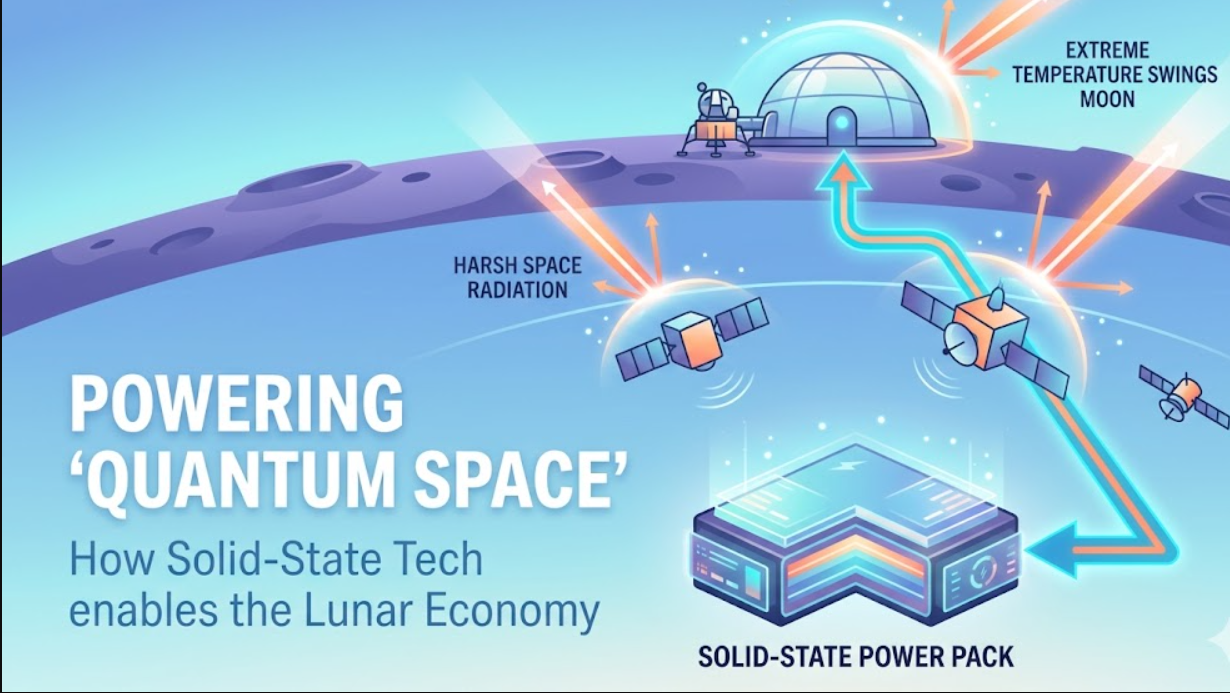
We are currently witnessing the birth of Quantum Space. It’s a world defined by thousands of new satellites weaving a “quantum-safe” web around Earth and the first permanent human outposts on the Moon. But as the Artemis II crew recently reminded us, space is not just a destination; it’s a logistical nightmare.
We can build the rockets, but one question remains the ultimate “bottleneck” for human expansion: How do we keep the lights on?
In space, traditional energy fails. You can’t burn fossil fuels in a vacuum, and solar power – while iconic – is far more fragile than most people realize. The answer to the energy crisis of the Moon isn’t coming from rocket science; it’s coming from the electric car parked in your driveway.
The “Lunar Night” Problem
On Earth, we take power for granted. In space, power is life.
Currently, satellites and moon bases rely on massive solar arrays. But these are plagued by three “silent killers”:
- Radiation: Constant bombardment from solar flares degrades panels over time.
- The Dust Factor: On the Moon, abrasive, “electrostatic” regolith (dust) coats everything, choking solar efficiency.
- The Temperature Swing: In the lunar day, it hits 120°C. At night? A bone-chilling -170°C.
If your batteries fail during the 14-day lunar night, the mission ends. Period.
Why Current Batteries Aren’t Cutting It
For decades, we’ve used Lithium-ion batteries – the same ones in your phone. But these use a liquid electrolyte. In the vacuum of space, liquid is a liability. It can freeze, boil, or leak. Even worse, radiation can break down these liquids, creating a fire risk in a place where there is no “out” for the smoke.
The Solid-State Revolution: From EVs to Orbit
This is where the “Quantum” in Quantum Space becomes literal. Companies like QuantumScape and research teams at NASA (via the SABERS project) are pivoting to Solid-State Batteries (SSBs).
By replacing the liquid “insides” of a battery with a solid ceramic or polymer material, we unlock five game-changing advantages for space exploration:
1. Thermal Immunity
Unlike car batteries that lose 50% of their range in a winter storm, solid-state batteries are “thermal tanks.” Recent tests show they can operate from -60°C to +120°C without breaking a sweat. The solid material doesn’t freeze or boil, making it the only viable choice for the lunar surface.
2. Radiation Shielding by Design
Radiation destroys liquids through a process called radiolysis. Solids are inherently more stable. Recent gamma-ray testing suggests that SSBs can survive the harsh environment of “Cis-lunar” space for 15+ years – nearly double the lifespan of current satellite power packs.
3. “Weight is Wealth”
In rocketry, every kilogram costs thousands of dollars. Solid-state batteries are significantly lighter and hold more energy (higher energy density) than liquid ones. This allows us to launch smaller rockets or, more importantly, pack more food, water, and scientific tools instead of heavy battery casings.
4. Zero Fire Risk
In a vacuum, a battery fire is a death sentence. Because SSBs don’t have flammable liquids, they are virtually “fire-proof.” This safety profile is why they are the top choice for the crewed modules of future Moon bases.
Real-World Proof: It’s Already Happening
This isn’t science fiction.
- The Japanese Milestone: A team from Japan recently conducted the first successful space test of an all-solid-state battery on the ISS, proving they work perfectly in zero-gravity and vacuum conditions.
- The QuantumScape Pivot: Just this week, following their Q1 2026 earnings, QuantumScape signaled a massive shift toward defense and aerospace. They realize that the same tech making your car go 500 miles on a single charge is what will keep a lunar greenhouse running.
The Future: A Two-World Energy Grid
The beauty of this trend is the Inverted Innovation Loop. Usually, NASA invents something and we get it 20 years later (like Velcro or GPS). This time, the massive R&D of the global car industry is subsidizing the colonization of space.
The “B-LO Zero” projects and lunar-night battery packs of tomorrow are being built in the EV factories of today.
Final Thought
Building “Quantum Space” is about more than just the “cool factor” of rockets. It’s about building a smart, resilient energy grid that can survive the most hostile environment known to man.
The next time you see an electric car, look at the floorboard. The technology inside isn’t just helping us save our planet – it’s giving us the power to leave it.
This article is for informational purposes only and should not be considered financial advice. Investing in stocks, cryptocurrencies, or other assets involves risks, including the potential loss of principal. Always conduct your own research or consult a qualified financial advisor before making investment decisions. The author and publisher are not responsible for any financial losses incurred from actions based on this article. While efforts have been made to ensure accuracy, economic data and market conditions can change rapidly. The author and publisher do not guarantee the completeness or accuracy of the information and are not liable for any errors or omissions. Always verify data with primary sources before making decisions.

With over 3 years of experience in financial markets, we focus on simplifying global and Indian markets through clear, practical insights. Our expertise also extends to the evolving landscape of digital finance, including blockchain, stablecoins, and decentralized finance (DeFi).