On May 28, 2025, GameStop (GME) stunned markets in two very different ways.
First, the company announced that it had purchased 4,710 Bitcoins at an average price of $108,837 each, committing $512.6 million to its first major cryptocurrency investment.
Then, in an almost immediate reversal of sentiment, GME shares plunged 9%.
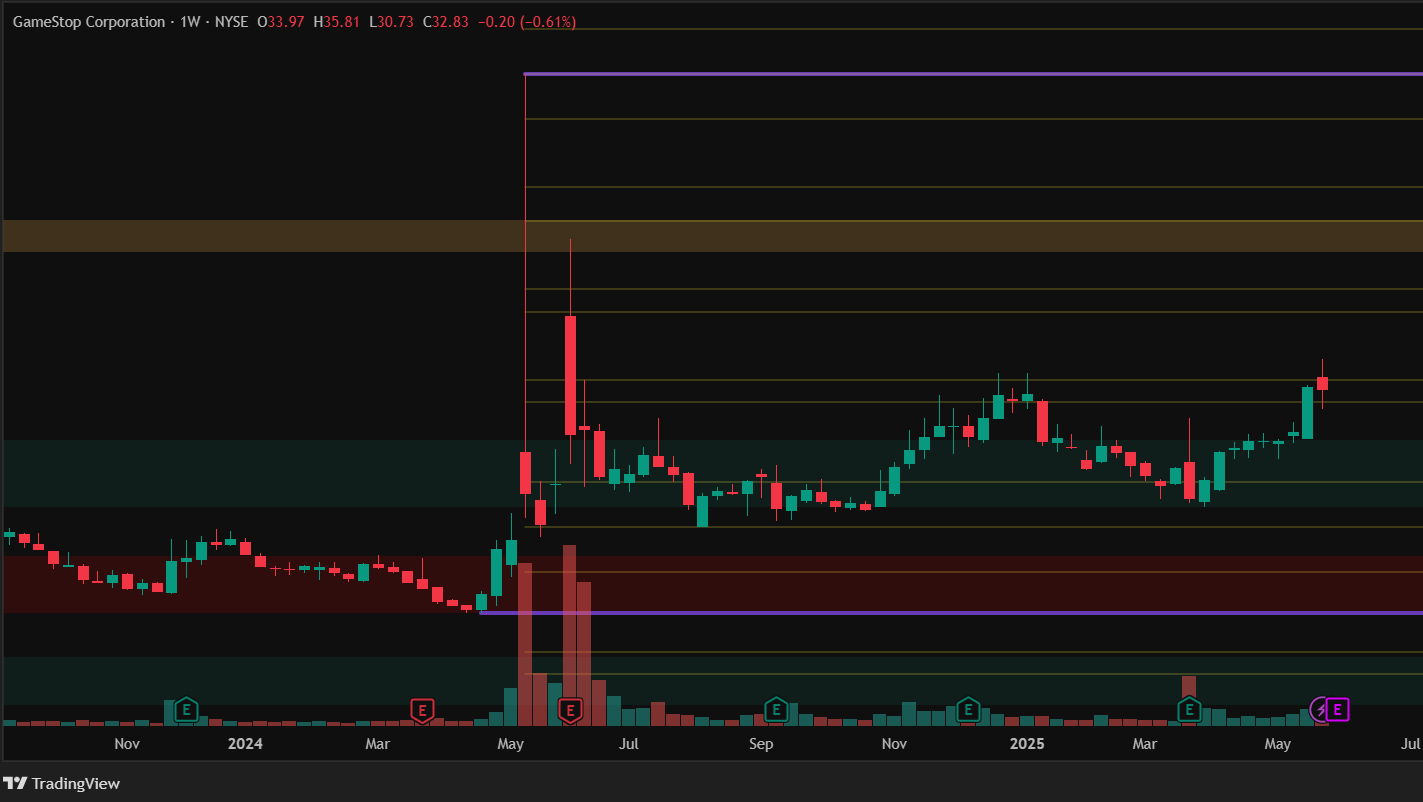
The stock opened that day at $35.785, climbed as high as $37.405, then tumbled to $30.77. A $6.63 swing in one trading session is huge for any company, but it’s especially wild for GameStop. With its roughly $12.75 billion market cap, the stock has become a magnet for meme-stock activity.
This fresh episode of volatility shows how retail-driven momentum often matters more than traditional financial metrics when it comes to GameStop’s stock price.
GameStop’s Current Situation
GameStop’s core retail business has been under pressure for years. Revenue dropped to $3.8 billion in early 2025 from $9.47 billion in 2010, and the company closed 960 stores in 2024 alone, with more closures expected this year.
Against this backdrop, jumping into Bitcoin looks like a bold play to stay relevant. It mirrors what MicroStrategy has done under Michael Saylor, and word is that CEO Ryan Cohen has been in talks with Saylor himself. Those conversations may have inspired GameStop’s crypto play, adding a new layer of excitement for investors who follow both stocks and crypto.
Now we will predict the price of GameStop for June 2025. But before making the price prediction, please be mindful that these price targets are speculative in nature.
Also, the technical analysis done here is only for educational and informational purposes. It is not meant to induce anyone to take a trade based on this chart analysis.
This price forecast for GME is simply the author’s personal opinion and speculation based on available technical analysis tools. So take it only for reference.
Always do your own research or consult a qualified advisor before making investment decisions.
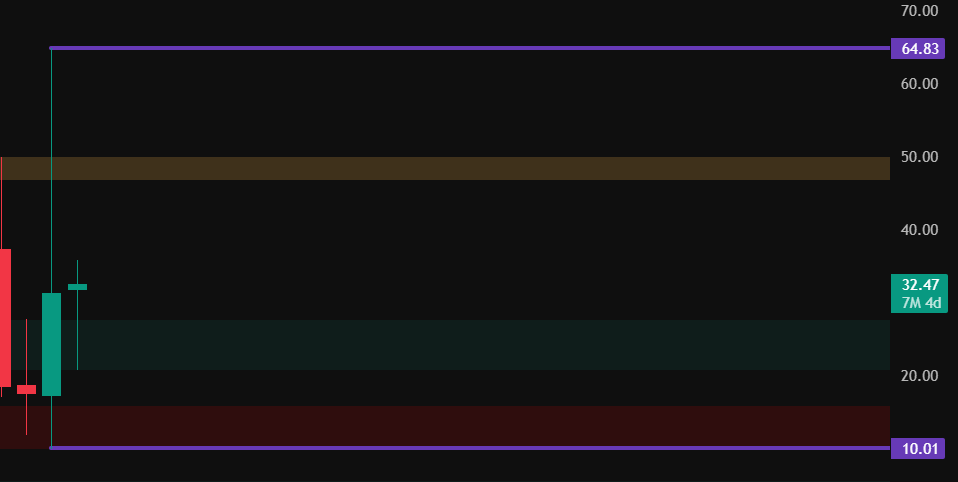
If we look at the yearly chart of GME, the price in 2025 is still within last year’s trading range. The stock is currently trading between a high of $64.83 and a low of $10.01.
The Bottom Line
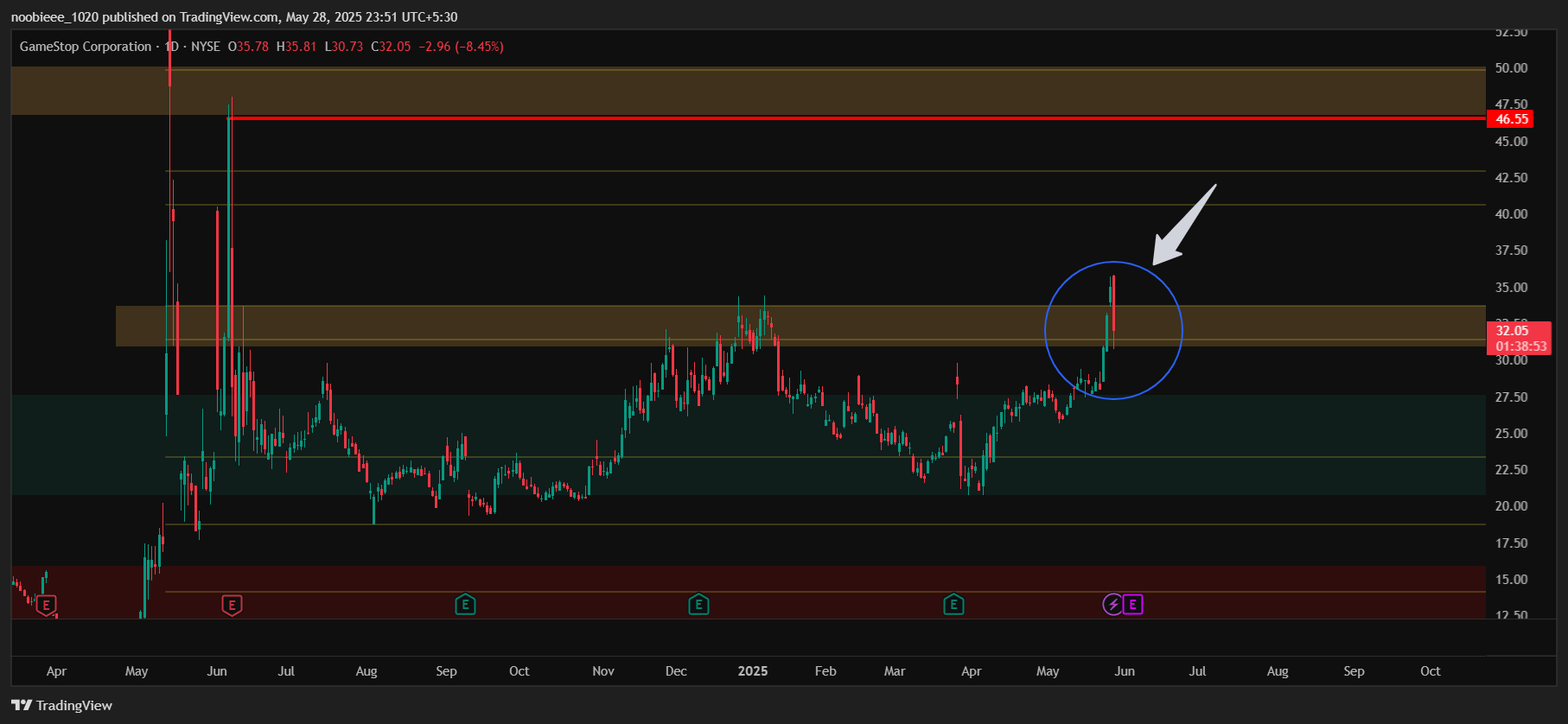
In June 2025, we may see GME stock touching the $46.50 mark with some decent pullbacks.
But overall, the verdict by FeelTheCandlesticks is bullish for the month of June 2025.
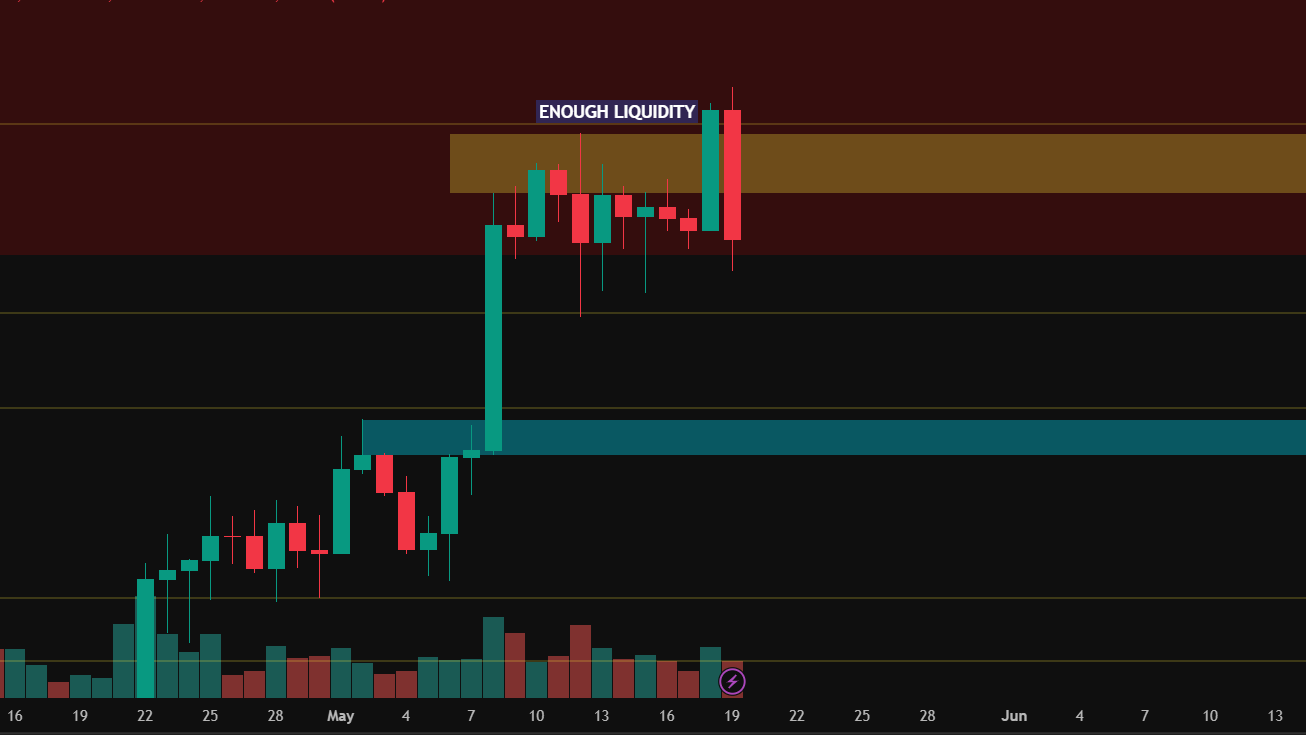
The 9% drop on May 28 seems to be a correction despite the bullish news, as the stock had already rallied in earlier trading sessions.
The price has also tested the 9-day EMA, and it has already pulled back to the FTC special SR zone (the golden zone in the picture). So there seems to be a very high probability that the price might rally upward in the coming days. The GME stock may continue to follow positive fundamental news.
Disclaimer: The information provided here is for educational and informational purposes only and does not constitute financial or investment advice. Trading and investing involve risk, and past performance is not indicative of future results. Always conduct your own research and consider consulting with a qualified financial advisor or professional before making any investment decisions.
With over 3 years of experience in financial markets, we focus on simplifying global and Indian markets through clear, practical insights. Our expertise also extends to the evolving landscape of digital finance, including blockchain, stablecoins, and decentralized finance (DeFi).
Circle Internet Group is the company behind the popular USDC stablecoin.
On May 27, 2025, the company filed for an IPO under the ticker symbol CRCL. The shares will be listed on the New York Stock Exchange (NYSE) and are expected to start trading on June 5, 2025. Circle is planning to raise up to $624 million by offering 24 million shares, each priced between $24 and $26. If this IPO goes as planned, the company’s value could reach between $5.2 billion and $6.71 billion.
Many investors are showing strong interest in this IPO. Bloomberg even reported that it is oversubscribed, meaning more people want to buy the shares than what’s available.
Big investors like Cathie Wood’s ARK Invest are also joining in. They plan to buy up to $150 million worth of shares.
As a result, many people are now searching online for price predictions and trying to guess where the stock might go after it starts trading.
Short-Term Price Prediction
Right after the listing in June 2025, CRCL shares could go up quickly.
If the IPO starts at $24–$26, the price might jump to $30–$35 within a few weeks. This would be a 15% to 35% gain.
One big reason is the GENIUS Act, a new U.S. law that supports stablecoins like USDC. If this Act becomes law by the end of June, it could bring more trust and use to USDC, which would help the CRCL stock. But if the Act is delayed or if the overall stock market is weak, the price might stay around $28–$30 instead.
Looking 6 to 12 months ahead, CRCL could rise even more. Experts at J.P. Morgan believe the stablecoin market might grow to $500–$750 billion in the near future.
If Circle gains more users and beats its main rival Tether, the share price could reach $40–$50 by mid-2026. This depends on USDC continuing to grow, since it already has $60 billion in circulation. But there are risks too. If the GENIUS Act is changed or if new rules ban interest-earning stablecoins, the stock might only rise to $28–$32.
Also, Circle depends a lot on Coinbase, which brings in 54% of its revenue. This could hurt profits if that partnership changes.
In the long run, from 2027 to 2030, the future looks big for CRCL. Citigroup thinks the stablecoin market could reach $1.6 trillion by 2030. If Circle keeps growing and competes well with Tether, the CRCL stock could rise to $60–$80. Circle already has a user network that reaches 600 million people, and if it gets a trust charter license, it would become even more trusted.
But Circle will face more competition. Big banks like Bank of America might launch their own stablecoins. Also, the world economy and new rules could slow down Circle’s growth, keeping the stock at $40–$50.
People on social media have mixed feelings—some are excited, while others worry about Circle’s profits.
Key Factors That Could Affect CRCL’s Stock Price
One important factor is regulation. If the GENIUS Act passes, USDC might become more widely used. But if it’s delayed or changed, the stock might not grow much.
Next is market sentiment. Right now, Bitcoin prices are high, and U.S. leaders like Trump are showing support for crypto. This is good for Circle.
Competition is another big factor. Circle must beat other stablecoins like Tether and watch out for new ones from banks.
Lastly, Circle’s financial results matter. In 2024, it earned $1.68 billion and had $285 million EBITDA, which is a sign of good business. But its net income fell by 42% to $155 million, which could worry investors.
The Bottom Line
These predictions are not guarantees. Stock prices after an IPO can be unpredictable. They depend on many things like market trends, new laws, and how well the company performs.
If you are planning to invest in the CRCL IPO, keep a close eye on the June 5 listing, updates about the GENIUS Act, and the performance of USDC in the market. And before investing your money, it’s always a good idea to talk to a financial advisor and understand your own risk tolerance.
The information in this article is meant only for educational and informational use. It is not financial, legal, or investment advice. Always talk to a trusted financial advisor before making any investment decision. The author and publisher are not responsible for any financial losses.
With over 3 years of experience in financial markets, we focus on simplifying global and Indian markets through clear, practical insights. Our expertise also extends to the evolving landscape of digital finance, including blockchain, stablecoins, and decentralized finance (DeFi).
Circle Internet Group, the company behind the USDC stablecoin, has officially filed for an IPO on May 27, 2025. The company plans to go public on the New York Stock Exchange under the ticker CRCL. The IPO is expected to raise up to $624 million, with the listing date set for June 5, 2025.
Circle is offering 24 million shares at a price range of $24 to $26 per share. If the IPO goes through as planned, it could value the company at somewhere between $5.2 billion and $6.71 billion.
This announcement has sparked a lot of interest among investors who are curious about whether Circle’s IPO is a good opportunity and if investing in a company behind a major stablecoin like USDC makes sense right now.
We can’t give you a direct yes or no answer to whether you should buy the CRCL IPO because the final choice is yours. But we can help by showing you both the good and risky sides of this IPO so you can decide what fits best with your financial goals.
Why is the Timing Important?
The timing of this IPO is quite interesting. It’s happening right when the U.S. Senate is discussing the GENIUS Act, a new law aimed at regulating stablecoins like USDC. The Senate voted on this law just days before, on May 19 and 20. If this bill moves forward, it could open up new opportunities for companies like Circle that work in the stablecoin space.
Circle’s financial performance looks promising. In 2024, the company reported $1.68 billion in revenue, which was a 16% increase from the year before. Although its net income fell to $157 million because of increased investments, the company still showed strong operating profits with $285 million in adjusted EBITDA. That means Circle is still running a healthy business and generating cash.
USDC’s Market Presence Gives Circle an Edge
USDC, the stablecoin issued by Circle, is one of the biggest in the market. It has between $60 and $62 billion in circulation and holds around 25% to 35% of the market share, based on data from CoinGecko. This puts Circle right behind Tether, which is the current market leader in stablecoins.
There’s also support coming from both the government and big investors. If the GENIUS Act becomes law, J.P. Morgan predicts the total stablecoin market could grow to $500 billion or even $750 billion. This could mean more demand for USDC.
On the political side, Donald Trump’s pro-crypto views may help push this IPO forward. In fact, Polymarket believes there’s a 90% chance the IPO will be approved.
Investor interest is already very high. Bloomberg reports that the Circle IPO is oversubscribed, meaning more people want shares than what is available. ARK Invest, led by Cathie Wood, is also planning to invest $150 million in the IPO. This shows strong confidence in Circle’s future.
What Are the Risks?
Still, there are things to watch out for. A large number of shares being sold—around 14.4 million out of 24 million—are coming from insiders, including the company’s founders. This can raise some concerns.
When insiders sell a big chunk during an IPO, it sometimes looks like they’re taking profits early. Something similar happened during Facebook’s IPO in 2012, and it made some investors nervous back then too.
Regulation is another area to keep an eye on. While the GENIUS Act could help the stablecoin industry grow, it might also bring stricter rules. For example, it could ban interest-paying stablecoins. If that happens, Circle’s earnings could take a hit. PYMNTS has already reported on these possible changes, which could impact how profitable USDC remains.
There’s also strong competition in this space. Tether holds about 60% to 67% of the stablecoin market, and if big banks like Bank of America enter the stablecoin market after regulations become clear, Circle could face serious competition from both old and new players.
Final Thoughts
We can’t tell you exactly what to do because investing always depends on your personal risk level and goals. What we can say is this – Circle’s IPO gives you a chance to invest in one of the leading companies in the growing crypto and stablecoin industry. Its financials are strong, and USDC has a wide user base. That makes it attractive.
However, insider selling, regulatory uncertainty, and competition are real challenges. If you’re seriously thinking about whether the CRCL IPO is a good investment, take time to look at your own situation. Think about how much risk you’re willing to take and how this fits into your current investment plan. Keep an eye on the listing day—June 5—and on updates about the GENIUS Act. Also, talk to a financial advisor if you’re unsure.
The information in this article is meant only for educational and informational use. It is not financial, legal, or investment advice. Buying shares in an IPO comes with risks, and you could lose money. Financial numbers are based on data as of May 28, 2025, and may change. Always talk to a trusted financial advisor before making any investment decision. The author and publisher are not responsible for any financial losses.
With over 3 years of experience in financial markets, we focus on simplifying global and Indian markets through clear, practical insights. Our expertise also extends to the evolving landscape of digital finance, including blockchain, stablecoins, and decentralized finance (DeFi).
Circle Internet Group — the company behind that USDC “digital dollar” you keep hearing about — just filed to go public on the NYSE.
But here’s what every headline got wrong: This isn’t just another crypto company trying to cash in. This is the moment stablecoins officially became Wall Street infrastructure.
Company Overview
Circle runs USDC — basically a digital version of the U.S. dollar that businesses use to move money around instantly. No waiting days for bank transfers. No ridiculous international wire fees. Just boom, money moves.
Second-largest stablecoin issuer by market capitalization
Key Investors
Goldman Sachs, BlackRock, Fidelity
Previous IPO Attempt
Failed SPAC deal in 2022; Circle Internet Group IPO is second attempt
The numbers are wild: USDC processes over $7 trillion in transactions every year. That’s not speculation money — that’s real businesses paying real bills with digital dollars.
And get this — Goldman Sachs and BlackRock aren’t just throwing money at Circle for fun. They actually use USDC infrastructure for their own operations. When Wall Street’s biggest players become your customers, you know you’re onto something real.
The CRCL IPO Breakdown
Circle Internet Financial officially filed for its IPO on May 27, 2025, and the stock is set to begin trading on the New York Stock Exchange (NYSE) on June 5, 2025, under the ticker CRCL.
Here’s what you need to know about the IPO:
Total Shares Offered: 24 million Class A shares
Price Range: $24 to $26 per share
Valuation Target: Between $5.2 billion to $6.71 billion
Who’s Selling the Shares?
Circle Itself is offering 9.6 million shares
Existing Shareholders like Accel, General Catalyst, and co-founders Jeremy Allaire and Sean Neville are selling 14.4 million shares
Underwriters:
Big investment banks are backing this IPO, including:
J.P. Morgan
Citigroup
Goldman Sachs
They also have the option to buy 3.6 million more shares if demand stays strong.
Big Investors Are Interested:
Cathie Wood’s ARK Invest is planning to invest up to $150 million in Circle’s shares.
According to Bloomberg, the IPO is already multiple times oversubscribed. That means way more people want to buy shares than the number of shares available — a sign that there is strong demand for Circle’s stock.
Everyone’s talking about Circle raising $624 million by selling shares at $24-26 each. That’s the surface story.
Here’s what actually matters: Circle made $1.68 billion in revenue last year. Not from people gambling on crypto prices, but from businesses using their payment infrastructure. That’s PayPal-level money, but with way better growth.
Their profit dropped to $157 million because they’re spending heavily on expansion. Smart companies do this before going public — invest everything in growth, then let public markets fund the next phase.
The share split is interesting too. Circle’s selling 9.6 million new shares, but existing investors are cashing out 14.4 million shares. That’s not desperation — that’s confidence. Early investors are taking profits because they know the public market will value Circle higher than private investors did.
The CRCL IPO has launched at a time when the GENIUS Act is making its way through the U.S. Senate. This bill was moved forward with a 66-32 procedural vote on May 19, 2025, gaining support from 16 Democrats, including Senators Cory Booker and Adam Schiff. Just a day later, on May 20, the Senate voted 69-31 to start working on amendments to the bill, aiming to pass it by Memorial Day on May 26, 2025.
The full name of the bill is the Guiding and Establishing National Innovation for U.S. Stablecoins Act. It requires stablecoins to be backed 1:1 by liquid assets like cash or U.S. Treasury bonds. It also ensures that stablecoin holders get priority during bankruptcy situations and that strong anti-money laundering rules are followed.
Under the Act, both banks and approved nonbank institutions can issue stablecoins, either under federal or state supervision. Big issuers handling more than $10 billion in stablecoins will come under the watch of the Federal Reserve and the Office of the Comptroller of the Currency (OCC). According to J.P. Morgan, this law could expand the stablecoin market to somewhere between $500 billion and $750 billion, helping boost the growth of USDC. Still, not everyone is on board.
Critics like Senators Elizabeth Warren and Chuck Schumer argue that the bill is tilted in favor of banks and doesn’t provide strong enough protections, such as FDIC insurance. Some of the proposed amendments are aimed at fixing potential conflicts of interest, especially concerns linked to former President Trump’s connections with World Liberty Financial’s USD1 stablecoin.
Three things make this different from every other crypto company that tried going public:
First, the timing is perfect. Remember when Coinbase went public in 2021 during peak crypto mania? That was speculation money chasing speculation companies. Circle’s going public now, when institutions actually need digital payment infrastructure. Totally different game.
Second, Circle makes money when businesses use digital payments. They don’t need Bitcoin to hit $100k or people to start day-trading again. Every time someone sends USDC for a real business transaction, Circle gets paid. It’s like owning the toll booth on a highway that gets busier every year.
Third, they’re basically bulletproof on regulations. While other crypto companies are fighting with regulators, Circle spent years building compliance systems. They publish detailed reports about their reserves. They work with U.S. regulators instead of against them. When crypto regulations finally get written, Circle will be the template everyone else has to follow.
The Competition Angle Everyone’s Missing
USDC currently handles about 35% of the stablecoin market.
Tether’s USDT dominates with 65%, but there’s a catch: Tether operates in regulatory gray areas and faces constant questions about whether they actually have the dollars they claim to have.
Circle’s different. They publish quarterly reports proving every USDC is backed by actual dollars in actual banks. Once they’re a public company, that transparency becomes legally required.
Here’s the kicker: Most big businesses won’t work with companies that might get shut down by regulators. They need reliable partners. Circle’s IPO basically puts a “safe to use” stamp on USDC that Tether can’t match.
What Happens Next Actually Matters for Everyone
If Circle’s IPO goes well, it opens the door for other real crypto infrastructure companies to go public. Not the speculation stuff — the companies building actual useful services.
Think about it: Stripe revolutionized online payments and became worth $95 billion. Circle could do the same thing for international payments and digital money infrastructure.
But if Circle struggles as a public company, it sends a message that even the most legitimate crypto companies aren’t ready for public markets. That delays the whole industry’s growth by years.
Why Regular Investors Should Care
Circle’s stock gives you a way to invest in crypto infrastructure without buying cryptocurrency. You’re betting on digital payments growing, not on Bitcoin’s price going up.
It’s like investing in Visa during the early days of credit cards. You’re not betting on any specific transaction — you’re betting that more transactions will happen electronically over time.
The international angle is huge too. Every country is exploring digital versions of their currency. Circle’s already built the infrastructure for digital dollars. When other countries need similar systems, Circle’s the obvious choice.
The Real Story Nobody’s Telling
This IPO proves something important: The useful parts of crypto are becoming normal business infrastructure. Circle’s not going public as a “crypto company” — they’re going public as a payment infrastructure company that happens to use blockchain technology.
That’s the real shift. Crypto is evolving from speculation to utility. The companies building useful services are separating from the companies chasing hype.
Circle’s IPO is like the moment when Amazon stopped being “that internet bookstore” and became “that logistics company that happens to sell books online.” Same technology, completely different business reality.
What This Means for Your Money
Whether you buy CRCL stock or not, understand what this IPO represents: Digital payments are becoming as normal as email. The companies building that infrastructure early are positioning themselves for massive growth.
Circle’s bet is simple: More business will happen digitally, and that business needs reliable infrastructure. If they’re right, owning that infrastructure becomes incredibly valuable.
The interesting part? You don’t need to understand blockchain technology to understand Circle’s business model. They make money when people use digital dollars for real purposes. That’s as straightforward as business gets.
Circle’s IPO isn’t just another crypto company going public. It’s infrastructure becoming a public utility.
The companies that win in crypto aren’t the ones chasing speculation — they’re the ones building services that make digital money actually useful. Circle figured that out years ago, and now they’re cashing in.
Watch how CRCL performs after going public. If it does well, expect more infrastructure-focused crypto companies to follow. If it struggles, the whole sector takes a step back.
The information provided in this article is for informational and educational purposes only and does not constitute financial, investment, or legal advice. Investing in initial public offerings (IPOs) involves significant risks, including the potential loss of principal. The cryptocurrency and stablecoin markets are highly volatile and subject to regulatory changes, which may impact investment outcomes. Readers should conduct their own research and consult with a qualified financial advisor before making investment decisions. The author and publisher are not responsible for any financial losses or damages resulting from the use of this information.
With over 3 years of experience in financial markets, we focus on simplifying global and Indian markets through clear, practical insights. Our expertise also extends to the evolving landscape of digital finance, including blockchain, stablecoins, and decentralized finance (DeFi).
Buying your first home in Canada is a big dream, but saving for a down payment is probably one of the bigger financial challenges you’ll face. The First Home Savings Account (FHSA) was designed specifically to help with this problem.
Introduced in 2023, the FHSA is designed to help first-time home buyers save money in a smart and tax-efficient way. It lets you contribute up to $8,000 per year, with a lifetime limit of $40,000—and the best part? Your investments can grow tax-free just like they do in a TFSA or RRSP.
Now, if you’re looking for an even better head start, there’s some good news.
TD Easy Trade is offering a $100 bonus when you open an FHSA and use the promo code STARTSAVE in 2025.
In this article, we’ll break down everything you need to know about this offer, how to qualify, and why it’s a solid choice if you’re planning to buy your first home.
How the STARTSAVE Code Works?
As of May 27, 2025, TD Easy Trade is offering a limited-time promo just for first-time home buyers. Use the promo code STARTSAVE, deposit $3,000 or more into your new FHSA, and you’ll get a $100 cash bonus.
The details are:
Promo Code: STARTSAVE
Deposit Deadline: May 31, 2025
Minimum Deposit: $3,000
Maintain Balance Until: February 28, 2026
Bonus Payment: Within 60 days after the end of the qualifying period
Who’s Eligible: Canadian residents between 19 and 71 who are first-time home buyers
Benefits of the TD Easy Trade FHSA
TD Easy Trade’s FHSA works like a hybrid between an RRSP and TFSA. You get the tax deduction when you contribute (like an RRSP), but withdrawals for your home purchase are tax-free (like a TFSA).
They don’t charge fees on TD ETF trades, which helps your investments grow without getting eaten up by commissions.
You also get 50 free stock trades per year if you want to pick individual companies.
Choosing to open your FHSA with TD Easy Trade comes with a bunch of useful features that make saving and investing for your first home simpler:
TD Easy Trade doesn’t charge you to keep your FHSA open, which is a big plus compared to other providers.
These features make it an attractive choice for first-time buyers who want to save and invest wisely with as little hassle and cost as possible.
Step-by-Step Guide: How to Open an FHSA and Apply the STARTSAVE Promo Code
Getting the $100 bonus is fairly straightforward.
Download the TD Easy Trade app and open an FHSA account.
During setup, enter STARTSAVE as your promo code.
You’ll need to deposit at least $3,000 by May 31, 2025, and keep that balance until February 28, 2026.
TD will add the $100 to your account within 60 days after that.
Eligibility Criteria for the TD Easy Trade FHSA Promo
To make sure you qualify for the bonus, you’ll need to meet these basic requirements:
You Must Live in Canada: Only Canadian residents are eligible.
First-Time Home Buyer: You must not have owned a home as your primary residence in the current or previous four years. This rule also applies to your spouse or common-law partner.
Age Between 19 and 71: You need to be at least 19 years old, and your FHSA must be closed either 15 years after opening it or by age 71—whichever comes first.
Open a New FHSA with TD Easy Trade: If you’re already a TD client, you can still qualify if you don’t have an FHSA yet.
You should also check the official terms on TD’s website because there might be more specific conditions based on your personal situation.
TD Easy Trade FHSA vs. Wealthsimple FHSA
Feature
TD Easy Trade FHSA
Wealthsimple FHSA
Cash Bonus
$100 bonus with promo code STARTSAVE
No cash bonus
Promo Deadline
May 31, 2025 (deposit $3,000 or more)
Not applicable
Minimum Deposit for Bonus
$3,000
No deposit requirement
Commission-Free ETF Trades
Unlimited free TD ETFs
Free ETFs from all providers
Free Stock Trades
50 free stock trades per year
All stock trades are free
Trading Fees After Limit
$9.99 per trade after 50 free trades
Still free
Platform Type
App-only (mobile access only)
App and web-based platform
Account Fees
No account fees
No account fees
Investment Options
TD ETFs, stocks, mutual funds, bonds
ETFs, stocks, crypto, and managed portfolios
Ease of Use
Beginner-friendly mobile app
Very user-friendly interface across devices
Robo-Advisor Option
Not available
Available
Which One Is Better?
If your goal is to get a quick savings boost, TD Easy Trade is a great pick thanks to the $100 bonus. It’s especially helpful for people who are just starting out and want to keep things simple.
However, if you plan to trade frequently or want more flexibility, Wealthsimple might be a better fit. It offers free trades across all investments and even gives you access to a robo-advisor, which can manage your portfolio for you.
The Bottom Line
The TD Easy Trade FHSA promo code STARTSAVE is a great chance to earn a little extra while saving for your first home. With the $100 bonus, tax-free investment growth, and a platform designed for beginners, it’s a solid choice for anyone just beginning their home-buying journey.
The promotion runs until May 31, 2025. If you’re already planning to open an FHSA and the timing works out, the extra $100 is a decent bonus to start with.
Disclaimer: Though the information in this article is provided with the utmost care, we do not guarantee its accuracy. Please visit the official TD Easy Trade website and speak to TD representatives for confirmation of any offers or details.
Frequently Asked Questions
1. Who qualifies as a first-time home buyer? You qualify if you (and your spouse or partner) haven’t owned a home as your main residence in the current or past four calendar years.
2. When will I receive the $100 bonus? If you meet the conditions, TD will deposit your bonus within 60 days after February 28, 2026.
3. Can I combine STARTSAVE with other TD offers? It might be possible. For example, TD often runs promotions for chequing accounts too. But check the terms to see if they can be combined.
4. What can I invest in through an FHSA? You can invest in stocks, ETFs, bonds, and mutual funds. TD Easy Trade gives you free access to TD ETFs and 50 free stock trades each year.
With over 3 years of experience in financial markets, we focus on simplifying global and Indian markets through clear, practical insights. Our expertise also extends to the evolving landscape of digital finance, including blockchain, stablecoins, and decentralized finance (DeFi).
Cryptography and blockchain are terms you often hear when people talk about online security or things like Bitcoin. They’re related but not the same. Cryptography is a technique—a collection of methods, such as encryption, designed to secure information. Blockchain is a system—a structured framework that employs cryptography to maintain a shared, tamper-resistant record.
In this article, we’ll explain 3 main differences between them in easy-to-understand language, perfect for anyone curious about how these technologies work.
Table of Contents
What is cryptography in simple words?
How do you explain cryptography to a child?
Cryptography is a technique that safeguards information by transforming it into a secure, unreadable format. It relies on mathematical methods to ensure data remains confidential, unaltered, and authentic.
If we have to explain cryptography to a child, then we will do it like this: Imagine you want to send a secret note to your best friend in class, but you don’t want anyone else to read it. Cryptography is like a magic trick that scrambles your note so it looks like a bunch of nonsense. Only your friend, who knows the secret to unscramble it, can read the real message.
Cryptography’s primary components include:
Encryption: Converting data into a coded format accessible only with a specific key.
Decryption: Using the key to restore coded data to its original form.
End-to-End Encryption: Ensuring only the sender and recipient can access the data, preventing intermediaries, such as service providers, from viewing it. This is common in secure messaging applications like WhatsApp.
Additional Methods: Cryptography includes hashing, which generates a unique identifier to verify data integrity, and digital signatures, which confirm the authenticity of messages or transactions.
Cryptography is essential to numerous applications, including online banking, secure communications, and device protection, safeguarding sensitive information in daily digital interactions.
What is blockchain technology in simple words?
Blockchain is a system that functions as a distributed digital ledger, recording information across a network of computers. It organizes data into “blocks” that are chronologically linked, forming a chain highly resistant to modification. This design promotes transparency and trust without requiring a central authority.
Widely recognized for powering Bitcoin, where it tracks digital currency transactions, blockchain has broader applications, such as supply chain management, secure voting systems, and automated contracts. By integrating cryptography with a decentralized network, blockchain establishes a reliable and transparent record-keeping system.
How does Cryptography work in Blockchain?
Cryptography is a foundational element of blockchain’s functionality.
The techniques of cryptography—like encryption, hashing, and digital signatures act like locks to protect blockchain data. These methods ensure that only authorized users can add information and they stop anyone from messing with what’s already there, so that existing records remain unaltered.
Cryptography supplies the essential tools, while blockchain builds a robust system with their help to enable secure, decentralized operations.
3 Important Differences Between Cryptography and Blockchain
The following are the three most critical differences between cryptography and blockchain, selected for their importance in understanding these concepts:
1. Technique vs. System
Cryptography: A technique comprising methods like encryption, decryption, and end-to-end encryption to secure data. It functions as a toolset for protecting information.
Blockchain: A system that integrates cryptography with a distributed network and consensus protocols to create a secure, shared ledger. It is a comprehensive framework for managing and verifying data.
2. Purpose and Objective
Cryptography: Focuses on ensuring data confidentiality, integrity and authenticity. Its primary goal is to protect information from unauthorized access or alteration.
Blockchain: Seeks to establish a transparent, tamper-resistant record that multiple parties can trust. It emphasizes shared accountability and verifiability across a network.
3. Independence vs. Dependence
Cryptography: Operates independently and has been employed for centuries, from ancient coded messages to modern digital security. It requires no specific system to function.
Blockchain: Relies on cryptography to ensure its security and integrity. Without cryptographic techniques, blockchain’s ability to maintain a trustworthy ledger would be compromised.
Cryptography has a long history, dating back to ancient methods like coded messages for military or diplomatic use. It remains a fundamental, often understated component of technology. Blockchain is a relatively new innovation, introduced with Bitcoin in 2009. It has garnered significant attention for its potential to transform industries like finance and logistics.
Let’s Sum Up Blockchain and Cryptography for Bitcoin
In a Bitcoin transaction, cryptography and blockchain collaborate seamlessly.
Picture a Bitcoin transaction: you send some digital cash to a friend. Cryptography is the secret agent making it happen safely—it encrypts your transaction details, uses digital signatures to prove it’s you, and hashes data to keep things secure. Blockchain is the public accountant, recording that transaction in a shared ledger everyone can check, so no one can lie about who owns what. Together, they make Bitcoin work: cryptography locks the deal, and blockchain keeps the record honest!
Cryptography provides the security foundation, while blockchain ensures a verifiable and decentralized record, enabling Bitcoin to operate as a trusted digital currency.
Cryptography and blockchain are integral to modern digital systems, yet they differ significantly. Cryptography is a technique that employs methods like encryption, decryption, and end-to-end encryption to secure data. Blockchain is a system that leverages cryptography to create a transparent, tamper-resistant ledger. Understanding these key differences helps readers see how cryptography and blockchain work together to improve security and trust, particularly in innovations like Bitcoin.
With over 3 years of experience in financial markets, we focus on simplifying global and Indian markets through clear, practical insights. Our expertise also extends to the evolving landscape of digital finance, including blockchain, stablecoins, and decentralized finance (DeFi).
A company that’s extremely confident in Bitcoin’s potential just invested $764.9 million to quickly buy 7,390 Bitcoin, showing strong belief in its future value.
Strategy, closely linked to Michael Saylor, a prominent Bitcoin proponent, is a major corporate holder of the cryptocurrency. Saylor has consistently advocated for Bitcoin as a superior store of value compared to traditional assets like gold or bonds, citing its fixed supply of 21 million coins and decentralized nature. Strategy’s acquisition of 7,390 BTC at $103,498 per coin brings its total holdings to 576,230 BTC, valued at $40.18 billion. With an average acquisition cost of $69,726 per coin, Strategy’s portfolio reflects significant unrealized gains, supported by a 16.3% year-to-date yield.
MicroStrategy Incorporated, founded in 1989 and headquartered in Tysons Corner, Virginia, is a global provider of enterprise analytics and mobility software. The company specializes in business intelligence, offering platforms for data visualization, reporting, and advanced analytics to help organizations make data-driven decisions. Led by CEO Michael Saylor, MicroStrategy has gained prominence in the cryptocurrency space since 2020, adopting Bitcoin as a primary treasury reserve asset. Listed on NASDAQ (MSTR), MicroStrategy serves thousands of clients across industries worldwide.
This move aligns with a broader trend of institutional buying, with firms like BlackRock and Twenty One Capital also making hefty Bitcoin purchases recently.
The Trump administration’s pro-cryptocurrency policies, alongside initiatives like American Bitcoin and World Liberty Financial, have bolstered market sentiment. Ethereum (above $2,600), Dogecoin (above $0.23), and Pi Coin (up 50% on ecosystem updates) reflect broader market strength, though Bitcoin retains over 50% of the market share.
With 19.7 million of Bitcoin’s 21 million total supply already mined, significant buys reduce available circulating supply, which can exert upward pressure on prices when demand remains strong.
The purchase reflects several macro trends shaping the cryptocurrency market in 2025:
Global Adoption: Political and economic developments, such as Pakistan’s agreement with World Liberty Financial and Trump-backed crypto initiatives, indicate increasing mainstream acceptance.
Technological Advancements: Innovations like Ethereum’s scaling solutions and Bitcoin’s Lightning Network are enhancing transaction efficiency, supporting broader use cases.
Diversification: Altcoins are gaining traction, with Ethereum, Dogecoin, and others posting gains, though Bitcoin’s dominance persists due to its perceived stability and brand recognition.
Strategy’s acquisition positions Bitcoin as a corporate reserve asset, akin to gold for central banks, particularly in an era of rising global debt and fiat currency concerns.
Disclaimer: This article is provided for informational and educational purposes only and does not constitute financial, investment, or legal advice. Cryptocurrency investments carry significant risks, including price volatility and potential loss of principal. Readers should consult with qualified financial professionals before making investment decisions.
With over 3 years of experience in financial markets, we focus on simplifying global and Indian markets through clear, practical insights. Our expertise also extends to the evolving landscape of digital finance, including blockchain, stablecoins, and decentralized finance (DeFi).
After consolidating for almost eight days straight, Bitcoin jumped to $107,000 on Sunday, May 18. But as soon as it touched $107,108, it crashed 4,000 points down to $103,000.
The reasons for this crash may not be linked to any major fundamental factor. After such a rally, Bitcoin needed a pullback, or we can say it had to come to a discount territory.
Market moves smartly. It does not let weak hands who are inexperienced in the market stay in the rally. So it broke out above resistance to trigger short positions and lure bulls into longs. That is exactly where smart money starts booking profit with high efficiency. The area above the previous resistance zone becomes an extreme liquidity zone for big bears. Hence, it crashed to $103,000 with strong volume.
Could BTC/USD fall further? Where might it find support before it rises again?
Based on my personal chart technique, BTC may drop to $97,000 again before continuing its journey upwards. That is supposedly the best discount zone for big bulls.
Please note that this is just speculation. There is no guarantee Bitcoin will follow the same price action.
Recent Developments in Fundamental Factors of Bitcoin
Big firms like BlackRock and MicroStrategy are buying Bitcoin as a shield against rising prices. ETF inflows are now much higher than the amount of new Bitcoin mined.
The April 2024 halving cut miner rewards to 3.125 BTC per block. By May 2025, the Bitcoin network’s computing power has grown a lot, showing more miners are joining. But with lower rewards, miners are using more efficient machines like Bitmain’s S21+ and finding cheaper electricity in places such as Oman and the UAE.
Large banks are planning to offer Bitcoin storage services if rules change. The EU’s new MiCA law in 2025 and clearer US regulations are making it safer for more investors to join. A new SEC chair, Paul Atkins, is also showing a friendlier stance toward digital assets.
Bitcoin (BTC) has seen significant price action in recent months, reaching an all-time high (ATH) of $109,114.88 on January 20, 2025. This milestone followed a strong rally, with BTC surpassing $100,000 for the first time on December 5, 2024, amid optimism from the U.S. election of a crypto-friendly administration.
This article is not financial advice. It reflects the personal opinion of the author. Bitcoin is highly volatile and carries significant risks. Always consult a financial advisor before making any investment decisions.
With over 3 years of experience in financial markets, we focus on simplifying global and Indian markets through clear, practical insights. Our expertise also extends to the evolving landscape of digital finance, including blockchain, stablecoins, and decentralized finance (DeFi).
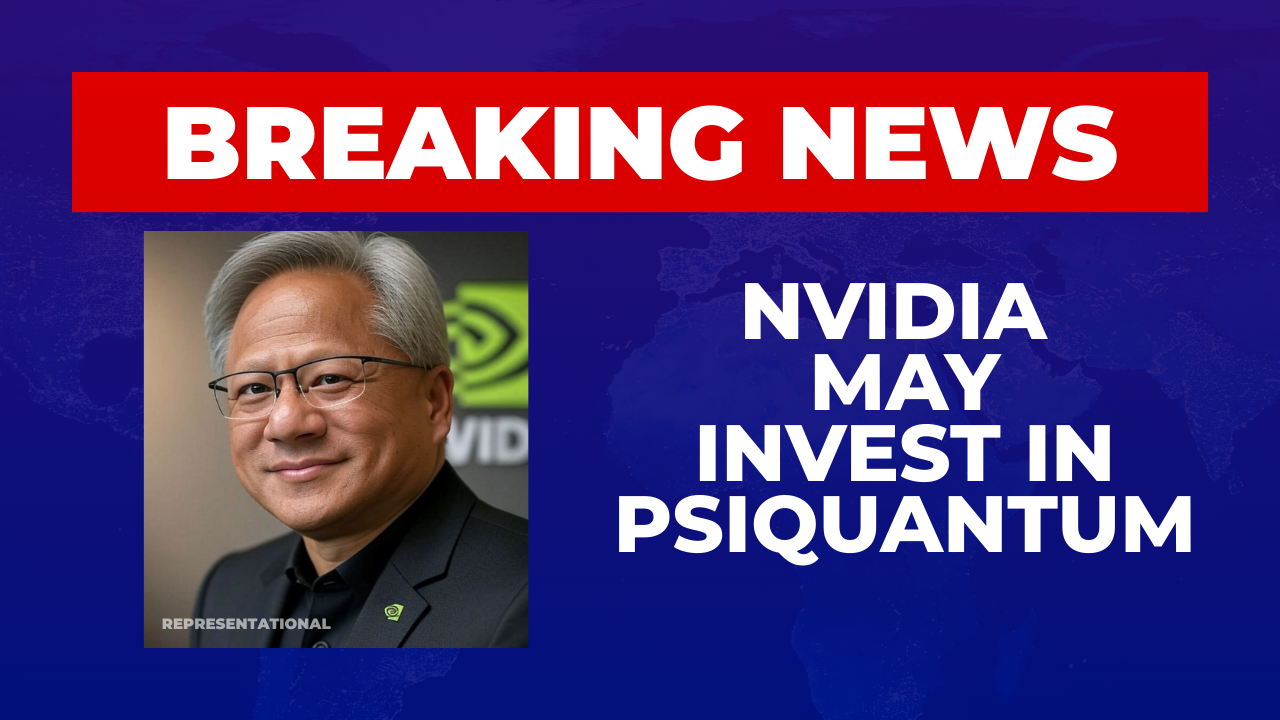
Nvidia (NVDA), the leading producer of graphics processing units (GPUs) critical for cryptocurrency mining, is reportedly in advanced talks to invest in PsiQuantum, a quantum computing startup valued at $6 billion pre-money, according to Reuters. This strategic move, as Nvidia prepares to announce its Q1 earnings on May 28, 2025—with expected earnings of $0.89 per share and revenue of $43.07 billion—could redefine its role in the tech landscape
PsiQuantum, backed by a $750 million funding round led by BlackRock (BLK), which closed Friday at $989.71 (–0.79%), is pioneering photonic quantum computing. Unlike traditional quantum systems, PsiQuantum’s approach uses photons and standard semiconductor manufacturing, enabling scalable production of its Omega chipset. The company aims to deliver a commercially viable quantum computer by 2029, with partnerships including GlobalFoundries, DARPA, and government projects in Chicago and Brisbane.
Quantum computing leverages quantum mechanics—superposition, entanglement, and interference—to perform calculations far beyond the capabilities of classical computers, including Nvidia’s GPU-powered AI systems. For cryptocurrency, quantum computers could break current cryptographic algorithms, threatening blockchain security. A 2023 study suggested quantum attacks could compromise Bitcoin within a decade, urging the development of quantum-resistant encryption.
Nvidia’s GPUs dominate crypto mining and AI, but quantum computing could unlock new applications in cybersecurity, drug discovery, and financial modeling. PsiQuantum’s scalable technology aligns with Nvidia’s recent quantum initiatives, including its Boston research center and “Quantum Day” event. This investment could position Nvidia to address quantum threats to crypto while diversifying its portfolio.
As quantum technology advances, its impact on cryptography and digital finance grows. Nvidia’s potential stake in PsiQuantum signals a bold step toward shaping the future of computing and securing cryptocurrency’s foundation.
Company Overview: Founded in 2016, PsiQuantum is a Palo Alto–based private quantum computing startup focused on photonic quantum computing. Using photons as qubits and semiconductor manufacturing, it aims to build a million-qubit system by 2029. In 2025, it raised $750 million at a $6 billion pre-money valuation, led by BlackRock (BLK, $989.71).
Stock Status: PsiQuantum is not publicly traded and has no ticker symbol (PSIQ belongs to another entity). Pre-IPO shares trade on platforms like Hiive, with December 2024 prices at $13–$15 per share. No IPO filing exists yet, but its funding and partnerships suggest a future listing is possible.
Investment Context: PsiQuantum’s Omega chipset, a $10.8 million Air Force contract, and Nvidia’s investment talks highlight its potential. However, pre-IPO investing is high risk, limited to accredited investors, and speculative due to quantum computing’s early stage.
Explaining Quantum Computing Quantum computing harnesses quantum mechanics to process information in ways classical computers cannot. Unlike classical bits (0 or 1), quantum bits (qubits) exist in superposition, representing 0 and 1 simultaneously. Qubits can also be entangled, linking their states across distances, and use interference to amplify correct solutions. These properties enable quantum computers to tackle complex problems—like factoring large numbers or simulating molecules—exponentially faster than classical systems, including Nvidia’s GPU-powered AI.
For cryptocurrency, quantum computing poses a dual-edged sword. It could break widely used cryptographic algorithms (e.g., RSA, ECC), potentially compromising blockchain security. For instance, Shor’s algorithm on a large-scale quantum computer could crack Bitcoin’s encryption, exposing wallets. However, quantum computing also offers solutions, like quantum-resistant cryptography, to secure future blockchains. Beyond crypto, it promises breakthroughs in cybersecurity, drug discovery, and optimization, making investments like Nvidia’s in PsiQuantum critical for technological leadership.
Disclaimer: This article is written in good faith and with proper care. However, complete accuracy is not guaranteed. Updates or corrections will be made wherever necessary. This article does not constitute financial advice. It is meant for informational and educational purposes only. Some parts of the content have been prepared with the help of AI tools, but the article has been published after careful editorial review.
With over 3 years of experience in financial markets, we focus on simplifying global and Indian markets through clear, practical insights. Our expertise also extends to the evolving landscape of digital finance, including blockchain, stablecoins, and decentralized finance (DeFi).
Engaged in the business of power generation through renewable energy sources such as solar, Waaree Renewables Technologies Ltd is a subsidiary company of the Waaree Group. It manages the execution of Engineering, Procurement, and Construction (EPC) works for solar power projects.
The company has received a massive order worth ₹114.23 crore, as informed through an exchange filing. The order has been awarded by a domestic entity, although the name of the entity was not disclosed in the document. The company received the Letter of Award on May 16, 2025. This order falls under the Mukhyamantri Saur Krushi Vahini Yojana-2.0 (MSKVY 2.0) scheme.
The Order Details Waaree Energies will construct a 94 MW AC / 131.6 MW DC ground-mounted solar power plant. AC (Alternating Current) capacity refers to the usable power that is sent to the grid after conversion from DC, while DC (Direct Current) is the raw power output generated by solar panels before losses in conversion. The plant will be spread across multiple agricultural zones identified under the MSKVY 2.0 initiative.
Under the EPC (Engineering, Procurement, and Construction) scope, Waaree will oversee all aspects of the project:
Design & Engineering: Includes plant layout, module alignment, electrical single-line diagrams, and foundation planning.
Procurement: Sourcing of solar panels, inverters, module-mounting structures, cabling systems, and all auxiliary equipment.
Construction & Commissioning: Covers site preparation, solar module installation, electrical wiring, inverter commissioning, grid connection, and overall system testing.
Furthermore, Waaree will be responsible for Operation & Maintenance (O&M) services over five years, which will include:
Monitoring: Continuous performance tracking and analytics to detect faults promptly.
Preventive Maintenance: Regular panel cleaning, torque and alignment checks, and vegetation control.
Corrective Maintenance: Quick resolution of faults, including inverter replacement, damaged panel repair, and electrical troubleshooting.
The entire project is expected to be completed by March 31, 2026, which is the end of the FY 2025-26 timeline.
Waaree RTL has a huge order book of 2,191 MWp that is yet to be executed. This is expected to be completed within 9–12 months.
The company exports its products to over 68 countries across the world.
Promoters hold a significant portion of the company, with the ownership percentage standing at 75%.
The company’s stock split from a face value of ₹10 to ₹2 in 2024, meaning it was done in the ratio of 1:5.
With a market cap of approximately ₹10,720 crore, shares of the company are trading at a P/E of 56.90. The company has generated a ROE of 58.93% over the period.
The company had reported a net profit margin of 17.17% in FY 2023–24.
Disclaimer: This article is for informational and educational purposes only. It does not constitute financial advice. The author is not a registered financial advisor. While the content is written in good faith and with the utmost care, complete accuracy is not guaranteed. However, updates and corrections will be made as needed to ensure current and correct information.
With over 3 years of experience in financial markets, we focus on simplifying global and Indian markets through clear, practical insights. Our expertise also extends to the evolving landscape of digital finance, including blockchain, stablecoins, and decentralized finance (DeFi).