3 Easy Ways to Enable Candlestick Timer in TradingView

Many trading strategies depend heavily on candle close confirmation, especially setups where entries, exits, or validations are considered reliable only after a candlestick has fully completed its formation.

In such cases, the candlestick close timer, officially called the ‘Countdown to Bar Close’, becomes an essential visual tool. This timer shows how much time remains before the current candle closes, helping traders avoid premature decisions and emotional entries during an unfinished price move.

Why the ‘Countdown to Bar Close’ Sometimes Disappears?

In TradingView, this feature can disappear if chart settings are changed unknowingly while experimenting with customization options.

The candlestick close timer does not vanish due to a system error or platform limitation. In most cases, it is turned off unintentionally when users adjust time scale settings, modify chart preferences, or experiment with visual layouts.

Since TradingView offers extensive chart customization, it is very easy to disable certain display elements without realizing their importance at the moment.

Also Read – 3 Easy Methods to Hide Candlesticks in TradingView


If your candle time is not showing, here are 3 simple methods to enable the candle timer for any timeframe in TradingView.

Method One: Enabling the ‘Countdown to Bar Close’ from Chart Settings

The most direct and controlled way to bring back the candlestick close timer is to enable it manually from the chart settings.

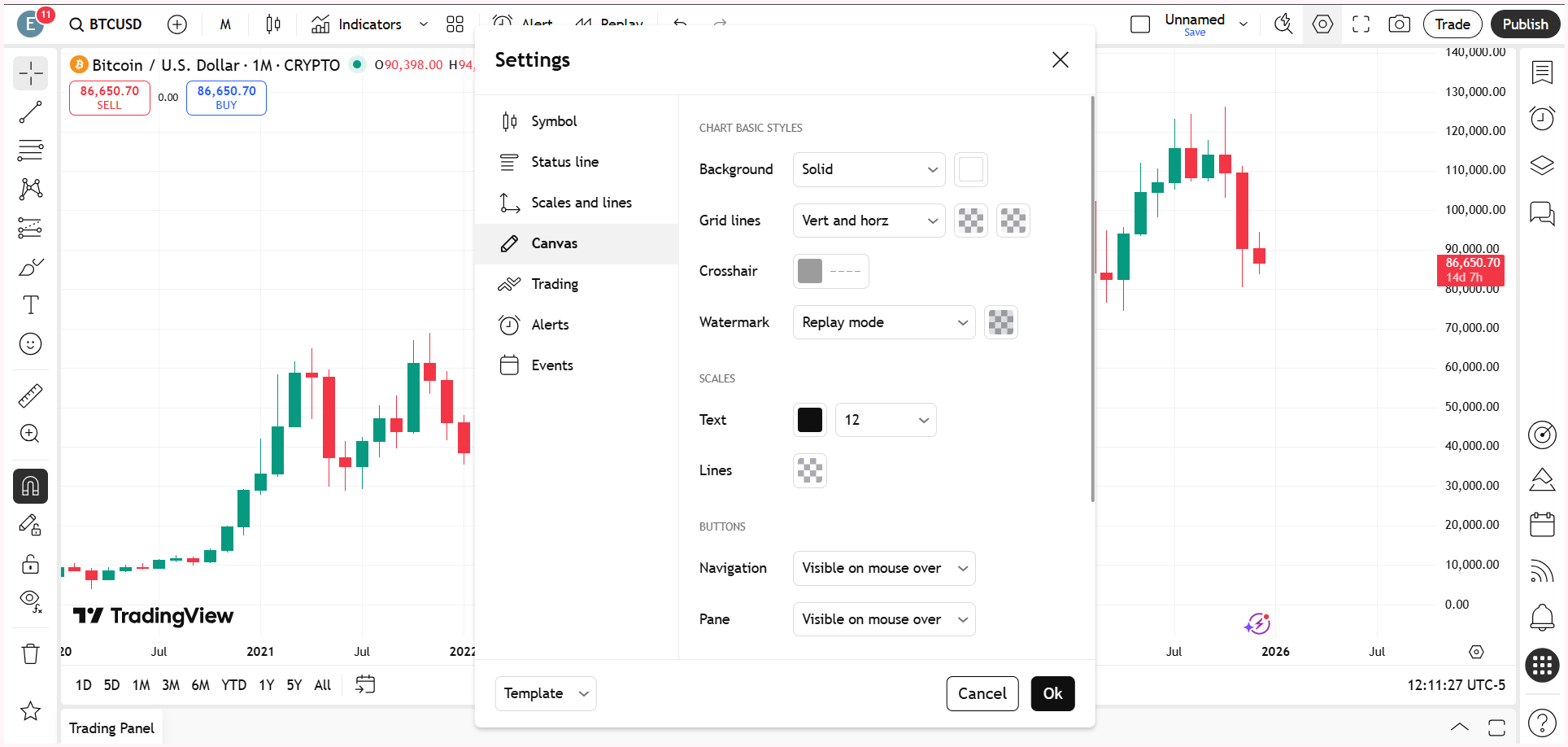
Right-click anywhere on the chart and open Settings. Then go to the Scales and Lines section and look for the option called ‘Countdown to Bar Close.’ Simply tick this option.

Once enabled, the countdown timer immediately appears on the price chart and starts showing the remaining time for the active candlestick on TradingView.

This method is ideal for traders who want to keep their existing chart layout, indicators, and visual preferences unchanged while restoring only the missing timer.

The most straightforward and controlled way to restore the candlestick close timer is to enable it manually through the chart settings.

Alternatively, you can access the Scales and Lines option by right-clicking directly on the price scale. Select More Settings, and then follow the same steps under Scales and Lines as explained above.

Method Two: Fix Candle Timer from Labels Menu

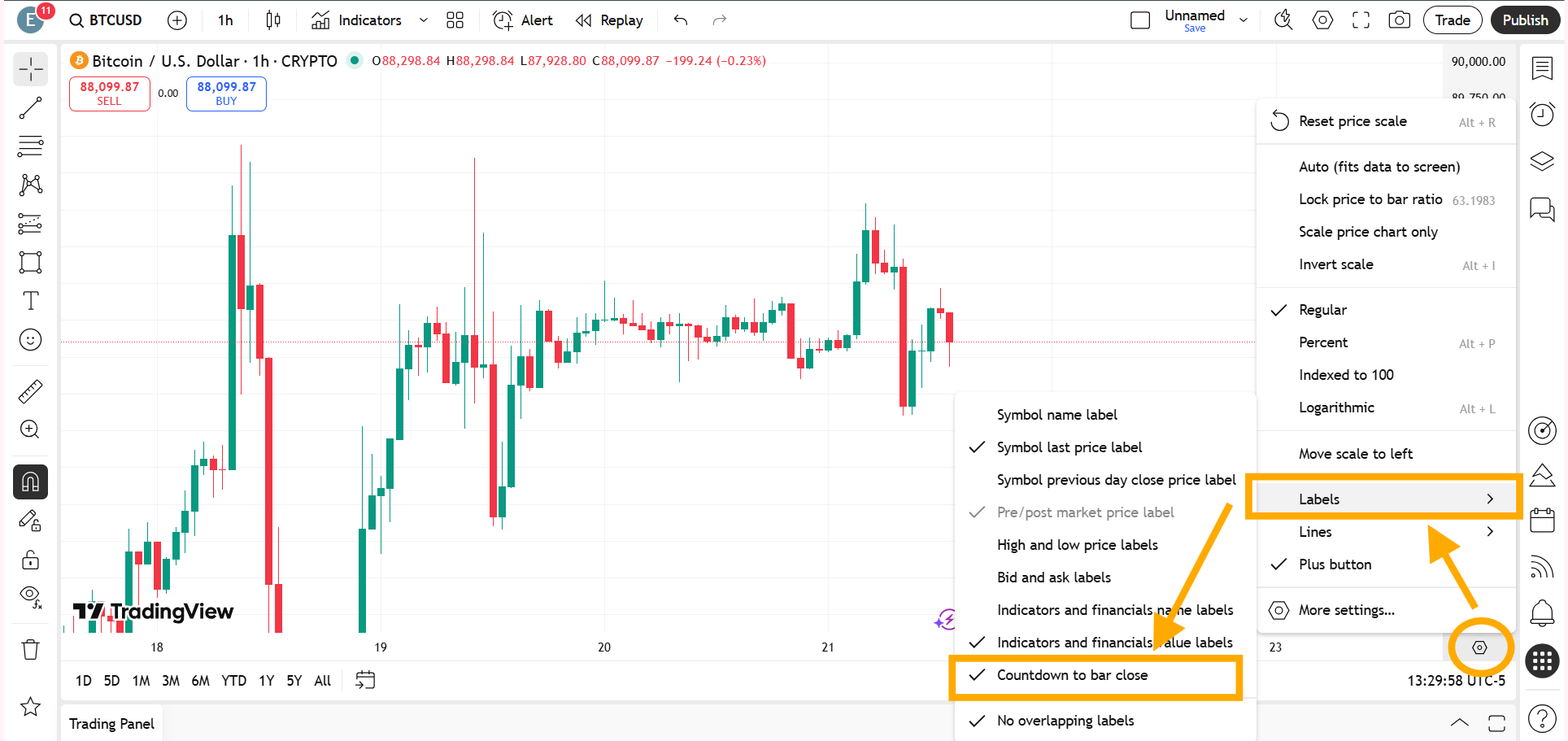
Click on the settings icon at the bottom of the price scale of the trading instrument and go to Labels.

When you hover your cursor over Labels, several options will appear. Find Countdown to Bar Close and enable it.

Once selected, the timer will start showing again.

You can restore the candle close timer by clicking the settings icon at the bottom of the price scale in TradingView, navigating to Labels, and enabling Countdown to Bar Close.

Method Three: Restoring the Timer by Resetting the Chart to Default

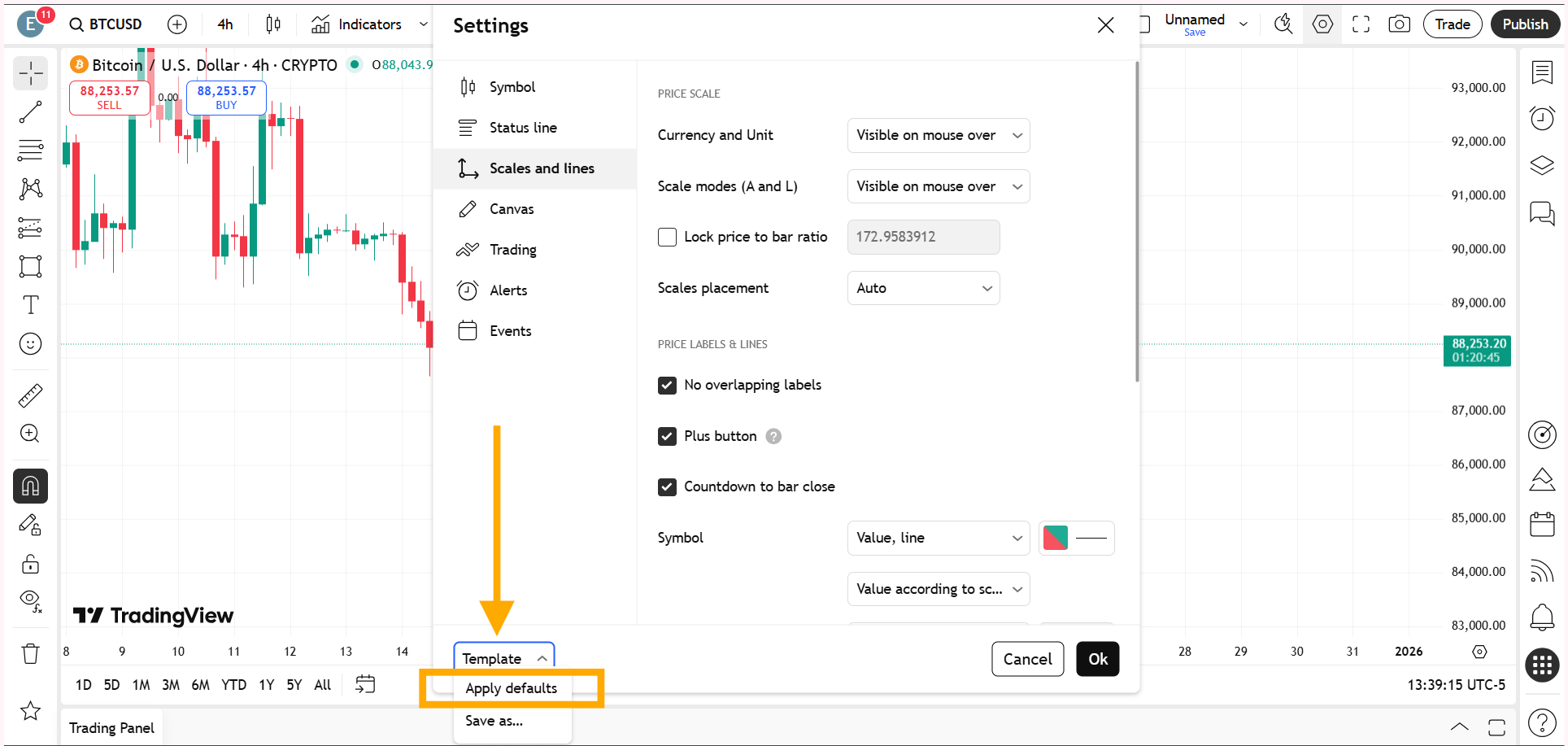
Another effective way to enable the candlestick close timer is by resetting the chart to its default configuration.

Because the Countdown to Bar Close is included in TradingViewโ€™s default chart layout, resetting the chart automatically brings the timer back along with the standard visual settings.

Since the Countdown to Bar Close is part of TradingViewโ€™s default chart setup, resetting the chart automatically restores the timer along with other standard visual settings.

By reverting the chart to its original state, all hidden or disabled features, including the candlestick close timer, become visible again.

While this approach may remove some customizations, it provides the fastest solution when troubleshooting becomes confusing or time-consuming.


Also Read – Candlesticks Not Showing or Visible in TradingView? โ€“ Complete Solution Guide

Which Method Should You Use?

All the methods ultimately lead to the same result, but the choice depends on the traderโ€™s specific situation.

If the chart is heavily customized and only the timer is missing, manually enabling the ‘Countdown to Bar Close’ is the better option.

On the other hand, if multiple chart elements are behaving unexpectedly or the cause of the missing timer is unclear, resetting the chart to default can save time and effort.


For a better understanding, watch the full video below.

This article is for informational purposes only and should not be considered financial advice. Investing in stocks, cryptocurrencies, or other assets involves risks, including the potential loss of principal. Always conduct your own research or consult a qualified financial advisor before making investment decisions. The author and publisher are not responsible for any financial losses incurred from actions based on this article. While efforts have been made to ensure accuracy, economic data and market conditions can change rapidly. The author and publisher do not guarantee the completeness or accuracy of the information and are not liable for any errors or omissions. Always verify data with primary sources before making decisions.
What time do the 4 hour candles close?

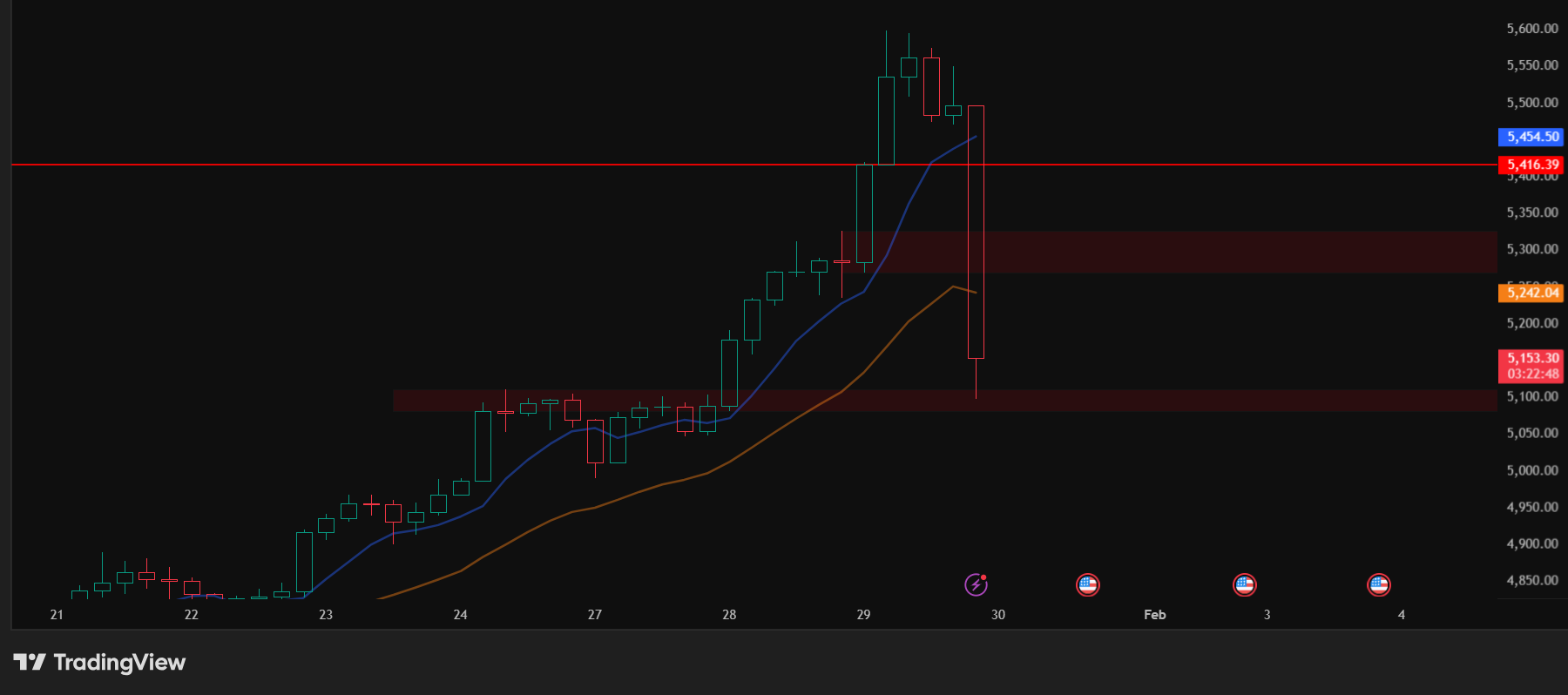
The answer is already contained in the question itself. A 4-hour candlestick closes exactly four hours after it opens. After every four hours, the current candle closes and a new 4-hour candle begins, which will again close after the next four hours. This happens only when the selected timeframe is set to 4H.
On TradingView, you can check the remaining time for a candle to close on the right-side price scale by enabling the candle close timer. This shows how much time is left before the current 4-hour candle closes.

Candlesticks Not Showing or Visible in TradingView? – Complete Solution Guide

When candlesticks are not showing or visible in TradingView, the issue is usually straightforward once you know where to look. Whether it is caused by unticked candle settings, hidden objects, an accidental chart type switch, a color clash, or extreme zoom levels, each of these problems can be resolved directly from the chart interface.

If you open a chart and suddenly notice that candlesticks are missing, invisible, or seem to have disappeared, it can be frustrating – especially when you are actively analyzing the market. This is one of the most common TradingView chart problems and is often mistaken for a loading issue or platform bug. In reality, candles not showing on TradingView is usually caused by a few specific settings or visual conflicts that can be fixed within seconds.

This article explains all the major reasons why a TradingView chart is not showing candles and shows you exactly how to unhide candlesticks on TradingView step by step.

Why Candlesticks Disappear on TradingView?

The root cause is rarely a server-side issue. In most cases, the chart is working perfectly, but certain visual settings, chart types, or zoom levels make the candles invisible.

Understanding how TradingView handles chart styles, object visibility, and color settings will help you quickly diagnose and fix the problem.

Also Read – 3 Easy Methods to Hide Candlesticks in TradingView

5 Possible Reasons Why Candlesticks Are Not Showing in TradingView

When candles are not showing or visible in TradingView, the solution is usually simple once you know where to look. Most issues can be fixed directly from the chart interface in just a few seconds.

Before learning how to bring candles back on a candlestick chart, first make sure you are on the correct instrument. For example, in my case, the instrument is BTCUSD.

Below are the five most common reasons candlesticks are not showing on TradingView.

Body, Wick, or Border Accidentally Unticked in Chart Settings

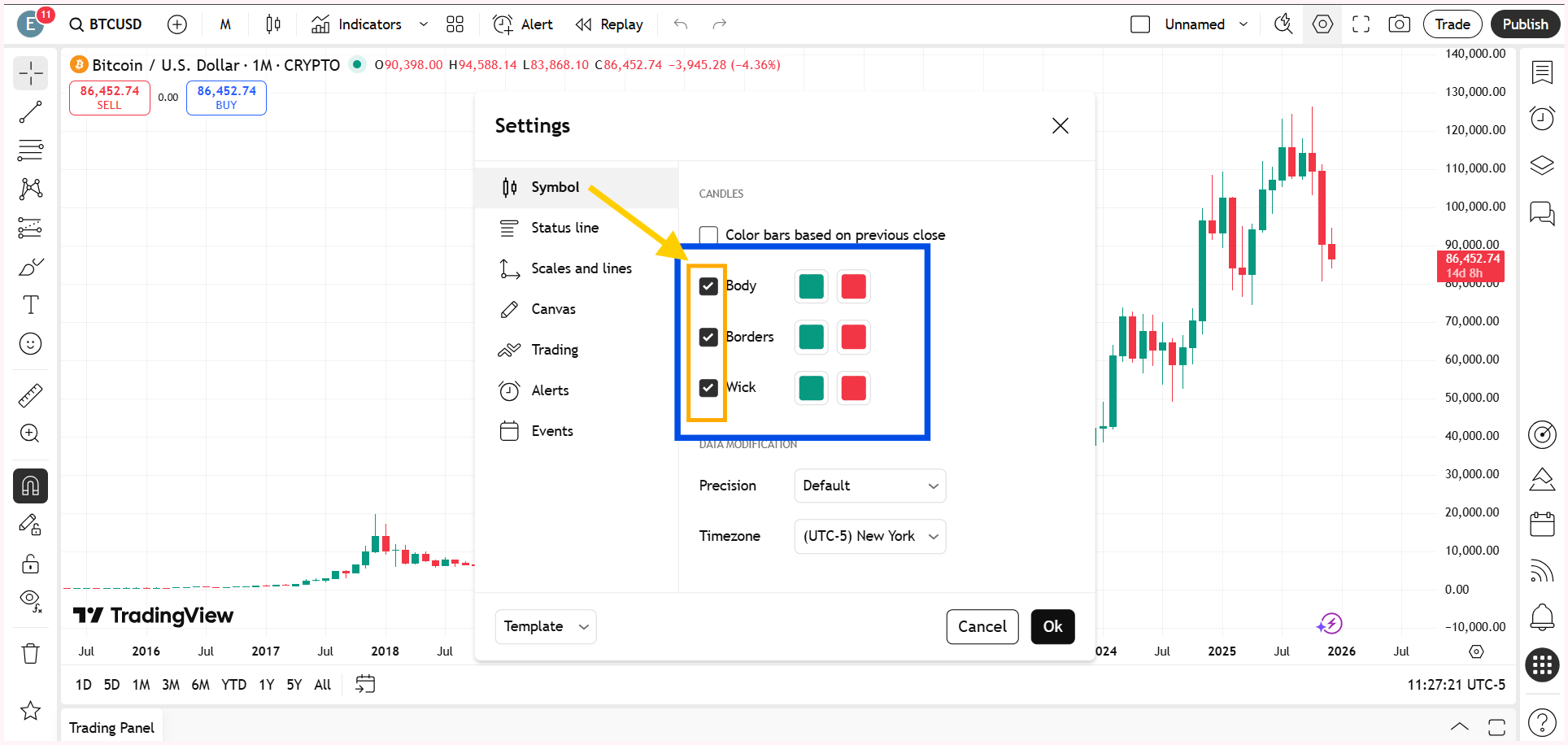
One of the most overlooked reasons for candles not showing on TradingView is related to candle style settings. TradingView allows you to individually control the visibility of the candle body, wick, and border. If the body, wick, or border option is unticked, the candles technically exist on the chart but are not visible.

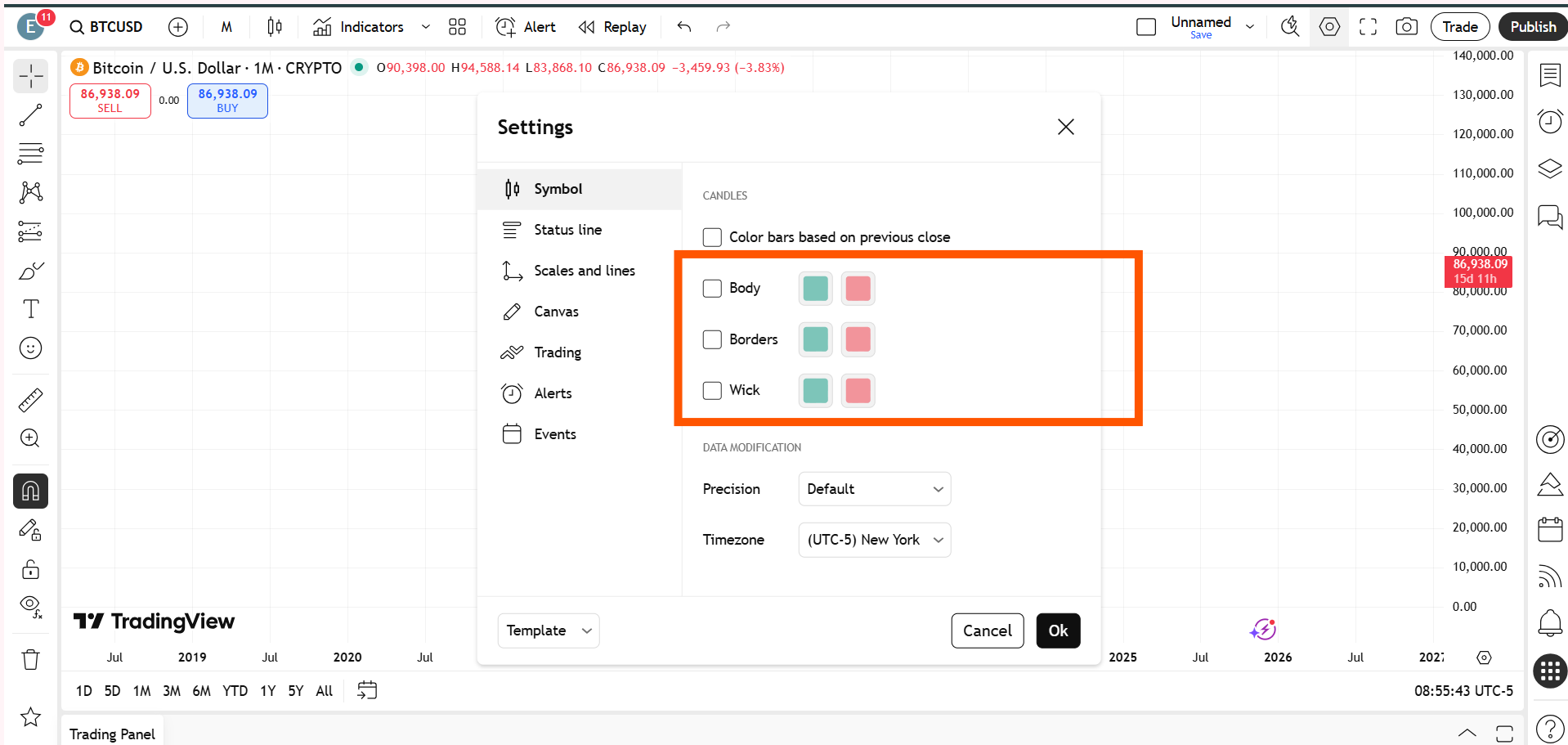
So, right-click on the chart and go to Settings. Within the Symbol option, make sure the body, wick, and border are ticked.

Right-click anywhere on the chart and open Settings. Inside the Symbol section, ensure that the body, wick, and border options are enabled.

Candles Hidden from the Object Tree or Data Window

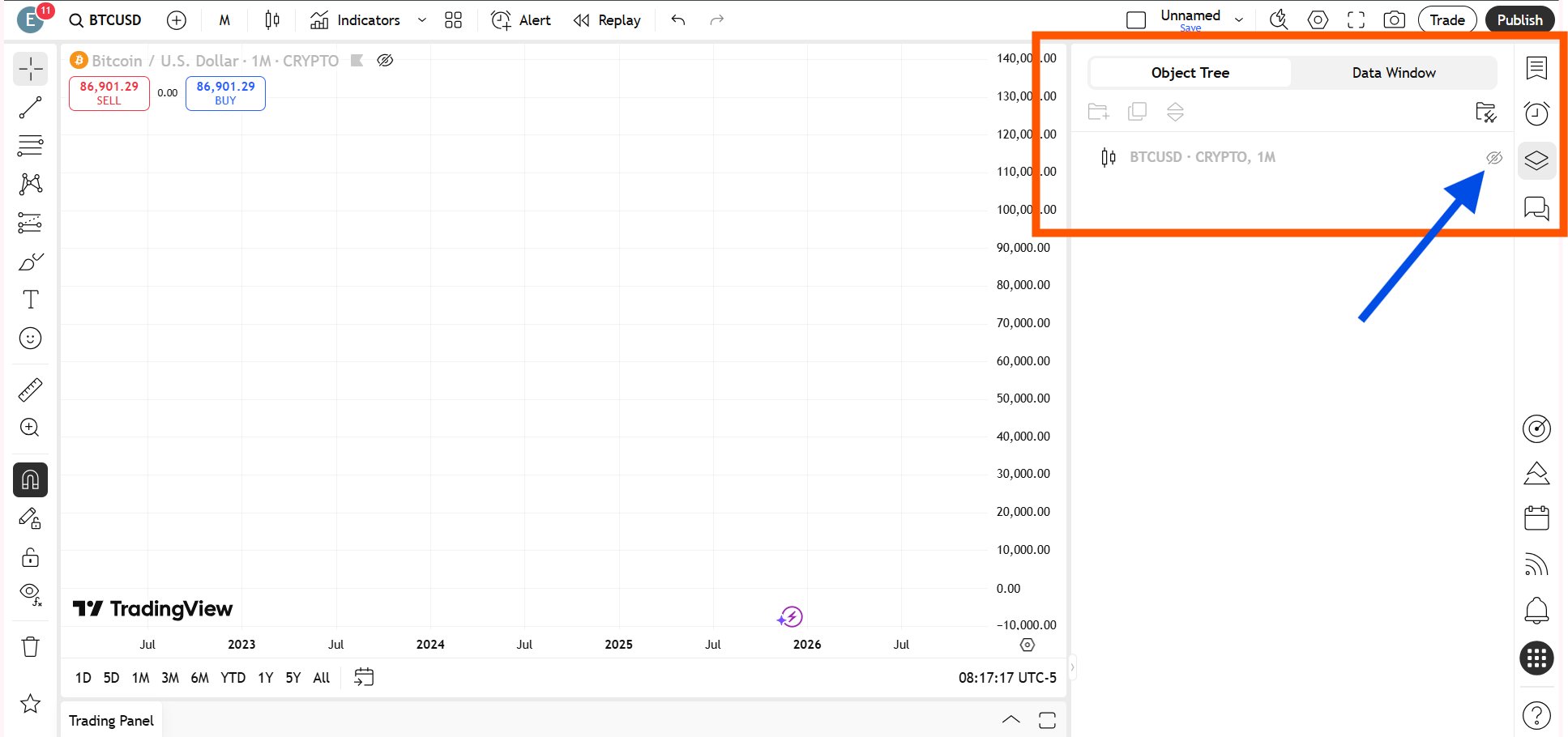
Another common TradingView chart problem occurs when candle visibility is disabled through the object tree or data window.

Just click on the Object Tree and Data Window on the right-side toolbar and check whether the eye icon is turned on or off.

By opening the object tree or data window and turning visibility back on, you can immediately unhide candles on TradingView.

Switched to a Different Chart Type by Mistake

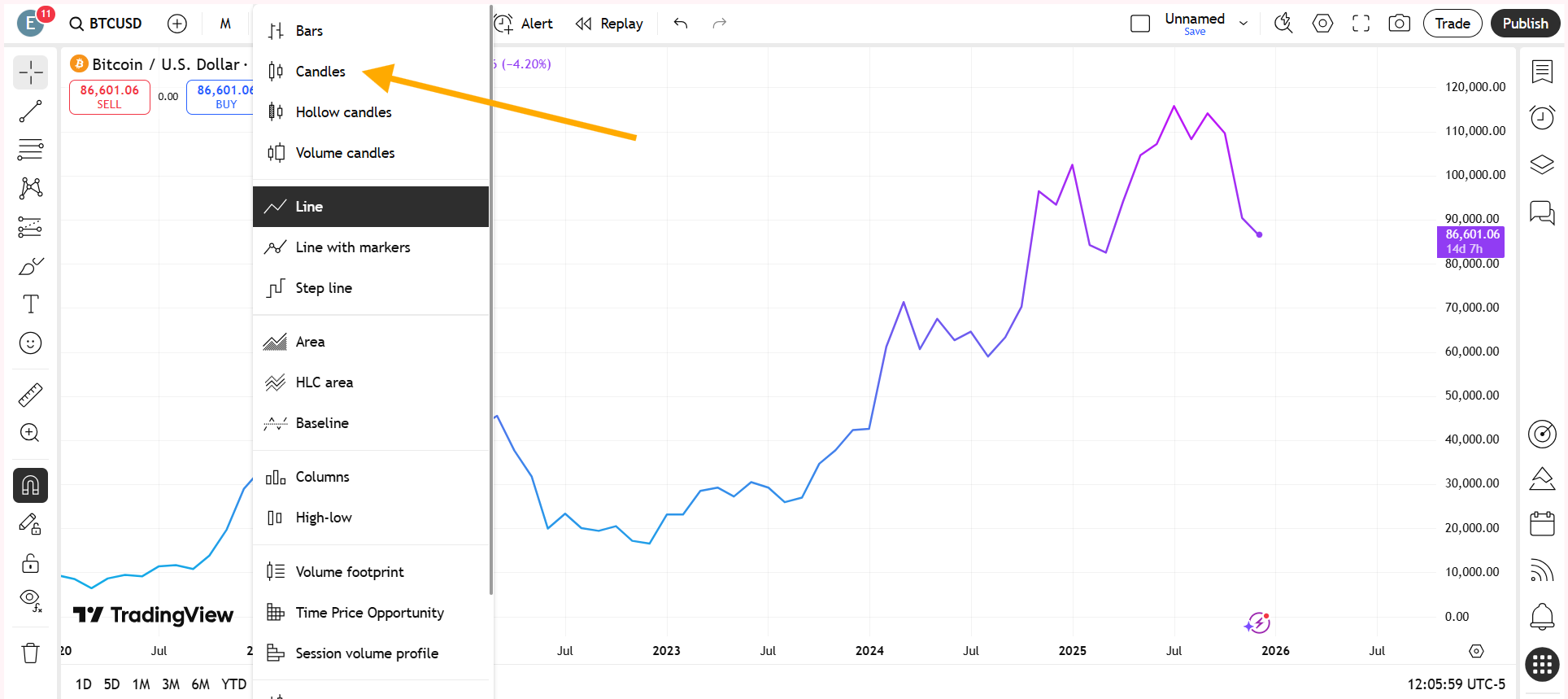
You may have accidentally changed the chart type to something like a line chart, and that is why you are no longer seeing candlesticks.

When the chart type is switched away from candlesticks, the candles do not disappear due to an error; they are simply replaced by another visual format. Switching the chart type back to candlestick instantly brings the candles back onto the chart, restoring the standard price view used for technical analysis.

How to change a line chart to a candlesticks chart on TradingView?

Open your chart on TradingView. Look at the top-left corner of the chart toolbar and click on the Chart Type icon. This icon usually displays the currently selected chart style, such as a line chart.

Switching the chart type back to candlestick instantly brings the candles back onto the chart, restoring the standard price view used for technical analysis.

From the dropdown menu, select Candlesticks. Once selected, the chart will instantly switch from a line chart to a candlestick chart.

Chart Background and Candle Color Clash

Sometimes the candles are present but completely blend into the chart background. If the candle color is identical or very close to the background color, the chart appears empty even though data is loaded.

This color clash usually occurs after applying a dark or custom theme or importing chart templates from other users.

Changing either the chart background color or the candle body and wick colors can immediately restore visibility and resolve the issue of candlesticks not showing on TradingView, without any technical troubleshooting.

Adjusting either the background color or the candle body and wick colors restores visibility and fixes the TradingView chart not showing issue without any technical troubleshooting.

Also Read – What is the difference between ICT and SMC?

Extreme Zoom Level Hiding Candlesticks

An extreme zoom-in or zoom-out level can also make candlesticks disappear on TradingView. When zoomed out too far, individual candles become too compressed to render clearly. When zoomed in too much, the chart may appear blank because the visible range contains no price data.

Resetting the chart view brings the candlesticks back into view immediately. Alternatively, you can press Alt + R.

This is one of the simplest fixes and should always be checked before assuming a chart loading problem.


Watch the full video below so you donโ€™t miss any important steps.

This article is for informational purposes only and should not be considered financial advice. Investing in stocks, cryptocurrencies, or other assets involves risks, including the potential loss of principal. Always conduct your own research or consult a qualified financial advisor before making investment decisions. The author and publisher are not responsible for any financial losses incurred from actions based on this article. While efforts have been made to ensure accuracy, economic data and market conditions can change rapidly. The author and publisher do not guarantee the completeness or accuracy of the information and are not liable for any errors or omissions. Always verify data with primary sources before making decisions.
Why is My TradingView Chart Not Showing Anything?

When a TradingView chart is not showing, it is usually not a data or server issue. In most cases, the chart is loaded but the candlesticks are hidden due to candle style settings, an accidental chart type change, extreme zoom levels, or visibility being turned off in the object tree or data window. Checking these settings typically restores the chart instantly.

Why is My TradingView Chart Not Loading Properly?

In some cases, a TradingView chart may not load properly due to a temporary technical glitch or a short connectivity issue. This can happen because of browser cache problems, momentary internet interruptions, or brief platform-side delays. When this occurs, simply refreshing the page or reloading the chart usually resolves the issue. If the problem persists, checking your internet connection or reopening the chart in a new tab can help restore normal chart loading on TradingView.

3 Easy Methods to Hide Candlesticks in TradingView

Learn three simple ways to hide candlesticks in TradingView and keep your charts clean, clear, and easy to analyze.

TradingView is one of the most widely used charting platforms among traders and investors. Although candlesticks are the default chart type, there are many situations where traders prefer to hide candlesticks to keep the chart clean and focused.

TradingView does not provide a single dedicated button called โ€œHide Candlesticks,โ€ but there are three simple and effective methods that allow you to remove candlesticks from your chart.

Why Do Traders Hide Candlesticks in TradingView?

Traders often choose to hide candlesticks to reduce visual clutter and keep their charts clean, simple, and easier to read, especially when too much price detail starts to overwhelm the view. Many do this to focus more clearly on indicators such as moving averages, VWAP, or oscillators, where the signal matters more than individual candle movements. Candlesticks are also hidden when traders want to study key price levels, zones, and overall market structure without unnecessary distractions. In drawing-heavy setups filled with trendlines, boxes, or Fibonacci tools, removing candlesticks helps bring clarity to the analysis and allows traders to concentrate on decision-making rather than noise.

Also Read – Candlesticks Not Showing or Visible in TradingView? โ€“ Complete Solution Guide

Method 1: Hide Candlesticks Using Chart Settings in TradingView

This method allows you to completely remove candlesticks by modifying the candlestick appearance settings. It is the most accurate and controlled way to hide candles without changing the chart type.

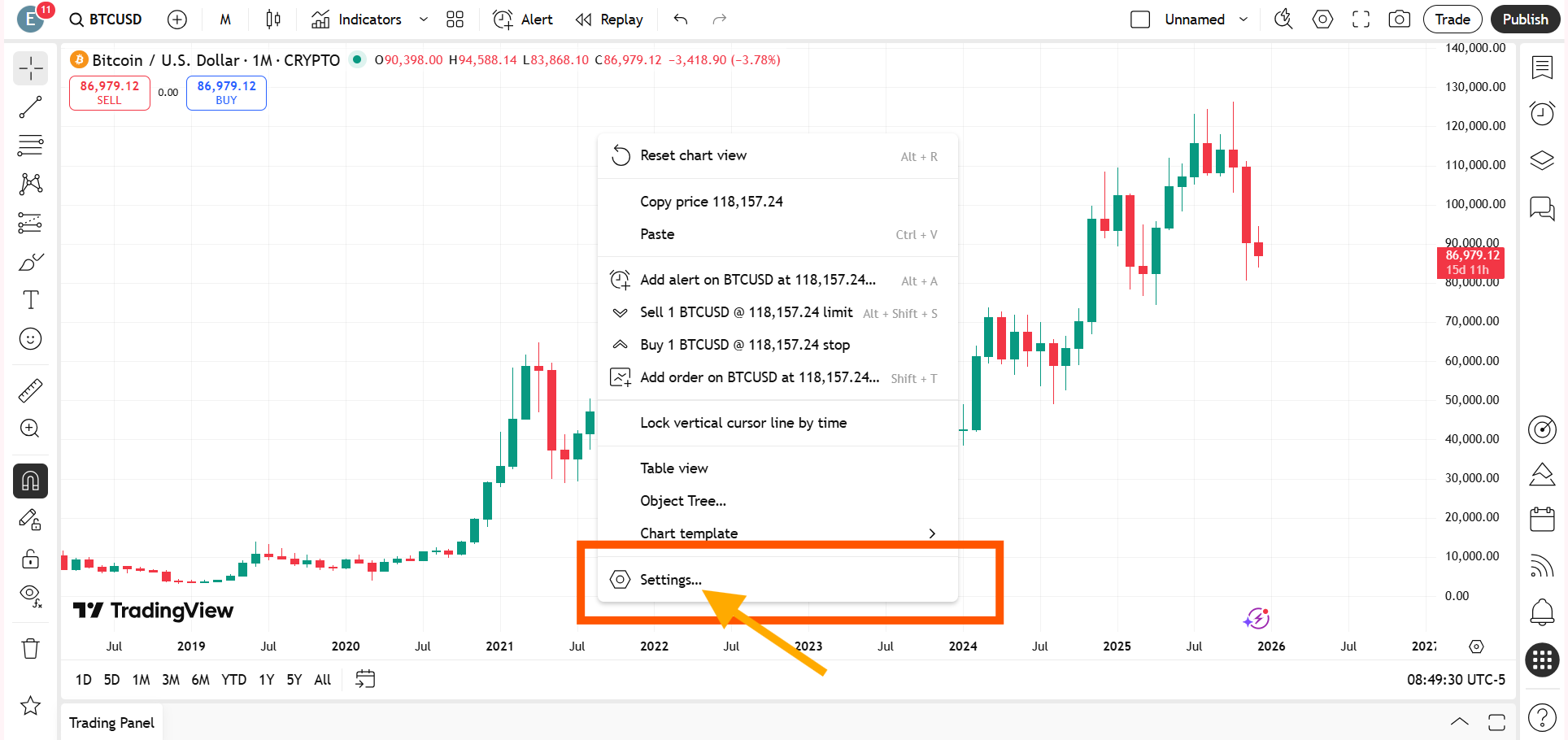
You need to right-click anywhere on the chart in TradingView to open the chart menu, and then click on Settings from the menu options.

Steps:

  1. You need to right-click anywhere on the TradingView chart to open the chart menu.
  2. You need to click on Settings from the menu options.
  3. You need to open the Symbol tab inside the settings panel.
  4. You need to uncheck the Body option so that the candle body is no longer visible.
  5. You need to uncheck the Wick option so that the candle wicks disappear from the chart.
  6. You need to uncheck the Border option so that the candle outlines are removed.
  7. You need to click OK to apply the changes.
Once the body, wick, and border are turned off, the candlesticks will no longer be visible on the chart.

After disabling the body, wick, and border, the candlesticks will be completely hidden from the chart.

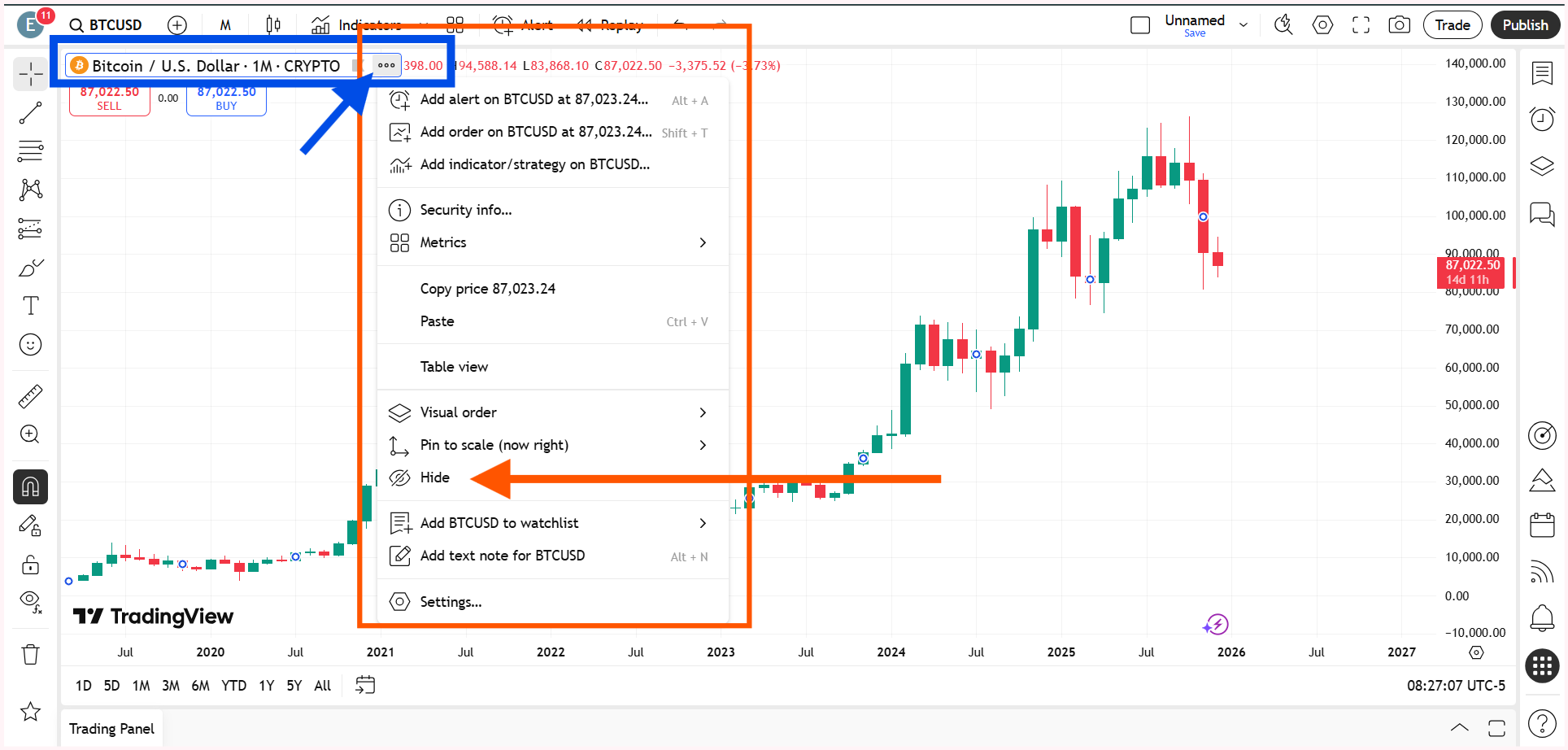
Method 2: Hide Candlesticks from the Top-Left โ€œMoreโ€ Menu

This is the fastest method to hide candlesticks and works directly from the chart interface without opening detailed settings.

As soon as you click Hide symbol, the candlesticks will instantly disappear from the chart.

Steps:

  1. You need to look at the top-left corner of the chart where the symbol name is displayed.
  2. You need to click on the three dots icon, also known as the More options menu.
  3. You need to select Hide Symbol from the dropdown list.

Once you click Hide symbol, the candlesticks will instantly disappear from the chart.

Also Read – What is the difference between ICT and SMC?

Method 3: Hide Candlesticks Using Object Tree and Data Window

This is probably the easiest and fastest way to hide the candlesticks on the chart.

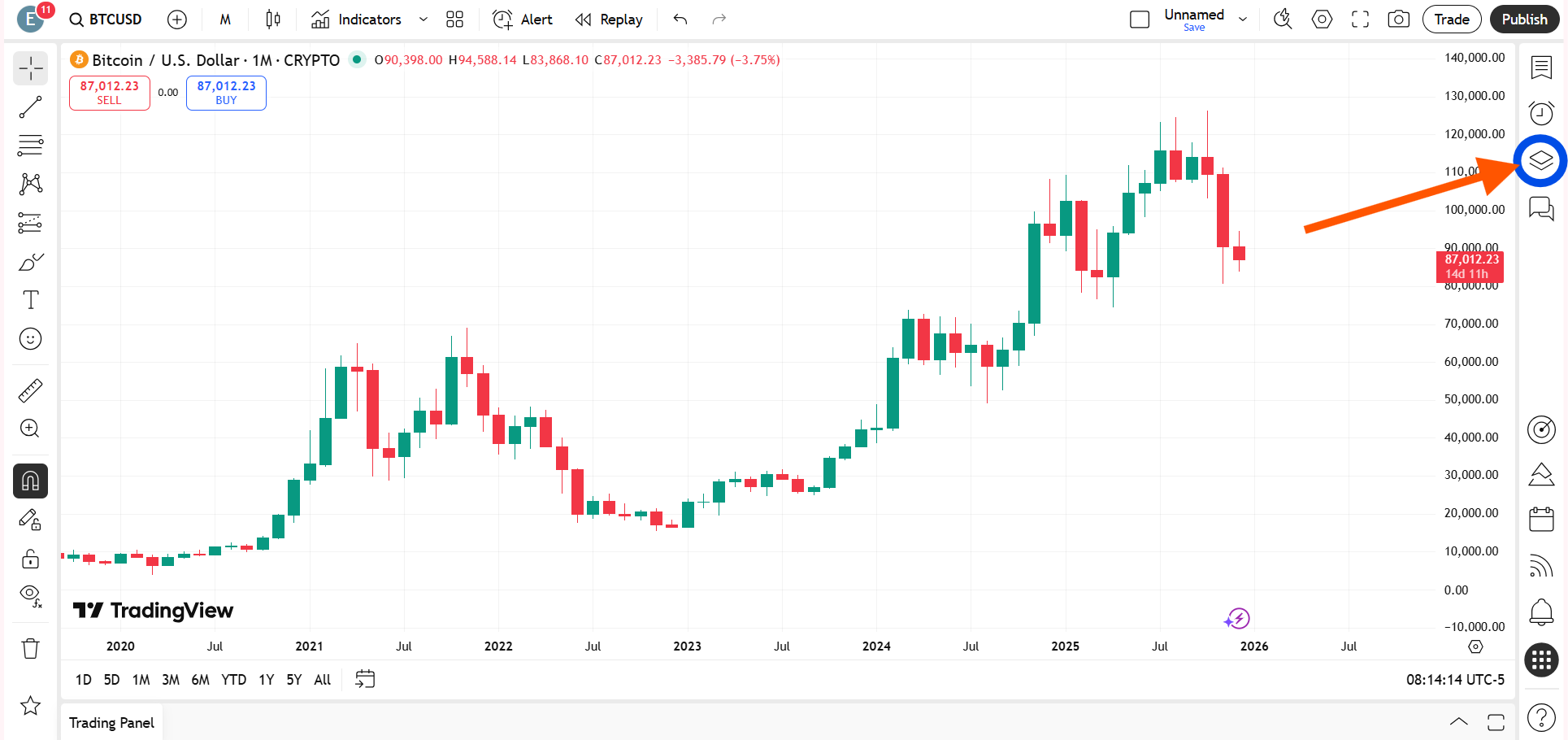
You can access the Object Tree and the Data Window from the right-side toolbar in TradingView.
  1. You need to open the Object Tree & Data Window from the right-side toolbar in TradingView.
  2. You need to locate the main price symbol inside the Object Tree.
  3. You need to click on the eye icon next to the symbol to hide it from the chart.
You need to click on the eye icon next to the symbol inside the Object Tree or the Data Window to hide the candlesticks from the chart.

Alternatively, you can do the same within the Data Window, using the same option the same option on the right-side toolbar in TradingView.

Both options allow you to control the visibility of candlesticks without altering chart layout or indicator settings.


Watch the video below to avoid missing any important steps.

This article is for informational purposes only and should not be considered financial advice. Investing in stocks, cryptocurrencies, or other assets involves risks, including the potential loss of principal. Always conduct your own research or consult a qualified financial advisor before making investment decisions. The author and publisher are not responsible for any financial losses incurred from actions based on this article. While efforts have been made to ensure accuracy, economic data and market conditions can change rapidly. The author and publisher do not guarantee the completeness or accuracy of the information and are not liable for any errors or omissions. Always verify data with primary sources before making decisions.

SMC-ICT – A Sophisticated Price Action Course for 2026

SMCโ€“ICT Mastery: The Advanced Price Action Framework for 2026

What is SMC?

SMC is simply a smart and efficient way of trading. It is a structured way of approaching the markets.

It is the process of identifying the best liquidity and the best discount zone when you are planning to buy – essentially โ€œthinking like a big bull.โ€

Or finding the best premium zone when you want to sell – โ€œthinking like a big bear.โ€

That is the core meaning of Smart Money Concepts.

The universal rules still remain the same:

โ€ข The best discount zone is the demand/support zone.
โ€ข The best premium zone is the supply/resistance zone.


The SMC vs ICT confusion

There is a common debate about whether SMC originated from ICT (Michael J. Huddleston).

Some argue that concepts like FVG and Order Blocks were introduced by ICT and later repackaged under the name SMC.

ICT claims this himself.

It may be true, or it may not be – we do not have an official conclusion.

But what is clear is that ICT has deep experience in financial markets, and he has introduced many strong concepts. His approach generally goes into micro-level price action analysis.

Modern SMC – or the version that people say is separate from ICT – is somewhat broader than ICTโ€™s complete methodology.

Yes, ICT has a very refined and structured approach. But if we focus purely on the term SMC, its meaning can simply be understood as trading in a smart way to capture the best liquidity and get the best price – whether you are a buyer or a seller.

There was a well-known trader, David Paul, who was also involved in trading education. He used a smart method that we now call a โ€œliquidity sweep,โ€ long before the term existed.

He used to say he places entries where the masses have placed their stops. A good trade is often a difficult trade. Large players can influence the market easily – this aligns with modern AMD where โ€œMโ€ stands for manipulation.

So, you could call it Davidโ€™s smart technique of trading.

And similarly, ICT (Michael J. Huddleston) has his smart technique of trading.

Ultimately, it depends on what you choose to follow.

The controversy will resolve when the right time and evidence come. It does not need to be our focus here.

Also Read – ICT (Michael J. Huddleston)-Biography, Net Worth, YouTube Channel, Family & Trading Success


What we will do here?

We follow a simple framework:

Technical Analysis < Price Action < Smart Money Concept < ICT-SMC (the refined approach from Michael J. Huddleston)

Also Read –What is the difference between ICT and SMC?

Yes, we believe in ICTโ€™s work. And yes, if someday strong verification proves that concepts like OB and FVG were first introduced by ICT, we would have no hesitation in accepting that.

But our approach starts broadly, using classical supportโ€“resistance theories, and then moves deeper.

Stay tuned for further learning.

This article is for informational purposes only and should not be considered financial advice. Investing in stocks, cryptocurrencies, or other assets involves risks, including the potential loss of principal. Always conduct your own research or consult a qualified financial advisor before making investment decisions. The author and publisher are not responsible for any financial losses incurred from actions based on this article. While efforts have been made to ensure accuracy, economic data and market conditions can change rapidly. The author and publisher do not guarantee the completeness or accuracy of the information and are not liable for any errors or omissions. Always verify data with primary sources before making decisions.

Understanding the Difference Between an Organization and a Company

If you are beginning to explore the stock market, this distinction between an organization and a company is the first concept you must understand. Everything in the stock market revolves around companies. Their financial performance, leadership, business strategy, and competitiveness determine how their stock behaves.

Before anyone begins learning about the stock market, it is essential to understand the difference between an organization and a company. Many beginners use both words as if they mean the same thing, but in the business world they represent two very different ideas.

Once this difference becomes clear, the entire structure of the stock market begins to make sense because stocks are always tied to companies, not organizations.


What Is an Organization?

An organization is a large umbrella structure that can include many different companies operating in different industries. You can think of an organization as a big family name that connects several businesses, even though each business may function independently.

In the United States, Alphabet is one of the clearest examples. Alphabet is the organization, and under it operate several individual companies such as Google LLC, YouTube, Waymo, and others. Each company has its own operations and goals, yet they are all connected through the Alphabet organization.

Another strong American example is Berkshire Hathaway. It is an organization headed by Warren Buffett, but inside it exist many individual companies like GEICO, BNSF Railway, Dairy Queen, and several others. Every company functions separately, but they all belong to the Berkshire Hathaway organization.

Understanding this structure helps clarify that an organization is not a single business. It is a parent-level entity under which multiple companies operate.


What Is a Company?

A company is a legally independent business entity created and recognized by the law of a country. In the United States, a company comes into existence when it is incorporated under state corporate laws. Once incorporated, it receives its own legal identity separate from the owners or shareholders.

To understand this better, it helps to revisit the classical definition of a company. Chief Justice Marshall described a company as an artificial, invisible, intangible person existing only in the eyes of the law. Because it is a creation of law, it possesses only those characteristics that the law grants to it, whether explicitly stated or essential to its existence.

A companyโ€™s evolution is an important concept. The company form of organization emerged as the third major stage in the development of business structures. Earlier stages allowed only small groups or individuals to own and manage a business. But as businesses grew, the need arose for a structure that could collect capital from a very large number of people. That led to the rise of the modern company.


A company raises money from many individuals called shareholders. These shareholders are the real owners of the company. But it is not practical for all shareholders to run the daily operations of the company. So they elect a Board of Directors. This board acts on behalf of the shareholders and takes key strategic decisions for the company.

Once the Board is appointed the responsibility of running the company is given to top executives. These executives handle daily operations and make sure the company works smoothly according to the boardโ€™s direction.

Managing Director or MD is the senior executive who oversees the overall functioning of the company. The MD ensures that every department is aligned with the companyโ€™s goals and reports major updates to the Board.

Chief Executive Officer or CEO is responsible for making major corporate decisions. The CEO leads the companyโ€™s long-term strategy and ensures that business goals are achieved. In many companies the roles of MD and CEO are held by the same person. In some companies they are separate roles.

Chief Financial Officer or CFO manages the financial planning of the company. The CFO looks after budgeting financial reporting tax planning and overall financial health. The CFO also works with the CEO and MD to decide how money should be used to grow the company.

Apart from these leaders companies also have other key executives:

Chief Operating Officer or COO manages day-to-day operations production logistics and overall efficiency of the company.

Chief Technology Officer or CTO looks after technology development product innovation and IT systems especially in tech-driven companies.

Company Secretary or CS ensures that the company follows all legal and compliance requirements and supports the Board in governance matters.

These leaders together form the top management team of the company. The Board provides direction. The top executives handle execution. And shareholders are the ultimate owners who expect the company to perform well and grow in value.

A company exists as a separate legal person, created by law and responsible to the law.

Companies usually raise their capital in the form of shares, which represent ownership, and in the form of debentures or other debt instruments, which represent borrowed funds. The entire stock market is built upon this system of raising and managing share capital.

Also Read – What If a Company Issues More Than Authorized Capital?


Why This Difference Matters in the Stock Market?

The stock market is built entirely on companies. Investors never buy shares of an organization. They buy shares of individual companies that operate under that organization.

For example, an investor cannot buy Alphabet stock as an umbrella organization. The investor buys stock in Googleโ€™s parent company only because it is legally structured as a single corporation. Similarly, no one buys โ€œBerkshire Hathaway Groupโ€ shares. Instead, they invest in Berkshire Hathaway Inc., which is the company recognized by U.S. corporate law.

When someone invests in a company, they are placing faith in that companyโ€™s business model, performance, revenue, and long-term future. This is why the foundation of stock market learning begins with a clear understanding of how a company differs from an organization.


How This Structure Exists in Developed Countries?

Countries like the United States are often described as highly developed because of their economic strength, technological growth, strong legal systems, and stable governance. In such countries, business structures like organizations and companies are well-defined and consistently regulated.

The same pattern appears across American corporations. Meta is an organization with companies such as Facebook, Instagram, Messenger, and WhatsApp operating under it. Amazon operates as a company but also functions like an organization, with subsidiaries like Whole Foods, Amazon Web Services, and Audible running as distinct business units.

The structure may vary slightly depending on the country, but the basic idea remains the same everywhere: organizations are parent-level structures while companies are legally independent entities with their own rights and responsibilities.


A Separate Note on U.S. Corporate and Market-Related Legal Bodies

America has dedicated systems that handle business and market-related disputes separately from general courts. Corporate matters such as mergers, bankruptcies, or restructuring often go through specialized federal or state courts. Stock-market related issues are handled by institutions that supervise securities regulations and hear appeals or disciplinary cases. These bodies are part of the wider business environment but remain distinct from the main discussion about organizations and companies.


This article is for informational purposes only and should not be considered financial advice. Investing in stocks, cryptocurrencies, or other assets involves risks, including the potential loss of principal. Always conduct your own research or consult a qualified financial advisor before making investment decisions. The author and publisher are not responsible for any financial losses incurred from actions based on this article. While efforts have been made to ensure accuracy, economic data and market conditions can change rapidly. The author and publisher do not guarantee the completeness or accuracy of the information and are not liable for any errors or omissions. Always verify data with primary sources before making decisions.
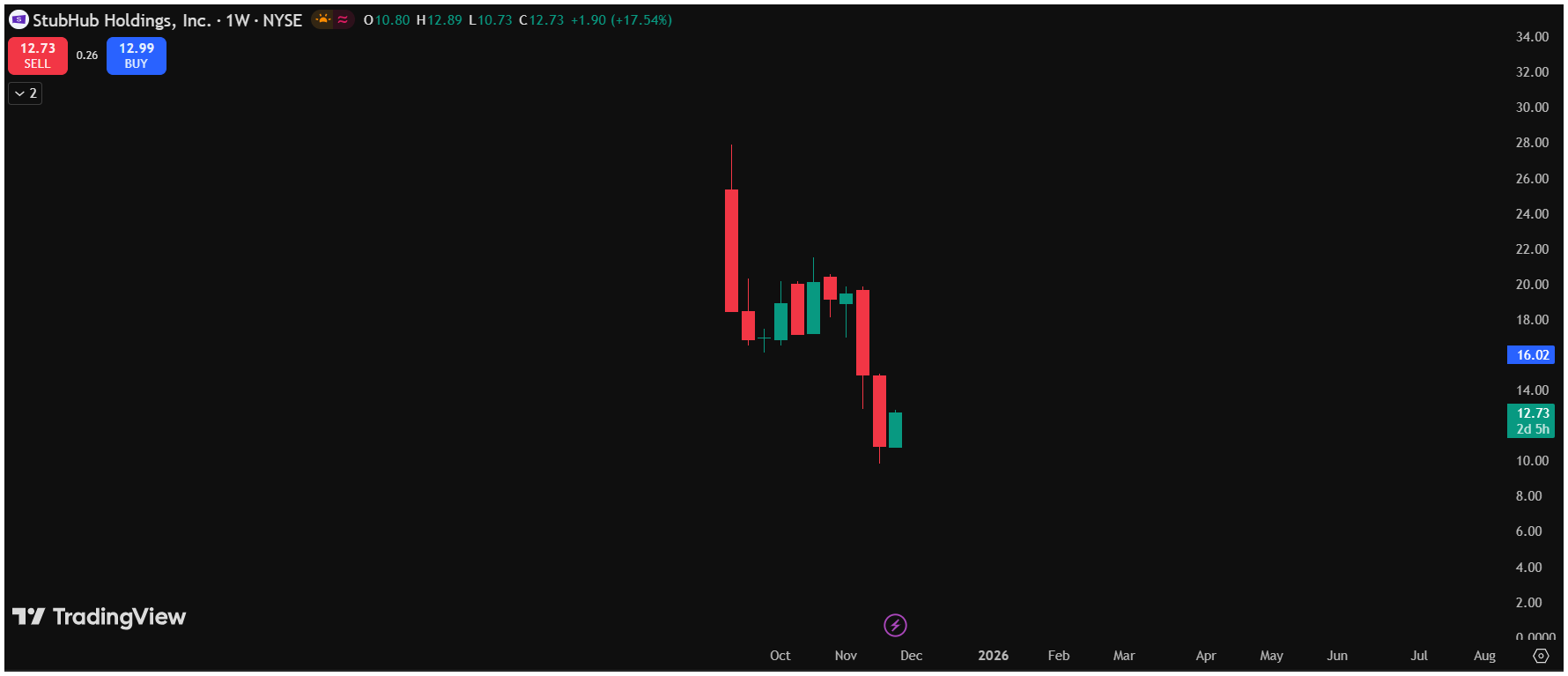
Why is StubHub being investigated? – StubHub Faces Multiple Class-Action Investigations After Sharp Stock Drop

StubHubโ€™s unfolding legal crisis is a reminder that IPO investing comes with risk and that the details buried in offering documents can make or break investment decisions. Whether the company misled investors will now be determined through multiple investigations and potential class actions.

StubHub Holdings Inc., the online ticket marketplace that went public in September 2025, is now at the center of a rapidly expanding legal storm. Over the past few days, several well-known investor-rights law firms have announced separate investigations and class-action filings against the company.

The situation is gaining momentum because the allegations strike at the core of what investors expect from newly listed companies: transparency, honest disclosures and reliable financial information. StubHubโ€™s stock, which debuted at 23.50 dollars per share, has fallen by more than half since the IPO. This sharp decline, paired with negative free cash flow that only surfaced after the listing, has triggered questions about whether the company misled the market.

What Sparked the StubHub Investigations?

The controversy began after StubHub reported its first quarterly results as a publicly traded company. For the quarter ending September 30, 2025, the company disclosed that its free cash flow was negative 4.6 million dollars, a steep decline from the previous yearโ€™s positive 10.6 million dollars. Net cash from operations also fell dramatically.

These numbers alone alarmed investors, but the real shock came when the company provided no forward guidance, leaving analysts without direction on expected performance. Within twenty-four hours, the stock dropped nearly 21 percent, closing at around 14.87 dollars.

Why did StubHub stock crash?

Law firms investigating the matter argue that the crash happened because the companyโ€™s IPO filings allegedly did not fully disclose changes in the timing of payments to vendors, such as ticket sellers, which materially impacted its cash flow. According to multiple filings, StubHub may have presented a stronger financial picture than reality justified at the time of the IPO.

Who Is Investigating StubHub?

Among the firms leading the charge:

  • Bronstein, Gewirtz & Grossman, LLC
    Alerted investors with โ€œsubstantial lossesโ€ that they have an opportunity to lead a class-action lawsuit.
  • The Portnoy Law Firm
    Announced that it is conducting an independent investigation into whether StubHub violated federal securities laws.
  • Faruqi & Faruqi, LLP
    Issued a detailed report stating that investors who purchased stock at or shortly after the IPO may have legal claims due to โ€œmaterially misleading statements and omissionsโ€ in the IPO documents.

Other law firms, including Kirby McInerney LLP and the Law Offices of Howard G. Smith, have also joined the wave of actions.

This raises another trending question:

โ€œIs StubHub facing multiple lawsuits?โ€

The answer increasingly appears to be yes.

What Are the Allegations Against StubHub?

The core allegations revolve around misleading IPO disclosures, specifically related to:

  • Timing of payments to ticket vendors
  • Impact of these payment-cycle changes on free cash flow
  • Published financial metrics that may not have reflected the true operational pressures
  • A failure to warn investors about cash-flow risks before the IPO

Law firms claim that these undisclosed or inadequately disclosed factors led investors to believe StubHubโ€™s financial health was stronger than it actually was. When the real picture emerged during the first earnings release, the stock plummeted, leaving thousands of investors exposed to large losses.

Did StubHub mislead investors?

While no court has ruled on these allegations yet, the number of firms filing investigations suggests that the claims are being taken seriously.

IPO to Investigation: The Timeline Investors Want Clarified

What happened to StubHub after its IPO?

Is StubHub a bad investment?

Here is the simplified sequence:

  • September 17, 2025: StubHub completes its IPO at 23.50 dollars.
  • Weeks after listing: The stock trades higher briefly, touching levels near 27โ€“28 dollars.
  • October 2025: Prices begin declining steadily.
  • November 13, 2025: First quarterly earnings release reveals negative free cash flow.
  • November 14, 2025: Stock falls over 20 percent in one day.
  • November 20โ€“25, 2025: Multiple law firms launch investigations and class-action filings.
  • The stock has reportedly touched lows near 10.31 dollars – more than a 56% fall from the IPO price.

Should Investors Join the Class-Action Lawsuit?

Many notices from law firms mention that investors with significant losses can seek to become โ€œlead plaintiffs,โ€ giving them a central role in the case.

How to know if I qualify for StubHub lawsuit?

Generally, investors who purchased shares during or shortly after the IPO and suffered financial loss are eligible to join. Lead-plaintiff deadlines vary by firm but typically fall in early 2026.

What This Means for the IPO Market?

The StubHub controversy comes at a time when investor confidence around tech-linked IPOs is already fragile. Many experts believe this case may become a reference point for discussions on transparency, especially regarding cash-flow reporting and vendor obligations.

If courts find that StubHub withheld critical information, the case could reshape disclosure standards for future listings.

This article is for informational purposes only and should not be considered financial advice. Investing in stocks, cryptocurrencies, or other assets involves risks, including the potential loss of principal. Always conduct your own research or consult a qualified financial advisor before making investment decisions. The author and publisher are not responsible for any financial losses incurred from actions based on this article. While efforts have been made to ensure accuracy, economic data and market conditions can change rapidly. The author and publisher do not guarantee the completeness or accuracy of the information and are not liable for any errors or omissions. Always verify data with primary sources before making decisions.
Meta discloses large insider donation as reports surface of looming multibillion-dollar spend

Meta CFO donates 33,583 shares while company reportedly plans billions in new spending amid regulatory pressure.

Meta Platforms, Inc. has disclosed that its Chief Financial Officer, Susan J. Li donated 33,583 shares of Class A common stock to the Li-Hegeman Family Foundation. Meanwhile, according to a separate report attributed to Reuters, Meta is in talks to ramp up its capital spending by โ€œbillionsโ€ of dollars as it addresses regulatory and competitive pressures.

In the filing submitted to the U.S. Securities and Exchange Commission (SEC) on November 24, 2025, Li made the transfer via the Li-Hegeman Living Trust. She retains voting power over the shares held by the foundation but does not retain any pecuniary interest – meaning she will not personally profit from future appreciation or dividends.

Separately, Reuters reports that Meta is considering major investment commitments spanning hardware, infrastructure and artificial intelligence initiatives as part of an effort to maintain its scale and innovation edge in a fiercely competitive market. These efforts are seen as part of a broader strategy to counter regulatory scrutiny and to match initiatives by other tech giants.

From a governance standpoint, the donation updates insider ownership disclosures and underscores Metaโ€™s spotlight on executive alignment and corporate transparency. From a strategic standpoint, the reported increased spending signals Metaโ€™s willingness to deploy substantial resources despite macroeconomic uncertainty.


Meta Platforms is a global technology company headquartered in Menlo Park, California. It operates flagship social media platforms including Facebook, Instagram and WhatsApp. The company went public in 2012 and generates the bulk of its revenue through digital advertising, supported by growth in hardware sales and platform-services.

This article is for informational purposes only and should not be considered financial advice. Investing in stocks, cryptocurrencies, or other assets involves risks, including the potential loss of principal. Always conduct your own research or consult a qualified financial advisor before making investment decisions. The author and publisher are not responsible for any financial losses incurred from actions based on this article. While efforts have been made to ensure accuracy, economic data and market conditions can change rapidly. The author and publisher do not guarantee the completeness or accuracy of the information and are not liable for any errors or omissions. Always verify data with primary sources before making decisions.

UBS Issues High-Yield Structured Notes Linked to Nvidia as Chipmaker Posts Stellar Q3 Results

Bank of America Launches Auto-Callable Note Linked to Apple, Microsoft and NVIDIA with Principal at Risk

In a move that underscores both opportunity and risk in todayโ€™s financial markets, UBS AG has filed to issue โ€œTrigger Autocallable Contingent Yield Notesโ€ tied to the stock of Nvidia Corporation (ticker NVDA) – and the timing of the product coincides with Nvidiaโ€™s recently reported blow-out third-quarter earnings that show the company remains at the heart of the AI boom.

On November 21, 2025 UBS announced the tranche of structured notes whose payoff will depend on the performance of Nvidiaโ€™s common stock. The offering promises a high coupon of approximately 17.01 % per annum, on the condition that predefined stock-performance thresholds are met. If the stock fails to clear certain barriers, investors may receive little or even lose their principal. The product matures on November 27, 2028, unless called early under the โ€œautocallโ€ provisions. Key terms include an initial level of $178.88 for Nvidiaโ€™s share price, a coupon barrier set at 100 % of that level on observation dates, and a downside threshold at 70โ€‰% of the initial level (roughly $125.22). For minimum investment of 100 notes (each note at $10), investors buy into both the equity-linkage and issuer credit risk of UBS.

Also Read – AMC Networks Inc. Names Dan McDermott Chief Content Officer and President of AMC Studios with Multi-Year Contract

Coinciding with this issuance, Nvidia disclosed its fiscal 2026 thirdโ€quarter results, reporting revenue of $57.01 billion – well ahead of analyst estimates – and earnings per share of $1.30. The data-centre segment alone delivered $51.2 billion, up 66 % year-on-year and beating forecasts around $49.3 billion. For the current quarter the company guided revenue of about $65 billion, significantly higher than consensus expectations near $61.6 billion. Nvidiaโ€™s gross margin outlook of around 75โ€‰% reinforces the companyโ€™s profitability in the high-end GPU market.

For UBS, linking a structured note to Nvidia appears to lean into this strength. By tying the product to a company showing both rapid growth and robust demand (especially in the AI infrastructure segment), UBS positions the note as a โ€œhigh-yield if successโ€ offering. For investors it presents a chance to access equity-linked upside while ostensibly receiving high coupon income.

However, the risks are meaningful. First, the coupon is contingent – it will only be paid if Nvidiaโ€™s stock meets or exceeds the barrier level on certain observation dates. If it fails, coupon payments may vanish. Second, on final maturity (if the note is not called), if Nvidiaโ€™s stock is below the downside threshold (~70 % of initial level) then investors may suffer a significant principal loss. Third, UBS bears credit risk: as the issuer of the debt, its ability to make payments is tied to its own financial health. Fourth, while the timing aligns with Nvidiaโ€™s stellar earnings, past performance does not guarantee future returns; despite the strong quarter, Nvidia and the wider AI theme carry valuation risk and execution risk.

Given Nvidiaโ€™s results, the offering may look appealing. Nvidiaโ€™s CEO, Jensen Huang, described demand for its latest โ€œBlackwellโ€ architecture and cloud GPUs as โ€œoff the charts,โ€ citing a worldwide surge in AI-infrastructure build-out. But investors are also asking whether this very growth could be the foundation of a bubble. Nvidiaโ€™s size and expectations are such that small cracks could ripple widely.

This article is for informational purposes only and should not be considered financial advice. Investing in stocks, cryptocurrencies, or other assets involves risks, including the potential loss of principal. Always conduct your own research or consult a qualified financial advisor before making investment decisions. The author and publisher are not responsible for any financial losses incurred from actions based on this article. While efforts have been made to ensure accuracy, economic data and market conditions can change rapidly. The author and publisher do not guarantee the completeness or accuracy of the information and are not liable for any errors or omissions. Always verify data with primary sources before making decisions.
AMC Networks Inc. Names Dan McDermott Chief Content Officer and President of AMC Studios with Multi-Year Contract

AMC Networks signs a new contract with Dan McDermott as Q3 earnings show revenue gains and ongoing profitability challenges.

AMC Networks Inc. has entered into a new employment agreement with Dan McDermott to continue serving as Chief Content Officer and President of AMC Studios, formalizing his role through December 31, 2028. The contract was executed on November 18, 2025 and took effect the same day.

The agreement comes shortly after AMC released its third-quarter results, which highlighted rising revenue but ongoing profitability challenges, placing the company at a delicate moment as it balances leadership continuity with financial pressures.

Under the new contract, McDermott will earn a minimum annual base salary of $1,625,000, retroactive to July 1, 2025. His annual target bonus is set at no less than 130 percent of actual salary dollars paid during the year, a structure made retroactive to January 1, 2025. The agreement ensures his continued participation in the long-term equity and incentive programs offered to similarly situated executives, subject to his ongoing employment.

Also Read – Amazon Raises $14.96 Billion Through Multiโ€‘Tranche Bond Sale

During each award cycle through 2028, McDermott is expected to receive annual grants of cash and equity valued at a minimum aggregate amount of $1,600,000, with the awards evenly split between cash and equity. For the 2025 cycle, he has already received additional long-term incentive grants totaling $600,000, made up of a $300,000 cash performance award and $300,000 in restricted stock units. These will vest under the same schedule as previously approved 2025 awards. McDermott will also continue to be eligible for standard company benefit programs, consistent with plan requirements.

The agreement outlines severance protections if his employment ends before the expiration date. If AMC terminates his employment without cause, or if he resigns for good reason and cause does not exist, he will receive severance benefits upon signing a release of claims. These benefits include a cash payment of not less than two times the sum of his annual salary and annual target bonus, a prorated bonus for the year of termination, any unpaid prior-year bonus, immediate vesting of his long-term cash incentive awards, the removal of time-based restrictions on restricted stock or restricted stock units, and continued vesting of stock options and stock appreciation awards according to their original schedules. If his employment ends before the expiration date due to death or disability, his estate or beneficiary will receive the prorated bonus and immediate vesting of all equity and cash-based awards. For awards tied to performance criteria, payouts will be made at target if the measurement period is incomplete, or in line with similarly situated executives if the performance period has already concluded.

The contract also includes an exclusivity covenant preventing McDermott from providing services to competitive entities through the contractโ€™s expiration date, except in situations where he departs the company under qualifying circumstances.

The employment announcement follows the release of AMCโ€™s third-quarter results, posted on its investor website. The companyโ€™s quarterly earnings per share came in ahead of market expectations, providing a notable upside surprise. Revenue for the quarter reached $1.30 billion, surpassing analyst forecasts and reflecting strong admissions activity and robust food and beverage sales, according to comments from CEO Adam Aron.

Despite the revenue momentum, AMC faces challenges in profitability and cash flow. The company reported a net income loss of $298 million for the period, while operating cash flow remained negative at $14.9 million. Profitability ratios illustrate the pressure: the EBIT margin stands at negative 2.9 percent, indicating that operating income remains below breakeven.

By contrast, the companyโ€™s gross margin exceeds 80 percent, showing that direct production costs remain relatively controlled, even as broader expenses weigh on overall results. These figures capture a company experiencing both operational strengths and financial headwinds, positioning the leadership stability provided by the McDermott agreement as a meaningful strategic step.

Company Profile

AMC Networks Inc. is a media and entertainment company headquartered in New York. Operating within the cable television, streaming, and content production industries, the company distributes original series, films, and programming across its network brands and digital platforms. It generates revenue through subscription fees, advertising sales, content licensing, and studio production activities.

AMC Networks became a publicly traded company in 2011 following its separation from Cablevision.

This article is for informational purposes only and should not be considered financial advice. Investing in stocks, cryptocurrencies, or other assets involves risks, including the potential loss of principal. Always conduct your own research or consult a qualified financial advisor before making investment decisions. The author and publisher are not responsible for any financial losses incurred from actions based on this article. While efforts have been made to ensure accuracy, economic data and market conditions can change rapidly. The author and publisher do not guarantee the completeness or accuracy of the information and are not liable for any errors or omissions. Always verify data with primary sources before making decisions.
Amazon Raises $14.96 Billion Through Multiโ€‘Tranche Bond Sale

Amazon.com issues $14.96โ€ฏbillion in multiโ€‘maturity notes to secure longโ€‘term funding.

Amazon.com, Inc. announced today the closing of a substantial debt offering totaling approximately $14.96โ€ฏbillion in aggregate principal amount. The offering comprised six series of senior unsecured notes, with maturities ranging from 2028 to 2065. The net proceeds – after underwriting discounts and before offering expenses – are estimated at approximately $14.93โ€ฏbillion.

The notes issued include: $2.5โ€ฏbillion of 3.900โ€ฏ% Notes due 2028, $2.5โ€ฏbillion of 4.100โ€ฏ% Notes due 2030, $1.5โ€ฏbillion of 4.350โ€ฏ% Notes due 2033, $3.5โ€ฏbillion of 4.650โ€ฏ% Notes due 2035, $3.0โ€ฏbillion of 5.450โ€ฏ% Notes due 2055, and $2.0โ€ฏbillion of 5.550โ€ฏ% Notes due 2065. The offering was underwritten pursuant to an Underwriting Agreement dated Novemberโ€ฏ17,โ€ฏ2025, with Goldmanโ€ฏSachsโ€ฏ&โ€ฏCo.โ€ฏLLC, J.P.โ€ฏMorgan Securitiesโ€ฏLLC and Morgan Stanleyโ€ฏ&โ€ฏCo.โ€ฏLLC serving as the managing underwriters.

Also Read – IMACโ€ฏHoldings, Inc. Issues Secured Promissory Note of $210,000 to Raise $150,000

The notes were issued under an Indenture initially dated Novemberโ€ฏ29,โ€ฏ2012, as amended and supplemented by a Supplemental Indenture dated Aprilโ€ฏ13,โ€ฏ2022, under which all series of the current offering will be governed. The series terms include interest payment dates of Mayโ€ฏ20 and Novemberโ€ฏ20 each year for the 2028, 2030, 2035, 2055 and 2065 Notes, beginning Mayโ€ฏ20,โ€ฏ2026; for the 2033 Notes, interest payment dates are Marchโ€ฏ20 and Septemberโ€ฏ20 each year, beginning Marchโ€ฏ20,โ€ฏ2026. The purchase prices of each series were set at slight discounts to par: for example, the 3.900โ€ฏ% Notes due 2028 were purchased at 99.878โ€ฏ% of principal, the 4.100โ€ฏ% Notes due 2030 at 99.773โ€ฏ%, and the 5.550โ€ฏ% Notes due 2065 at 99.074โ€ฏ%.

From a corporateโ€‘finance perspective, the size, structure and yield spread of the offering reflect Amazonโ€™s strategy to lock in longโ€‘term funding at current interestโ€‘rate levels. By issuing across six maturity dates, Amazon has diversified its debt load over time, presumably offering some flexibility in managing interest and refinancing risk.

For investors and market watchers, such multiโ€‘tranche issues often signal confidence in the issuerโ€™s credit quality and a proactive funding posture in a macroโ€‘environment where interest rates remain elevated compared with historical lows.

For general readers, it is helpful to note that when a company issues bonds (or โ€œnotesโ€), it is borrowing money from investors and agreeing to pay them a fixed interest rate (coupon) until repayment at maturity; the fact that the bonds were issued at slightly below โ€œ100โ€ means Amazon accepted a small discount to raise the desired principal amount.

In this case there is no indication from the filing that the proceeds will be earmarked for a specific project or acquisition. The absence of specific earmarking suggests the proceeds may be used for general corporate purposes, which could include refinancing existing debt, capital expenditures, or workingโ€‘capital needs. The firm disclosed that no material adverse change in its financial or operational condition has occurred from the time of the prospectus to the closing date.

Company Profile

Amazon.com, Inc. is a leading global eโ€‘commerce and cloudโ€‘computing company headquartered in Seattle, Washington. Classified in the retailโ€‘catalog & mailโ€‘order houses industrial category, Amazon was incorporated in Delaware and listed on the Nasdaq Global Select Market under ticker symbol AMZN. The company generates revenue primarily from online product sales, subscription services (including its Prime membership), and its cloudโ€‘computing arm (Amazonโ€ฏWebโ€ฏServices), among other business segments.

This article is for informational purposes only and should not be considered financial advice. Investing in stocks, cryptocurrencies, or other assets involves risks, including the potential loss of principal. Always conduct your own research or consult a qualified financial advisor before making investment decisions. The author and publisher are not responsible for any financial losses incurred from actions based on this article. While efforts have been made to ensure accuracy, economic data and market conditions can change rapidly. The author and publisher do not guarantee the completeness or accuracy of the information and are not liable for any errors or omissions. Always verify data with primary sources before making decisions.