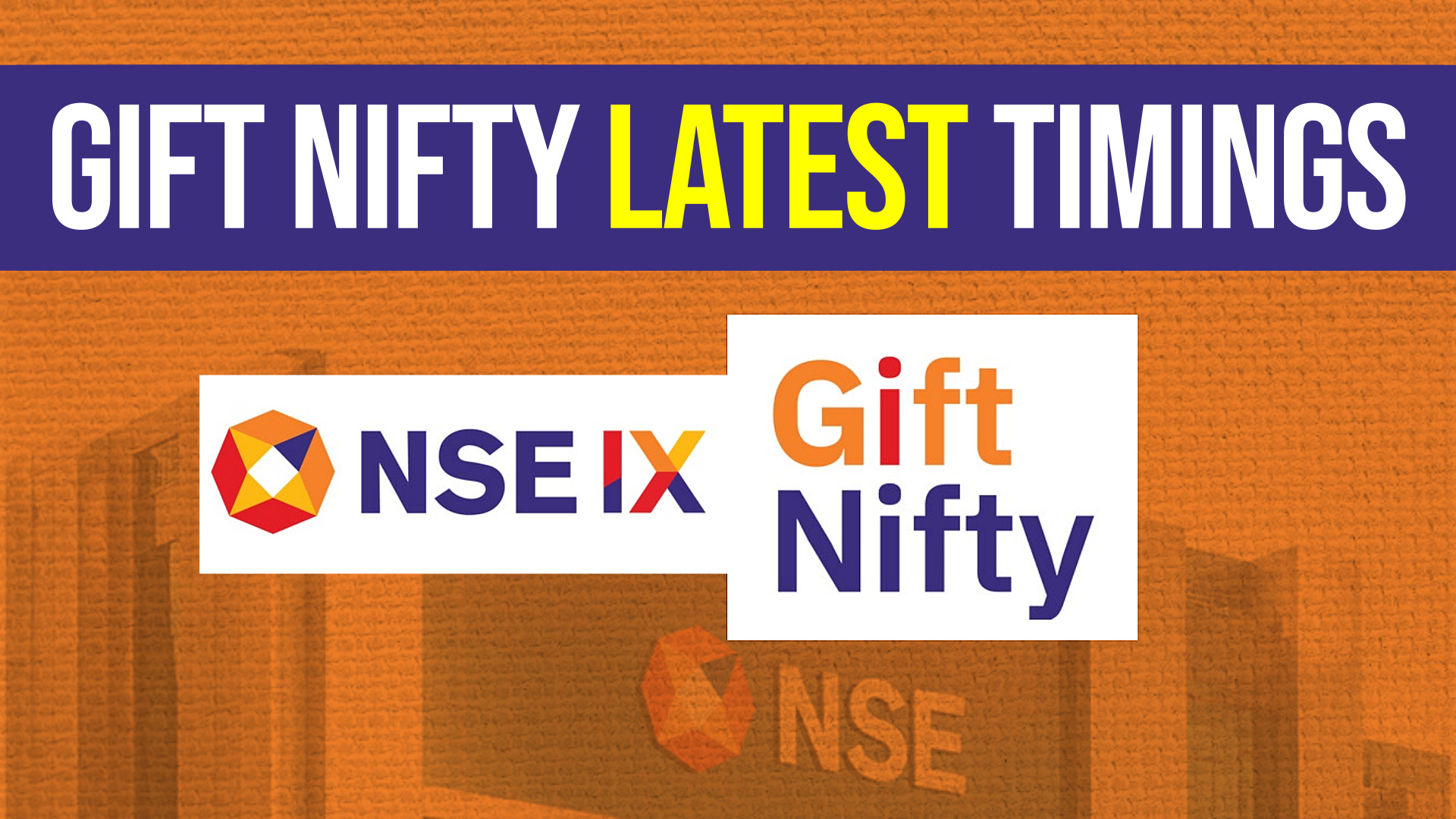
Gift Nifty – traded at NSE IFSC (NSE International Exchange) located at GIFT City, Gandhinagar, Gujarat – is the international version of India’s flagship Nifty 50 index futures. It was formerly known as SGX Nifty, traded on the Singapore Exchange (SGX), before migrating to GIFT City in 2023 under the NSE IFSC-SGX Connect framework.
Gift Nifty is widely watched by traders across India and globally because it provides early signals for how the domestic Nifty 50 index may open on the NSE. Since it trades almost round the clock, it acts as a live barometer of global market sentiment towards Indian equities.
Why Have Gift Nifty Timings Changed?
As per the official circular, NSE IFSC has revised trading session timings.
The key objective of this revision is to reduce the gap between Session 1 and Session 2, allowing for a smoother transition between market sessions and better alignment with global markets.
The most significant changes are in the Session 2 Pre-Open timings and the Trade Modification End Times across all instrument categories.
Latest Gift Nifty Timings in India 2026 (Revised)
Session 1
| Session | Trading Hours (IST) |
|---|---|
| Pre-Open Open Time | 06:15 hrs |
| Pre-Open Close Time | 06:25 hrs |
| Normal Market Open Time | 06:30 hrs |
| Normal Market Close Time | 15:40 hrs |
| Pre-Close Open Time | 15:40 hrs |
| Pre-Close Close Time | 15:50 hrs |
| Pre-Close End Time | 15:55 hrs |
| Trade Modification End Time | 15:55 hrs |
Session 2
| Session | Trading Hours (IST) |
|---|---|
| Pre-Open Open Time | 15:58 hrs |
| Pre-Open Close Time | 16:03 hrs |
| Normal Market Open Time | 16:05 hrs |
| Normal Market Close Time | 02:45 hrs (Next Day) |
| Trade Modification End Time | 02:45 hrs (Next Day) |
Session 2 now begins 30 minutes earlier than it did under the previous schedule.
The Pre-Open for Session 2 starts at 15:58 hrs (previously 16:25 hrs) and normal market trading kicks off at 16:05 hrs (previously 16:35 hrs). This significantly reduces the gap between the two sessions.
Check out the video below for a clear explanation.
What Has Changed in Gift Nifty Timings?
Here is a bird’s eye view of the most important changes:
| Change | Old Timing | New Timing |
|---|---|---|
| Index Futures Session 2 Pre-Open | 16:25 hrs | 15:58 hrs |
| Index Futures Session 2 Normal Open | 16:35 hrs | 16:05 hrs |
Also Read – 5 Reasons GIFT Nifty May Not Be Moving
What Time Does Gift Nifty Open in India?
Gift Nifty opens at 6:30 AM IST for Session 1, with Pre-Open beginning at 6:15 AM IST.
What Time Does Gift Nifty Session 2 Open?
After the revised timings, Gift Nifty Session 2 opens at 16:05 hrs (4:05 PM IST) – a full 30 minutes earlier than before (previously 16:35 hrs).
Gift Nifty Break Time – When Is the Gap Between Sessions?
After the revision, the break between sessions is significantly narrowed:
- Session 1 ends (Index Futures Pre-Close End): 15:55 hrs
- 15:40pm
- Session 2 Pre-Open begins: 15:58 hrs
- Session 2 Normal Market opens: 16:05 hrs
In practice, there is now only a ~3 minute gap between Session 1 Pre-Close and Session 2 Pre-Open for Index Futures – a dramatic improvement from the previous ~30-minute gap.
Is Gift Nifty Open on Weekends? – Saturday and Sunday Timings
Gift Nifty does NOT operate on Saturdays and Sundays. Like the domestic NSE, NSE IFSC observes weekends as non-trading days. Trading resumes Monday morning from 6:15 AM IST (Pre-Open).
However, there are exceptions based on NSE IFSC’s holiday calendar.
Always check the official holiday list at www.nseix.com before assuming markets are open.
Does Gift Nifty Operate 24 Hours? Is It Open All the Time?
No, Gift Nifty does not operate 24/7. Trading happens across two sessions:
- Session 1: ~6:30 AM to ~3:55 PM IST (varies by segment)
- Session 2: ~4:05 PM to ~2:45 AM IST (next day)
While Session 2 runs deep into the night, there is a short gap between the two sessions.
The combined trading window covers 20 hours and 35 minutes per day, making Gift Nifty one of the longest-running index futures markets globally – but it is not a round-the-clock 24/7 market.
Can We Trade in Gift Nifty?- Who Trades in Gift Nifty?
Retail investors in India generally cannot directly trade in Gift Nifty on NSE IFSC.
The exchange is located in the GIFT City International Financial Services Centre (IFSC), which is a special economic zone.
Direct participation is limited to:
- Registered broker-dealers and remote trading participants on NSE IFSC
- Foreign Portfolio Investors (FPIs)
- Non-Resident Indians (NRIs) through IFSC-registered brokers
- Domestic institutions via specific connect frameworks
Why Does Gift Nifty Open Early (at 6:30 AM IST)?
Gift Nifty opens early to align with Asian and European market hours. Since it trades in US dollars and is positioned as an international platform, the early opening helps global investors hedge or build positions in Indian index futures while other Asian markets (Japan, China, Hong Kong, Singapore) are also active.
This early session also gives Indian traders and institutions a vital pre-market signal well before the NSE opens at 9:15 AM IST.
Does Gift Nifty Affect Nifty 50?
Yes, absolutely. Gift Nifty is one of the most closely tracked indicators for predicting the Nifty 50’s opening direction. Here is how:
- Gift Nifty reflects overnight and early morning global sentiment towards Indian markets
- A rising Gift Nifty typically suggests a positive (gap-up) opening for Nifty 50 on NSE
- A falling Gift Nifty suggests a negative (gap-down) opening
- Institutional traders and analysts quote Gift Nifty levels every morning before 9:15 AM IST to gauge market mood
While not a perfect predictor (events can shift rapidly between 6:30 AM and 9:15 AM), Gift Nifty is considered the single best pre-market indicator for Nifty 50 in India.
Is Gift Nifty a Good Indicator? How Accurate Is It?
Gift Nifty is a strong directional indicator but not always an exact predictor of the Nifty 50 opening level. Its accuracy depends on:
- Overnight global cues: US markets (Dow Jones, S&P 500, Nasdaq), European markets
- Macro events: RBI policy, Fed decisions, geopolitical news
- FII/DII activity: Foreign institutional flow heavily influences both Gift Nifty and Nifty 50
- SGX Connect volumes: Liquidity levels impact price discovery
Traders generally use Gift Nifty in combination with US futures and Asian market movements for a holistic pre-market view. It is a good indicator, but should not be used in isolation.
How Is Gift Nifty Calculated?
Gift Nifty futures are priced based on the Nifty 50 index, using standard futures pricing methodology:
Futures Price ≈ Spot Price × [1 + (Risk-Free Rate – Dividend Yield) × (Time to Expiry/365)]
Since it is USD-denominated, the exchange rate between INR and USD also plays a role in the absolute price levels.
Also Read – FII Selling Because the Rupee is Falling, or the Rupee Falling Because FIIs Are Selling?
Who Handles Gift Nifty?- Who Is Behind It?
Gift Nifty is managed by NSE IFSC Ltd. (NSE IX) – a subsidiary of the National Stock Exchange of India (NSE) – operating under the regulatory framework of the International Financial Services Centres Authority (IFSCA) at GIFT City, Gandhinagar, Gujarat.
The exchange works in collaboration with Singapore Exchange (SGX) under the NSE IFSC–SGX Connect framework for certain products including Negotiated Large Trading (NLT).
Unlike domestic Indian exchanges regulated by SEBI, the exchange hosting Gift Nifty operates under the regulatory framework of the IFSCA.
What Are the Benefits of Gift Nifty?
Gift Nifty offers several advantages for eligible market participants:
- Extended trading hours: Near round-the-clock access to Nifty 50 exposure across two sessions
- USD denomination: Useful for foreign investors without INR currency risk on futures
- Global reach: International traders can access Indian index futures from GIFT City IFSC
- Price discovery: Acts as a continuous price discovery mechanism for Nifty 50 during NSE off-hours
- Lower taxes: GIFT City IFSC offers significant tax and regulatory concessions under IFSCA rules
- Pre-market signal: Invaluable tool for Indian retail traders to gauge market opening direction
How Many Companies Are in Gift Nifty?
Gift Nifty is a derivative based on the underlying Nifty 50 index, which comprises 50 of India’s largest and most liquid companies listed on NSE across key sectors including banking, IT, oil & gas, FMCG, pharma, and auto.
So technically, Gift Nifty does not contain any companies. It just mirrors or, one could say, acts like the Nifty 50.
Does Gift Nifty work 24 hours?
No, it operates across two sessions covering more than 20 hours per day, but is not a true 24/7 market.
Why does Gift Nifty fall suddenly sometimes?
Sudden drops are typically triggered by negative global cues – such as a sharp fall in US markets overnight, geopolitical events, unexpected central bank actions (Fed or RBI), or major corporate/economic news.
What time is Gift Nifty open in India?
Gift Nifty Session 1 opens at 6:30 AM IST (Pre-Open from 6:15 AM). Session 2 now opens at 4:05 PM IST after the revised timings.
What time does Gift Nifty Session 2 start?
Session 2 Normal Market opens at 16:05 hrs (4:05 PM IST) for Index Futures and Options.
This article is written for informational purposes only. Do not consider it as any kind of investment or trading advice. Investing money in the stock market carries risk, so before making any financial decision, always consult a professional advisor. The author is not a SEBI-registered investment advisor. The author or platform will not be responsible for any profit or loss. This platform, in compliance with the Right to Freedom of Speech and Expression granted under Article 19(1)(a) of the Constitution of India, only functions to further share publicly available company news and filings. Full care has been taken for accuracy, but complete accuracy cannot be guaranteed. For credibility, do make sure to check the original documents issued by the company, the link to which has been provided in the article.
With over 3 years of experience in financial markets, we focus on simplifying global and Indian markets through clear, practical insights. Our expertise also extends to the evolving landscape of digital finance, including blockchain, stablecoins, and decentralized finance (DeFi).