
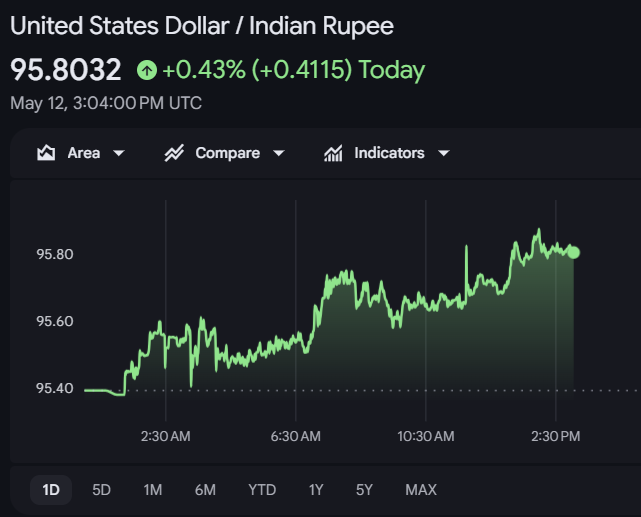
The Indian Rupee has hit a fresh all-time low. As of today, USD/INR is trading around 95.70–95.80.
Markets are unsettled, Prime Minister Modi is asking 1.4 billion citizens to skip gold purchases and postpone foreign holidays, and the financial press is in a predictable frenzy.
But beneath the noise lies a question that actually matters- what is driving what?
Are Foreign Institutional Investors (FIIs) selling Indian assets because the rupee is falling? Or is the rupee falling because FIIs are selling?
The honest answer – both – turns out to be the beginning of a much more interesting story.
The Fire and the Fuel
Every currency crisis has an ignition point and an accelerant. In 2026, India got both delivered simultaneously.
Geopolitical tensions around Iran pushed Brent crude above $100 per barrel. For a country that imports roughly 85% of its oil, this is not a headline – it is a balance-sheet event.
Every $10 rise in crude adds billions of dollars to India’s import bill, widening the current account deficit and putting structural pressure on the rupee long before any investor touches a sell button.
A Current Account Deficit (CAD) occurs when a country’s total expenditures on foreign goods, services, and transfers exceed the total revenue it earns from its own exports and receipts.
Importers and oil marketing companies moved first. They rushed to buy dollars, flooding the forex market with rupees and amplifying USD demand. The exchange rate began to slip – and that is when FIIs entered the picture.
The Self-Reinforcing Loop
This is where the chicken-and-egg dynamic becomes genuinely reflexive – in the Soros sense of the word.

George Soros used “reflexivity” to describe markets where perceptions alter fundamentals, which in turn alter perceptions, in a self-reinforcing cycle. The 2026 rupee story is textbook.
Here is how the cycle compounded, step by step:
Step 1 – Oil shock: Brent above $100. India’s import bill surges, the current account deficit widens, and structural dollar demand rises immediately.
Step 2 – Rupee slips: Importers buy dollars en masse. USD/INR drifts higher. Sentiment turns cautious across markets.
Step 3 – FII calculus shifts: Rupee losses erode dollar-equivalent returns on Indian assets. Inflation risk rises. A global risk-off mood compounds domestic pressure. FIIs begin selling equities and bonds.
Step 4 – Amplification: FII selling converts more rupees into dollars. The rupee falls further. More investors see the trend and sell more. The cycle feeds itself.
Step 5 – Record pace: In just the first four months of 2026, FIIs pulled out over ₹1.9–2 lakh crore (~$20–25 billion) from Indian equities a historic outflow rate with no near-term sign of reversal.
Notice that the loop has no clean starting point. Oil lit the match, but the reflexive dynamics took over quickly. It is rarely pure one-way causation in forex markets – it is a system responding to itself.
Also Read – 8 Indian Stocks That Quietly Profit From Every Mom’s Daily Decisions
How Forex Actually Works?
The foreign exchange market is the largest financial market in the world, with trillions traded daily. Unlike stock exchanges, there is no single venue – it is a decentralised, over-the-counter market where price is purely a function of supply and demand between currencies.
USD/INR rises (rupee weakens) when demand for dollars exceeds supply.
The key sources of dollar demand in India in 2026:
- Oil imports – Oil marketing companies buy dollars to pay for crude. With Brent above $100, this is the single largest pressure point.
- Gold imports – Physical gold requires dollar settlement. India’s appetite for gold remains structurally large regardless of price.
- FII repatriation – Every exit by a foreign investor involves selling rupees and buying dollars. At record outflow pace, this is significant.
- Foreign debt repayments – Corporate USD-denominated loans come due regardless of where the exchange rate sits.
- Education and travel – Outward remittances for overseas study, tourism, and destination weddings. This is the segment PM Modi targeted with his public appeal.
Technically, most of this flows through the interbank market – large banks and corporates trading in spot (immediate settlement) and forwards markets. There is also a significant NDF (Non-Deliverable Forward) market offshore, particularly in Singapore and Dubai, where speculative positioning can amplify onshore moves in ways the RBI cannot directly control.
A Non-Deliverable Forward (NDF) is basically a bet on currency exchange rates without actually exchanging the money. It’s a currency protection contract where only the profit or loss is paid, not the actual currency.
The Reserve Bank of India operates a managed float regime. It does not fix the rupee, but it intervenes – selling dollars from reserves – to prevent disorderly, sharp moves. India’s forex reserves currently stand at approximately $690–698 billion, providing meaningful firepower. But the RBI cannot and should not fight a fundamental trend indefinitely. Reserve drawdowns have their own costs.
PM Modi’s Unusual Intervention
In May 2026, Prime Minister Modi made a direct, televised appeal to Indian citizens – an unusual move that signalled the government’s seriousness about the forex situation without deploying blunt administrative controls or capital restrictions.

His requests: avoid buying gold for at least a year, postpone non-essential foreign trips and destination weddings abroad, work from home where possible, use public transport or EVs, and carpool to reduce fuel consumption.
Why these specific asks?
The logic is precise.
Gold and oil are two of India’s largest import drains.
Gold imports alone can absorb tens of billions of dollars annually. Reducing discretionary dollar outflows – even marginally, across 1.4 billion people – narrows the current account deficit without forcing the RBI into heavy-handed intervention or the government into politically costly capital controls.
Also Read – Does money go to the company when you buy shares from the stock exchange?
What Could Break the Loop?
Self-reinforcing cycles do not run forever. They break when an external shock reverses the momentum – or when the feedback loop overshoots and creates its own correction opportunity.
In India’s case, the most credible circuit-breakers are-
- A meaningful decline in crude prices, most likely through geopolitical de-escalation around Iran
- A pivot or softening in the US Dollar’s global strength
- Strong domestic macroeconomic data – GDP, inflation, or CAD numbers – that re-attracts long-term institutional capital
- A decisive RBI rate or liquidity action that restores confidence in the currency outlook
It is also worth noting that a weaker rupee, once the volatility subsides, is not entirely without merit. Export competitiveness improves. India becomes a cheaper destination for foreign capital in real terms. Long-term investors who understand the fundamentals may actually find current valuations attractive – in dollar terms, Indian equities are meaningfully cheaper than they were a year ago.
This article is written for informational purposes only. Do not consider it as any kind of investment or trading advice. Investing money in the stock market carries risk, so before making any financial decision, always consult a professional advisor. The author is not a SEBI-registered investment advisor. This analysis is based on publicly available data for educational purposes. The author or platform will not be responsible for any profit or loss. This platform, in compliance with the Right to Freedom of Speech and Expression granted under Article 19(1)(a) of the Constitution of India, only functions to further share publicly available company news and filings. Full care has been taken for accuracy, but complete accuracy cannot be guaranteed. For credibility, do make sure to check the original documents issued by the company, the link to which has been provided in the article.

With over 3 years of experience in financial markets, we focus on simplifying global and Indian markets through clear, practical insights. Our expertise also extends to the evolving landscape of digital finance, including blockchain, stablecoins, and decentralized finance (DeFi).