
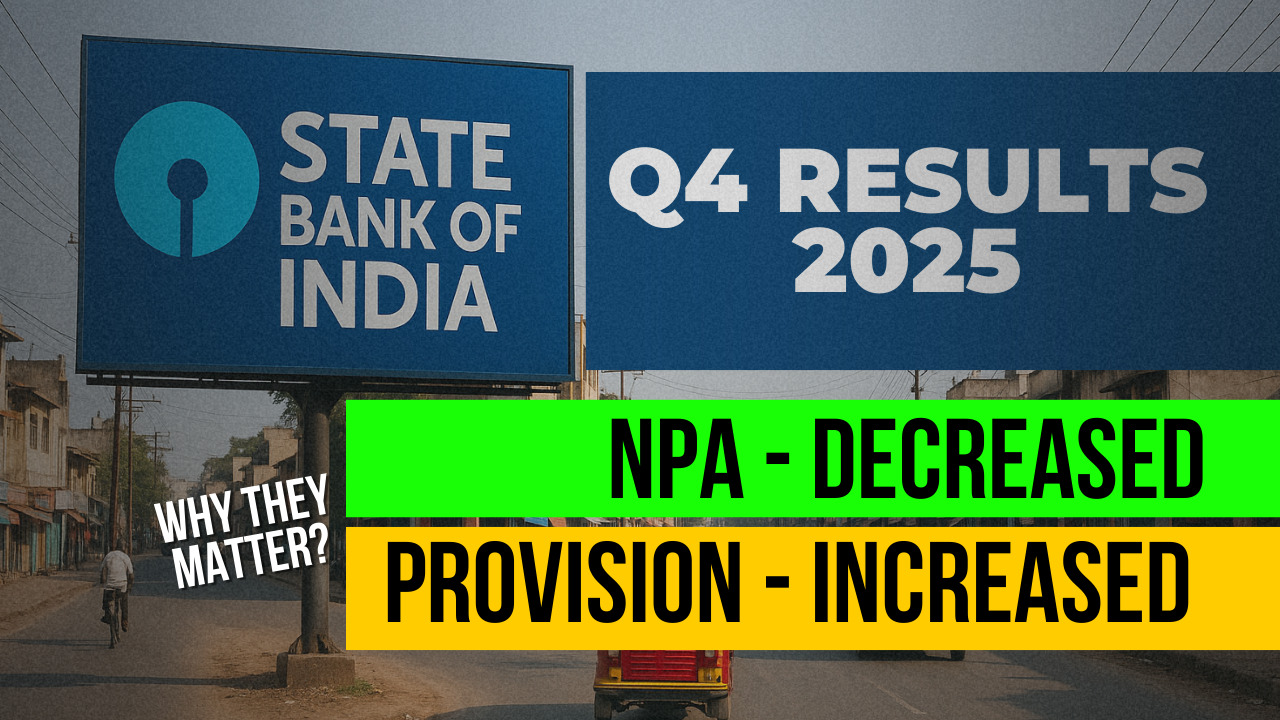
This article is written in the context of State Bank of India’s Q4 results for FY25, where the bank’s gross non-performing assets (NPAs) fell to 1.82% of total advances, indicating that fewer loans are going unpaid. At the same time, SBI’s provisions for bad loans rose by nearly 300% to ₹6,442 crore.
| Revenue | ₹42,775 crore | ₹41,655 crore |
| Operating Profit | ₹31,286 crore | ₹28,748 crore |
| Net Profit | ₹18,643 crore | ₹20,698 crore |
| Provisions | ₹6,442 crore | ₹1,608 crore |
| Provisions (QoQ) | ₹6,442 crore | ₹911 crore |
| Gross NPA (%) | 1.82% | 2.07% (Q3 FY25) |

State Bank of India, the country’s largest bank in terms of assets and deposits, currently holds a market valuation of approximately ₹7,14,014.23 crore. The bank’s shares are trading at a price-to-earnings (P/E) ratio of 9.00, reflecting the multiple investors are willing to pay for its earnings. Over the past five years, SBI’s stock has appreciated by 319.95%, supported by strong financial performance. The earnings per share (EPS) for the trailing twelve months stand at ₹81.75, with a consistent growth rate of 20.56% recorded during the same period.
Below, we explain NPAs and provisions in simple terms and use an example of a small bank to make it clear.
Table of Contents
What Are NPAs?
Simple Definition
See, money is also an asset as it provides economic benefit to the bank in the future. So, non-performing assets or simply called NPA is that money that becomes unable to bring interest to the bank.
- Non-Performing Assets (NPAs) are loans where the borrower has stopped paying interest or principal for 90 days or more, or the bank thinks they won’t be repaid in full.
Sometimes NPAs are also called bad loans since they stop generating income for the bank and need special handling.
Why Declining NPAs Matter
Declining NPA simply means the bank is getting interest on the money it has given as a loan, which can lead to banks making more profits.
In technical terms:
When NPAs fall, it means:
- Fewer troubled loans: The bank has made better quality loans that customers are repaying on time.
What Are Provisions?
If a bank has a doubt or is almost sure that some part of the total loan it has given to borrowers is not going to come back to the bank (let alone interest), it sets aside some security amount out of its past profit just to offset those bad loans. Those are called provisions.
Provisions lead to reductions in a bank’s retained profits.
Simple Definition in Technical Terms
- Provisions for bad loans are money the bank sets aside from its profits to cover loans that might go bad in the future.
- In accounting, provisions show up as an expense, reducing the bank’s reported profit because these funds are reserved rather than kept as earnings.
Why Rising Provisions Can Hurt
When a bank increases its provisions:
- Lower reported profits: More money is parked in a reserve account, so there’s less profit left to distribute or reinvest.
- Signal of caution: It may imply the bank expects more loans to turn bad soon, which can worry investors even if current NPAs are low.
However, provisions are also a sign of responsible and cautious banking. If a bank doesn’t make enough provisions and loans turn bad later, it could hurt the bank’s stability. So, provisions are not always bad—they show the bank is preparing for possible risks.
Also Read –SBI Declares Dividend for 2025—Check SBI Dividend 2025-Record Date & Payment Details
Putting It All Together with a Simple Bank Example
Imagine a small bank, EasyBank, with:
- Total loans of ₹100 crore
- Initially, ₹3 crore in NPAs (3% of loans)
- It sets aside ₹1 crore as provisions.
Scenario A: NPAs fall
- NPAs drop from ₹3 crore to ₹1.82 crore (1.82% of ₹100 crore).
- This is great: fewer bad loans, more money coming in from interest.
Scenario B: Provisions rise
- EasyBank sees early signs that some newer loans might go bad, so it raises provisions from ₹1 crore to ₹4 crore.
- Even though NPAs are low, ₹3 crore extra is taken out of profit and held in reserve.
- Result: reportable profit falls since ₹4 crore is an expense, not earnings.
Why SBI’s Q4 FY25 Looks This Way
- Gross NPAs at SBI fell to 1.82% of advances (loans), marking healthier loan quality.
- But SBI boosted its bad-loan provisions to ₹6,442 crore, reducing net profit for the quarter.
In simple terms: Lower NPAs mean the bank’s loan book is cleaner, while higher provisions mean the bank is being extra cautious and setting aside more money—good for safety but not for short-term profits.
Conclusion
The more NPA drops, the better it is for a bank.
But higher provisions are not always bad. They reduce short-term profit but also show that the bank is being careful and preparing for possible future risks. So, the best situation is when NPAs are low and provisions are made wisely based on risk.
Also Read – Understanding the CASA Ratio: Important Points to Know
What do you mean by “advances”?
In banking, “advances” refers to the total amount of money that a bank has lent to its customers. Whenever we talk about NPAs as a percentage of advances, we are comparing bad loans to the bank’s entire loan book, that is, all the loans the bank has given out.
Disclaimer:
This article is purely intended for informational and educational purposes. It does not constitute financial advice or a recommendation to buy, sell, or hold any financial instrument. The author is not a SEBI-registered financial advisor. Readers are strongly advised to consult with a certified financial advisor before making any investment or financial decisions.