
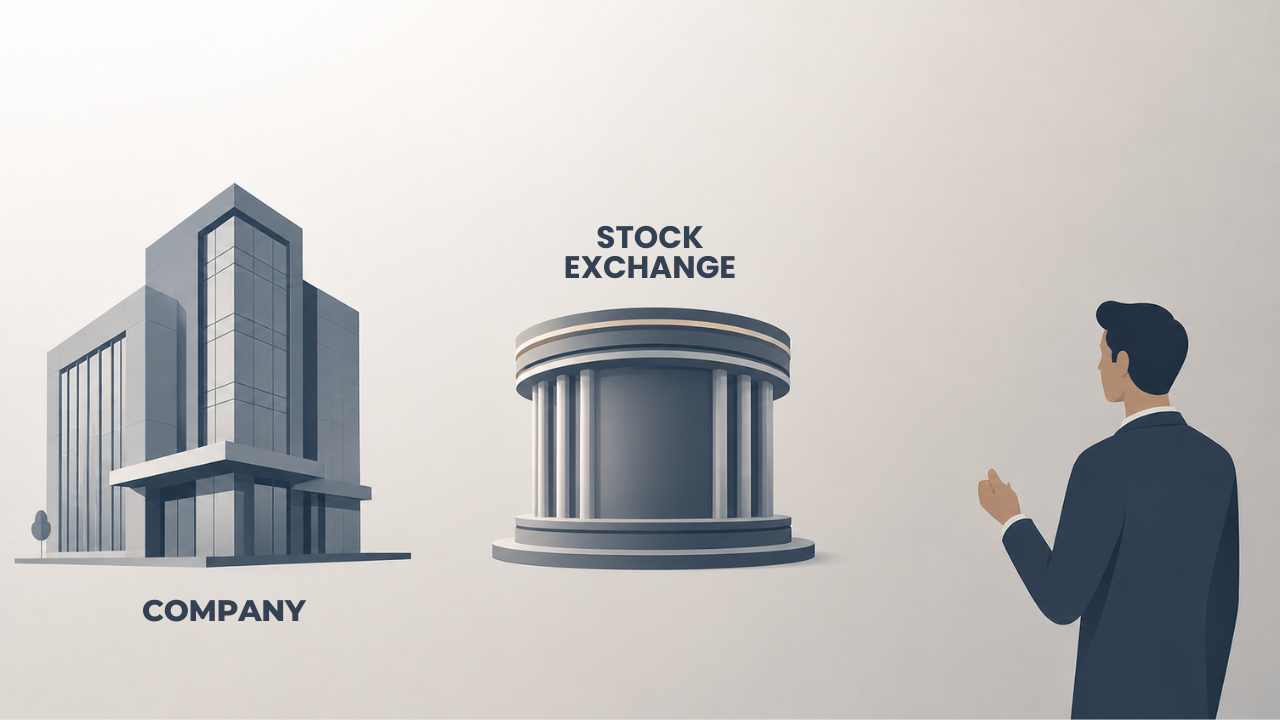
If you’ve ever bought a stock and wondered – “wait, where did my money actually go?” – you’re asking exactly the right question.
Most beginners assume the company receives their money. The reality is a little more interesting.
The short answer is: no, the company generally does not get your money when you buy shares on the stock exchange.
Here’s why.
The Stock Market Has Two Very Different Phases
Think of the stock market not as one single place, but as a system with two distinct phases. Understanding this is the key to everything.
Phase 1 – The Primary Market
This is the phase where a company actually receives money from investors. It happens through a process called an IPO (Initial Public Offering) — the very first time a company offers its shares to the public.
When a company launches an IPO (and it’s not an OFS – Offer for Sale, where existing shareholders are selling), it is essentially saying: “We’re selling shares to raise funds.” Investors buy those freshly created shares, and that money lands directly in the company’s bank account. The company then uses it for operations, expansion, hiring, paying off debt – whatever it needs.
This is the one moment where buying a share means the company directly benefits from your money. It’s a direct transaction: company on one side, investor on the other.
Phase 2 – The Secondary Market
This is where the confusion starts for most beginners – because this is where almost all everyday stock trading happens.
Once a company has done its IPO, those shares are now out in the world, held by investors. Those shares are now listed on the stock exchange – NSE, BSE, NYSE, or wherever.
Who gets the money when you buy a share on the stock exchange?
When you log into your trading app and buy a stock, you are almost always buying from one of these existing investors, not from the company itself.
The person selling it to you – another investor – gets the money. The company is simply watching from the sidelines. It doesn’t receive a single rupee from this transaction.
The stock exchange here is just a facilitator – a giant, highly efficient marketplace that connects buyers and sellers. It doesn’t create new ownership; it just transfers existing ownership from one person to another.
Also Read – Does the share price go up because company profits are added to it?
When you sell a stock, where does the money come from?
When you decide to sell your shares, the money comes from a new investor who wants to buy what you’re selling. They pay you, you hand over the shares, and the company is again completely uninvolved.
It’s a continuous chain:
- Early investor buys in IPO – company gets money
- Early investor sells on exchange – new investor pays them
- New investor sells later – another new investor pays them …and so on
The company’s shares keep changing hands, but the company only ever saw money from that very first transaction.
One Exception Worth Knowing – Share Buybacks
There is one scenario where the company does pay you money for your shares — it’s called a Share Buyback.
Sometimes, a company decides it wants to repurchase its own shares from the market. It does this for various reasons – perhaps it believes its stock is undervalued, or it wants to return extra cash to shareholders. There are two common ways this happens: in an open market buyback, the company simply buys shares at the prevailing market price, just like any other investor would. In a tender offer buyback, the company approaches shareholders directly and offers to buy their shares at a fixed price, which is usually above the current market price – giving investors an incentive to participate.
Either way, the money flows from the company’s treasury to you. This is one of the few times the company actively steps into the market as a buyer rather than watching from the sidelines.
So What Do You Actually Own After Buying Shares?
Even though your money went to a previous investor and not to the company, you are now a part-owner of that company. This is what a share represents – a small slice of ownership.
As a shareholder, you’re entitled to:
- A share of the company’s profits, if they pay dividends
- Voting rights on major company decisions
- A proportional claim on the company’s assets if it ever shuts down
The company may not have received your money, but your stake in the company is completely real.
A Simple Way to Think About It
Imagine a friend starts a bakery and sells you 10% of it for ₹10,000. That money goes to them to buy ovens and ingredients – that’s the primary market.
A year later, you want to sell your 10% stake. You find another person who pays you ₹15,000 for it. The bakery owner was never part of that deal – that’s the secondary market.
The stock exchange works exactly like this, just at a massive scale with millions of buyers and sellers every single day.
Quick Recap
| Situation | Where does your money go? |
|---|---|
| Buying in an IPO | Directly to the company |
| Buying on the stock exchange | To the investor selling you the shares |
| Company does a share buyback | Company pays money to you |
Most of the time, when someone asks
“does the company get the money when I buy its stock?”
– the honest answer is no.
But you still become a real owner. And that ownership is what makes stocks valuable in the first place.
This article is for informational purposes only and should not be considered financial advice. Investing in stocks, cryptocurrencies, or other assets involves risks, including the potential loss of principal. Always conduct your own research or consult a qualified financial advisor before making investment decisions. The author and publisher are not responsible for any financial losses incurred from actions based on this article. While efforts have been made to ensure accuracy, economic data and market conditions can change rapidly. The author and publisher do not guarantee the completeness or accuracy of the information and are not liable for any errors or omissions. Always verify data with primary sources before making decisions.

With over 3 years of experience in financial markets, we focus on simplifying global and Indian markets through clear, practical insights. Our expertise also extends to the evolving landscape of digital finance, including blockchain, stablecoins, and decentralized finance (DeFi).