What Are Trading Sessions? – Understand Their Relevance

Trading Sessions Explained

The best time to trade XAU/USD is overwhelmingly during the London/New York overlap (usually 8:00 AM to 12:00 PM ET).

In the world of financial markets, a trading session refers to a specific period of time when markets in a particular geographic region are most active.

Since forex operates on a 24-hour cycle, the sessions follow the sun around the globe – markets open in Asia, then Europe, and finally North America before the cycle begins again.

Also Read – I Created the Best Bitcoin Guide You’ll Ever Read

The Four Main Global Trading Sessions

There are four major sessions that divide the trading day:

The Sydney Session

The Sydney session takes place in Australia.

It opens the market after the weekend and marks the beginning of the weekly trading cycle. Since it is the first session of the week, activity is usually quieter compared to the other major sessions.

The Tokyo Session

The Tokyo session happens in Japan and also includes other large Asian markets.

This session is especially important for Asian currencies, with the Japanese yen (JPY) being the most active. Traders often watch this time to see how Asian markets set the tone for the day.

The London Session

The London session is based in the United Kingdom and is the busiest of all four sessions.

It sees the largest trading volume and the highest liquidity, making it the center of global forex activity. Because of this, a lot of price movements and trading opportunities occur during these hours.

The New York Session

The New York session runs in the United States and is the second busiest trading session after London.

It is known for strong volatility, especially during the time when it overlaps with the London session. Many important U.S. economic announcements are also released during this period, which can cause major market moves.

Also Read – What is the difference between ICT and SMC?


The Most Important Sessions to Watch

While each session brings opportunities, the overlap periods are where the most action happens.

During overlaps, more traders are active, which increases liquidity, reduces spreads, and fuels stronger movements in price.

London and New York Overlap

This is the prime time for traders everywhere.

With both European and North American markets open, trading volume reaches its peak. Combine this with frequent economic data releases from both regions, and you get fast-moving, highly liquid conditions. If you can only trade a few hours a day, this overlap is often the best choice.

Tokyo and London Overlap

This overlap isn’t as intense as London/New York but is still meaningful.

It bridges the Asian and European sessions, often leading to fresh volatility as traders shift focus from yen-related pairs to European currencies like the GBP and EUR. Pairs such as GBP/JPY or EUR/JPY can be particularly active at this time.


As a new trader, you don’t need to stay awake 24/7 monitoring the markets. Instead, focus your attention on the times of highest liquidity and volatility, particularly the overlap periods.

By concentrating on these sessions, you not only conserve time and energy but also increase your chances of finding profitable opportunities in the market.

Remember, trading is not about being present all the time – it’s about being present at the right time.

This article is for informational purposes only and should not be considered financial advice. Investing in stocks, cryptocurrencies, or other assets involves risks, including the potential loss of principal. Always conduct your own research or consult a qualified financial advisor before making investment decisions. The author and publisher are not responsible for any financial losses incurred from actions based on this article. While efforts have been made to ensure accuracy, economic data and market conditions can change rapidly. The author and publisher do not guarantee the completeness or accuracy of the information and are not liable for any errors or omissions. Always verify data with primary sources before making decisions.

Margin and Leverage Explained for Beginners

With margin and leverage, you put up a small amount of your own money (the margin) to control a much larger trade position (the full traded value) by borrowing the rest from your broker (the leverage)

Margin is the portion of a trade’s value you put in as collateral, while Leverage is the facility your broker provides that allows you to control the full value of the trade without putting up the entire amount yourself.

What is Margin in Trading?

Margin is the amount you deposit with a broker or exchange to open a trade. You can think of it as a security deposit. Instead of paying the full value of the trade upfront, you only put in a small percentage of the total value of the trading instrument, and your broker allows you to control the rest.

For example, suppose Bitcoin is trading at $100,000. Your broker might only require you to deposit $5,000 to open a position. This $5,000 is your margin, which you are depositing with your broker.

The word “margin” comes from the Latin word margō, meaning “edge” or “border.” Over time, this evolved to mean “an extra amount” or “a surplus” that is kept in reserve. The term “margin” was applied to trading because it perfectly describes the function of the deposit: it is the cushion or borderline that a trader must maintain to keep a position open. If the value of the trade drops and “eats into” this margin, the broker issues a “margin call,” demanding that you restore the cushion to the required level.

What is Leverage in Trading?

Leverage is the facility your broker offers that lets you control the full value of a trade without having to provide the entire capital yourself.

Using the earlier example, you deposited $5,000 to open a trade for one Bitcoin worth $100,000. Your broker provided the remaining $95,000 to facilitate the trade.

In this scenario:

  • You provided 5% of the total value ($5,000).
  • Your broker provided the remaining 95% ($95,000).

Because your broker helped you control a position 20 times the size of your initial margin ($100,000 ÷ $5,000 = 20), you are said to be using 20x leverage provided by your broker.

Similarly, if a broker asked you to deposit $10,000 for a $100,000 Bitcoin trade, the broker would cover the remaining $90,000. In this case, you would be using 10x leverage ($100,000 / $10,000 = 10).

Leverage is the multiple of your deposited Margin that shows the Total Value of your trading position.

The calculation uses the full value of the asset, not just the amount of money a broker lends you.

Margin and leverage are directly linked:

Margin × Leverage = Total Trade Value

Leverage is the ability to control a much larger trading position than your initial capital would normally allow, using borrowed money from your broker. It is usually expressed as a ratio, such as 10:1 (or 10x) or 100:1 (or 100x).


Bitcoin Example – Price $100,000 with 100x Leverage

Imagine Bitcoin is trading at $100,000 and you want to trade one full Bitcoin. If your broker’s margin requirement is 1%, you can calculate the margin needed.

That would be $100,000 ÷ 100 = $1,000.

This means with just $1,000 of your own money, you can control a $100,000 Bitcoin position using 100x leverage ($1000 × 100 = 100,000).

If the price of Bitcoin rises by 1% ($1,000), your profit will also be $1,000, which is a 100% gain on your margin. But if the price falls by 1%, you lose $1,000 and your margin is completely wiped out.

This is why high leverage is extremely risky – even a small move against you can lead to liquidation.

Reference Table

Margin RequirementLeverageMargin NeededPrice Move for Liquidation
1%100x$1,0001%
2%50x$2,0002%
5%20x$5,0005%
10%10x$10,00010%

Benefits and Risks

Profit and loss are calculated on the total size of your trade, not just your margin. Any profit you make using leveraged money is yours to keep, but if the trade goes against you, the loss comes out of your margin.

Using margin and leverage allows you to trade larger positions with a smaller amount of money, which can lead to significant profits even with small market movements.

However, the same principle works in reverse. Losses are also magnified, and a highly leveraged trade can be wiped out by even a small unfavorable price move.

This is especially true in volatile markets like cryptocurrencies, where prices can swing by several percent in a matter of minutes.

This article is for informational purposes only and should not be considered financial advice. Investing in stocks, cryptocurrencies, or other assets involves risks, including the potential loss of principal. Always conduct your own research or consult a qualified financial advisor before making investment decisions. The author and publisher are not responsible for any financial losses incurred from actions based on this article. While efforts have been made to ensure accuracy, economic data and market conditions can change rapidly. The author and publisher do not guarantee the completeness or accuracy of the information and are not liable for any errors or omissions. Always verify data with primary sources before making decisions.

US Inflation Cools as July CPI Data Shows Stabilization

FOMC meeting september 2025

The latest Consumer Price Index (CPI) report, released by the U.S. Bureau of Labor Statistics (BLS) on August 12, 2025, indicates a continued cooling of inflationary pressures. The all-items CPI, often referred to as headline inflation, rose by 2.7% on a year-over-year (YoY) basis in July, unchanged from the previous month’s rate. On a month-over-month (MoM) basis, prices increased by 0.2%.

This data reflects ongoing progress toward the Federal Reserve’s 2% inflation target, down from peaks above 9% in 2022, though some underlying pressures persist.


Understanding the Key Metrics

The CPI measures the average change in prices paid by urban consumers for a basket of goods and services.

  • CPI-U: The Consumer Price Index for All Urban Consumers is the broadest and most commonly cited measure of inflation, covering about 93% of the U.S. population. It includes a wide range of expenses, from food and housing to transportation and medical care.
  • Core CPI: This version removes volatile food and energy prices to give a clearer picture of underlying inflation trends. In July, Core CPI rose by 3.1% YoY, showing that while headline inflation is moderating, prices for goods and services outside food and energy remain a factor.

Breakdown of Major Categories

CategoryMoM ChangeYoY ChangeNotes
Shelter (Housing)+0.2%+3.7%Remains a major driver of core inflation due to lingering rent and homeownership costs
Food0.0%+2.2%Food at home dipped slightly (-0.1% MoM) but overall stable
Energy-1.1%-1.6%Gasoline prices fell sharply (-2.2% MoM, -9.5% YoY) easing overall pressures
Medical Care+0.4%+3.5%Steady increases in healthcare services
Motor Vehicle Insurance+0.5%+5.3%One of the hotter areas, reflecting higher repair and claim costs
Core (ex-food/energy)+0.3%+3.1%Shows stickier inflation in non-volatile items

While some areas like energy are cooling, others like housing and insurance are keeping costs elevated for many households.


Comparison to Expectations and Trends

The July data largely met economists’ expectations, with headline CPI in line at 2.7% YoY and 0.2% MoM. However, core CPI came in slightly higher than anticipated (3.1% YoY vs. a forecasted 3.0%), signaling that underlying inflation is not cooling as quickly as hoped.

Inflation has been on a downward trajectory since mid-2022, but the pace has slowed recently, with rates hovering around 2.7–3.0% over the past few months.


How CPI is Calculated

The CPI data is released every month and is a statistical estimate based on a weighted average of prices.

The BLS collects around 80,000 price quotes monthly from retail stores and service establishments. These prices are compared on both a month-over-month and year-over-year basis.

The YoY comparison is generally considered more reliable for tracking long-term trends, as it removes seasonal fluctuations. For example, comparing July 2025’s prices to July 2024’s provides a more stable view than comparing July to June, which might be influenced by seasonal demand.


Implications for Everyday People and the Economy

Moderating inflation means your purchasing power is not eroding as quickly. Groceries, gas, and other essentials might stabilize or even drop in some cases. With headline inflation at 2.7%, closer to the Fed’s 2% goal, there is growing expectation for interest rate cuts soon, which could make borrowing cheaper for homes, cars, or credit cards.

However, sticky core inflation (driven by shelter and services) suggests challenges remain, especially for renters facing higher housing costs or drivers dealing with rising insurance premiums. Overall, this report is positive for economic stability but underscores the need to monitor categories that affect daily life.


CPI’s Influence on Federal Reserve Policy and Stock Markets

The CPI plays a pivotal role in shaping monetary policy and financial markets.

The Federal Reserve, the U.S. central bank, adjusts interest rates to achieve its dual mandate of maximum employment and stable prices. When inflation runs high, the Fed raises rates to cool the economy by making borrowing more expensive, reducing spending and investment. Conversely, when inflation moderates, as in the July report, the Fed may cut rates to stimulate growth by lowering borrowing costs, encouraging business expansion and consumer spending.

July’s CPI data, with headline inflation steady at 2.7% and core at 3.1%, has fueled market bets on a September rate cut, easing fears of tariff-driven spikes and increasing the odds of 75 basis points of cuts in the final three Fed meetings of 2025. While the slight uptick in core inflation may not halt cuts, it highlights the need for ongoing vigilance.

For U.S. stock markets, CPI data is significant because it signals potential Fed actions that directly impact valuations. Lower-than-expected inflation boosts investor confidence in rate cuts, leading to rallies as cheaper borrowing supports corporate profits and economic expansion.

High inflation readings, however, could prompt rate hikes, pressuring stocks by increasing costs and reducing growth prospects.

CPI often acts as a barometer for market sentiment, with softer data sparking broad gains in equities.

This article is for informational purposes only and should not be considered financial advice. Investing in stocks, cryptocurrencies, or other assets involves risks, including the potential loss of principal. Always conduct your own research or consult a qualified financial advisor before making investment decisions. The author and publisher are not responsible for any financial losses incurred from actions based on this article. While efforts have been made to ensure accuracy, economic data and market conditions can change rapidly. The author and publisher do not guarantee the completeness or accuracy of the information and are not liable for any errors or omissions. Always verify data with primary sources before making decisions.

How Options Are Priced – A Simple Guide

Option Pricing: Components, Black–Scholes, Put–Call Parity, and Futures vs Spot

Options are not priced randomly. They follow certain principles and mathematical models that take multiple factors into account. Let’s break down the components and logic behind how options are priced, and also understand some important related concepts.

1. Components Behind Option Pricing

The price of an option depends mainly on:

  • Price of the Underlying Asset – Whether it is a stock, index, or commodity.
  • Intrinsic Value – The part of the option price that comes from how much the option is “in the money.”
  • Time to Expiration – More time means more chances for the option to move in your favour.
  • Volatility – How much the underlying price is expected to move.
  • Interest Rates – Market interest rates also have a small but measurable impact on option pricing.

These components work together in a formula. The most popular formula is the Black–Scholes Model, which takes all these inputs to calculate a fair price for the option.


2. The Basic Option Price Formula

Option Price = Intrinsic Value + Extrinsic Value

  • Extrinsic value includes Time Value + Implied Volatility value.

If an option is at the moment of expiration, the time value becomes zero. At that point, the option price equals only the intrinsic value. This is because the “Theta component” (rate of time decay) has fully eroded.


3. Role of Theta – Time Decay

The Theta of an option measures how fast its price will fall as time passes, assuming all else remains the same.

The Theta of an option measures the rate at which its value declines each day as expiration approaches, assuming all else remains unchanged.

  • For option buyers, Theta is always negative, meaning your option loses value with time.
  • This time decay speeds up as expiry gets closer, which is why short-term options lose value quickly.

4. Volatility’s Direct Impact

Option prices are directly proportional to volatility.

High volatility = higher premiums, because there’s a greater chance for large moves that could put your option in the money.

Low volatility = cheaper premiums, as price swings are expected to be smaller.


5. Put-Call Parity and Arbitrage

For European-style options, there’s a mathematical relationship between the prices of calls, puts, and futures called Put–Call Parity:

Futures Price = Strike Price + Call Price – Put Price

A “synthetic future” is not a separate product you can buy or sell. It’s simply an options combination that behaves exactly like a futures contract:

  • Long Call + Short Put = behaves like Long Futures
  • Short Call + Long Put = behaves like Short Futures

Same strike, same expiry.

If this relationship is not true in the market, arbitragers can make risk-free profits.

Arbitrage is the practice of taking advantage of price differences for the same asset in different markets.

For example:

Case 1: Synthetic is Overpriced

  • Strike Price (K) = $100
  • Call Price (C) = $7
  • Put Price (P) = $4
  • Actual Futures Price = $102

From the formula: Synthetic Futures Price=K+C−P=100+7−4=$103

Here, the synthetic is $1 more expensive than the actual futures.

How to Arbitrage:

  1. Sell the synthetic (using options):
    • Sell the call at $7.
    • Buy the put at $4.
      (This behaves like shorting a futures contract.)
  2. Buy the actual futures at $102.

Why It Works:

  • The futures you bought and the short-futures-like options combo cancel each other’s price risk.
  • The $1 difference is locked in as profit, regardless of market movement.

Case 2: Synthetic is Underpriced

  • Strike Price (K) = $100
  • Call Price (C) = $6
  • Put Price (P) = $5
  • Actual Futures Price = $103

From the formula: Synthetic Price=100+6−5=$101

Here, the synthetic is $2 cheaper than the actual futures.

How to Arbitrage:

  1. Buy the synthetic (using options):
    • Buy the call at $6.
    • Sell the put at $5.
      (This behaves like going long on a futures contract.)
  2. Sell the actual futures at $103.

Why It Works:

  • Again, the long-futures-like options combo and the short actual futures cancel each other’s price movements.
  • The $2 difference is your locked-in profit.

6. Why Sometimes Calls Seem More Expensive Than Puts

It may look like calls are more expensive than puts at the same strike or vice versa.

But in reality, options are usually priced correctly according to put–call parity and the level of the synthetic futures price.

This is true even for weekly options. They are priced based on implied futures rather than directly from the spot price.

So, even if you are trading short-term options, futures pricing plays a role.


7. Why Futures Prices Can Be Higher Than Spot Prices?

Futures prices are often higher than spot prices when there’s still significant time to expiration. This happens because of cost of carry, which includes:

  • Financing cost (interest rate for holding the position until expiry).
  • Any other costs involved in holding the asset.

This difference between spot and futures price is known as contango.

As expiry approaches, futures prices converge with spot prices, and the difference disappears on the expiration day.

This article is for informational purposes only and should not be considered financial advice. Investing in stocks, cryptocurrencies, or other assets involves risks, including the potential loss of principal. Always conduct your own research or consult a qualified financial advisor before making investment decisions. The author and publisher are not responsible for any financial losses incurred from actions based on this article. While efforts have been made to ensure accuracy, economic data and market conditions can change rapidly. The author and publisher do not guarantee the completeness or accuracy of the information and are not liable for any errors or omissions. Always verify data with primary sources before making decisions.

5 Possible Reasons Figma Stock Is Crashing After Its IPO

Figma, Inc. (NYSE: FIG), the design software powerhouse, made headlines with its explosive IPO debut on July 31, 2025, soaring 250% from its $33 offering price to close at $115.50, valuing the company at nearly $60 billion. However, just four trading sessions later, after reaching an intraday peak of $142.91, the stock dropped significantly to $79 by August 5, 2025 - a 45% slide from its peak.

Figma, Inc. (NYSE: FIG) – the popular design software company – made headlines with its blockbuster IPO on July 31, 2025. The stock jumped by 250% on its debut day, rising from its issue price of $33 to close at $115.50. At its peak, Figma’s valuation touched nearly $60 billion.

Also Read – Will the Figma (FIG) Rally Continue After a 250% Gain on Debut?

However, just four trading sessions later, after reaching an intraday peak of $142.91, the stock dropped significantly to $79 by August 5, 2025 – a 45% slide from its peak.

This sharp correction has made investors ask one key question – Why is Figma’s stock dropping?

Here are five possible reasons behind this sudden drop:


1. Post-IPO Profit-Taking

Figma’s IPO saw overwhelming demand, with subscriptions exceeding 40 times the available shares. This demand pushed the stock to an intraday high of $142.91. However, once trading began, early investors and institutions quickly started booking profits.

Only 7% of the company’s shares were available for trading (free float), making the stock more volatile. In such cases, even modest selling can trigger sharp price swings. This is a classic example of a “buy the hype, sell the news” pattern, often seen in popular tech IPOs.


2. Overvaluation Concerns

After its debut, Figma was trading at a forward price-to-sales (P/S) ratio of over 60x. For context:

  • Microsoft trades at about 14.1x
  • Datadog trades near 17.8x

What is Price-to-Sales (P/S)?
It’s a metric used to compare a company’s stock price with its sales. A high P/S means investors are paying a premium for every dollar of revenue – which is only justified if the company grows rapidly and profitably.

Even after dropping to $79, Figma’s valuation still looks expensive when compared to its peers. While it grew revenue by 46% year-over-year, some investors are questioning whether that’s enough to support such a high price.


3. Competitive Pressures and AI Disruption

Figma is a market leader in design software with over 40% market share, serving major clients like Google and Netflix. However, the company’s IPO filing mentioned increasing competition, especially from AI-powered design tools.

Startups like Lovable and Bolt are using generative AI to create design systems more efficiently. Meanwhile, giants like Canva and Microsoft are expanding their presence by integrating design tools into existing software platforms.

Some tech analysts believe AI could even replace traditional design tools, allowing developers to convert code directly into designs. Figma has launched Figma Make to stay ahead, but investor concerns about its long-term competitive edge may be weighing on the stock.


4. Macro Market Turbulence

Figma’s decline is also linked to wider market conditions. Around the same time, the NASDAQ Composite and other tech-heavy indices experienced notable pullbacks, driven by:

  • Uncertainty over President Trump’s tariff policies
  • A general sell-off in high-growth tech stocks

Even though Figma’s business remains strong, the timing of its listing overlapped with broader negative investor sentiment in tech. As a result, it may have been caught in a sector-wide correction.


5. Looming Insider Selling Pressure

A major concern for investors is the upcoming expiration of the IPO lock-up period, set for January 2026. Currently, most of Figma’s shares are held by insiders, including venture firms like Sequoia Capital and Index Ventures, whose stakes are collectively worth around $24 billion.

Although insiders cannot sell now, the fear of future selling often pushes current investors to exit early- adding psychological pressure to the stock.

If a large number of shares are released into the market when the lock-up ends, it could increase supply significantly, putting downward pressure on prices.

Also Read – Bullish Launches $724M IPO – BLSH Targets NYSE Listing


Is the IPO Boom Slowing Down?

Despite Figma’s correction, the overall IPO market remains very active in 2025. So far, 123 tech companies have gone public, raising a total of $19.7 billion, which is 48% higher than last year.

But investors seem to be becoming more cautious and selective. They’re still excited about new listings – but only when valuations are seen as reasonable and the growth story is convincing.

Figma’s 250% debut-day gain was historic, but the subsequent 45% drop is a reminder that post-IPO volatility is common, especially in richly valued tech stocks.

This article is for informational purposes only and should not be considered financial advice. Investing in stocks, cryptocurrencies, or other assets involves risks, including the potential loss of principal. Always conduct your own research or consult a qualified financial advisor before making investment decisions. The author and publisher are not responsible for any financial losses incurred from actions based on this article. While efforts have been made to ensure accuracy, economic data and market conditions can change rapidly. The author and publisher do not guarantee the completeness or accuracy of the information and are not liable for any errors or omissions. Always verify data with primary sources before making decisions.

Bullish Launches $724M IPO – BLSH Targets NYSE Listing

Bullish IPO: A New Crypto Player Eyes NYSE Listing with Ticker “BLSH”
Total Potential Raise$724 million
Base Offering20,300,000 shares (up to $629.3M at $31)
Underwriters’ Option3,045,000 shares (up to $94.4M at $31)
Total Shares Offered23,345,000
Price Range$28.00–$31.00 per share
Ticker SymbolBLSH
ExchangeApplied to list on NYSE
Offering TypeOffer for Sale (OFS)
Lead UnderwritersJ.P. Morgan, Jefferies, Citigroup

Cayman Islands-based Bullish, a global digital asset platform backed by billionaire investor Peter Thiel, announced the launch of its initial public offering (IPO) roadshow on August 4, 2025, aiming to raise up to $724 million. The company has applied to list its shares on the New York Stock Exchange (NYSE) under the ticker symbol “BLSH”, marking a significant step in bridging the crypto and traditional financial markets.

Also Read – The Very First Post You Should Read to Learn Cryptocurrency

The IPO includes an offer of 20.3 million ordinary shares in a price range of $28 to $31 per share, potentially raising $629.3 million at the top end. Bullish has also granted underwriters a 30-day option to purchase up to an additional 3.045 million shares, which could add $94.4 million in proceeds, bringing the total potential raise to $723.7 million (rounded to $724 million).

Bullish’s IPO signals crypto’s mainstream push, with BLSH poised to attract investors seeking exposure to digital assets.

This is an Offer for Sale (OFS), meaning the proceeds will go to existing shareholders rather than the company itself. However, Bullish noted that the funds may still support “general corporate purposes,” including potential acquisitions.

The company operates a regulated spot and derivatives exchange in Germany, Hong Kong, and Gibraltar, focusing on institutional-grade liquidity. Bullish also owns CoinDesk, a leading crypto media brand, and provides market indices and data services through its CoinDesk Indices and CoinDesk Data divisions.

The offering is being led by J.P. Morgan, Jefferies, and Citigroup, and taps into growing institutional interest in regulated crypto infrastructure – similar to recent listings by players like Circle.

Bullish has filed a Form F-1 with the U.S. Securities and Exchange Commission (SEC). The offering is subject to market conditions and regulatory approval.

If fully subscribed, Bullish could be valued at around $4.23 billion, positioning BLSH as a potential bellwether for crypto on Wall Street.

Bullish’s IPO reflects crypto’s ongoing push into mainstream financial markets. As the roadshow unfolds, final terms will be determined, making this one of the most closely watched IPOs in the digital asset space this year.

Also Read – 8 Important Facts About Stablecoins You Need to Know in 2025

This article is for informational purposes only and should not be considered financial advice. Investing in stocks, cryptocurrencies, or other assets involves risks, including the potential loss of principal. Always conduct your own research or consult a qualified financial advisor before making investment decisions. The author and publisher are not responsible for any financial losses incurred from actions based on this article. While efforts have been made to ensure accuracy, economic data and market conditions can change rapidly. The author and publisher do not guarantee the completeness or accuracy of the information and are not liable for any errors or omissions. Always verify data with primary sources before making decisions.

Will the Figma (FIG) Rally Continue After a 250% Gain on Debut?

Figma FIG NYSE Debut

Figma Inc. (NYSE: FIG) went public on July 31, 2025, pricing at $33 and raising approximately $1.22 billion by selling around 36.94 million shares. Demand was enormous – oversubscribed about 40×.

The stock opened at $85, hit an intraday high of around $124.63 (nearly +277%), and closed at $115.50, representing a 250% gain and boosting Figma’s market capitalization to roughly $67 billion by day’s end. This sets a new record for U.S. IPOs raising over $500 million.

The stock is trading at $127 in pre-market at the time of writing, up 9.96% from yesterday’s closing price of $115.50.

Financially, Figma’s Q1 2025 revenue was $228.2 million, up 46% year-over-year, with net income of $44.9 million. It reported 13 million monthly active users and claimed usage by ~95% of Fortune 500 companies. At its IPO price, the valuation was $19.3 billion, comparable to the previously proposed $20 billion acquisition by Adobe – an earlier deal terminated due to regulatory concerns in late 2023. Figma received a $1 billion breakup fee from Adobe.


Circle Internet Group (CRCL) IPO: A Crypto Counterpoint

CRCL's USDC

Circle, issuer of the USDC stablecoin, launched its IPO on June 5, 2025, pricing at $31, raising around $1.1 billion, and oversubscribed approximately 25×. It opened near $69, closed the first day at $83.23 (a 168% gain), and hit $123.49 the next day (~300% gain), before trading near $150+ within weeks.

Also Read – The Very First Post You Should Read to Learn Cryptocurrency

Figma’s IPO action is somewhat similar to the CRCL IPO launched in 2025, which also raised over $1 billion and had a strong debut and investor craze. Both IPOs were significantly oversubscribed, reflecting strong market demand during the 2025 tech IPO resurgence.


Adobe’s IPO: Perspective from the 1980s

Adobe Systems went public on August 20, 1986. Its split-adjusted IPO price was around $0.17, closing at $0.22, a modest ~29% gain. In contrast to Figma’s dramatic trajectory, Adobe’s debut was more restrained, reflecting different market dynamics in the 1980s. Adobe eventually grew to a behemoth – $158 billion market cap – through gradual expansion via its software suite.

Adobe’s failed bid to acquire Figma in 2022 highlights the shift: Figma’s standalone valuation post-IPO (~$67 billion) significantly surpasses the scuttled deal value, underscoring the company’s modern strength.


Figma vs. Circle vs. Adobe: Summary Table

MetricFigma (FIG)Circle (CRCL)Adobe (1986)
IPO Price$33$31~$0.17 (split-adjusted)
First-Day % Gain~250% (closed $115.50)~168% (closed $83.23)~29%
Peak Intraday Gain~277%~300%+ (two-day high ~$123)
Capital Raised~$1.22 billion~$1.1 billionSmall, modest float
Oversubscription~40×~25×Nan
Revenue ModelSaaS (Design platform)Stablecoin interest/reservesTraditional software sales

Can Figma’s Rally Persist?

Drivers That Support Continued Momentum
  • Massive demand & tight float: The 40× oversubscription and limited share supply sustained the initial pop.
  • Strong fundamentals: Reliable revenue base, significant MBU growth (~13 M users), and major enterprise penetration (~95 % of Fortune 500) provide a stable foundation.
  • AI powered innovation: Launch of tools like Figma Make, Dev Mode, Figma Sites, and Buzz provide differentiation in AI-enhanced design workflows.
  • IPO market revival: Figma joins a string of successful tech IPOs in 2025, signalling renewed investor appetite.
Risks That Could Trim Gains
  • High valuation: The ~$67 billion cap equates to ~11× next‒twelve-months revenue – premium for SaaS.
  • Lock‑up expiry: Around 180 days post-IPO (~late January 2026), insider sales could increase supply and pressure prices.
  • Competitive dynamics: Adobe’s entrenched position and emerging AI-backed design offerings could challenge growth.
  • Economic headwinds: Macroeconomic risks – tariffs, rising rates, or market volatility—may impact market sentiment.

This article is for informational purposes only and should not be considered financial advice. Investing in stocks, cryptocurrencies, or other assets involves risks, including the potential loss of principal. Always conduct your own research or consult a qualified financial advisor before making investment decisions. The author and publisher are not responsible for any financial losses incurred from actions based on this article. While efforts have been made to ensure accuracy, economic data and market conditions can change rapidly. The author and publisher do not guarantee the completeness or accuracy of the information and are not liable for any errors or omissions. Always verify data with primary sources before making decisions.

4 Possible Reasons Why NEGG Stock Crashed Nearly 20%

The Shipping Corporation of India Limited – stock latest AUDITED FINANCIAL RESULTS news

Newegg Commerce Inc. (NEGG) stock shocked retail investors today with a sharp drop of nearly 20%, falling from an opening price of $46.98 to an intraday low of $41.01, before stabilizing slightly. After a powerful rally in recent weeks, this sudden crash has raised many questions in the minds of traders and long-term investors.

Let’s take a closer look at the 4 most likely reasons behind today’s fall:

1. Selling Pressure from the $55 Supply Zone

NEGG latest chart by trading view - support and resistance

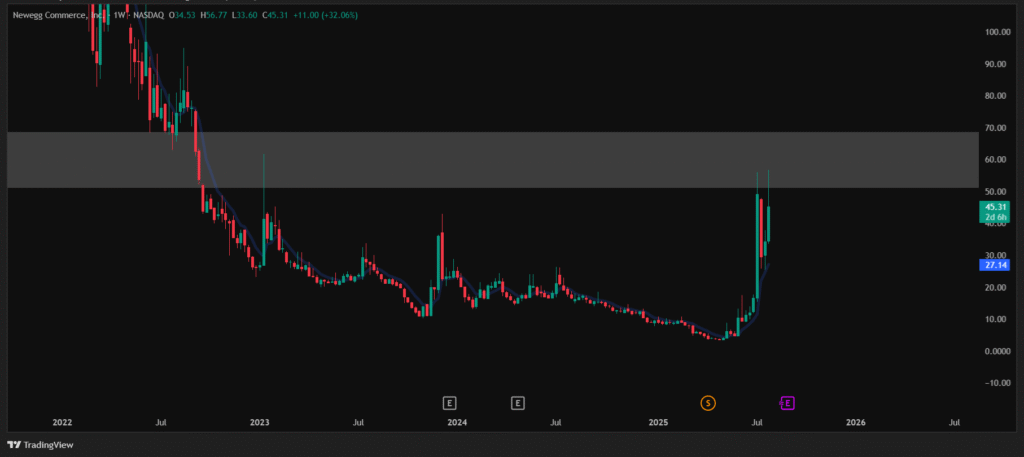
One of the most probable technical reasons for NEGG’s sharp fall is strong selling pressure from the supply zone around $55. The stock recently touched a high of $56.77, which falls right into this zone.

Historically, NEGG had formed a crucial support in the $50–$60 range. But after it broke down from this range earlier, the same zone has now turned into a resistance. As the stock retraced back to that level with a parabolic structure, it gave swing traders and short-term holders the perfect chance to sell and exit.

This kind of resistance-based selling is common after vertical rallies, especially in stocks with high volatility like NEGG.


2. Parabolic Rally Followed by Exhaustion

NEGG had been consolidating for a long time, and once it broke out, the movement was nothing short of parabolic. But when stocks rise too fast, they often run out of momentum just as quickly.

This rally lacked consistent volume spikes or major news-based triggers. So, when the price reached overextended levels, exhaustion selling kicked in – driven by both retail and institutional traders trying to book profits before a possible correction.

3. Broader Market and Sector Rotation

The internet retail sector as a whole has seen some weakness recently. Even large-cap players have faced pressure due to mixed earnings and slower e-commerce growth projections.

In such a scenario, speculative or mid-cap retail stocks like NEGG tend to fall faster, especially when overall investor sentiment turns cautious.

Investors are also rotating money into safer sectors such as energy, utilities, or dividend-yielding assets-leaving tech and e-commerce under pressure.


4. No New Fundamental Trigger to Sustain the Rally

While there was buzz around insider buying, and a temporary momentum spike followed it, there’s been no concrete news related to revenue growth, partnerships, or new launches from the company.

That means the recent rally was largely speculation-driven, and when such stocks don’t follow up with strong news or numbers, they often face sharp corrections – just like we saw today.


What Next for NEGG?

Even though the fall was sharp, some traders still believe NEGG could move higher in the coming weeks. But the path may not be easy. Given the past price behavior, expect a bumpy ride with ups and downs along the way.

The stock will likely face strong resistance in the $50–$55 range again, and unless there’s a solid fundamental trigger, the rally might remain limited.

This article is for informational purposes only and should not be considered financial advice. Investing in stocks, cryptocurrencies, or other assets involves risks, including the potential loss of principal. Always conduct your own research or consult a qualified financial advisor before making investment decisions. The author and publisher are not responsible for any financial losses incurred from actions based on this article. While efforts have been made to ensure accuracy, economic data and market conditions can change rapidly. The author and publisher do not guarantee the completeness or accuracy of the information and are not liable for any errors or omissions. Always verify data with primary sources before making decisions.

How does the stock price go up when the company goes up?

Company goes up, stock price goes up - how does that work?

As Jeff Bezos, the founder of Amazon, once said

“The company is not the stock, and the stock is not the company.”

This means that a company’s actual business and its stock price may seem related, but they are not always the same. They are connected, but not equal.

Let’s break this down in simple terms.

IPO vs Stock Market – What’s the Difference?

When a company offers its shares to the public for the first time, it’s called an IPO or Initial Public Offering. This happens in the primary market.

Here, the company directly receives money from investors. In return, investors get ownership in the form of shares. This is how the company raises capital to fund its business.

But once the IPO is over and the company is listed on a stock exchange like NSE, BSE, NASDAQ, or NYSE, any shares you buy are usually from other investors – not the company itself. This buying and selling happens in the secondary market.

So, in the stock market, you are mostly trading ownership with other people, not giving money to the company.


What Makes the Stock Price Go Up or Down?

After the IPO, the company’s stock price is driven by investor demand. This demand depends on how investors feel about the company’s performance and future potential.

If a company is:

  • Making good profits
  • Launching new products
  • Expanding into new markets
  • Managing its operations well

Then more people want to buy its shares, and the stock price usually goes up.

On the other hand, if the company is:

  • Facing losses
  • Losing market share
  • Involved in controversy
  • Or showing weak future prospects

Then investors may sell their shares, and the stock price falls.

This is why a company’s real-world success or failure affects how people value its shares in the market.


Important to Remember

A company’s stock price reaching zero does not always mean the company is bankrupt. It may just mean investors have lost confidence in its future.

Similarly, a stock trading at five hundred rupees or dollars does not always mean the company is truly worth that much. It could be due to hype, speculation, or unrealistic expectations.


A Simple Analogy – Student and Teacher

Think of a company as a student, and the investors as teachers.

Just like teachers give marks based on a student’s performance, investors assign a stock price based on the company’s financial health and future potential.

  • If the company performs well, investors give it a higher “mark” in the form of a rising stock price.
  • If the performance is poor or uncertain, the price drops—just like getting lower marks.

Also Read – Understanding the Basics of Buying, Selling, and Stop Hunting in Financial Markets


This article is for informational purposes only and should not be considered financial advice. Investing in stocks, cryptocurrencies, or other assets involves risks, including the potential loss of principal. Always conduct your own research or consult a qualified financial advisor before making investment decisions. The author and publisher are not responsible for any financial losses incurred from actions based on this article. While efforts have been made to ensure accuracy, economic data and market conditions can change rapidly. The author and publisher do not guarantee the completeness or accuracy of the information and are not liable for any errors or omissions. Always verify data with primary sources before making decisions.

Important Margin-Related Terms in Indian Stock Market That You Must Know

Complete Guide to Margin in the Indian Stock Market – Understand SPAN, Exposure, Initial, Peak, and Other Important Margins in Simple Words

Margin is the money or securities you must deposit to take or hold a position in the stock market, especially in the futures and options (F&O) segment. It is not the full value of the trade, but a fraction of it. This allows traders to use leverage, meaning they can take larger positions using a smaller capital base.

  • Margin is the money you put upfront to take a trade. Think of it as your security deposit.
  • Leverage is the additional buying power that your broker provides based on the margin you maintain. It’s like a loan that lets you control larger trades with less money.

Types of Margins in Indian Capital Markets

1. SPAN Margin (Standard Portfolio Analysis of Risk)

SPAN margin is the minimum margin required to cover expected losses from a one-day move in your position. It is calculated by the exchange using a risk-based system. It varies based on the risk and volatility of each contract.

Example: If you buy 1 lot of NIFTY futures, the SPAN margin may be ₹50,000. This value is not fixed and may change with volatility.

2. Exposure Margin

This is charged over and above SPAN to cover unexpected or extreme market movements. It serves as an additional buffer against market risk.

Example: If the SPAN is ₹50,000 and the exposure margin is ₹30,000, you need ₹80,000 in total to initiate the trade.

3. Total Initial Margin

This is the sum of SPAN Margin and Exposure Margin. You must have this total amount in your account before taking an F&O position.

Formula: Total Initial Margin = SPAN Margin + Exposure Margin

4. Premium Margin (for Options Buyers)

When buying options, you don’t need to maintain SPAN or exposure margin. You only pay the full premium upfront, which is called the premium margin.

Example: If a call option has a premium of ₹200 and the lot size is 50, your premium margin would be ₹10,000.

5. Mark to Market (MTM) Margin

MTM margin represents the daily gain or loss based on the difference between your entry price and the day’s closing price.

This margin is applicable to futures and also to short (sold) options positions. However, options buyers don’t face daily MTM charges, as their maximum loss is limited to the premium paid.

Example: If you buy NIFTY futures at ₹20,000 and it closes at ₹19,950, you lose ₹50 per unit. This loss is debited from your account that day.

6. Additional Margin

SEBI or exchanges may impose additional margins during volatile market conditions or special events. This is a temporary measure but mandatory when applied.

Example: During events like Union Budget or elections, an additional 10% margin may be imposed to curb speculation.

7. Special Margin

This is imposed on specific stocks or segments that show unusual price or volume movements. It aims to control speculative activity or price manipulation in that particular stock.

Example: If a small-cap stock suddenly rises 70–80% in a few sessions without fundamental news, a special margin may be applied.

8. Maintenance Margin

After taking a position, this is the minimum balance that you must maintain in your account. If your margin balance falls below this level, you will get a margin call to deposit more funds.

9. Margin Shortfall

This occurs when you fail to maintain the required margins (initial and MTM). A margin shortfall may lead to penalties, interest charges, or forced closure of your positions by the broker.

10. Delivery Margin

For F&O contracts that result in physical delivery, exchanges may require an extra delivery margin near expiry. This ensures that both buyer and seller are capable of fulfilling the delivery obligation.

11. Peak Margin

Introduced by SEBI in 2021, peak margin is the highest margin requirement at any point during the trading day. Brokers must collect this maximum margin from clients, reducing the ability to offer excessive intraday leverage.

12. Intraday Margin

Earlier, brokers offered high intraday leverage for trades that were squared off within the day. But under SEBI’s peak margin framework, this is now restricted. Brokers can no longer offer excessively low intraday margins unless the client has funded the position sufficiently.

13. VaR Margin (Value at Risk)

This applies to the cash (equity) segment and represents the margin needed to protect against losses in 99% of trading scenarios. Stocks with higher volatility attract higher VaR margins.

14. ELM (Extreme Loss Margin)

Also applicable in the cash segment, ELM covers rare or extreme events that go beyond the VaR calculation. Exchanges collect both VaR and ELM together.

Total margin in the cash segment = VaR Margin + ELM

15. Pledged Margin

If you don’t have enough cash, you can pledge your shares to generate margin. This is called Margin Against Shares (MAS). However, a haircut is applied to the pledged value, meaning you don’t receive 100% of the value as usable margin.

Example: If you pledge ₹1,00,000 worth of shares and the haircut is 20%, you will get ₹80,000 as usable margin.


Summary Table

Type of MarginApplies ToPurpose
SPAN MarginF&OCovers expected daily market risk
Exposure MarginF&OExtra buffer for unexpected moves
Total Initial MarginF&OSPAN + Exposure
Premium MarginOptions BuyerFull premium payment only
MTM MarginFutures, Short OptionsDaily settlement of gains/losses
Additional MarginAllExtra margin in volatile situations
Special MarginAllStock-specific speculative control
Maintenance MarginAllMinimum balance to hold positions
Margin ShortfallAllWhen margin requirement is unmet
Delivery MarginF&OFor physical delivery contracts
Peak MarginAllMax margin during the day
Intraday MarginIntraday TradesShort-term trades (restricted now)
VaR MarginCash SegmentRisk margin based on price movement
ELMCash SegmentExtra buffer for rare price swings
Pledged MarginF&OMargin from pledged shares

This article is for informational purposes only and should not be considered financial advice. Investing in stocks, cryptocurrencies, or other assets involves risks, including the potential loss of principal. Always conduct your own research or consult a qualified financial advisor before making investment decisions. The author and publisher are not responsible for any financial losses incurred from actions based on this article. While efforts have been made to ensure accuracy, economic data and market conditions can change rapidly. The author and publisher do not guarantee the completeness or accuracy of the information and are not liable for any errors or omissions. Always verify data with primary sources before making decisions.