
Coinbase CFO Alesia Haas Files Notice for $2 Million Stock Sale Ahead of Q1 Results

Feel The Candlesticks

Coinbase Global, Inc. Chief Financial Officer Alesia Haas has filed a notice to sell 10,020 shares of the company’s common stock, according to a recent Form 144 filing with the Securities and Exchange Commission.

The proposed transaction, dated April 16, 2026, carries an estimated aggregate market value of $2,004,000. This planned sale comes as the digital asset industry prepares for a pivotal stretch of corporate reporting and structural shifts in the crypto-economy.

The securities involved in this filing were originally acquired by Haas through equity compensation directly from Coinbase, with shares earned in May and August of 2025. In corporate finance, equity compensation is a non-cash pay category where executives receive shares or stock options. This practice is intended to align the interests of leadership with those of shareholders, as the value of the compensation rises or falls based on the company’s market performance.

Also Read – Circle Internet Group (CRCL) – Insider Activity and Outlook Ahead of Q1 Earnings

This latest filing follows a period of significant selling activity for the CFO. Over the past three months, Haas has sold a total of 384,570 shares, generating gross proceeds of approximately $59.5 million. The largest of these transactions occurred on February 6, 2026, when 364,600 shares were sold for more than $55.4 million. The sale is being conducted through a Rule 10b5-1 trading plan adopted on September 3, 2025. This specialized financial tool allows company insiders to set up a predetermined schedule for selling stocks at a time when they do not possess private, market-moving information, providing a transparent way to manage personal liquidity.

Anticipation Builds for Q1 Earnings and Crypto Market Milestones

The timing of the disclosure coincides with heightened investor interest as Coinbase prepares to report its first-quarter financial results. The company is scheduled to release its Q1 2026 earnings on April 30, 2026, following the close of market trading. These results are expected to provide a health check on the broader cryptocurrency sector, particularly regarding trading volumes and the growth of institutional services.

Beyond the earnings calendar, the digital asset landscape is navigating significant technical and regulatory updates. Market participants are closely monitoring the impact of the recent Bitcoin Halving—a recurring event that reduces the rate at which new units of the cryptocurrency are created. This process is designed to manage scarcity and has historically influenced market volatility and trading activity across exchange platforms. Additionally, the industry is tracking the expansion of spot crypto Exchange-Traded Funds (ETFs), which have increasingly integrated traditional finance with digital assets, directly impacting the custodial and transaction revenue models for firms like Coinbase.

Market Context and Regulatory Standards

The proposed sale represents a small fraction of the total 223,041,278 shares outstanding for the exchange operator. While the filing indicates an intent to sell, such notices are standard regulatory requirements under Rule 144. This rule governs the sale of “restricted” or “control” securities held by insiders, ensuring that such trades do not cause undue instability in the public marketplace.

By filing the Form 144, the executive represents that they are unaware of any material adverse information regarding the company’s operations that has not been disclosed to the public. The transaction is slated to be handled through Merrill Lynch on the Nasdaq exchange, maintaining the transparent reporting standards expected of major financial institutions.

Company Profile

Coinbase Global, Inc. operates within the financial technology sector, specifically classified under the software and services industry as a leading provider of financial infrastructure and technology for the crypto-economy. The company went public via a direct listing in 2021 and maintains its corporate headquarters in New York City. Coinbase provides a comprehensive platform that allows consumers, institutions, and developers to trade, store, and interact with various digital assets and decentralized applications. The business generates the majority of its revenue through transaction fees earned from trades executed on its platform, as well as through subscription and services revenue, which includes interest income, staking rewards, and custodial fees.

This article is for informational purposes only and should not be considered financial advice. Investing in stocks, cryptocurrencies, or other assets involves risks, including the potential loss of principal. Always conduct your own research or consult a qualified financial advisor before making investment decisions. The author and publisher are not responsible for any financial losses incurred from actions based on this article. While efforts have been made to ensure accuracy, economic data and market conditions can change rapidly. The author and publisher do not guarantee the completeness or accuracy of the information and are not liable for any errors or omissions. Always verify data with primary sources before making decisions.
Circle Internet Group (CRCL) – Insider Activity and Outlook Ahead of Q1 Earnings

Feel The Candlesticks

As Circle Internet Group, Inc. (NYSE: CRCL) prepares to pull back the curtain on its first-quarter performance for 2026, recent regulatory filings and market data suggest a company at a significant crossroads. With a pivotal earnings date set for May and notable insider selling by top leadership, investors are closely watching how the “infrastructure layer of the digital economy” will fare in an increasingly complex regulatory environment.

Insider Sales Under the Microscope

A Form 144 filing dated April 13, 2026, reveals that Heath Tarbert, President of Circle, proposed the sale of 15,000 Class A shares with an approximate market value of $1.43 million.

The sale was executed through Fidelity Brokerage Services under a pre-arranged Rule 10b5-1 trading plan adopted on August 14, 2025. This transaction follows a string of disposals by Tarbert over the last three months, totaling over 200,000 shares for proceeds exceeding $20 million. While insider selling can sometimes trigger alarm, these automated plans are often scheduled months in advance to diversify executive holdings regardless of current market sentiment.

Q1 2026 Earnings: What to Expect

Circle has officially scheduled its Q1 2026 financial results for Monday, May 11, 2026, at 8:00 a.m. ET. Analysts are looking for several key indicators:

  • USDC Adoption: Investors will gauge transaction volumes and market share for USDC to determine recurring platform revenue.
  • Arc Blockchain Milestones: Progress on the enterprise-focused Arc blockchain will be a primary focus for those looking for SaaS-style growth.
  • Earnings Growth: Consensus estimates project high growth, with annual earnings expected to rise by 69.4% as the company moves toward sustained profitability.

Stock Performance and Market Sentiment

CRCL’s performance in 2026 has been a tale of recovery. After a volatile start to the year that saw shares dip toward the $50 mark in early February, the stock has rallied significantly.

MetricValue (As of April 17, 2026)
Last Price$105.91
52-Week High$298.99
52-Week Low$49.90
Market Cap~$26.18 Billion

The stock is currently up roughly 14% year-to-date, trading well above its 50-day moving average of $90.08.

The Road Ahead

Circle’s transition from a “crypto proxy” to a critical piece of “financial infrastructure” appears to be gaining traction with institutional investors. However, the path to the $120+ level predicted by some models will likely depend on the regulatory clarity surrounding the Clarity Act and the company’s ability to maintain high margins amidst rising global operational costs.

Investors should keep a sharp eye on the May 11 call for updates on stablecoin yield legislation and new enterprise partnerships.

This article is for informational purposes only and should not be considered financial advice. Investing in stocks, cryptocurrencies, or other assets involves risks, including the potential loss of principal. Always conduct your own research or consult a qualified financial advisor before making investment decisions. The author and publisher are not responsible for any financial losses incurred from actions based on this article. While efforts have been made to ensure accuracy, economic data and market conditions can change rapidly. The author and publisher do not guarantee the completeness or accuracy of the information and are not liable for any errors or omissions. Always verify data with primary sources before making decisions.

Which Stocks, Industries, and Sectors May Get Affected by a U.S.–Iran Conflict?

Weekly Market Outlook - How a US–Iran–Israel Conflict Could Reshape Global Markets

Rising geopolitical tensions involving the United States, Iran, and Israel are beginning to influence global financial markets. Historically, even the risk of escalation in the Middle East has been enough to shift capital flows, increase volatility, and trigger sector rotation across equity markets.

This week, markets are likely to trade more on geopolitical headlines than on earnings or macroeconomic data.


Energy Sector: The Most Direct Impact

The energy sector is typically the first and most sensitive area impacted by Middle East tensions.

• Crude oil prices often rise due to supply disruption fears.
• Oil producers and integrated energy companies may benefit from higher realized prices.
• Oilfield services and drilling companies could see renewed investor interest.

However:

• Airlines, logistics firms, and chemical manufacturers may face margin pressure due to higher fuel and input costs.
• Sustained oil spikes can increase inflation expectations, influencing central bank policy outlooks.

Short-term winner: Upstream oil producers.
Short-term risk: Fuel-dependent industries.

Also Read – Top 13 Stocks That Could Be Impacted by a Strait of Hormuz Blockade


Defense & Aerospace: Structural Beneficiary

Heightened geopolitical risk tends to increase expectations for defense spending.

• Missile systems, aerospace manufacturing, and military technology providers often attract capital during periods of conflict.
• Long-term government contracts provide earnings visibility, which can make defense stocks relatively defensive during uncertainty.

Even if tensions ease, increased security budgets often remain in place, providing medium-term support.


Precious Metals & Safe-Haven Assets

Geopolitical uncertainty usually drives investors toward perceived safe havens.

• Gold and precious metal miners often gain as investors hedge risk.
• U.S. Treasuries may see increased demand.
• Defensive sectors such as utilities and consumer staples may outperform broader cyclical markets.


Transportation & Industrials: Potential Headwinds

• Airlines face rising jet fuel costs and potential airspace disruptions.
• Shipping companies could experience route uncertainty and higher insurance premiums.
• Export-heavy industrial firms may see demand concerns if global trade sentiment weakens.

Defense-linked industrial companies, however, may diverge positively from the broader industrial sector.


Financials: Volatility Sensitivity

Banks and financial institutions often underperform during periods of geopolitical uncertainty due to:

• Increased market volatility
• Tighter credit conditions
• Risk repricing in global markets

If higher oil prices revive inflation concerns, interest rate expectations could also shift, adding another layer of complexity for financial stocks.


Technology Sector: Mixed Reaction

Large-cap technology stocks can behave in two ways:

• Software and cloud companies may act as relative safe growth plays.
• Hardware and semiconductor companies could face volatility due to supply chain concerns and global risk sentiment.

The reaction largely depends on whether tensions escalate into broader regional disruption.

Also Read – I Created the Best Bitcoin Guide You’ll Ever Read


Broader Market Outlook

In most historical geopolitical episodes:

• Markets experience short-term volatility spikes.
• Sector rotation becomes more pronounced.
• Energy and defense lead performance.
• Cyclical and transport-linked stocks lag.

Unless escalation becomes prolonged or expands regionally, markets typically stabilize once risk clarity improves.


Investor Takeaway

A U.S.–Iran conflict scenario primarily reshuffles sector leadership rather than triggering systemic collapse.

Potential beneficiaries:
• Energy producers
• Defense contractors
• Precious metals

Potentially vulnerable sectors:
• Airlines and transportation
• Consumer discretionary
• Financials

For investors, this is a phase of selective positioning and risk management rather than broad liquidation. Monitoring oil prices, defense spending signals, and diplomatic developments will remain critical in assessing near-term market direction.

Also Read – Why Every Investor is a Trader?

This article is for informational purposes only and should not be considered financial advice. Investing in stocks, cryptocurrencies, or other assets involves risks, including the potential loss of principal. Always conduct your own research or consult a qualified financial advisor before making investment decisions. The author and publisher are not responsible for any financial losses incurred from actions based on this article. While efforts have been made to ensure accuracy, economic data and market conditions can change rapidly. The author and publisher do not guarantee the completeness or accuracy of the information and are not liable for any errors or omissions. Always verify data with primary sources before making decisions.

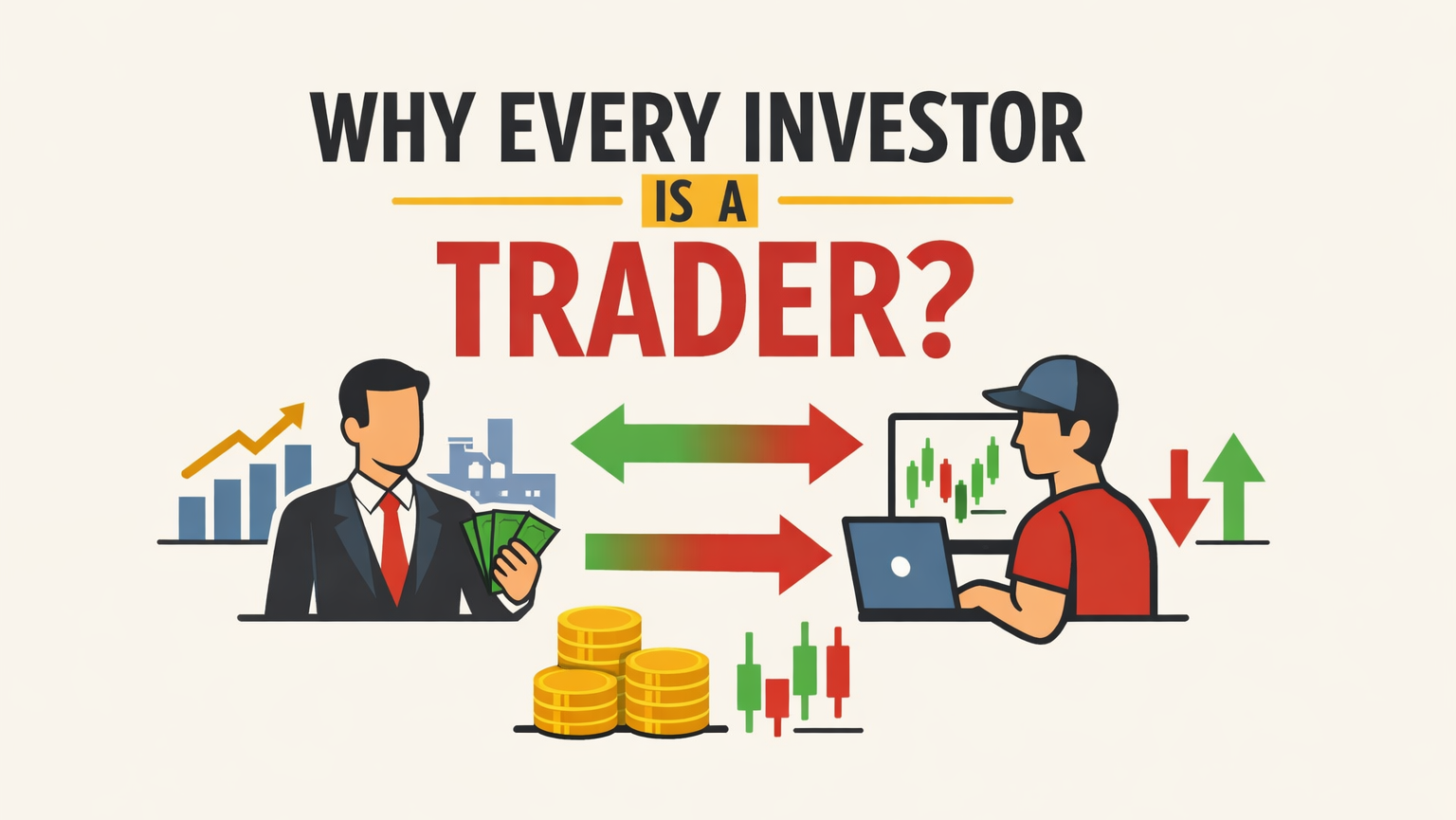
Why Every Investor is a Trader?

Investing Begins With a Trade

Trading is often portrayed as reckless speculation, while investing is positioned as thoughtful and virtuous. But this framing collapses under scrutiny. Every investment begins with a trade. When you buy shares with a long-term mindset, you are still executing a trade with someone selling. When you exit years later, you trade again – this time with a buyer. Mechanically, investing is simply low-frequency trading stretched across time.

So if both investing and trading rely on the same market actions, the distinction clearly lies somewhere else.

Also Read – I Created the Best Bitcoin Guide You’ll Ever Read

If It’s Not the Act of Trading, Then What Actually Separates Investing from Speculation?

The true difference is not whether trades occur, but why capital is deployed. Investing is driven by ownership – the belief that a business will grow, generate cash flows, and create real economic value over time.

Speculative trading, on the other hand, seeks profit primarily from price movements, often disconnected from long-term value creation.

Frequent buying and selling is not inherently wrong. But when activity shifts from owning risk to arbitraging expectations, the economic character of participation changes – and so do the moral and financial consequences.

Why Can a Well-Reasoned Investment Still Fail?

An investor may buy a stock believing earnings will rise over the next year or two. The reasoning may be sound. The business may even perform exactly as expected. Yet the stock price may stagnate or fall.

This apparent contradiction confuses many market participants – and it reveals something crucial about how markets actually work.

What Makes Financial Markets Fundamentally Different from Every Other Market?

Financial markets are not reactive; they are forward-looking. Prices do not wait for earnings announcements or business results. They continuously absorb expectations about the future. By the time growth, profitability, or industry tailwinds become visible, those narratives are often already reflected in prices.

The market is never asking whether a company will do well. It is asking whether the company will do better than what is already expected.

Who Is Pricing the Future Faster Than You Think?

Modern markets are dominated by participants with extraordinary informational and analytical advantages – institutional investors, analysts, quantitative funds, and algorithmic systems. These players process massive data sets and model future outcomes at speed.

Their collective activity compresses the time window in which new information can create mispricing, especially in the short to medium term. This is why being “right” about a company often isn’t enough.

Why Being Right About the Business Isn’t the Same as Being Right About the Stock?

Stock market returns do not come from predicting the future accurately. They come from recognizing when market expectations about the future are wrong, incomplete, or mispriced.

You can be correct about earnings growth and still lose money if that growth was already priced in. Markets reward expectation gaps, not correctness.

Is Investing Really About Trading Less – or About Understanding Expectations Better?

At its core, investing is not a debate between trading and not trading.

It is a debate between owning value creation and competing over price expectations.

Understanding this distinction is not optional. It is essential for navigating markets responsibly, intelligently, and with realistic expectations of risk and reward.

This article is for informational purposes only and should not be considered financial advice. Investing in stocks, cryptocurrencies, or other assets involves risks, including the potential loss of principal. Always conduct your own research or consult a qualified financial advisor before making investment decisions. The author and publisher are not responsible for any financial losses incurred from actions based on this article. While efforts have been made to ensure accuracy, economic data and market conditions can change rapidly. The author and publisher do not guarantee the completeness or accuracy of the information and are not liable for any errors or omissions. Always verify data with primary sources before making decisions.

5 Reasons MSFT Might Be at the Right Spot for a Potential Bounce

Microsoft’s sharp post-earnings fall illustrates that short-term price moves are often about sentiment, expectations, and liquidity rather than fundamental shifts in business quality. Structurally, the stock is now trading near zones that historically matter to technical participants and longer-term investors.

Microsoft has been one of the strongest blue-chip performers of the last decade. Yet even the strongest stocks go through phases where price corrects faster than sentiment can adjust.

Microsoft’s recent price action has left many investors confused. Strong earnings, record cloud revenue, and solid guidance would normally support higher prices. Instead, the stock corrected sharply, falling with greater magnitude immediately after the earnings release.

After a sharp decline from recent highs, investors are now asking a simple but important question: Is MSFT setting up for a move back up, or is this weakness just the beginning?

To answer that, it’s important to step away from emotions and look at how markets actually behave.


Why Did MSFT Fall So Strongly After Good Earnings Itself?

Financial markets are far more intelligent than they appear on the surface. Time and again, they manage to locate liquidity at precisely the right moment and at the right price levels. This behavior has been observed repeatedly across market cycles.

More often than not, technical structures move first, and fundamentals arrive later as the catalyst that validates the move. From our perspective, we focus on feeling the candlesticks—placing greater weight on technical analysis than anything else. That said, fundamentals are not ignored; they are simply treated as secondary confirmation rather than the primary driver.

In Microsoft’s case, the market had already priced in the company’s strong performance well before the earnings release. Expectations were high, optimism was elevated, and positioning reflected that confidence. What followed appears to be a classic case of profit booking.

After the earnings announcement, many euphoric participants likely rushed in to buy the stock, assuming strong results would automatically push prices higher. At the same time, more experienced investors found exactly the liquidity they needed to exit their positions and lock in gains. This imbalance between late buyers and early sellers could explain why MSFT declined sharply—even after delivering solid earnings results.

In essence, the post-earnings drop may not be a reflection of weakness in the business, but rather the market efficiently redistributing risk and reward.

When expectations are high, even strong performance can fail to push prices higher. What follows is often a reset rather than a rejection of the business itself.

Markets Are Smarter Than They Look

Financial markets have a habit of doing one thing extremely well: finding liquidity at the right time and at the right levels. This has been seen repeatedly across cycles, sectors, and asset classes.

Very often, technical direction leads, and fundamentals arrive later as the justification.

Price moves first; narratives follow. That’s why, in our framework, we focus on feeling the candlesticks. Technical analysis takes priority – not because fundamentals don’t matter, but because they are usually already reflected in price.

In Microsoft’s case, the market had already priced in strong performance well ahead of earnings. Optimism was elevated, positioning was heavy, and expectations were stretched.


Strong Earnings, Weak Price: A Classic Market Reaction

Microsoft reported its earnings after the bell, delivering impressive results:

  • Revenue: $81.3 billion, up 17% year over year (above expectations of $80.2 billion)
  • Net Income: $38.5 billion
  • Non-GAAP EPS: $4.14, beating the $3.93 consensus
  • Cloud Revenue: Surpassed $50 billion for the first time

On paper, this was a strong quarter by almost any metric.

Yet the stock fell sharply, dropping more than 11% in the session that followed. This reaction highlights an important reality for Big Tech in 2026: “good” is no longer good enough when valuations are already stretched.

What likely played out was profit booking. Euphoric investors may have bought into the earnings release expecting immediate upside, while more seasoned participants used that surge in liquidity to exit positions. The result was a sharp downside move -not because the business weakened, but because expectations had already peaked.


Long-Term Structure – Inside the 2025 Yearly Range

From a higher-timeframe perspective, MSFT is still trading within the 2025 yearly candlestick range, roughly bounded between 555 on the upper end and 344 on the lower end.

The stock has now retraced sufficiently from its top, entering zones that historically attract interest from long-term participants. This pullback has likely cleared a significant amount of investor froth that built up in the upper range.

For savvy investors, such retracements often matter more than headlines.


Medium-Term Setup – Approaching a Key Moving Average

On the six-month chart, Microsoft is approaching its 9-EMA, a level that has acted as reliable dynamic support in many prior instances.

While no indicator works every time, this moving average often marks zones where selling pressure slows and price discovery becomes more balanced.

This is not a guarantee of a reversal – but it is a zone where risk-reward dynamics begin to shift.


Monthly and Daily Charts Point to the Same Gap Zone

Switching to the monthly timeframe, there is a visible price gap between 396 and 424, created during the sharp upward move at the beginning of May. From that point onward, the stock stayed in a strong upward trajectory – until now.

Price is currently poised to fill that gap, a process that markets frequently undergo before establishing fresh accumulation. Importantly, the same gap structure is visible on the daily chart, reinforcing the technical significance of this zone.

When multiple timeframes point to the same area, markets tend to respond.


The 396–350 Zone: Where Bulls and Bears Clash

The broader range between roughly 396 and 350 represents an area where price discovery could intensify. This zone may attract significant interaction between buyers and sellers, potentially serving as a battleground for accumulation. Such zones often draw interest from institutional and sophisticated investors who prefer to scale into positions systematically rather than chase momentum at elevated levels. As sentiment shifts from euphoria toward caution, this range could be where price begins to stabilize and reset.

As the saying goes:

Be greedy when others are fearful, and fearful when others are greedy.


MSFT’s Long-Term Strategic Position Remains Strong

Microsoft’s fundamental positioning remains deeply rooted in enduring secular trends. Its cloud and enterprise software businesses continue to generate substantial revenue, and its ongoing investments in artificial intelligence reflect a strategic commitment to future growth.

Recent coverage highlights that Microsoft’s AI division has become larger than some of its longstanding franchises, and the company continues to invest heavily in AI infrastructure. CEO Satya Nadella has emphasized that the company is still in the early stages of AI adoption, even as cloud revenue growth slightly decelerates.

Additionally, the market’s concerns around elevated capital expenditures largely tied to AI capacity build-out suggest that investors are wrestling with timing and cost dynamics as much as revenue strength. High AI spending and associated build-out costs have weighed on sentiment, despite long-term revenue potential.

Microsoft’s Stance on Cryptocurrency

Regarding cryptocurrency, Microsoft has maintained a cautious and selective approach rather than aggressive direct investment. In a recent shareholder vote, investors rejected a proposal to explore adding Bitcoin to Microsoft’s corporate treasury, reflecting both the board’s and major investors’ preference for stability over the volatility commonly associated with crypto assets.

Also Read – I Created the Best Bitcoin Guide You’ll Ever Read

Microsoft’s involvement in blockchain technology primarily comes through its Azure cloud platform rather than direct ownership of digital currencies. Azure has offered blockchain-related services and support for enterprise blockchain development, including tools and frameworks that leverage platforms such as Ethereum and other distributed ledger technologies. This reflects a strategy of enabling blockchain and decentralized applications through infrastructure and enterprise services rather than using its corporate balance sheet to hold cryptocurrencies.

This article is for informational purposes only and should not be considered financial advice. Investing in stocks, cryptocurrencies, or other assets involves risks, including the potential loss of principal. Always conduct your own research or consult a qualified financial advisor before making investment decisions. The author and publisher are not responsible for any financial losses incurred from actions based on this article. While efforts have been made to ensure accuracy, economic data and market conditions can change rapidly. The author and publisher do not guarantee the completeness or accuracy of the information and are not liable for any errors or omissions. Always verify data with primary sources before making decisions.

5 Reasons Gold Pulled Back 4% from $5,598 to $5,100

Why Gold Pulled Back 4% From $5,500 to $5,100

Gold prices have been on a historic tear in 2026, smashing through multiple all-time highs amid geopolitical chaos, economic uncertainty, and a weakening U.S. dollar.

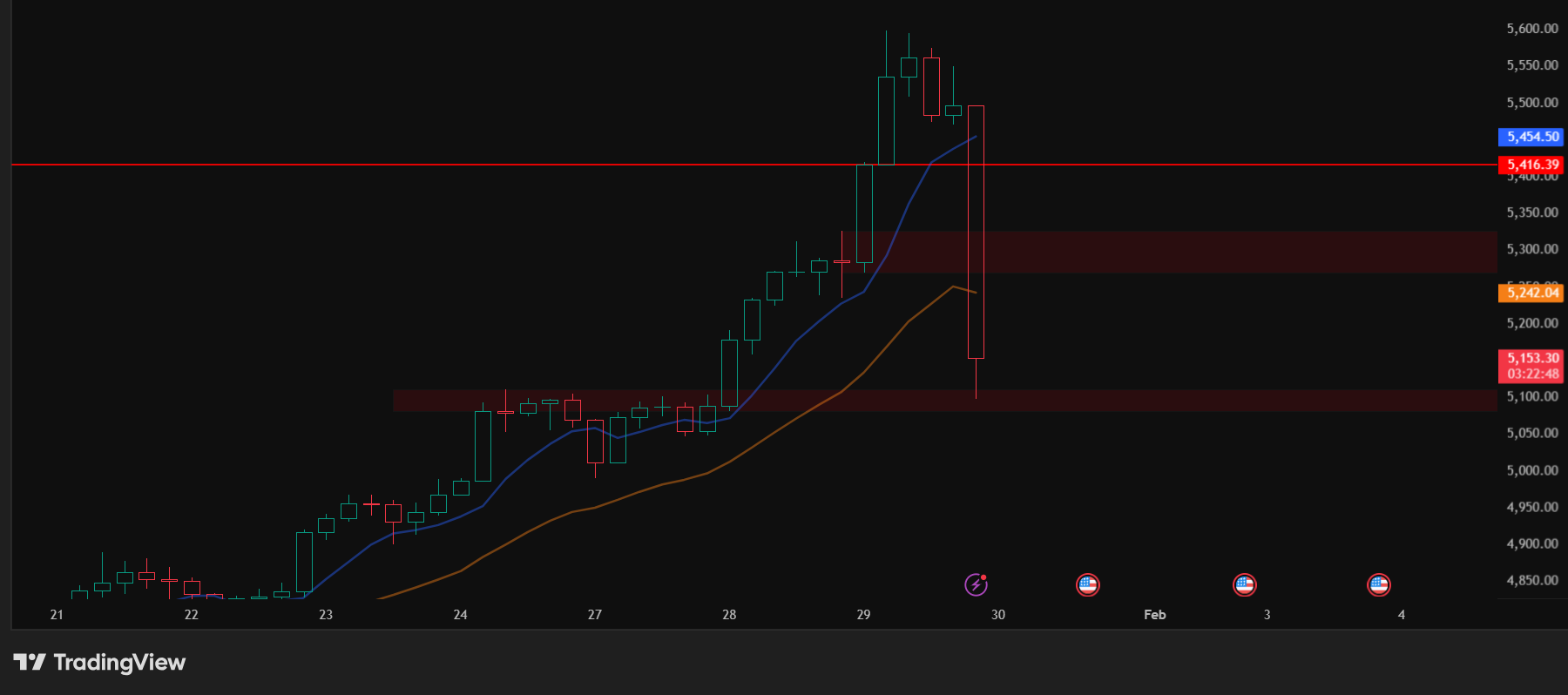
After peaking near $5,598 per ounce on January 29, the yellow metal witnessed a sharp 4% retreat, slipping toward the $5,100 level in intraday trading.

The 4% pullback from $5,500 to $5,100 appears to be a healthy correction within a broader bull market rather than a trend reversal. Long-term fundamentals—including central bank diversification, geopolitical uncertainty, and global macro risks—continue to support elevated gold prices.

Such volatility is not unusual in overheated bull markets. Rapid, parabolic gains often invite corrections, even when the broader trend remains intact. While the long-term outlook for gold continues to look constructive – supported by safe-haven demand and sustained central bank buying—the recent pullback reflects a convergence of short-term pressures.

Below are the five key reasons behind gold’s swift reversal.


1. Profit-Taking After an Explosive Rally

Gold’s January rally was extraordinary. Prices surged more than 30% in a single month, rising from around $4,319 at the start of the year to above $5,598 at the peak. Moves of this magnitude naturally attract short-term traders looking to capitalize on momentum.

Once gold approached a major psychological level like $5,500, profit-taking intensified. Many investors chose to lock in gains, especially after gold delivered an unprecedented 64% return in 2025.

As selling began, algorithmic strategies and stop-loss orders amplified the downside, creating a cascading effect that accelerated the decline.


2. Hawkish Federal Reserve and Shifting Rate Expectations

The Federal Reserve’s January decision to keep interest rates unchanged at 3.50%–3.75%, combined with Chair Jerome Powell’s assessment that the U.S. economy remains in a “good place,” dampened expectations for near-term rate cuts.

Also Read – Fed Interest Rates vs Gold Prices – What to Expect Ahead of the September 2025 FOMC Meeting?

Gold typically performs best in low-interest-rate environments, since it does not generate yield. As markets adjusted to the possibility of fewer rate cuts in 2026—amid persistent inflation and resilient growth—real yields edged higher. This shift reduced gold’s relative appeal and triggered a rapid unwinding of bullish positions, contributing to the sharp pullback.


3. Forced Selling From Index Funds and Market Rebalancing

January is a common period for commodity index rebalancing. Passive funds are required to adjust their holdings based on predefined rules, regardless of price trends or fundamentals. This process can result in forced selling, even during strong bull markets.

Such mechanical flows can temporarily distort prices, increasing volatility and pressuring gold lower. With banks holding sizable net short positions in paper gold, these rebalancing-driven selloffs tend to magnify downside moves, as weaker hands are shaken out and liquidity-driven declines feed on themselves.


4. Easing Geopolitical Fears and a Shift Toward Risk Assets

Gold’s rally has been fueled in large part by safe-haven demand, driven by geopolitical tensions, trade conflicts, and rising global debt concerns. However, even minor signs of de-escalation can cool demand for defensive assets.

Recent indications of softer trade rhetoric and progress in diplomatic discussions have reduced immediate hedging urgency. At the same time, strong corporate earnings—particularly in the technology sector—and major equity indices pushing to new highs have encouraged a risk-on environment. As capital rotates back into equities, gold often experiences temporary pullbacks.


5. Dollar Stabilization and Speculative Position Unwind

Earlier weakness in the U.S. dollar provided a powerful tailwind for gold, making it cheaper for international buyers. However, as the dollar stabilized, the traditional inverse relationship between the two assets reasserted itself.

Crowded speculative long positions—built on themes such as de-dollarization and fiat currency debasement—began to unwind rapidly once macro signals shifted. While these flows can drive sharp short-term declines, they do not necessarily undermine gold’s longer-term structural support.


This article is for informational purposes only and should not be considered financial advice. Investing in stocks, cryptocurrencies, or other assets involves risks, including the potential loss of principal. Always conduct your own research or consult a qualified financial advisor before making investment decisions. The author and publisher are not responsible for any financial losses incurred from actions based on this article. While efforts have been made to ensure accuracy, economic data and market conditions can change rapidly. The author and publisher do not guarantee the completeness or accuracy of the information and are not liable for any errors or omissions. Always verify data with primary sources before making decisions.

3 Easy Ways to Enable Candlestick Timer in TradingView

Feel The Candlesticks

Many trading strategies depend heavily on candle close confirmation, especially setups where entries, exits, or validations are considered reliable only after a candlestick has fully completed its formation.

In such cases, the candlestick close timer, officially called the ‘Countdown to Bar Close’, becomes an essential visual tool. This timer shows how much time remains before the current candle closes, helping traders avoid premature decisions and emotional entries during an unfinished price move.

Why the ‘Countdown to Bar Close’ Sometimes Disappears?

In TradingView, this feature can disappear if chart settings are changed unknowingly while experimenting with customization options.

The candlestick close timer does not vanish due to a system error or platform limitation. In most cases, it is turned off unintentionally when users adjust time scale settings, modify chart preferences, or experiment with visual layouts.

Since TradingView offers extensive chart customization, it is very easy to disable certain display elements without realizing their importance at the moment.

Also Read – 3 Easy Methods to Hide Candlesticks in TradingView


If your candle time is not showing, here are 3 simple methods to enable the candle timer for any timeframe in TradingView.

Method One: Enabling the ‘Countdown to Bar Close’ from Chart Settings

The most direct and controlled way to bring back the candlestick close timer is to enable it manually from the chart settings.

Right-click anywhere on the chart and open Settings. Then go to the Scales and Lines section and look for the option called ‘Countdown to Bar Close.’ Simply tick this option.

Once enabled, the countdown timer immediately appears on the price chart and starts showing the remaining time for the active candlestick on TradingView.

This method is ideal for traders who want to keep their existing chart layout, indicators, and visual preferences unchanged while restoring only the missing timer.

The most straightforward and controlled way to restore the candlestick close timer is to enable it manually through the chart settings.

Alternatively, you can access the Scales and Lines option by right-clicking directly on the price scale. Select More Settings, and then follow the same steps under Scales and Lines as explained above.

Method Two: Fix Candle Timer from Labels Menu

Click on the settings icon at the bottom of the price scale of the trading instrument and go to Labels.

When you hover your cursor over Labels, several options will appear. Find Countdown to Bar Close and enable it.

Once selected, the timer will start showing again.

You can restore the candle close timer by clicking the settings icon at the bottom of the price scale in TradingView, navigating to Labels, and enabling Countdown to Bar Close.

Method Three: Restoring the Timer by Resetting the Chart to Default

Another effective way to enable the candlestick close timer is by resetting the chart to its default configuration.

Because the Countdown to Bar Close is included in TradingView’s default chart layout, resetting the chart automatically brings the timer back along with the standard visual settings.

Since the Countdown to Bar Close is part of TradingView’s default chart setup, resetting the chart automatically restores the timer along with other standard visual settings.

By reverting the chart to its original state, all hidden or disabled features, including the candlestick close timer, become visible again.

While this approach may remove some customizations, it provides the fastest solution when troubleshooting becomes confusing or time-consuming.


Also Read – Candlesticks Not Showing or Visible in TradingView? – Complete Solution Guide

Which Method Should You Use?

All the methods ultimately lead to the same result, but the choice depends on the trader’s specific situation.

If the chart is heavily customized and only the timer is missing, manually enabling the ‘Countdown to Bar Close’ is the better option.

On the other hand, if multiple chart elements are behaving unexpectedly or the cause of the missing timer is unclear, resetting the chart to default can save time and effort.


For a better understanding, watch the full video below.

This article is for informational purposes only and should not be considered financial advice. Investing in stocks, cryptocurrencies, or other assets involves risks, including the potential loss of principal. Always conduct your own research or consult a qualified financial advisor before making investment decisions. The author and publisher are not responsible for any financial losses incurred from actions based on this article. While efforts have been made to ensure accuracy, economic data and market conditions can change rapidly. The author and publisher do not guarantee the completeness or accuracy of the information and are not liable for any errors or omissions. Always verify data with primary sources before making decisions.

What time do the 4 hour candles close?

The answer is already contained in the question itself. A 4-hour candlestick closes exactly four hours after it opens. After every four hours, the current candle closes and a new 4-hour candle begins, which will again close after the next four hours. This happens only when the selected timeframe is set to 4H.
On TradingView, you can check the remaining time for a candle to close on the right-side price scale by enabling the candle close timer. This shows how much time is left before the current 4-hour candle closes.

Candlesticks Not Showing or Visible in TradingView? – Complete Solution Guide

When candlesticks are not showing or visible in TradingView, the issue is usually straightforward once you know where to look. Whether it is caused by unticked candle settings, hidden objects, an accidental chart type switch, a color clash, or extreme zoom levels, each of these problems can be resolved directly from the chart interface.

If you open a chart and suddenly notice that candlesticks are missing, invisible, or seem to have disappeared, it can be frustrating – especially when you are actively analyzing the market. This is one of the most common TradingView chart problems and is often mistaken for a loading issue or platform bug. In reality, candles not showing on TradingView is usually caused by a few specific settings or visual conflicts that can be fixed within seconds.

This article explains all the major reasons why a TradingView chart is not showing candles and shows you exactly how to unhide candlesticks on TradingView step by step.

Why Candlesticks Disappear on TradingView?

The root cause is rarely a server-side issue. In most cases, the chart is working perfectly, but certain visual settings, chart types, or zoom levels make the candles invisible.

Understanding how TradingView handles chart styles, object visibility, and color settings will help you quickly diagnose and fix the problem.

Also Read – 3 Easy Methods to Hide Candlesticks in TradingView

5 Possible Reasons Why Candlesticks Are Not Showing in TradingView

When candles are not showing or visible in TradingView, the solution is usually simple once you know where to look. Most issues can be fixed directly from the chart interface in just a few seconds.

Before learning how to bring candles back on a candlestick chart, first make sure you are on the correct instrument. For example, in my case, the instrument is BTCUSD.

Below are the five most common reasons candlesticks are not showing on TradingView.

Body, Wick, or Border Accidentally Unticked in Chart Settings

One of the most overlooked reasons for candles not showing on TradingView is related to candle style settings. TradingView allows you to individually control the visibility of the candle body, wick, and border. If the body, wick, or border option is unticked, the candles technically exist on the chart but are not visible.

So, right-click on the chart and go to Settings. Within the Symbol option, make sure the body, wick, and border are ticked.

Right-click anywhere on the chart and open Settings. Inside the Symbol section, ensure that the body, wick, and border options are enabled.

Candles Hidden from the Object Tree or Data Window

Another common TradingView chart problem occurs when candle visibility is disabled through the object tree or data window.

Just click on the Object Tree and Data Window on the right-side toolbar and check whether the eye icon is turned on or off.

By opening the object tree or data window and turning visibility back on, you can immediately unhide candles on TradingView.

Switched to a Different Chart Type by Mistake

You may have accidentally changed the chart type to something like a line chart, and that is why you are no longer seeing candlesticks.

When the chart type is switched away from candlesticks, the candles do not disappear due to an error; they are simply replaced by another visual format. Switching the chart type back to candlestick instantly brings the candles back onto the chart, restoring the standard price view used for technical analysis.

How to change a line chart to a candlesticks chart on TradingView?

Open your chart on TradingView. Look at the top-left corner of the chart toolbar and click on the Chart Type icon. This icon usually displays the currently selected chart style, such as a line chart.

Switching the chart type back to candlestick instantly brings the candles back onto the chart, restoring the standard price view used for technical analysis.

From the dropdown menu, select Candlesticks. Once selected, the chart will instantly switch from a line chart to a candlestick chart.

Chart Background and Candle Color Clash

Sometimes the candles are present but completely blend into the chart background. If the candle color is identical or very close to the background color, the chart appears empty even though data is loaded.

This color clash usually occurs after applying a dark or custom theme or importing chart templates from other users.

Changing either the chart background color or the candle body and wick colors can immediately restore visibility and resolve the issue of candlesticks not showing on TradingView, without any technical troubleshooting.

Adjusting either the background color or the candle body and wick colors restores visibility and fixes the TradingView chart not showing issue without any technical troubleshooting.

Also Read – What is the difference between ICT and SMC?

Extreme Zoom Level Hiding Candlesticks

An extreme zoom-in or zoom-out level can also make candlesticks disappear on TradingView. When zoomed out too far, individual candles become too compressed to render clearly. When zoomed in too much, the chart may appear blank because the visible range contains no price data.

Resetting the chart view brings the candlesticks back into view immediately. Alternatively, you can press Alt + R.

This is one of the simplest fixes and should always be checked before assuming a chart loading problem.


Watch the full video below so you don’t miss any important steps.

This article is for informational purposes only and should not be considered financial advice. Investing in stocks, cryptocurrencies, or other assets involves risks, including the potential loss of principal. Always conduct your own research or consult a qualified financial advisor before making investment decisions. The author and publisher are not responsible for any financial losses incurred from actions based on this article. While efforts have been made to ensure accuracy, economic data and market conditions can change rapidly. The author and publisher do not guarantee the completeness or accuracy of the information and are not liable for any errors or omissions. Always verify data with primary sources before making decisions.

Why is My TradingView Chart Not Showing Anything?

When a TradingView chart is not showing, it is usually not a data or server issue. In most cases, the chart is loaded but the candlesticks are hidden due to candle style settings, an accidental chart type change, extreme zoom levels, or visibility being turned off in the object tree or data window. Checking these settings typically restores the chart instantly.

Why is My TradingView Chart Not Loading Properly?

In some cases, a TradingView chart may not load properly due to a temporary technical glitch or a short connectivity issue. This can happen because of browser cache problems, momentary internet interruptions, or brief platform-side delays. When this occurs, simply refreshing the page or reloading the chart usually resolves the issue. If the problem persists, checking your internet connection or reopening the chart in a new tab can help restore normal chart loading on TradingView.

3 Easy Methods to Hide Candlesticks in TradingView

Learn three simple ways to hide candlesticks in TradingView and keep your charts clean, clear, and easy to analyze.

TradingView is one of the most widely used charting platforms among traders and investors. Although candlesticks are the default chart type, there are many situations where traders prefer to hide candlesticks to keep the chart clean and focused.

TradingView does not provide a single dedicated button called “Hide Candlesticks,” but there are three simple and effective methods that allow you to remove candlesticks from your chart.

Why Do Traders Hide Candlesticks in TradingView?

Traders often choose to hide candlesticks to reduce visual clutter and keep their charts clean, simple, and easier to read, especially when too much price detail starts to overwhelm the view. Many do this to focus more clearly on indicators such as moving averages, VWAP, or oscillators, where the signal matters more than individual candle movements. Candlesticks are also hidden when traders want to study key price levels, zones, and overall market structure without unnecessary distractions. In drawing-heavy setups filled with trendlines, boxes, or Fibonacci tools, removing candlesticks helps bring clarity to the analysis and allows traders to concentrate on decision-making rather than noise.

Also Read – Candlesticks Not Showing or Visible in TradingView? – Complete Solution Guide

Method 1: Hide Candlesticks Using Chart Settings in TradingView

This method allows you to completely remove candlesticks by modifying the candlestick appearance settings. It is the most accurate and controlled way to hide candles without changing the chart type.

You need to right-click anywhere on the chart in TradingView to open the chart menu, and then click on Settings from the menu options.

Steps:

  1. You need to right-click anywhere on the TradingView chart to open the chart menu.
  2. You need to click on Settings from the menu options.
  3. You need to open the Symbol tab inside the settings panel.
  4. You need to uncheck the Body option so that the candle body is no longer visible.
  5. You need to uncheck the Wick option so that the candle wicks disappear from the chart.
  6. You need to uncheck the Border option so that the candle outlines are removed.
  7. You need to click OK to apply the changes.
Once the body, wick, and border are turned off, the candlesticks will no longer be visible on the chart.

After disabling the body, wick, and border, the candlesticks will be completely hidden from the chart.

Method 2: Hide Candlesticks from the Top-Left “More” Menu

This is the fastest method to hide candlesticks and works directly from the chart interface without opening detailed settings.

As soon as you click Hide symbol, the candlesticks will instantly disappear from the chart.

Steps:

  1. You need to look at the top-left corner of the chart where the symbol name is displayed.
  2. You need to click on the three dots icon, also known as the More options menu.
  3. You need to select Hide Symbol from the dropdown list.

Once you click Hide symbol, the candlesticks will instantly disappear from the chart.

Also Read – What is the difference between ICT and SMC?

Method 3: Hide Candlesticks Using Object Tree and Data Window

This is probably the easiest and fastest way to hide the candlesticks on the chart.

You can access the Object Tree and the Data Window from the right-side toolbar in TradingView.
  1. You need to open the Object Tree & Data Window from the right-side toolbar in TradingView.
  2. You need to locate the main price symbol inside the Object Tree.
  3. You need to click on the eye icon next to the symbol to hide it from the chart.
You need to click on the eye icon next to the symbol inside the Object Tree or the Data Window to hide the candlesticks from the chart.

Alternatively, you can do the same within the Data Window, using the same option the same option on the right-side toolbar in TradingView.

Both options allow you to control the visibility of candlesticks without altering chart layout or indicator settings.


Watch the video below to avoid missing any important steps.

This article is for informational purposes only and should not be considered financial advice. Investing in stocks, cryptocurrencies, or other assets involves risks, including the potential loss of principal. Always conduct your own research or consult a qualified financial advisor before making investment decisions. The author and publisher are not responsible for any financial losses incurred from actions based on this article. While efforts have been made to ensure accuracy, economic data and market conditions can change rapidly. The author and publisher do not guarantee the completeness or accuracy of the information and are not liable for any errors or omissions. Always verify data with primary sources before making decisions.

SMC-ICT – A Sophisticated Price Action Course for 2026

SMC–ICT Mastery: The Advanced Price Action Framework for 2026

What is SMC?

SMC is simply a smart and efficient way of trading. It is a structured way of approaching the markets.

It is the process of identifying the best liquidity and the best discount zone when you are planning to buy – essentially “thinking like a big bull.”

Or finding the best premium zone when you want to sell – “thinking like a big bear.”

That is the core meaning of Smart Money Concepts.

The universal rules still remain the same:

• The best discount zone is the demand/support zone.
• The best premium zone is the supply/resistance zone.


The SMC vs ICT confusion

There is a common debate about whether SMC originated from ICT (Michael J. Huddleston).

Some argue that concepts like FVG and Order Blocks were introduced by ICT and later repackaged under the name SMC.

ICT claims this himself.

It may be true, or it may not be – we do not have an official conclusion.

But what is clear is that ICT has deep experience in financial markets, and he has introduced many strong concepts. His approach generally goes into micro-level price action analysis.

Modern SMC – or the version that people say is separate from ICT – is somewhat broader than ICT’s complete methodology.

Yes, ICT has a very refined and structured approach. But if we focus purely on the term SMC, its meaning can simply be understood as trading in a smart way to capture the best liquidity and get the best price – whether you are a buyer or a seller.

There was a well-known trader, David Paul, who was also involved in trading education. He used a smart method that we now call a “liquidity sweep,” long before the term existed.

He used to say he places entries where the masses have placed their stops. A good trade is often a difficult trade. Large players can influence the market easily – this aligns with modern AMD where “M” stands for manipulation.

So, you could call it David’s smart technique of trading.

And similarly, ICT (Michael J. Huddleston) has his smart technique of trading.

Ultimately, it depends on what you choose to follow.

The controversy will resolve when the right time and evidence come. It does not need to be our focus here.

Also Read – ICT (Michael J. Huddleston)-Biography, Net Worth, YouTube Channel, Family & Trading Success


What we will do here?

We follow a simple framework:

Technical Analysis < Price Action < Smart Money Concept < ICT-SMC (the refined approach from Michael J. Huddleston)

Also Read –What is the difference between ICT and SMC?

Yes, we believe in ICT’s work. And yes, if someday strong verification proves that concepts like OB and FVG were first introduced by ICT, we would have no hesitation in accepting that.

But our approach starts broadly, using classical support–resistance theories, and then moves deeper.

Stay tuned for further learning.

This article is for informational purposes only and should not be considered financial advice. Investing in stocks, cryptocurrencies, or other assets involves risks, including the potential loss of principal. Always conduct your own research or consult a qualified financial advisor before making investment decisions. The author and publisher are not responsible for any financial losses incurred from actions based on this article. While efforts have been made to ensure accuracy, economic data and market conditions can change rapidly. The author and publisher do not guarantee the completeness or accuracy of the information and are not liable for any errors or omissions. Always verify data with primary sources before making decisions.