
JPMorgan Dips 0.31% Ahead of Chase Sapphire Reserve Fee Increase

AMC Networks signs a new contract with Dan McDermott as Q3 earnings show revenue gains and ongoing profitability challenges.

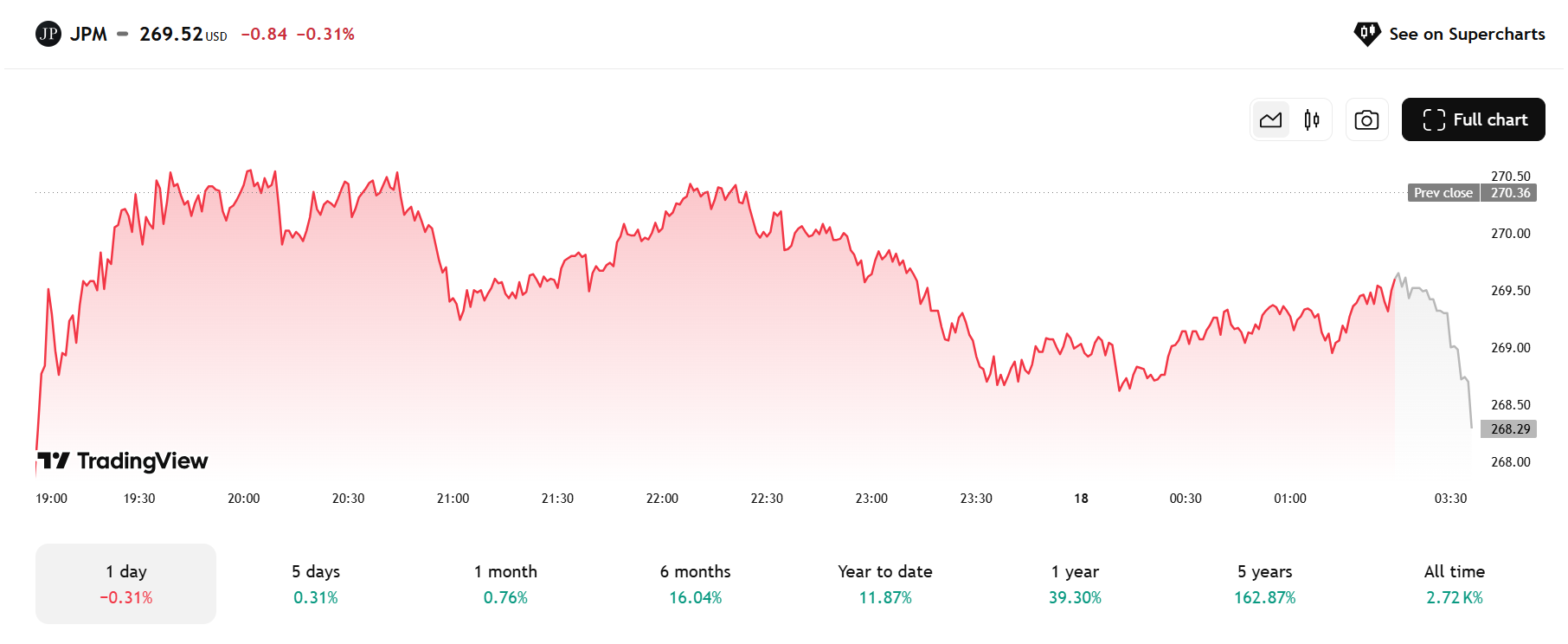
JPMorgan Chase & Co. (NYSE: JPM) shares slipped 0.31% to $269.52 as of the latest trade, amid renewed investor attention sparked by a major update to one of its flagship financial products.

The price movement comes in the backdrop of a 162.87% return over the past five years, making JPMorgan one of the standout performers in the financial sector.

JP Morgan Chase Price Chart Trading View

On Tuesday, the banking giant announced a significant change to its premium credit card, the Chase Sapphire Reserve. Starting June 23, the card’s annual fee will rise sharply from $550 to $795. This move positions the Sapphire Reserve above rival premium cards like the American Express Platinum, which charges a $695 annual fee.

The change is expected to create mixed reactions among customers and investors. While some may be discouraged by the higher upfront cost, others may look forward to potential added benefits, which JPMorgan has hinted will be revealed in detail at the time of the hike.

The timing of the announcement comes during a relatively stable performance phase for JPMorgan stock. Although the daily change was a minor dip, the broader picture remains strong. Over the last year, the stock is up 39.30%, and it has gained 11.87% year-to-date. The all-time performance stands at 2,720%.

JPMorgan Chase & Co. is one of the largest and most influential financial institutions in the world. Headquartered in New York, it offers a wide range of services including investment banking, asset management, commercial banking, and credit cards. The firm’s strong brand reputation, innovative financial products like the Sapphire Reserve, and robust earnings history have helped it maintain a leadership position in the global banking sector.

Key Trading Data

MetricValue
1 Month Return0.76%
6 Month Return16.04%
Year-to-Date Return11.87%
1 Year Return39.30%
5 Year Return162.87%
All-Time Return2,720%

This article is for informational purposes only and should not be considered financial advice. Investing in stocks, cryptocurrencies, or other assets involves risks, including the potential loss of principal. Always conduct your own research or consult a qualified financial advisor before making investment decisions. The author and publisher are not responsible for any financial losses incurred from actions based on this article. While efforts have been made to ensure accuracy, economic data and market conditions can change rapidly. The author and publisher do not guarantee the completeness or accuracy of the information and are not liable for any errors or omissions. Always verify data with primary sources before making decisions.

RTX Stock Climbs 1.38% in a Day, 5-Year Return Surges Over 118%

JPMorgan Chase Launches Auto-Callable Notes Tied to Tech and Small-Cap Performance

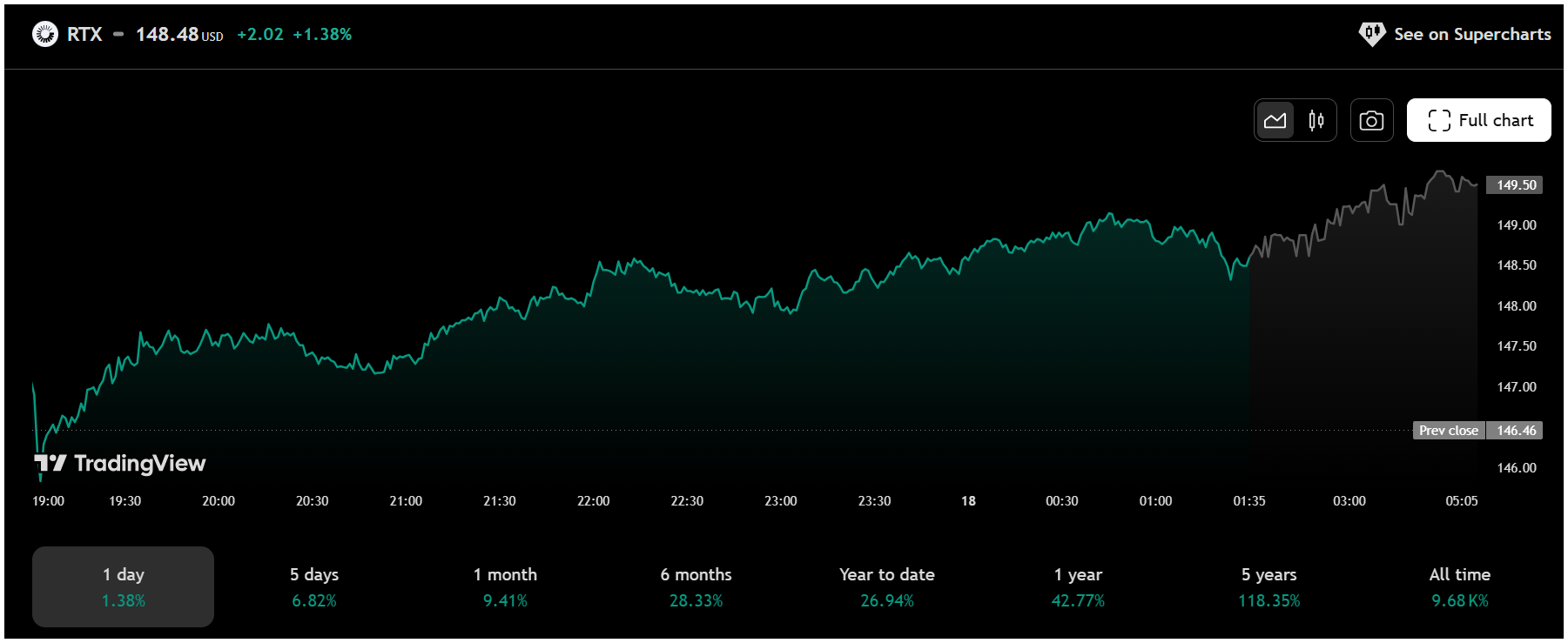
Shares of RTX Corporation (NYSE: RTX) rose by 1.38% to $148.48, adding $2.02 in a single day of trade. While short-term gains grabbed headlines, long-term investors are taking notice of something far more impressive: RTX has delivered a stellar 118.35% return over the past five years.

RTX Stock Performance Trading View

This strong 5-year performance signals consistent value creation in the defense and aerospace sector. From legacy operations under Raytheon Technologies to a refined post-merger strategy under the RTX brand, the company has steadily expanded its business, boosted innovation, and maintained strong earnings despite global uncertainty.

Over the past six months alone, the stock has risen 28.33%, while it has climbed 26.94% year-to-date. In the past one month, RTX has returned 9.41%, with a 6.82% gain in the past five trading sessions. Its one-year return stands at an impressive 42.77%, further reinforcing investor confidence.

RTX Corporation, formerly known as Raytheon Technologies, is a major American aerospace and defense company. Headquartered in Arlington, Virginia, it operates through three main segments: Collins Aerospace, Pratt & Whitney, and Raytheon. The company provides advanced systems and services for commercial and military customers globally. RTX is one of the largest defense contractors in the world, known for producing high-tech missiles, sensors, aircraft engines, and avionics systems.

Analysts say RTX’s long-term uptrend is supported by robust defense contracts, steady cash flows, and rising demand for aerospace and military technology. In addition, a global geopolitical environment that continues to prioritize defense spending has helped drive sentiment around the stock.

Yesterday’s rise is a continuation of its recent bullish pattern, following strong buying momentum seen across the broader sector. If this trend continues, RTX may test new highs over the coming quarters.

However, market watchers recommend keeping an eye on macroeconomic risks, such as interest rate decisions and global tensions, which could affect near-term volatility.

Recent Developments Bolster RTX’s Outlook

RTX Corporation continues to strengthen its position in the defense and aerospace sectors with significant contract wins and strategic advancements. On June 18, 2025, RTX secured a $299.69 million contract modification for missile testing equipment and spares, reinforcing its critical role in U.S. defense programs. Earlier in June, Raytheon, an RTX business, was awarded a $1.1 billion U.S. Navy contract to produce AIM-9X Block II missiles and a $646 million contract for SPY-6 radar production, highlighting sustained demand for its advanced missile and radar systems.

Additionally, RTX’s Collins Aerospace expanded its aircraft electrification capabilities with a new engineering center in the UK and a production line in France, announced on June 9, 2025, aligning with the industry’s push toward sustainable aviation. Pratt & Whitney, another RTX division, secured a contract on June 16, 2025, to supply TJ150 engines for Leidos’ Small Cruise Missile program, further diversifying its propulsion portfolio.

Despite a U.S. Department of Justice mandate requiring Safran to divest its North American actuation business as part of a $1.8 billion acquisition from Collins Aerospace, announced on June 17, 2025, RTX’s diversified backlog of $92 billion as of Q1 2025 supports long-term revenue stability.

Financial Disclaimer: This article is for informational purposes only and should not be considered as financial advice. Investing in the stock market involves risk. Readers are advised to do their own research or consult with a professional before making any investment decisions.

Circle Stock Falls 3.5% Amid Market Volatility

Centene Corporation stock latest news

Shares of Circle Internet Group, Inc. (NYSE: CRCL), the company behind the USDC stablecoin, fell by 3.5 percent to close at 145.54 dollars by 3:26 PM ET. This drop comes after a highly volatile week for the newly listed company. Circle’s stock had earlier reached a high of 165.60 dollars on June 16 but settled at 151.06 dollars by the end of that day. The company’s current market valuation stands at around 33.6 billion dollars.

Despite the recent dip, the stock has climbed an impressive 434 percent since its initial public offering on June 5, 2025. The current pullback appears to be a case of investors booking profits following the strong rally, combined with broader market concerns.

Circle’s journey post-IPO has been marked by sharp price swings. On the day of its NYSE debut, June 5, the stock opened at 69 dollars and closed at 83.23 dollars, delivering a 168 percent gain and valuing the company at 18.4 billion dollars. This was followed by continued gains that took the stock to a peak of 165.60 dollars on June 16, boosted by positive sentiment around stablecoins and digital assets. However, today’s 3.5 percent decline is being seen as a natural correction after such a steep and rapid rise.

The broader market mood has also been unstable. US index futures have shown signs of weakness, and rising tensions in the Middle East have contributed to overall investor caution. Such a backdrop often leads to increased volatility in high-growth stocks like Circle.

Adding to investor concerns are the regulatory uncertainties. The US Senate is preparing to vote on a new stablecoin regulation bill that could impact the way Circle operates its USDC product. This development has raised questions about how potential legal changes might affect the company’s growth. Reports of large retail giants like Amazon and Walmart exploring their own stablecoin plans have further intensified concerns about future competition.

Here is a look at the recent price trend of Circle stock:

June 5, 2025 – 83.23 dollars, up 168 percent
June 10, 2025 – 77.06 dollars, down 7.42 percent
June 12, 2025 – 106.54 dollars, down 5.5 percent
June 16, 2025 – 151.06 dollars, up 18.6 percent
June 17, 2025 – 145.54 dollars, down 3.5 percent

Since its IPO, Circle’s stock is still up by 54.64 percent. The company’s financials for Q1 2025 showed a net income of 65 million dollars, mainly earned through interest on reserves backing USDC. The company also reported an operating cash flow of 56 million dollars during the same quarter. Strategic partnerships, including one with BlackRock, have helped Circle strengthen its position in the digital asset space. However, the company’s heavy reliance on interest income means that any cuts in interest rates could hurt its profitability going forward.

Looking ahead, investors will be closely watching the outcome of the Senate’s vote on stablecoin regulation. Any changes in the law could either support Circle’s expansion or limit its operations. The entry of new players in the stablecoin sector could also add pressure. Circle is scheduled to announce its Q2 earnings in August 2025, and those results will be important in assessing the company’s ability to maintain growth in USDC adoption.

In summary, while Circle has delivered strong returns in a short period, the stock is currently facing multiple headwinds, including regulatory risks, market volatility, and increasing competition. Investors are advised to approach with caution and keep an eye on upcoming developments before making any long-term decisions.

Disclaimer: This article is for informational purposes only and should not be considered financial advice. Investing in the stock market involves risk. Please consult a certified financial advisor before making any investment decisions.

Palantir Shares Drop 3.5% Amid Market Volatility and Tariff Concerns

Why is NEGG stock falling?

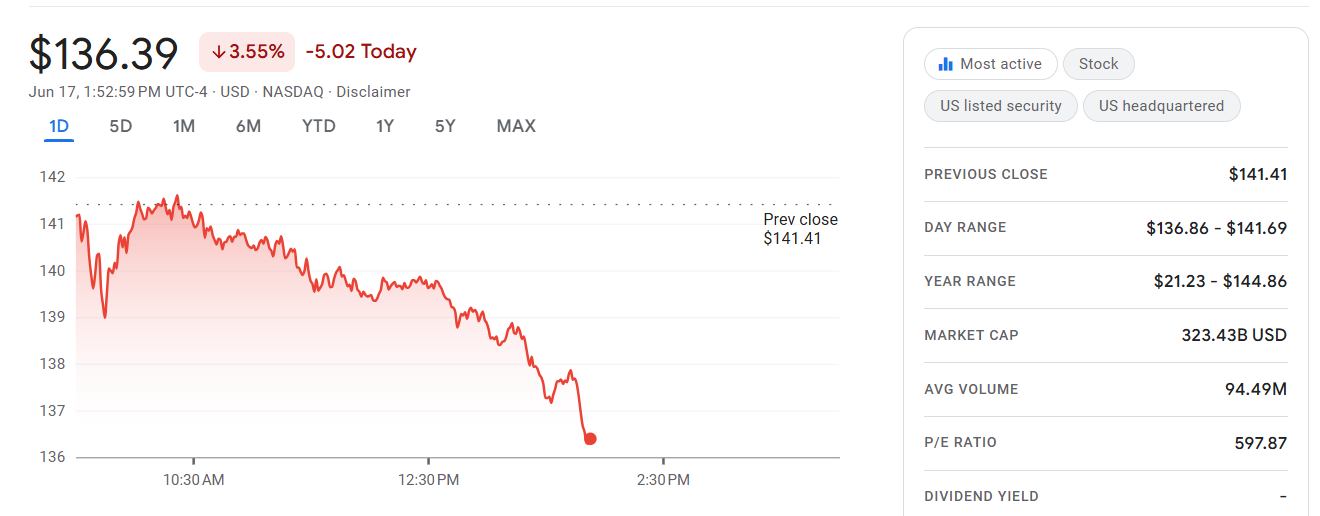
Shares of Palantir Technologies Inc. (NASDAQ: PLTR) faced significant selling pressure today, dropping 3.55% to close at $136.39, down $5.02 from Monday’s close of $141.41, according to Yahoo Finance data. The stock reached an intraday high of $141.69 before slipping to a low of $136.86, reflecting heightened volatility in a cautious broader market. Despite today’s decline, Palantir’s stock remains near its 52-week high of $144.86, showcasing robust investor enthusiasm for the AI and data analytics leader.

palantir Stock chart

An analysis of Palantir’s performance reveals a mixed but impressive trajectory. Over the past five days, PLTR gained 2.1%, and over the past month, it rose 7.8%, per Yahoo Finance, signaling strong short-term momentum. Year-to-date, the stock has surged 77.7%, and its one-year gain stands at a remarkable 392.7%, driven by Palantir’s dominance in AI-driven data solutions. However, today’s dip contrasts with a six-month pullback of -8.4%, highlighting the stock’s volatility amid high investor expectations.

Palantir’s market capitalization of $323.43 billion underscores its prominence in the tech sector. Its price-to-earnings ratio of 597.87 reflects optimism about future growth, though some analysts caution about overvaluation.

According to Bloomberg, Loop Capital raised its price target to $155 on June 13, 2025, citing Palantir’s expanding commercial contracts, while Yahoo Finance reports a median target of $104.27, suggesting potential downside.

The company’s Q1 2025 revenue grew 39% to $883.86 million, exceeding estimates, per its May 5, 2025, 10-Q filing, fueled by its Gotham and Foundry platforms.

Today’s decline may stem from broader market dynamics and company-specific concerns. U.S. index futures fell, and European markets closed lower amid tariff fears. Additionally, insider selling, including CTO Shyam Sankar’s disposal of 405,000 shares on June 10 for $53.49 million, per an SEC Form 4, may have sparked profit-taking.

Despite the day’s dip, Palantir remains a focal point for investors, with its AI leadership and government contracts driving long-term optimism. Traders are eyeing the July 28, 2025, earnings report for updates on commercial growth and tariff impacts. With its stock still up significantly for the year, Palantir’s trajectory suggests resilience, but investors should stay vigilant amid market uncertainties.

This article is for informational purposes only and should not be considered financial advice. Investing in stocks, cryptocurrencies, or other assets involves risks, including the potential loss of principal. Always conduct your own research or consult a qualified financial advisor before making investment decisions. The author and publisher are not responsible for any financial losses incurred from actions based on this article. While efforts have been made to ensure accuracy, economic data and market conditions can change rapidly. The author and publisher do not guarantee the completeness or accuracy of the information and are not liable for any errors or omissions. Always verify data with primary sources before making decisions.

Lockheed Martin Stock Plunged 4% Yesterday: Will the Decline Persist?

Manhattan Bridge Capital authorizes up to 100,000 share repurchase programme to address stock price decline and signal confidence.

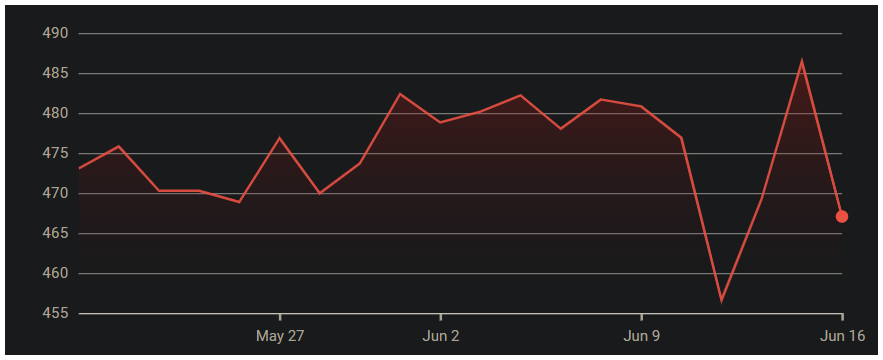
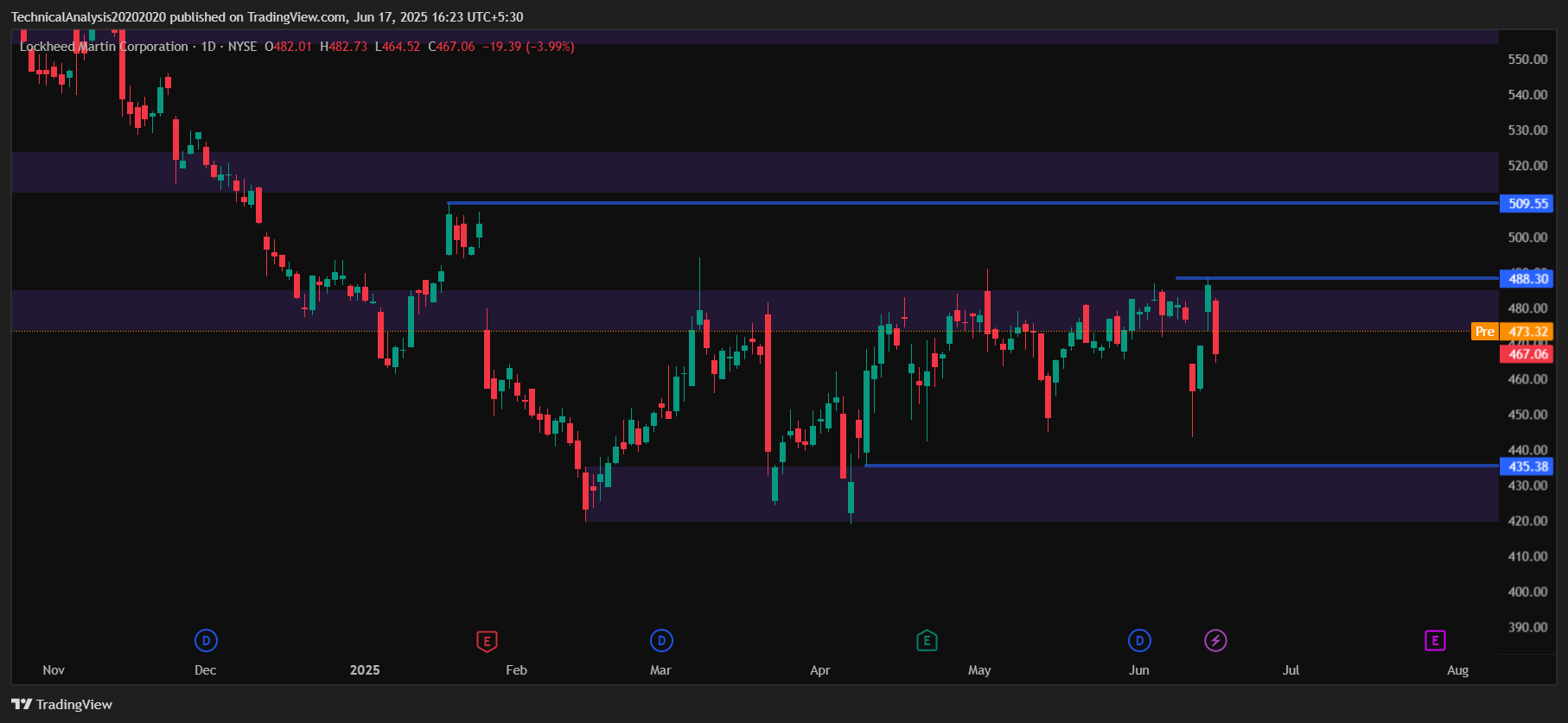
(New York, June 17, 2025) – Lockheed Martin Corporation (NYSE: LMT), a leading name in the aerospace and defense sector, is currently experiencing significant stock price volatility. On June 16, 2025, the company’s shares dropped nearly 4%, closing at $467.00. However, by 6:04 AM EDT on June 17 (4:21 PM IST), pre-market trading showed a slight recovery, with the stock rising to $472.00. This shift suggests possible stabilization in the near term.

Key Factors Driving Volatility

1. Geopolitical Tensions

On June 13, LMT stock surged 3.66% to $491.95 following increased tensions in the Middle East after Israel launched strikes against Iran. As a primary supplier of F-35 jets to Israel, Lockheed was expected to benefit from a boost in defense spending. However, the rally reversed on June 16 after Iran indicated a willingness to de-escalate, lowering short-term demand expectations.

2. F-35 Contract Reductions

Investor concerns deepened after news emerged on June 11 that the U.S. Air Force plans to cut its F-35 jet orders for FY 2026 from 48 to 24. This announcement triggered a 6% decline in the stock to $447.96 and may lead to a revenue loss of up to $3.5 billion for Lockheed Martin.

3. Defense Budget Uncertainty

While long-term government contracts like the F-35 program and the U.S. Golden Dome initiative provide a base of revenue stability, ongoing Congressional discussions about future defense spending have created uncertainty, adding pressure to the stock.

4. Macroeconomic Conditions

Rising interest rates and inflation fears continue to challenge the broader defense sector. Even though Lockheed’s forward P/E ratio of 17.49 is below the industry average of 23.2, its stock remains vulnerable to market-wide volatility.

5. Diversified Product Portfolio

Lockheed’s portfolio, which includes PAC-3 missiles, THAAD interceptors, and AI-enabled defense systems, helps mitigate some risk from the F-35 uncertainty. However, short-term price movement remains largely influenced by global headlines and news-driven sentiment.

Despite the turbulence, Lockheed Martin has managed a 4.33% year-to-date return, slightly trailing the broader aerospace and defense sector’s 6.1% gain.


Chart Overview

lmt stock monthly chart

A review of the one-month chart shows LMT fluctuating between $457.00 and $491.95 since mid-May. Key price points include:

  • June 4: Peaked at $485.00
  • June 11: Dropped to $457.00 following F-35 news
  • June 13: Rebounded to $491.95 due to geopolitical escalation
  • June 16: Closed at $467.00
  • June 17 (Pre-Market): Slight recovery to $472.00

Over the past year, LMT reached a 52-week high of $618.95 in October 2024 and a low of $418.88. The current price is about 23.7% below its peak.


Technical Outlook

lmt stock tradingview chart

Technical indicators suggest potential for a bullish breakout:

  • Resistance Level: $488.00
  • Breakout Target: If breached, the stock could move toward $509.00
  • Support Zone: Strong buying interest expected between $430.00 and $420.00

What’s Next?

Lockheed Martin’s upcoming earnings call on July 29, 2025, is expected to provide critical updates on contract pipelines and defense funding trends. While the June 17 pre-market recovery hints at a pause in the downtrend, the stock’s direction will likely depend on:

  • Clarification regarding F-35 program cuts
  • U.S. defense budget decisions
  • Further geopolitical developments

As a key player in the global defense industry, LMT will remain in focus for investors tracking market momentum and sector stability.


Frequently Asked Questions (FAQs)

Q1: Why did Lockheed Martin’s stock drop 4% on June 16?
A: The decline followed Iran’s de-escalation signals, reducing expectations for immediate defense spending.

Q2: What technical levels should investors monitor?
A: Resistance is at $488.00 with a breakout target of $509.00. Support lies between $430.00 and $420.00.

Q3: How does the F-35 program affect LMT’s stock?
A: The F-35 is a major revenue driver. Reduced U.S. orders for 2026 caused a sell-off, but long-term contracts still provide revenue stability.

Q4: Are geopolitical events important for LMT’s stock?
A: Yes. Global conflicts, especially in the Middle East, often lead to increased demand for Lockheed’s products.

Q5: What supports Lockheed Martin’s long-term outlook?
A: A strong product portfolio, focus on AI and hypersonic technologies, and leadership in major defense programs.


Financial Disclaimer: This article is for informational and educational purposes only. It does not constitute financial advice or a recommendation to buy, sell, or hold Lockheed Martin (LMT) stock. Investing involves risk. Past performance does not guarantee future results. Please consult a licensed financial advisor before making investment decisions. The author and publisher are not responsible for any financial losses resulting from actions taken based on this content.

Dow Jones and Nasdaq Futures Signal Bullish Gap Open Amid Global Optimism and Geopolitical Risks

StubHub’s unfolding legal crisis is a reminder that IPO investing comes with risk and that the details buried in offering documents can make or break investment decisions. Whether the company misled investors will now be determined through multiple investigations and potential class actions.

As of Monday, June 16, 2025, at 05:24 AM EDT, U.S. stock market futures are trading on a bullish note, signaling optimism despite ongoing geopolitical tensions. Dow Jones Industrial Average futures are up 135 points (+0.32%) at approximately 42,658.00, and Nasdaq 100 futures have gained 108 points (+0.49%) at around 21,968.75.

European markets, including the FTSE 100, CAC 40, and DAX, are averaging gains of about 0.50%, bolstering global sentiment. If current conditions persist, U.S. markets could see a gap-up open of 0.50% or more, driven by strong futures and European equities, though tempered by rising oil prices, higher U.S. Treasury yields, and Middle East tensions.

Dow Jones and Nasdaq Futures: Poised for a Gap-Up Open

DJIA 30 Trading View Chart - Daily TimeFrame

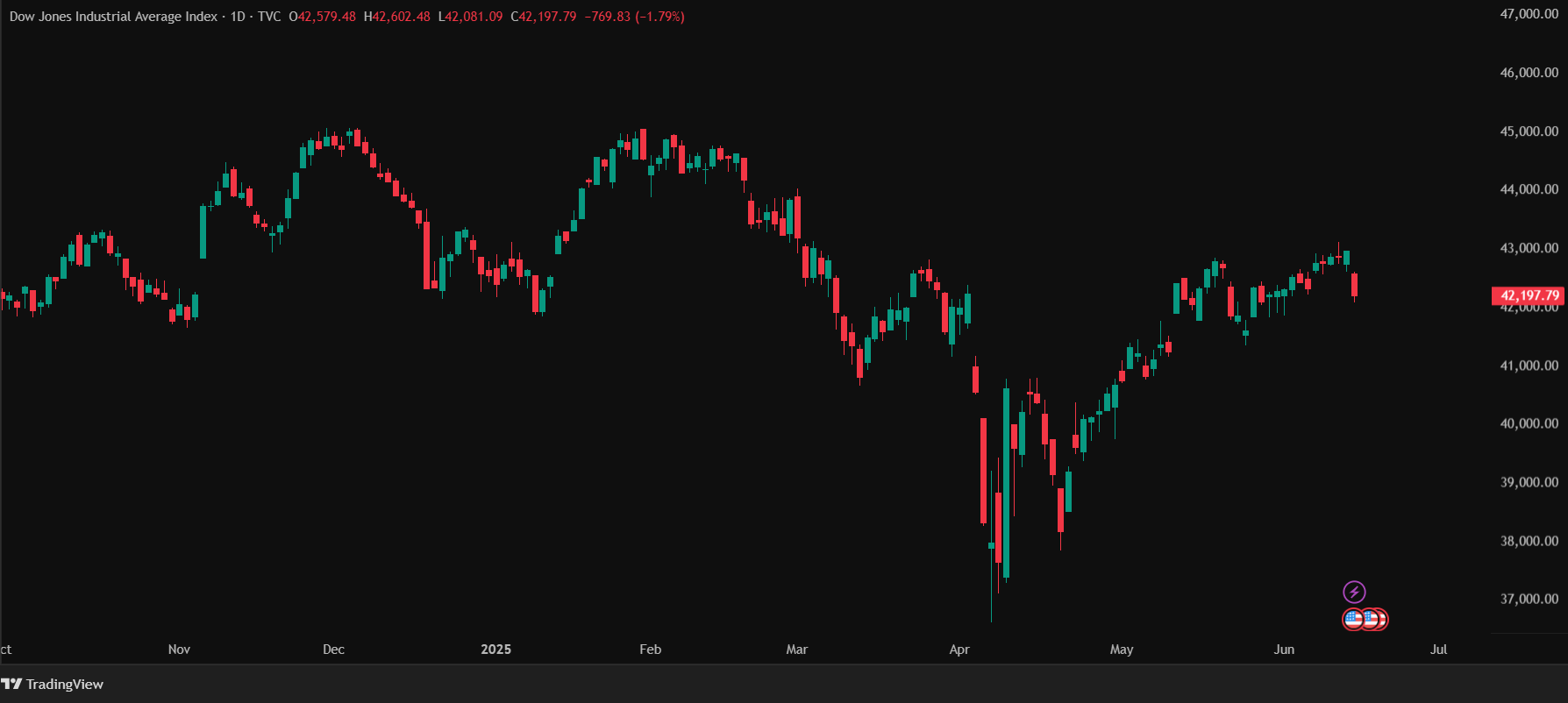
Last Friday, U.S. markets faced sharp declines after Israel’s airstrikes on Iran, with the Dow Jones Industrial Average dropping 770 points (1.8%) and the Nasdaq Composite falling 1.3%. Futures initially reflected this panic, with Dow futures down 593 points (1.38%) and Nasdaq 100 futures sliding 1.73%. However, Monday’s pre-market trading at 05:24 AM EDT shows a robust recovery, with Dow futures up 135 points and Nasdaq futures gaining 108 points.

The bullish futures movement, coupled with European markets averaging 0.50% gains – FTSE 100, CAC 40, and DAX all up around this level – suggests U.S. markets could open with a gap-up of at least 0.50%. For the Dow, this translates to a potential opening increase of approximately 213 points (based on Friday’s close of 42,197), while the Nasdaq Composite could rise by about 104 points (from 19,406).

European Markets Bolster Global Sentiment

European equities are providing a supportive backdrop for U.S. futures. The FTSE 100, CAC 40, and DAX are each up around 0.50% on Monday, reversing Friday’s declines when the Stoxx Europe 600 fell nearly 1% and the DAX dropped 1.5%. This recovery reflects cautious optimism, possibly driven by hopes of de-escalation in the Middle East or positive economic signals.

If these gains hold, the positive momentum in Europe could amplify the bullish tone in U.S. futures, supporting a gap-up open.

Treasury Yields and Inflation Concerns

U.S. Treasury yields continue to reflect inflation fears. On Friday, the 2-year Treasury yield rose nearly 2 basis points to 3.974%, and the 10-year yield climbed 1 basis point to 4.432%. By Monday, yields were slightly lower at 3.96% for the 2-year and 4.41% for the 10-year, per pre-market data.

The inverse relationship between bond yields and prices underscores investor concerns about rising energy costs fueling inflation.

The Federal Reserve’s upcoming meeting is critical, with markets pricing in a 3.1% chance of a rate cut this week. Higher yields could increase borrowing costs, potentially pressuring equities despite the bullish futures. A hawkish Fed stance might limit the extent of the gap-up open, while a dovish signal could amplify it.

Oil Price Volatility and Geopolitical Risks

Brent crude oil prices, a key market driver, surged 7% on Friday to $74.23 per barrel and rose another 0.5% to $74.60 by Monday, nearing a five-month high. The volatility is tied to fears of supply disruptions through the Strait of Hormuz, which carries 20% of global oil and liquefied natural gas (LNG) flows. A closure – potentially triggered by Iranian retaliation – could push Brent prices toward $90 or higher, per JPMorgan estimates, significantly impacting global markets.

West Texas Intermediate (WTI) crude futures rose 7.6% to $73.20 per barrel on Friday, hitting an intraday high of $77.60, the highest since January. Rising oil prices have reignited U.S. inflation fears, complicating the Fed’s policy outlook. While the bullish futures suggest investors are looking past these risks for now, a sharp oil price spike could derail the gap-up open.

Global Market Dynamics

Global markets show mixed but improving sentiment. Chinese stocks (CSI 300) oscillated, closing down 0.7% on Friday, but Monday’s European gains suggest a broader recovery. Safe-haven assets like gold remain near record highs above $3,400 per ounce, with gold futures up 1.5% to $3,455 on Friday, reflecting lingering anxiety.

The U.S. dollar index is steady at 98.64, down 0.5% after a milder-than-expected U.S. inflation report for May.

Recent U.S.-China trade talks in London offer some optimism, but the Israel-Iran conflict dominates market focus.

Market Outlook: A Bullish Open with Risks

The bullish Dow Jones and Nasdaq futures, up 135 and 108 points respectively, combined with European markets gaining 0.50% on average, point to a likely gap-up open of 0.50% or more for U.S. markets, assuming conditions remain stable. Key factors to watch include:

  • Geopolitical Stability: De-escalation in the Middle East could sustain the bullish momentum, while escalation could trigger a reversal.
  • Federal Reserve Signals: A dovish Fed could amplify the gap-up, while a hawkish stance might cap gains.
  • Oil Prices: Further spikes in Brent or WTI crude could reignite inflation fears, pressuring equities.
  • Global Cues: Sustained European gains and Chinese market stability could reinforce U.S. optimism.

The Bottom Line

Dow Jones and Nasdaq futures are poised for a bullish gap-up open of 0.50% or more, driven by gains of 135 and 108 points respectively and supported by European markets (FTSE 100, CAC, DAX) averaging 0.50% higher. Despite optimism, risks from the Israel-Iran conflict, volatile oil prices, and rising Treasury yields loom large. Investors should monitor Middle East developments, Federal Reserve signals, and global market cues to gauge the sustainability of the rally. A cautious yet opportunistic approach is warranted in this volatile environment.

This article is for informational purposes only and should not be considered financial advice. Investing in stocks, cryptocurrencies, or other assets involves risks, including the potential loss of principal. Always conduct your own research or consult a qualified financial advisor before making investment decisions. The author and publisher are not responsible for any financial losses incurred from actions based on this article. While efforts have been made to ensure accuracy, economic data and market conditions can change rapidly. The author and publisher do not guarantee the completeness or accuracy of the information and are not liable for any errors or omissions. Always verify data with primary sources before making decisions.

2 Reasons Bitcoin is Surging on 09 June 2025

Why is bitcoin rising today?

Bitcoin (BTC) is rising sharply and is now trading at $108,446 at the time of writing.

Its market capitalization has reached $2,155,543,471,788, and two key factors are pushing this rally forward—an institutional purchase and a strong technical breakout.

Here’s a clear look at what’s happening and what it might mean for Bitcoin’s next move.

1. Strategy’s Massive Bitcoin Purchase

Formerly known as MicroStrategy, Strategy is driving this surge by making a bold purchase today.

As shared by Michael Saylor on X, Strategy bought 1,045 BTC on June 9 for $110.2 million, paying an average of $105,426 per coin. This brings their total holdings to 582,000 BTC, which they acquired at an average price of $70,086, with a total value of around $40.79 billion.

Analyst Adam Livingston calls this move a “synthetic halving” because Strategy is buying Bitcoin faster than it’s being mined – 450 BTC are mined daily. This reduces supply and pushes up the price.

The purchase is backed by a $1 billion stock offering, showing strong confidence from Strategy and helping drive the price up.

2. Bitcoin’s Bullish Technical Breakout

Bitcoin’s rally also has strong support from a technical breakout.

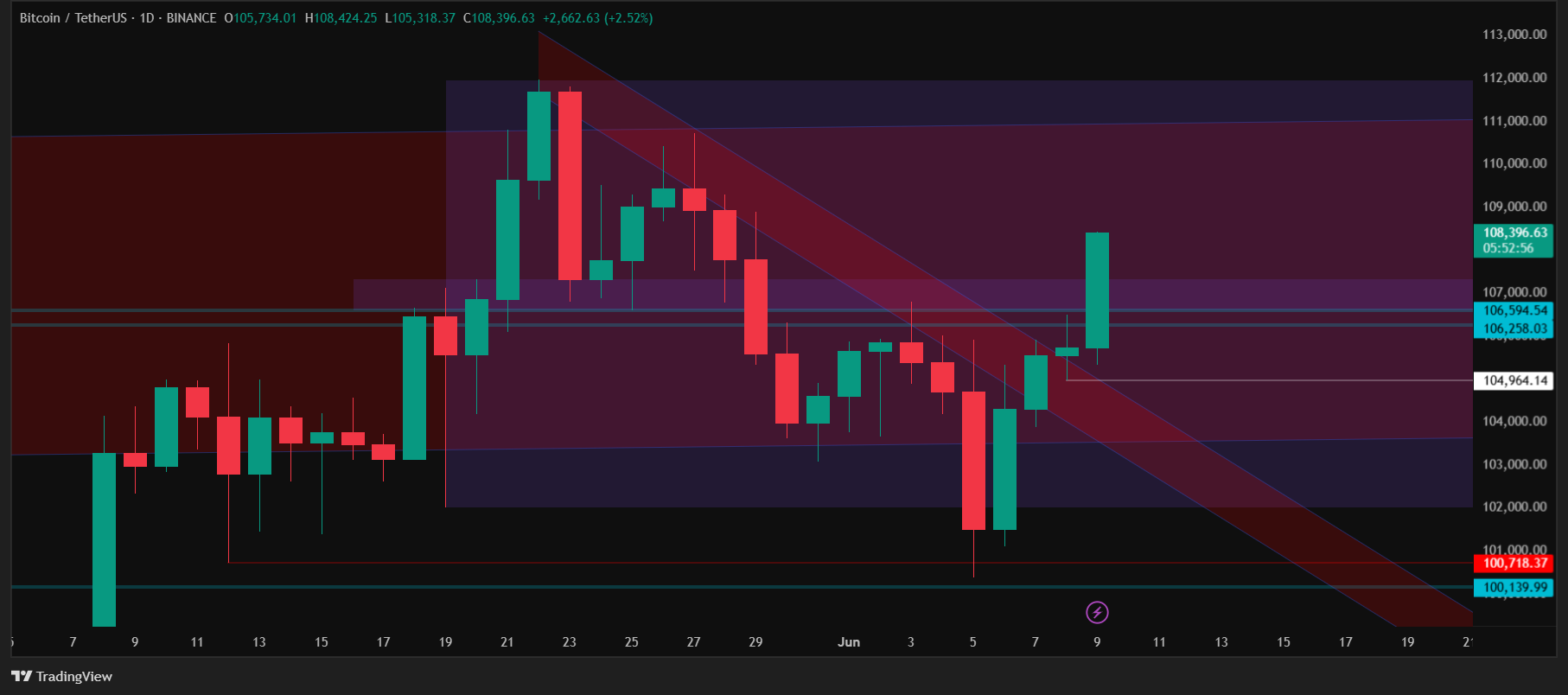
The price jumped from $105,000 to $107,687 within a few hours.

bitcoin technical analyis june 2025 trading view

This breakout, backed by high trading volume, indicates a healthy uptrend, which is pulling in more traders and buyers.

Also Read – I Created the Best Bitcoin Guide You’ll Ever Read

Latest Bitcoin Price Movements

At the time of writing this article, Bitcoin is at $108,446, up from $103,994 on June 1. It is still below its June 6 high of $115,230. On June 5, Bitcoin dipped to around $101,000, following Circle’s $4.5 billion IPO and ETF outflows of about $278 million. Despite that, Bitcoin has gained 12.82% in the past week and is up 147.39% over the past year.

Right now, strong support exists between $95,000 and $100,000, while the 50-day EMA acts as a resistance zone.

Bitcoin’s Market Cap and Supply Details

With a $2.15 trillion market cap, Bitcoin is among the world’s top assets. It has a circulating supply of 19.87M BTC, out of a total cap of 21 million BTC. This leaves around 1.3 million BTC still to be mined.

Strategy’s 582,000 BTC equals 2.78% of the entire Bitcoin supply, which gives the company massive influence on market movement.

Next Bitcoin Halving Events

Bitcoin has already gone through four halvings in 2012, 2016, 2020, and 2024. The next one is expected around April 2028, when the block reward will be reduced to 1.5625 BTC. By that point, 97% of Bitcoin’s supply will be in circulation.

After that, only small amounts of BTC will be released until the final halving near 2140, after which no new Bitcoin will be created. Miners will then depend entirely on transaction fees. Experts believe the 2028 halving might be the last one to significantly affect prices. Future price moves will likely depend more on usage and adoption.

What’s Next for Bitcoin?

The current price rally is being fueled by today’s massive BTC purchase from Strategy and a solid technical breakout. While Bitcoin did face a quick dip on June 5, it has rebounded strongly.

Many analysts believe BTC could reach between $150,000 and $250,000 by the end of 2025, but this depends on how macroeconomic trends play out and whether Strategy continues holding or begins to sell if BTC falls below their average purchase price of $70,086.

This article is for informational purposes only and should not be considered financial advice. Investing in stocks, cryptocurrencies, or other assets involves risks, including the potential loss of principal. Always conduct your own research or consult a qualified financial advisor before making investment decisions. The author and publisher are not responsible for any financial losses incurred from actions based on this article. While efforts have been made to ensure accuracy, economic data and market conditions can change rapidly. The author and publisher do not guarantee the completeness or accuracy of the information and are not liable for any errors or omissions. Always verify data with primary sources before making decisions.

XRP Holds at $2.22 – Will ETF News or SEC Clarity Push It Past $2.50?

Will ETF News or SEC Clarity Push XRP Past $2.50?

XRP is staying strong at $2.22, up 3.9% in the last 24 hours. Investors are now waiting for two big events – a possible spot XRP ETF approval and the final decision in Ripple’s long-running SEC case.

With companies like VivoPower investing millions and Ripple’s stablecoin RLUSD gaining attention, many are wondering: Is XRP ready to break past $2.50?

SEC Case – Almost Over?

Ripple’s battle with the SEC has been going on since 2020. But now it looks like things may finally be coming to an end. A key update is expected by June 16.

Back in 2023, Ripple had to pay a $125 million fine – which was a win considering the SEC wanted $2 billion. That decision gave investors more confidence.

But it hasn’t been all good news. A court recently refused to lift a ban on institutional XRP sales on May 15, which caused XRP to drop by 18 percent.

Insiders believe the case could wrap up soon. If that happens, it could push XRP’s price higher.

Big Investors and ETF Hype

There’s a lot of talk about a spot ETF for XRP. Coinpedia reports that Franklin Templeton’s application is under review, with a decision expected by June 17.

Meanwhile, VivoPower’s $121 million XRP investment, backed by a Saudi prince, shows that big institutions are trusting XRP more.

Demand is rising fast. XRP futures trading on platforms like CME and Nasdaq also add more credibility.

But not everything is perfect. CoinShares reported that $28.2 million was pulled out from XRP investment products last week. This shows that some big players are still being cautious.

Technical Analysis of XRP for June 2025

xrp trading view chart 08 june 2025

Right now, XRP is holding steady between $2.22 and $2.26, but it’s still 34 percent lower than its all-time high of $3.40 from January.

Currently, XRP is trading within the $2.00 to $2.50 range, as shown in the purple zone on the chart. It is also forming a declining wedge pattern, which typically signals a potential breakout. However, due to current market uncertainty and the decreasing reliability of chart patterns these days, it’s somewhat difficult to predict which direction the breakout might take.

Additionally, XRP is trading above its key 200-day moving average of $2.07, which is a positive sign. But trading volume is down by 16 percent, and network activity has also decreased—only about 4,400 daily active addresses compared to a peak of 15,800, according to FXStreet.

We believe that if XRP moves above $2.50, it could rally up to $2.82. On the other hand, if it falls below $2.00, it might drop as low as $1.68.

RLUSD – Making XRP More Useful

Ripple’s stablecoin RLUSD is gaining momentum. Dubai’s financial authority has approved it for use in things like cross-border payments and even real estate, says Brave New Coin.

Ripple also works with over 300 major financial institutions – including Santander and the Bhutan central bank. These deals show that XRP is becoming more useful for real-world finance.

Still, XRP faces tough competition from stablecoins like USDC, and its network activity is going down, which could be a concern.

Also Read – USDC vs. RLUSD vs. USDT – Key Differences and Why They Matter

The Bottom Line

XRP is holding strong around $2.22, and all eyes are on the upcoming ETF decision and the final word from the SEC.

If either of these turns out to be positive, we could see a big price jump. But if not, XRP may stay stuck in its current range or even fall.

This article is for informational purposes only and should not be considered financial advice. Investing in stocks, cryptocurrencies, or other assets involves risks, including the potential loss of principal. Always conduct your own research or consult a qualified financial advisor before making investment decisions. The author and publisher are not responsible for any financial losses incurred from actions based on this article. While efforts have been made to ensure accuracy, economic data and market conditions can change rapidly. The author and publisher do not guarantee the completeness or accuracy of the information and are not liable for any errors or omissions. Always verify data with primary sources before making decisions.

Will Trump’s Ban and FIFA’s Blockchain Redefine the World Cup?

Travel Bans vs. World Cup Dreams: Can Blockchain Save Soccer’s Soul?

The FIFA World Cup has always been soccer’s biggest stage—a place where fans from every corner of the globe come together to celebrate the beautiful game. But as the U.S. prepares to host the 2025 FIFA Club World Cup and co-host the 2026 Men’s World Cup, things have gotten complicated.

On June 4, 2025, President Trump signed a travel ban affecting 12 countries, including Iran, Haiti, Libya, and Afghanistan. The timing couldn’t be worse—just 10 days before the Club World Cup kicks off.

Meanwhile, FIFA has been busy launching its own blockchain network, moving its FIFA Collect platform to what they’re calling the “FIFA Blockchain.” It’s a strange moment where cutting-edge tech meets old-fashioned politics, and soccer fans are caught in the middle.

The Travel Ban Problem

Trump’s latest travel restrictions hit 12 countries hard: Afghanistan, Myanmar, Chad, Republic of Congo, Equatorial Guinea, Eritrea, Haiti, Iran, Libya, Somalia, Sudan, and Yemen. Seven others face partial restrictions. The official reason? National security concerns following a terror attack in Boulder, Colorado.

There’s an exemption for athletes and coaches—they can still compete. But fans? They’re mostly out of luck. Iran has already qualified for the 2026 World Cup, and their supporters won’t be able to make the trip to cheer them on. Same goes for fans from other affected countries whose teams might qualify.

The numbers are stark. FIFA says they’ve sold tickets to people from over 130 countries for the Club World Cup, but there’s no clear plan for handling fans from banned nations. Visa processing delays, already stretching over 700 days in some regions, make things even worse.

Back in 2017, FIFA President Gianni Infantino was pretty clear about this stuff: “Any team, including supporters, who qualify for a World Cup need to have access, otherwise there is no World Cup.” That statement feels pretty relevant right now, but Infantino has been notably quiet about the current situation.

FIFA Goes Digital

While dealing with travel restrictions, FIFA has been pushing hard into blockchain technology. In May 2025, they moved their FIFA Collect platform to their own custom blockchain network, built on Avalanche technology. They’re calling it faster and more wallet-friendly than their previous setup on Algorand.

The numbers are impressive—over 1.5 million NFTs minted and 10 million transactions recorded. FIFA is clearly betting big on digital fan engagement, offering everything from collectible cards to VIP event access through their platform.

There’s been speculation about a “FIFA Coin” ever since Infantino showed up at a White House Crypto Summit in March. While nothing’s been officially announced, the idea makes sense given FIFA’s blockchain push. A FIFA-controlled digital currency could handle cross-border transactions, reward programs, or even virtual fan experiences.

Also Read – The Very First Post You Should Read to Learn Cryptocurrency

But the technology isn’t without problems. Some users are already complaining about speed issues compared to the old Algorand system. One post on social media warned about potential system crashes during high-demand events like World Cup ticket sales.

The Political Dance

Here’s where things get interesting. Infantino has been making regular visits to the White House, including a May 2025 meeting where Trump signed a FIFA soccer ball. It’s a far cry from his 2017 stance about open access for all fans.

The relationship appears practical rather than principled. FIFA needs the U.S. as a host – the 2026 World Cup is expected to generate $50 billion in economic impact. But this cozy relationship comes at a cost to FIFA’s stated values of global unity and inclusion.

The blockchain technology could give FIFA more independence from host country restrictions, at least in the digital realm. A FIFA-controlled currency and platform could theoretically allow excluded fans to participate virtually, even if they can’t physically attend games.

What’s Next?

The United States is set to host major FIFA soccer events in 2025 and 2026, showcasing its growing role in global sports.

The 2025 Club World Cup starts June 14, featuring 32 top clubs across 12 U.S. venues. Ten players from travel-restricted countries will be there, but their fans largely won’t be. It’s a preview of what might happen during the much larger 2026 World Cup.

FIFA’s blockchain experiment is still in its early stages. While the technology offers interesting possibilities for fan engagement, it can’t solve the fundamental problem of physical exclusion from stadiums. Virtual experiences might help, but they’re not the same as being there in person.

The real test will be whether FIFA uses its growing technological capabilities to find creative solutions for excluded fans, or whether the blockchain initiative remains focused on revenue generation through digital collectibles and NFTs.

Human Rights Watch has already questioned whether the U.S. should host global events while maintaining travel restrictions. FIFA faces a choice between its stated principles of global inclusion and the practical realities of working with host governments.

The World Cup has always been about more than just soccer—it’s a statement about bringing the world together. As we head toward 2026, that vision is being tested in ways that even the most advanced blockchain technology might not be able to fix.

Also Read – I Created the Best Bitcoin Guide You’ll Ever Read

This article is for informational purposes only and should not be considered financial advice. Investing in stocks, cryptocurrencies, or other assets involves risks, including the potential loss of principal. Always conduct your own research or consult a qualified financial advisor before making investment decisions. The author and publisher are not responsible for any financial losses incurred from actions based on this article. While efforts have been made to ensure accuracy, economic data and market conditions can change rapidly. The author and publisher do not guarantee the completeness or accuracy of the information and are not liable for any errors or omissions. Always verify data with primary sources before making decisions.

Why Cathie Wood’s Big Bet on Circle’s IPO Has Everyone Talking?

Cathie Wood’s ARK Invest, known for bold tech bets.

On June 5, 2025, Circle Internet Group, the company behind the popular USDC stablecoin, officially went public on the New York Stock Exchange under the ticker “CRCL.”

Expectations were already high, but Circle surprised everyone by pricing its IPO at $31 per share, above the expected range of $27 to $28. That gave the company a valuation of about $6.8 billion. Not only that, Circle increased the number of shares offered to 34 million, allowing it to raise $1.05 billion – a clear sign that demand was strong.

What really grabbed headlines, though, was news that Cathie Wood’s ARK Invest would be buying up to $150 million worth of shares. Given Wood’s reputation for backing major tech disruptors, this move could be a game-changer for both Circle and the broader crypto space.


Cathie Wood’s Bold Investment Style

Cathie Wood isn’t new to making big, forward-looking bets. She built her career around spotting disruptive innovations before the rest of the world caught on. Born in 1955 in Los Angeles, she graduated from the University of Southern California in 1981 with top honors in finance and economics. Early in her career, she worked at big names like Capital Group and Jennison Associates, sharpening her skills as an economist and fund manager.

In 2014, she co-founded ARK Invest, a firm focused on groundbreaking technologies like AI, blockchain, genomics, and robotics.

Her most famous call? Tesla. She started buying the stock back in 2014 when it was trading around $50 (adjusted for splits). When Tesla exploded in value, ARK’s flagship fund posted a 153% return in 2020, making it one of the top performers globally. She was also one of the earliest institutional voices backing Bitcoin, with ARK investing in the Grayscale Bitcoin Trust as far back as 2015.

Also Read – I Created the Best Bitcoin Guide You’ll Ever Read

Even with some rough patches – including a $7.1 billion loss between 2014 and 2023 – Wood’s influence is undeniable. As of mid-2025, her estimated net worth stands at $250 million, and she’s publicly stated that 25% of her personal wealth is in Bitcoin.


IPO Pricing Shows Big Investor Confidence

Circle’s IPO pricing tells a story of its own. Starting out with a target range of $24 to $26, the final price came in at $31. That’s a bold move, especially in today’s market.

The total offering includes 14.8 million shares from Circle itself and another 19.2 million shares from existing investors. With that, the company’s total valuation reaches around $6.8 billion, and even more when you include future stock options, hitting $8.1 billion on a fully diluted basis.

This strong showing highlights the growing confidence investors have in crypto infrastructure companies – especially those tied to real-world use cases like stablecoins.


Is Cathie Wood’s Backing Just About Money — or Is It a Signal?

Cathie Wood’s planned $150 million purchase in the IPO isn’t just about numbers – it’s a stamp of approval. Given her history with game-changers like Tesla and Bitcoin, her support for Circle speaks volumes. It’s not just about the company’s current performance – it’s about where she believes the industry is heading.

ARK Invest has been increasing its exposure to blockchain tech, and Circle fits perfectly into that theme. Add in the fact that BlackRock is also buying about 10% of the IPO shares, and you’ve got the makings of a mainstream moment for crypto. Big names getting behind Circle might just convince more institutions to jump in.


What This Means for Circle – and for Crypto as a Whole?

Circle’s stablecoin USDC now boasts a $62 billion market cap, and it’s been growing steadily — up 40% in 2025 alone. That makes it the second-largest stablecoin in the world, behind Tether. The money raised through the IPO will likely go toward expanding internationally, investing in regulatory compliance, and developing tokenized financial products – tools that could help crypto gain even more ground in traditional finance.

Also Read – USDC vs. RLUSD vs. USDT – Key Differences and Why They Matter

The higher-than-expected IPO price and upsized offering send a clear message – investors believe Circle can help bridge the gap between crypto and traditional finance. And with legislative tailwinds like the U.S. GENIUS Act (which supports stablecoin regulation and adoption), the timing might be just right.


Risks You Shouldn’t Ignore

Of course, not everything is smooth sailing for Circle, even with all the buzz surrounding its IPO and Cathie Wood’s major investment. Beneath the optimism, there are a few red flags that investors shouldn’t ignore. Circle’s net income fell sharply from $268 million in 2023 to $156 million in 2024, raising eyebrows about the company’s ability to sustain profitability. What’s more concerning is that distribution costs are rising faster than revenue. If this trend continues, Circle’s profit margins could come under real pressure.

The company’s most recent earnings, for the quarter ending March 31, 2025, show mixed signals. On the surface, things look promising—Circle reported $64.8 million in net income on $579 million in revenue, reflecting a solid 33% increase in net income year-over-year. But dig deeper, and the challenges become clear. Distribution and transaction costs during the same period shot up by 68.2%, far outpacing the 55.1% rise in revenue, most of which came from interest earned on U.S. Treasuries backing the USDC stablecoin. That kind of imbalance between income and operating expenses could be a sign of growing inefficiencies.

Cathie Wood’s involvement, while exciting, also comes with its own baggage. Her ARK Invest funds have a history of sharp ups and downs. After posting eye-popping gains in 2020, many of her flagship ETFs faced steep losses post-2021. That track record, while bold and visionary, also adds a layer of volatility that some investors may be cautious about.

Then there’s the regulatory environment. Even though the GENIUS Act has brought some clarity to the U.S. stance on stablecoins, crypto regulations are still a moving target both at home and globally. Lawmakers continue to debate how digital assets should be governed, and Circle will need to tread carefully to avoid getting caught in any crossfire.


Are Stablecoins Entering a New Era?

Circle’s debut on the public market is more than just another crypto company going public. With a higher share price, more shares offered, and a valuation of nearly $7 billion, this IPO signals that Wall Street is paying attention to stablecoins in a big way.

Cathie Wood’s $150 million investment adds fuel to that momentum. Her involvement doesn’t just bring capital – it brings credibility, especially in a space that’s still trying to win mainstream trust. Given her past bets on Tesla and Bitcoin, many will be watching closely to see if her Circle investment becomes another success story.

This article is for informational purposes only and should not be considered financial advice. Investing in stocks, cryptocurrencies, or other assets involves risks, including the potential loss of principal. Always conduct your own research or consult a qualified financial advisor before making investment decisions. The author and publisher are not responsible for any financial losses incurred from actions based on this article. While efforts have been made to ensure accuracy, economic data and market conditions can change rapidly. The author and publisher do not guarantee the completeness or accuracy of the information and are not liable for any errors or omissions. Always verify data with primary sources before making decisions.