Dawson Blake is a financial markets expert with over 10 years of experience, focusing mainly on stock market news and price movements. He aims to become a top-tier authority in curating stock news content that readers can trust as their go-to source for market information. Dawson enjoys breaking down market activity, company updates, and daily trends to help investors stay informed and make smarter financial decisions. His writing is simple, clear, and designed to make the stock market easy to follow for everyone.
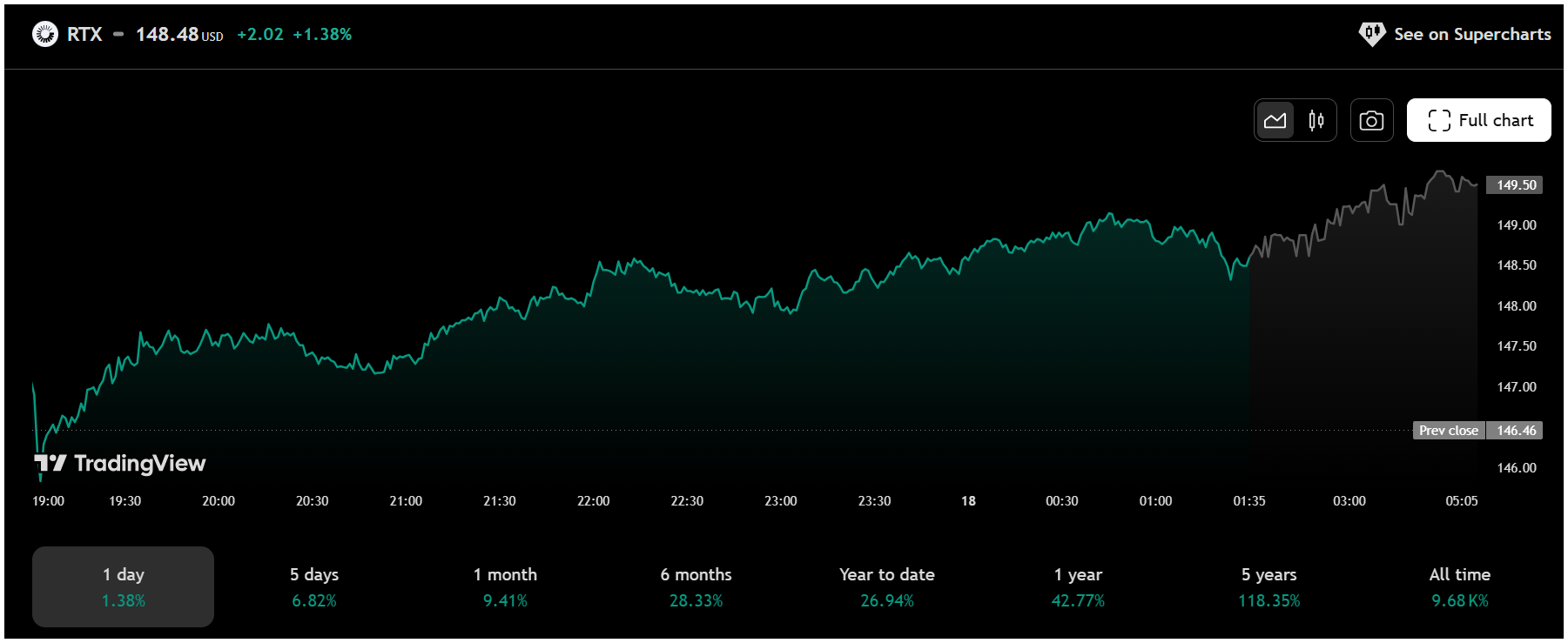
Shares of RTX Corporation (NYSE: RTX) rose by 1.38% to $148.48, adding $2.02 in a single day of trade. While short-term gains grabbed headlines, long-term investors are taking notice of something far more impressive: RTX has delivered a stellar 118.35% return over the past five years.
This strong 5-year performance signals consistent value creation in the defense and aerospace sector. From legacy operations under Raytheon Technologies to a refined post-merger strategy under the RTX brand, the company has steadily expanded its business, boosted innovation, and maintained strong earnings despite global uncertainty.
Over the past six months alone, the stock has risen 28.33%, while it has climbed 26.94% year-to-date. In the past one month, RTX has returned 9.41%, with a 6.82% gain in the past five trading sessions. Its one-year return stands at an impressive 42.77%, further reinforcing investor confidence.
RTX Corporation, formerly known as Raytheon Technologies, is a major American aerospace and defense company. Headquartered in Arlington, Virginia, it operates through three main segments: Collins Aerospace, Pratt & Whitney, and Raytheon. The company provides advanced systems and services for commercial and military customers globally. RTX is one of the largest defense contractors in the world, known for producing high-tech missiles, sensors, aircraft engines, and avionics systems.
Analysts say RTX’s long-term uptrend is supported by robust defense contracts, steady cash flows, and rising demand for aerospace and military technology. In addition, a global geopolitical environment that continues to prioritize defense spending has helped drive sentiment around the stock.
Yesterday’s rise is a continuation of its recent bullish pattern, following strong buying momentum seen across the broader sector. If this trend continues, RTX may test new highs over the coming quarters.
However, market watchers recommend keeping an eye on macroeconomic risks, such as interest rate decisions and global tensions, which could affect near-term volatility.
Recent Developments Bolster RTX’s Outlook
RTX Corporation continues to strengthen its position in the defense and aerospace sectors with significant contract wins and strategic advancements. On June 18, 2025, RTX secured a $299.69 million contract modification for missile testing equipment and spares, reinforcing its critical role in U.S. defense programs. Earlier in June, Raytheon, an RTX business, was awarded a $1.1 billion U.S. Navy contract to produce AIM-9X Block II missiles and a $646 million contract for SPY-6 radar production, highlighting sustained demand for its advanced missile and radar systems.
Additionally, RTX’s Collins Aerospace expanded its aircraft electrification capabilities with a new engineering center in the UK and a production line in France, announced on June 9, 2025, aligning with the industry’s push toward sustainable aviation. Pratt & Whitney, another RTX division, secured a contract on June 16, 2025, to supply TJ150 engines for Leidos’ Small Cruise Missile program, further diversifying its propulsion portfolio.
Despite a U.S. Department of Justice mandate requiring Safran to divest its North American actuation business as part of a $1.8 billion acquisition from Collins Aerospace, announced on June 17, 2025, RTX’s diversified backlog of $92 billion as of Q1 2025 supports long-term revenue stability.
Financial Disclaimer: This article is for informational purposes only and should not be considered as financial advice. Investing in the stock market involves risk. Readers are advised to do their own research or consult with a professional before making any investment decisions.
Dawson Blake is a financial markets expert with over 10 years of experience, focusing mainly on stock market news and price movements. He aims to become a top-tier authority in curating stock news content that readers can trust as their go-to source for market information. Dawson enjoys breaking down market activity, company updates, and daily trends to help investors stay informed and make smarter financial decisions. His writing is simple, clear, and designed to make the stock market easy to follow for everyone.
Shares of Circle Internet Group, Inc. (NYSE: CRCL), the company behind the USDC stablecoin, fell by 3.5 percent to close at 145.54 dollars by 3:26 PM ET. This drop comes after a highly volatile week for the newly listed company. Circle’s stock had earlier reached a high of 165.60 dollars on June 16 but settled at 151.06 dollars by the end of that day. The company’s current market valuation stands at around 33.6 billion dollars.
Despite the recent dip, the stock has climbed an impressive 434 percent since its initial public offering on June 5, 2025. The current pullback appears to be a case of investors booking profits following the strong rally, combined with broader market concerns.
Circle’s journey post-IPO has been marked by sharp price swings. On the day of its NYSE debut, June 5, the stock opened at 69 dollars and closed at 83.23 dollars, delivering a 168 percent gain and valuing the company at 18.4 billion dollars. This was followed by continued gains that took the stock to a peak of 165.60 dollars on June 16, boosted by positive sentiment around stablecoins and digital assets. However, today’s 3.5 percent decline is being seen as a natural correction after such a steep and rapid rise.
The broader market mood has also been unstable. US index futures have shown signs of weakness, and rising tensions in the Middle East have contributed to overall investor caution. Such a backdrop often leads to increased volatility in high-growth stocks like Circle.
Adding to investor concerns are the regulatory uncertainties. The US Senate is preparing to vote on a new stablecoin regulation bill that could impact the way Circle operates its USDC product. This development has raised questions about how potential legal changes might affect the company’s growth. Reports of large retail giants like Amazon and Walmart exploring their own stablecoin plans have further intensified concerns about future competition.
Here is a look at the recent price trend of Circle stock:
June 5, 2025 – 83.23 dollars, up 168 percent June 10, 2025 – 77.06 dollars, down 7.42 percent June 12, 2025 – 106.54 dollars, down 5.5 percent June 16, 2025 – 151.06 dollars, up 18.6 percent June 17, 2025 – 145.54 dollars, down 3.5 percent
Since its IPO, Circle’s stock is still up by 54.64 percent. The company’s financials for Q1 2025 showed a net income of 65 million dollars, mainly earned through interest on reserves backing USDC. The company also reported an operating cash flow of 56 million dollars during the same quarter. Strategic partnerships, including one with BlackRock, have helped Circle strengthen its position in the digital asset space. However, the company’s heavy reliance on interest income means that any cuts in interest rates could hurt its profitability going forward.
Looking ahead, investors will be closely watching the outcome of the Senate’s vote on stablecoin regulation. Any changes in the law could either support Circle’s expansion or limit its operations. The entry of new players in the stablecoin sector could also add pressure. Circle is scheduled to announce its Q2 earnings in August 2025, and those results will be important in assessing the company’s ability to maintain growth in USDC adoption.
In summary, while Circle has delivered strong returns in a short period, the stock is currently facing multiple headwinds, including regulatory risks, market volatility, and increasing competition. Investors are advised to approach with caution and keep an eye on upcoming developments before making any long-term decisions.
Disclaimer: This article is for informational purposes only and should not be considered financial advice. Investing in the stock market involves risk. Please consult a certified financial advisor before making any investment decisions.
Dawson Blake is a financial markets expert with over 10 years of experience, focusing mainly on stock market news and price movements. He aims to become a top-tier authority in curating stock news content that readers can trust as their go-to source for market information. Dawson enjoys breaking down market activity, company updates, and daily trends to help investors stay informed and make smarter financial decisions. His writing is simple, clear, and designed to make the stock market easy to follow for everyone.
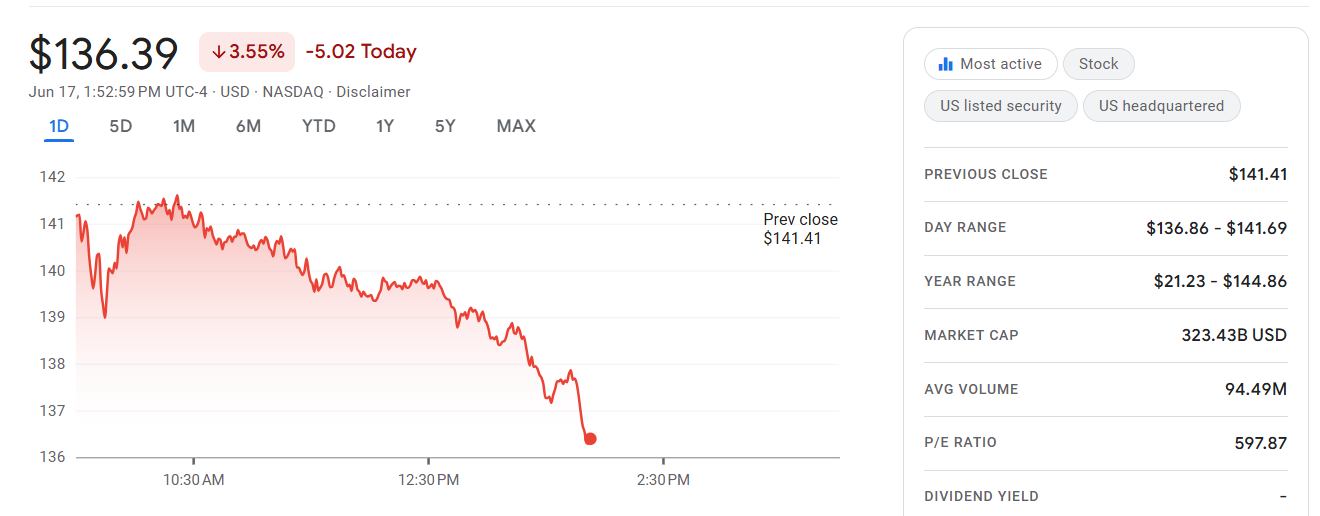
Shares of Palantir Technologies Inc. (NASDAQ: PLTR) faced significant selling pressure today, dropping 3.55% to close at $136.39, down $5.02 from Monday’s close of $141.41, according to Yahoo Finance data. The stock reached an intraday high of $141.69 before slipping to a low of $136.86, reflecting heightened volatility in a cautious broader market. Despite today’s decline, Palantir’s stock remains near its 52-week high of $144.86, showcasing robust investor enthusiasm for the AI and data analytics leader.
An analysis of Palantir’s performance reveals a mixed but impressive trajectory. Over the past five days, PLTR gained 2.1%, and over the past month, it rose 7.8%, per Yahoo Finance, signaling strong short-term momentum. Year-to-date, the stock has surged 77.7%, and its one-year gain stands at a remarkable 392.7%, driven by Palantir’s dominance in AI-driven data solutions. However, today’s dip contrasts with a six-month pullback of -8.4%, highlighting the stock’s volatility amid high investor expectations.
Palantir’s market capitalization of $323.43 billion underscores its prominence in the tech sector. Its price-to-earnings ratio of 597.87 reflects optimism about future growth, though some analysts caution about overvaluation.
According to Bloomberg, Loop Capital raised its price target to $155 on June 13, 2025, citing Palantir’s expanding commercial contracts, while Yahoo Finance reports a median target of $104.27, suggesting potential downside.
The company’s Q1 2025 revenue grew 39% to $883.86 million, exceeding estimates, per its May 5, 2025, 10-Q filing, fueled by its Gotham and Foundry platforms.
Today’s decline may stem from broader market dynamics and company-specific concerns. U.S. index futures fell, and European markets closed lower amid tariff fears. Additionally, insider selling, including CTO Shyam Sankar’s disposal of 405,000 shares on June 10 for $53.49 million, per an SEC Form 4, may have sparked profit-taking.
Despite the day’s dip, Palantir remains a focal point for investors, with its AI leadership and government contracts driving long-term optimism. Traders are eyeing the July 28, 2025, earnings report for updates on commercial growth and tariff impacts. With its stock still up significantly for the year, Palantir’s trajectory suggests resilience, but investors should stay vigilant amid market uncertainties.
This article is for informational purposes only and should not be considered financial advice. Investing in stocks, cryptocurrencies, or other assets involves risks, including the potential loss of principal. Always conduct your own research or consult a qualified financial advisor before making investment decisions. The author and publisher are not responsible for any financial losses incurred from actions based on this article. While efforts have been made to ensure accuracy, economic data and market conditions can change rapidly. The author and publisher do not guarantee the completeness or accuracy of the information and are not liable for any errors or omissions. Always verify data with primary sources before making decisions.
Dawson Blake is a financial markets expert with over 10 years of experience, focusing mainly on stock market news and price movements. He aims to become a top-tier authority in curating stock news content that readers can trust as their go-to source for market information. Dawson enjoys breaking down market activity, company updates, and daily trends to help investors stay informed and make smarter financial decisions. His writing is simple, clear, and designed to make the stock market easy to follow for everyone.
(New York, June 17, 2025) – Lockheed Martin Corporation (NYSE: LMT), a leading name in the aerospace and defense sector, is currently experiencing significant stock price volatility. On June 16, 2025, the company’s shares dropped nearly 4%, closing at $467.00. However, by 6:04 AM EDT on June 17 (4:21 PM IST), pre-market trading showed a slight recovery, with the stock rising to $472.00. This shift suggests possible stabilization in the near term.
Key Factors Driving Volatility
1. Geopolitical Tensions
On June 13, LMT stock surged 3.66% to $491.95 following increased tensions in the Middle East after Israel launched strikes against Iran. As a primary supplier of F-35 jets to Israel, Lockheed was expected to benefit from a boost in defense spending. However, the rally reversed on June 16 after Iran indicated a willingness to de-escalate, lowering short-term demand expectations.
2. F-35 Contract Reductions
Investor concerns deepened after news emerged on June 11 that the U.S. Air Force plans to cut its F-35 jet orders for FY 2026 from 48 to 24. This announcement triggered a 6% decline in the stock to $447.96 and may lead to a revenue loss of up to $3.5 billion for Lockheed Martin.
3. Defense Budget Uncertainty
While long-term government contracts like the F-35 program and the U.S. Golden Dome initiative provide a base of revenue stability, ongoing Congressional discussions about future defense spending have created uncertainty, adding pressure to the stock.
4. Macroeconomic Conditions
Rising interest rates and inflation fears continue to challenge the broader defense sector. Even though Lockheed’s forward P/E ratio of 17.49 is below the industry average of 23.2, its stock remains vulnerable to market-wide volatility.
5. Diversified Product Portfolio
Lockheed’s portfolio, which includes PAC-3 missiles, THAAD interceptors, and AI-enabled defense systems, helps mitigate some risk from the F-35 uncertainty. However, short-term price movement remains largely influenced by global headlines and news-driven sentiment.
Despite the turbulence, Lockheed Martin has managed a 4.33% year-to-date return, slightly trailing the broader aerospace and defense sector’s 6.1% gain.
Chart Overview
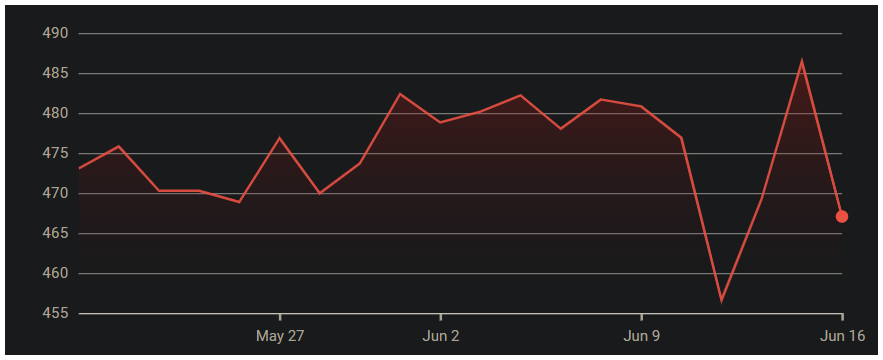
A review of the one-month chart shows LMT fluctuating between $457.00 and $491.95 since mid-May. Key price points include:
June 4: Peaked at $485.00
June 11: Dropped to $457.00 following F-35 news
June 13: Rebounded to $491.95 due to geopolitical escalation
June 16: Closed at $467.00
June 17 (Pre-Market): Slight recovery to $472.00
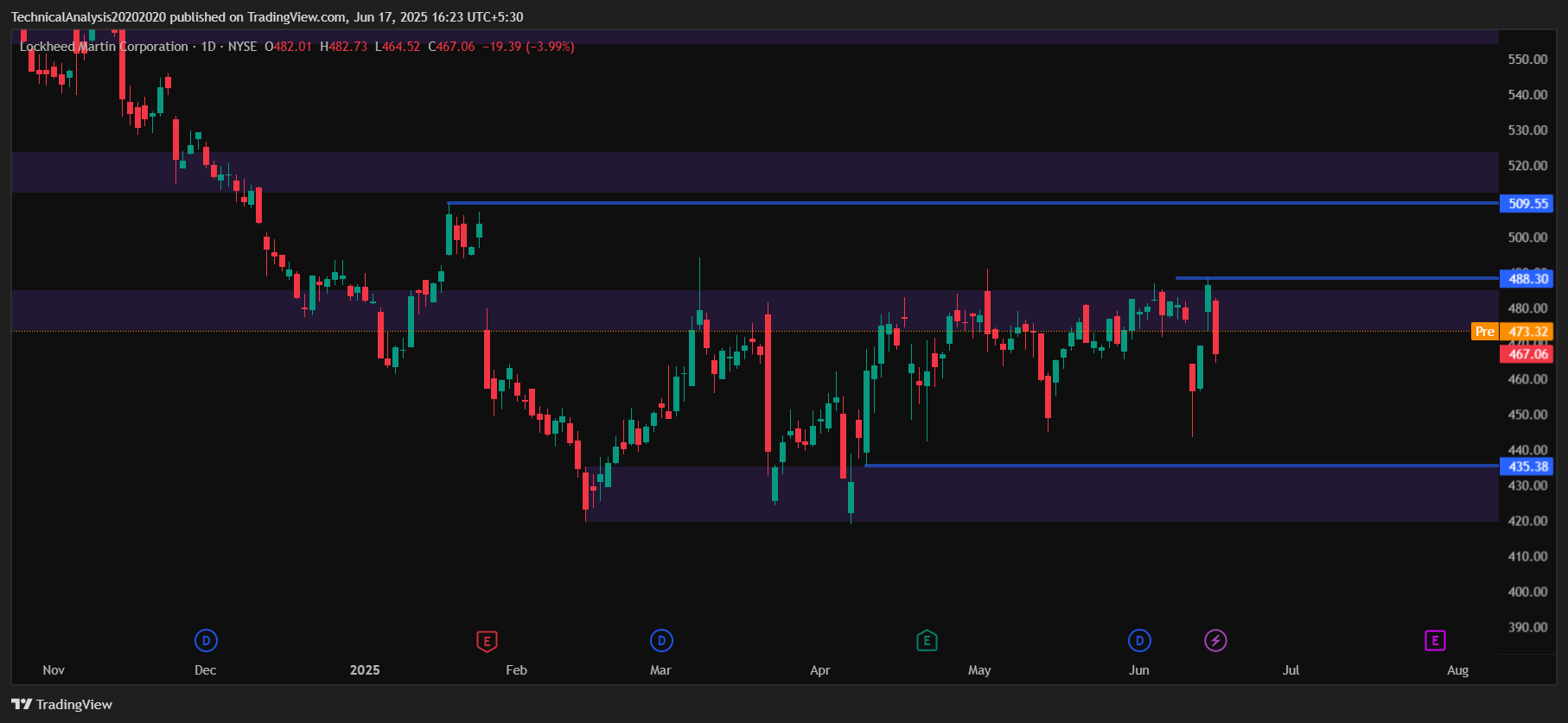
Over the past year, LMT reached a 52-week high of $618.95 in October 2024 and a low of $418.88. The current price is about 23.7% below its peak.
Technical Outlook
Technical indicators suggest potential for a bullish breakout:
Resistance Level: $488.00
Breakout Target: If breached, the stock could move toward $509.00
Support Zone: Strong buying interest expected between $430.00 and $420.00
What’s Next?
Lockheed Martin’s upcoming earnings call on July 29, 2025, is expected to provide critical updates on contract pipelines and defense funding trends. While the June 17 pre-market recovery hints at a pause in the downtrend, the stock’s direction will likely depend on:
Clarification regarding F-35 program cuts
U.S. defense budget decisions
Further geopolitical developments
As a key player in the global defense industry, LMT will remain in focus for investors tracking market momentum and sector stability.
Frequently Asked Questions (FAQs)
Q1: Why did Lockheed Martin’s stock drop 4% on June 16? A: The decline followed Iran’s de-escalation signals, reducing expectations for immediate defense spending.
Q2: What technical levels should investors monitor? A: Resistance is at $488.00 with a breakout target of $509.00. Support lies between $430.00 and $420.00.
Q3: How does the F-35 program affect LMT’s stock? A: The F-35 is a major revenue driver. Reduced U.S. orders for 2026 caused a sell-off, but long-term contracts still provide revenue stability.
Q4: Are geopolitical events important for LMT’s stock? A: Yes. Global conflicts, especially in the Middle East, often lead to increased demand for Lockheed’s products.
Q5: What supports Lockheed Martin’s long-term outlook? A: A strong product portfolio, focus on AI and hypersonic technologies, and leadership in major defense programs.
Financial Disclaimer: This article is for informational and educational purposes only. It does not constitute financial advice or a recommendation to buy, sell, or hold Lockheed Martin (LMT) stock. Investing involves risk. Past performance does not guarantee future results. Please consult a licensed financial advisor before making investment decisions. The author and publisher are not responsible for any financial losses resulting from actions taken based on this content.
Dawson Blake is a financial markets expert with over 10 years of experience, focusing mainly on stock market news and price movements. He aims to become a top-tier authority in curating stock news content that readers can trust as their go-to source for market information. Dawson enjoys breaking down market activity, company updates, and daily trends to help investors stay informed and make smarter financial decisions. His writing is simple, clear, and designed to make the stock market easy to follow for everyone.
As of Monday, June 16, 2025, at 05:24 AM EDT, U.S. stock market futures are trading on a bullish note, signaling optimism despite ongoing geopolitical tensions. Dow Jones Industrial Average futures are up 135 points (+0.32%) at approximately 42,658.00, and Nasdaq 100 futures have gained 108 points (+0.49%) at around 21,968.75.
European markets, including the FTSE 100, CAC 40, and DAX, are averaging gains of about 0.50%, bolstering global sentiment. If current conditions persist, U.S. markets could see a gap-up open of 0.50% or more, driven by strong futures and European equities, though tempered by rising oil prices, higher U.S. Treasury yields, and Middle East tensions.
Dow Jones and Nasdaq Futures: Poised for a Gap-Up Open
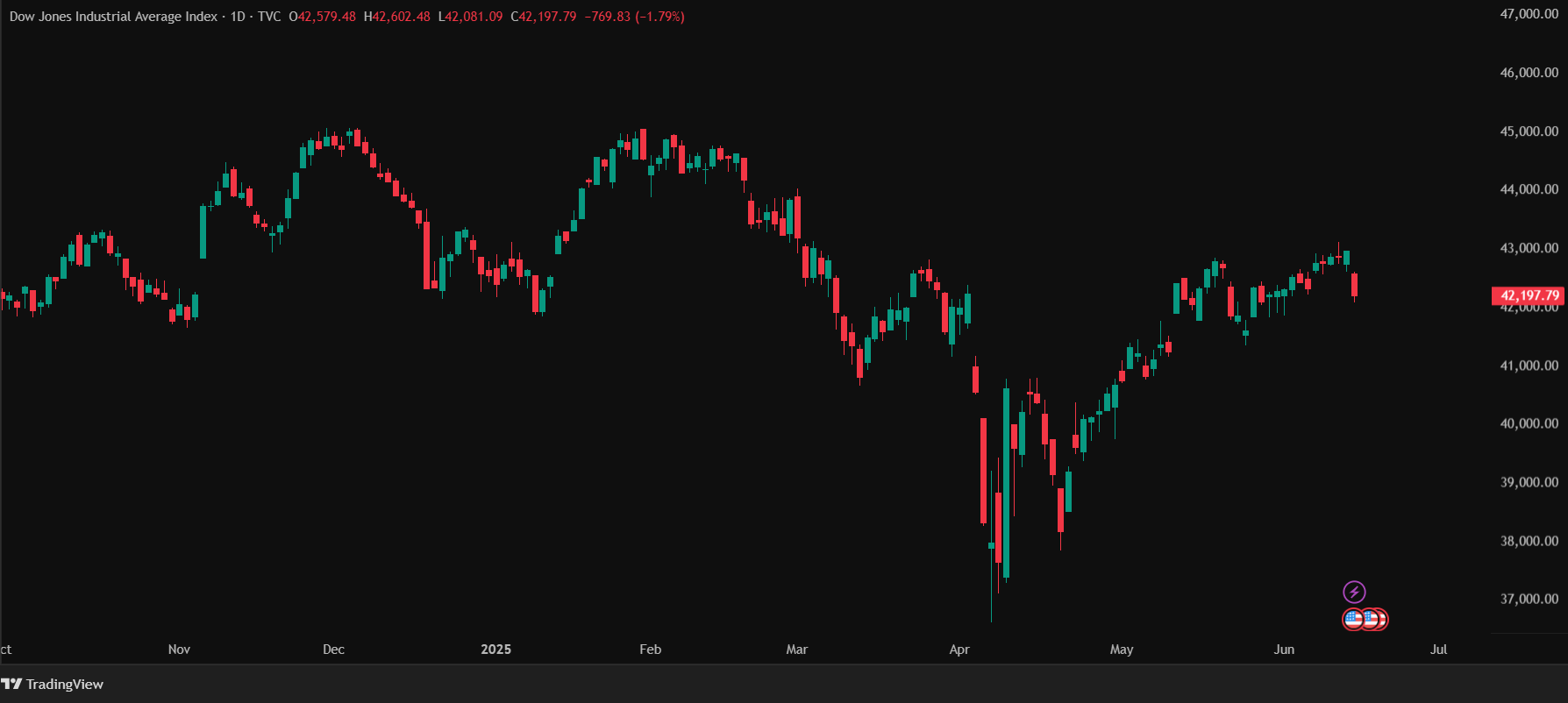
Last Friday, U.S. markets faced sharp declines after Israel’s airstrikes on Iran, with the Dow Jones Industrial Average dropping 770 points (1.8%) and the Nasdaq Composite falling 1.3%. Futures initially reflected this panic, with Dow futures down 593 points (1.38%) and Nasdaq 100 futures sliding 1.73%. However, Monday’s pre-market trading at 05:24 AM EDT shows a robust recovery, with Dow futures up 135 points and Nasdaq futures gaining 108 points.
The bullish futures movement, coupled with European markets averaging 0.50% gains – FTSE 100, CAC 40, and DAX all up around this level – suggests U.S. markets could open with a gap-up of at least 0.50%. For the Dow, this translates to a potential opening increase of approximately 213 points (based on Friday’s close of 42,197), while the Nasdaq Composite could rise by about 104 points (from 19,406).
European Markets Bolster Global Sentiment
European equities are providing a supportive backdrop for U.S. futures. The FTSE 100, CAC 40, and DAX are each up around 0.50% on Monday, reversing Friday’s declines when the Stoxx Europe 600 fell nearly 1% and the DAX dropped 1.5%. This recovery reflects cautious optimism, possibly driven by hopes of de-escalation in the Middle East or positive economic signals.
If these gains hold, the positive momentum in Europe could amplify the bullish tone in U.S. futures, supporting a gap-up open.
Treasury Yields and Inflation Concerns
U.S. Treasury yields continue to reflect inflation fears. On Friday, the 2-year Treasury yield rose nearly 2 basis points to 3.974%, and the 10-year yield climbed 1 basis point to 4.432%. By Monday, yields were slightly lower at 3.96% for the 2-year and 4.41% for the 10-year, per pre-market data.
The inverse relationship between bond yields and prices underscores investor concerns about rising energy costs fueling inflation.
The Federal Reserve’s upcoming meeting is critical, with markets pricing in a 3.1% chance of a rate cut this week. Higher yields could increase borrowing costs, potentially pressuring equities despite the bullish futures. A hawkish Fed stance might limit the extent of the gap-up open, while a dovish signal could amplify it.
Oil Price Volatility and Geopolitical Risks
Brent crude oil prices, a key market driver, surged 7% on Friday to $74.23 per barrel and rose another 0.5% to $74.60 by Monday, nearing a five-month high. The volatility is tied to fears of supply disruptions through the Strait of Hormuz, which carries 20% of global oil and liquefied natural gas (LNG) flows. A closure – potentially triggered by Iranian retaliation – could push Brent prices toward $90 or higher, per JPMorgan estimates, significantly impacting global markets.
West Texas Intermediate (WTI) crude futures rose 7.6% to $73.20 per barrel on Friday, hitting an intraday high of $77.60, the highest since January. Rising oil prices have reignited U.S. inflation fears, complicating the Fed’s policy outlook. While the bullish futures suggest investors are looking past these risks for now, a sharp oil price spike could derail the gap-up open.
Global Market Dynamics
Global markets show mixed but improving sentiment. Chinese stocks (CSI 300) oscillated, closing down 0.7% on Friday, but Monday’s European gains suggest a broader recovery. Safe-haven assets like gold remain near record highs above $3,400 per ounce, with gold futures up 1.5% to $3,455 on Friday, reflecting lingering anxiety.
The U.S. dollar index is steady at 98.64, down 0.5% after a milder-than-expected U.S. inflation report for May.
Recent U.S.-China trade talks in London offer some optimism, but the Israel-Iran conflict dominates market focus.
Market Outlook: A Bullish Open with Risks
The bullish Dow Jones and Nasdaq futures, up 135 and 108 points respectively, combined with European markets gaining 0.50% on average, point to a likely gap-up open of 0.50% or more for U.S. markets, assuming conditions remain stable. Key factors to watch include:
Geopolitical Stability: De-escalation in the Middle East could sustain the bullish momentum, while escalation could trigger a reversal.
Federal Reserve Signals: A dovish Fed could amplify the gap-up, while a hawkish stance might cap gains.
Oil Prices: Further spikes in Brent or WTI crude could reignite inflation fears, pressuring equities.
Global Cues: Sustained European gains and Chinese market stability could reinforce U.S. optimism.
The Bottom Line
Dow Jones and Nasdaq futures are poised for a bullish gap-up open of 0.50% or more, driven by gains of 135 and 108 points respectively and supported by European markets (FTSE 100, CAC, DAX) averaging 0.50% higher. Despite optimism, risks from the Israel-Iran conflict, volatile oil prices, and rising Treasury yields loom large. Investors should monitor Middle East developments, Federal Reserve signals, and global market cues to gauge the sustainability of the rally. A cautious yet opportunistic approach is warranted in this volatile environment.
This article is for informational purposes only and should not be considered financial advice. Investing in stocks, cryptocurrencies, or other assets involves risks, including the potential loss of principal. Always conduct your own research or consult a qualified financial advisor before making investment decisions. The author and publisher are not responsible for any financial losses incurred from actions based on this article. While efforts have been made to ensure accuracy, economic data and market conditions can change rapidly. The author and publisher do not guarantee the completeness or accuracy of the information and are not liable for any errors or omissions. Always verify data with primary sources before making decisions.
Dawson Blake is a financial markets expert with over 10 years of experience, focusing mainly on stock market news and price movements. He aims to become a top-tier authority in curating stock news content that readers can trust as their go-to source for market information. Dawson enjoys breaking down market activity, company updates, and daily trends to help investors stay informed and make smarter financial decisions. His writing is simple, clear, and designed to make the stock market easy to follow for everyone.
On June 5, 2025, Circle Internet Group, the company behind the popular USDC stablecoin, officially went public on the New York Stock Exchange under the ticker “CRCL.”
Expectations were already high, but Circle surprised everyone by pricing its IPO at $31 per share, above the expected range of $27 to $28. That gave the company a valuation of about $6.8 billion. Not only that, Circle increased the number of shares offered to 34 million, allowing it to raise $1.05 billion – a clear sign that demand was strong.
What really grabbed headlines, though, was news that Cathie Wood’s ARK Invest would be buying up to $150 million worth of shares. Given Wood’s reputation for backing major tech disruptors, this move could be a game-changer for both Circle and the broader crypto space.
Cathie Wood’s Bold Investment Style
Cathie Wood isn’t new to making big, forward-looking bets. She built her career around spotting disruptive innovations before the rest of the world caught on. Born in 1955 in Los Angeles, she graduated from the University of Southern California in 1981 with top honors in finance and economics. Early in her career, she worked at big names like Capital Group and Jennison Associates, sharpening her skills as an economist and fund manager.
In 2014, she co-founded ARK Invest, a firm focused on groundbreaking technologies like AI, blockchain, genomics, and robotics.
Her most famous call? Tesla. She started buying the stock back in 2014 when it was trading around $50 (adjusted for splits). When Tesla exploded in value, ARK’s flagship fund posted a 153% return in 2020, making it one of the top performers globally. She was also one of the earliest institutional voices backing Bitcoin, with ARK investing in the Grayscale Bitcoin Trust as far back as 2015.
Even with some rough patches – including a $7.1 billion loss between 2014 and 2023 – Wood’s influence is undeniable. As of mid-2025, her estimated net worth stands at $250 million, and she’s publicly stated that 25% of her personal wealth is in Bitcoin.
IPO Pricing Shows Big Investor Confidence
Circle’s IPO pricing tells a story of its own. Starting out with a target range of $24 to $26, the final price came in at $31. That’s a bold move, especially in today’s market.
The total offering includes 14.8 million shares from Circle itself and another 19.2 million shares from existing investors. With that, the company’s total valuation reaches around $6.8 billion, and even more when you include future stock options, hitting $8.1 billion on a fully diluted basis.
This strong showing highlights the growing confidence investors have in crypto infrastructure companies – especially those tied to real-world use cases like stablecoins.
Is Cathie Wood’s Backing Just About Money — or Is It a Signal?
Cathie Wood’s planned $150 million purchase in the IPO isn’t just about numbers – it’s a stamp of approval. Given her history with game-changers like Tesla and Bitcoin, her support for Circle speaks volumes. It’s not just about the company’s current performance – it’s about where she believes the industry is heading.
ARK Invest has been increasing its exposure to blockchain tech, and Circle fits perfectly into that theme. Add in the fact that BlackRock is also buying about 10% of the IPO shares, and you’ve got the makings of a mainstream moment for crypto. Big names getting behind Circle might just convince more institutions to jump in.
What This Means for Circle – and for Crypto as a Whole?
Circle’s stablecoin USDC now boasts a $62 billion market cap, and it’s been growing steadily — up 40% in 2025 alone. That makes it the second-largest stablecoin in the world, behind Tether. The money raised through the IPO will likely go toward expanding internationally, investing in regulatory compliance, and developing tokenized financial products – tools that could help crypto gain even more ground in traditional finance.
The higher-than-expected IPO price and upsized offering send a clear message – investors believe Circle can help bridge the gap between crypto and traditional finance. And with legislative tailwinds like the U.S. GENIUS Act (which supports stablecoin regulation and adoption), the timing might be just right.
Risks You Shouldn’t Ignore
Of course, not everything is smooth sailing for Circle, even with all the buzz surrounding its IPO and Cathie Wood’s major investment. Beneath the optimism, there are a few red flags that investors shouldn’t ignore. Circle’s net income fell sharply from $268 million in 2023 to $156 million in 2024, raising eyebrows about the company’s ability to sustain profitability. What’s more concerning is that distribution costs are rising faster than revenue. If this trend continues, Circle’s profit margins could come under real pressure.
The company’s most recent earnings, for the quarter ending March 31, 2025, show mixed signals. On the surface, things look promising—Circle reported $64.8 million in net income on $579 million in revenue, reflecting a solid 33% increase in net income year-over-year. But dig deeper, and the challenges become clear. Distribution and transaction costs during the same period shot up by 68.2%, far outpacing the 55.1% rise in revenue, most of which came from interest earned on U.S. Treasuries backing the USDC stablecoin. That kind of imbalance between income and operating expenses could be a sign of growing inefficiencies.
Cathie Wood’s involvement, while exciting, also comes with its own baggage. Her ARK Invest funds have a history of sharp ups and downs. After posting eye-popping gains in 2020, many of her flagship ETFs faced steep losses post-2021. That track record, while bold and visionary, also adds a layer of volatility that some investors may be cautious about.
Then there’s the regulatory environment. Even though the GENIUS Act has brought some clarity to the U.S. stance on stablecoins, crypto regulations are still a moving target both at home and globally. Lawmakers continue to debate how digital assets should be governed, and Circle will need to tread carefully to avoid getting caught in any crossfire.
Are Stablecoins Entering a New Era?
Circle’s debut on the public market is more than just another crypto company going public. With a higher share price, more shares offered, and a valuation of nearly $7 billion, this IPO signals that Wall Street is paying attention to stablecoins in a big way.
Cathie Wood’s $150 million investment adds fuel to that momentum. Her involvement doesn’t just bring capital – it brings credibility, especially in a space that’s still trying to win mainstream trust. Given her past bets on Tesla and Bitcoin, many will be watching closely to see if her Circle investment becomes another success story.
This article is for informational purposes only and should not be considered financial advice. Investing in stocks, cryptocurrencies, or other assets involves risks, including the potential loss of principal. Always conduct your own research or consult a qualified financial advisor before making investment decisions. The author and publisher are not responsible for any financial losses incurred from actions based on this article. While efforts have been made to ensure accuracy, economic data and market conditions can change rapidly. The author and publisher do not guarantee the completeness or accuracy of the information and are not liable for any errors or omissions. Always verify data with primary sources before making decisions.
Dawson Blake is a financial markets expert with over 10 years of experience, focusing mainly on stock market news and price movements. He aims to become a top-tier authority in curating stock news content that readers can trust as their go-to source for market information. Dawson enjoys breaking down market activity, company updates, and daily trends to help investors stay informed and make smarter financial decisions. His writing is simple, clear, and designed to make the stock market easy to follow for everyone.
Circle Internet Group is the company behind the popular USDC stablecoin.
On May 27, 2025, the company filed for an IPO under the ticker symbol CRCL. The shares will be listed on the New York Stock Exchange (NYSE) and are expected to start trading on June 5, 2025. Circle is planning to raise up to $624 million by offering 24 million shares, each priced between $24 and $26. If this IPO goes as planned, the company’s value could reach between $5.2 billion and $6.71 billion.
Many investors are showing strong interest in this IPO. Bloomberg even reported that it is oversubscribed, meaning more people want to buy the shares than what’s available.
Big investors like Cathie Wood’s ARK Invest are also joining in. They plan to buy up to $150 million worth of shares.
As a result, many people are now searching online for price predictions and trying to guess where the stock might go after it starts trading.
Short-Term Price Prediction
Right after the listing in June 2025, CRCL shares could go up quickly.
If the IPO starts at $24–$26, the price might jump to $30–$35 within a few weeks. This would be a 15% to 35% gain.
One big reason is the GENIUS Act, a new U.S. law that supports stablecoins like USDC. If this Act becomes law by the end of June, it could bring more trust and use to USDC, which would help the CRCL stock. But if the Act is delayed or if the overall stock market is weak, the price might stay around $28–$30 instead.
Looking 6 to 12 months ahead, CRCL could rise even more. Experts at J.P. Morgan believe the stablecoin market might grow to $500–$750 billion in the near future.
If Circle gains more users and beats its main rival Tether, the share price could reach $40–$50 by mid-2026. This depends on USDC continuing to grow, since it already has $60 billion in circulation. But there are risks too. If the GENIUS Act is changed or if new rules ban interest-earning stablecoins, the stock might only rise to $28–$32.
Also, Circle depends a lot on Coinbase, which brings in 54% of its revenue. This could hurt profits if that partnership changes.
In the long run, from 2027 to 2030, the future looks big for CRCL. Citigroup thinks the stablecoin market could reach $1.6 trillion by 2030. If Circle keeps growing and competes well with Tether, the CRCL stock could rise to $60–$80. Circle already has a user network that reaches 600 million people, and if it gets a trust charter license, it would become even more trusted.
But Circle will face more competition. Big banks like Bank of America might launch their own stablecoins. Also, the world economy and new rules could slow down Circle’s growth, keeping the stock at $40–$50.
People on social media have mixed feelings—some are excited, while others worry about Circle’s profits.
Key Factors That Could Affect CRCL’s Stock Price
One important factor is regulation. If the GENIUS Act passes, USDC might become more widely used. But if it’s delayed or changed, the stock might not grow much.
Next is market sentiment. Right now, Bitcoin prices are high, and U.S. leaders like Trump are showing support for crypto. This is good for Circle.
Competition is another big factor. Circle must beat other stablecoins like Tether and watch out for new ones from banks.
Lastly, Circle’s financial results matter. In 2024, it earned $1.68 billion and had $285 million EBITDA, which is a sign of good business. But its net income fell by 42% to $155 million, which could worry investors.
The Bottom Line
These predictions are not guarantees. Stock prices after an IPO can be unpredictable. They depend on many things like market trends, new laws, and how well the company performs.
If you are planning to invest in the CRCL IPO, keep a close eye on the June 5 listing, updates about the GENIUS Act, and the performance of USDC in the market. And before investing your money, it’s always a good idea to talk to a financial advisor and understand your own risk tolerance.
The information in this article is meant only for educational and informational use. It is not financial, legal, or investment advice. Always talk to a trusted financial advisor before making any investment decision. The author and publisher are not responsible for any financial losses.
Dawson Blake is a financial markets expert with over 10 years of experience, focusing mainly on stock market news and price movements. He aims to become a top-tier authority in curating stock news content that readers can trust as their go-to source for market information. Dawson enjoys breaking down market activity, company updates, and daily trends to help investors stay informed and make smarter financial decisions. His writing is simple, clear, and designed to make the stock market easy to follow for everyone.
Circle Internet Group, the company behind the USDC stablecoin, has officially filed for an IPO on May 27, 2025. The company plans to go public on the New York Stock Exchange under the ticker CRCL. The IPO is expected to raise up to $624 million, with the listing date set for June 5, 2025.
Circle is offering 24 million shares at a price range of $24 to $26 per share. If the IPO goes through as planned, it could value the company at somewhere between $5.2 billion and $6.71 billion.
This announcement has sparked a lot of interest among investors who are curious about whether Circle’s IPO is a good opportunity and if investing in a company behind a major stablecoin like USDC makes sense right now.
We can’t give you a direct yes or no answer to whether you should buy the CRCL IPO because the final choice is yours. But we can help by showing you both the good and risky sides of this IPO so you can decide what fits best with your financial goals.
Why is the Timing Important?
The timing of this IPO is quite interesting. It’s happening right when the U.S. Senate is discussing the GENIUS Act, a new law aimed at regulating stablecoins like USDC. The Senate voted on this law just days before, on May 19 and 20. If this bill moves forward, it could open up new opportunities for companies like Circle that work in the stablecoin space.
Circle’s financial performance looks promising. In 2024, the company reported $1.68 billion in revenue, which was a 16% increase from the year before. Although its net income fell to $157 million because of increased investments, the company still showed strong operating profits with $285 million in adjusted EBITDA. That means Circle is still running a healthy business and generating cash.
USDC’s Market Presence Gives Circle an Edge
USDC, the stablecoin issued by Circle, is one of the biggest in the market. It has between $60 and $62 billion in circulation and holds around 25% to 35% of the market share, based on data from CoinGecko. This puts Circle right behind Tether, which is the current market leader in stablecoins.
There’s also support coming from both the government and big investors. If the GENIUS Act becomes law, J.P. Morgan predicts the total stablecoin market could grow to $500 billion or even $750 billion. This could mean more demand for USDC.
On the political side, Donald Trump’s pro-crypto views may help push this IPO forward. In fact, Polymarket believes there’s a 90% chance the IPO will be approved.
Investor interest is already very high. Bloomberg reports that the Circle IPO is oversubscribed, meaning more people want shares than what is available. ARK Invest, led by Cathie Wood, is also planning to invest $150 million in the IPO. This shows strong confidence in Circle’s future.
What Are the Risks?
Still, there are things to watch out for. A large number of shares being sold—around 14.4 million out of 24 million—are coming from insiders, including the company’s founders. This can raise some concerns.
When insiders sell a big chunk during an IPO, it sometimes looks like they’re taking profits early. Something similar happened during Facebook’s IPO in 2012, and it made some investors nervous back then too.
Regulation is another area to keep an eye on. While the GENIUS Act could help the stablecoin industry grow, it might also bring stricter rules. For example, it could ban interest-paying stablecoins. If that happens, Circle’s earnings could take a hit. PYMNTS has already reported on these possible changes, which could impact how profitable USDC remains.
There’s also strong competition in this space. Tether holds about 60% to 67% of the stablecoin market, and if big banks like Bank of America enter the stablecoin market after regulations become clear, Circle could face serious competition from both old and new players.
Final Thoughts
We can’t tell you exactly what to do because investing always depends on your personal risk level and goals. What we can say is this – Circle’s IPO gives you a chance to invest in one of the leading companies in the growing crypto and stablecoin industry. Its financials are strong, and USDC has a wide user base. That makes it attractive.
However, insider selling, regulatory uncertainty, and competition are real challenges. If you’re seriously thinking about whether the CRCL IPO is a good investment, take time to look at your own situation. Think about how much risk you’re willing to take and how this fits into your current investment plan. Keep an eye on the listing day—June 5—and on updates about the GENIUS Act. Also, talk to a financial advisor if you’re unsure.
The information in this article is meant only for educational and informational use. It is not financial, legal, or investment advice. Buying shares in an IPO comes with risks, and you could lose money. Financial numbers are based on data as of May 28, 2025, and may change. Always talk to a trusted financial advisor before making any investment decision. The author and publisher are not responsible for any financial losses.
Dawson Blake is a financial markets expert with over 10 years of experience, focusing mainly on stock market news and price movements. He aims to become a top-tier authority in curating stock news content that readers can trust as their go-to source for market information. Dawson enjoys breaking down market activity, company updates, and daily trends to help investors stay informed and make smarter financial decisions. His writing is simple, clear, and designed to make the stock market easy to follow for everyone.
Circle Internet Financial, Inc. (CRCL), the company behind the USDC stablecoin, launched its IPO on June 5, 2025. The shares were priced at $31 each, with 34 million shares sold, raising $1.1 billion and targeting a valuation of $6.9 billion. It’s clear the company has big plans.
Initially, Circle’s IPO filing planned to offer 24 million shares at a price range of $24 to $26, targeting approximately $624 million. However, due to exceptional investor demand, Circle increased the offering size and priced its IPO at $31 per share, above the revised range of $27 to $28. The IPO includes approximately 34 million shares – 15.1 million new shares from the company and 19.2 million from existing stockholders – raising about $1.1 billion and valuing Circle at roughly $7.1 billion.
Circle Internet Group (CRCL) made a strong debut on the New York Stock Exchange on June 5, 2025.
On the first day of trading, the stock opened at $69, which was a jump of 123% from its IPO price. During the day, it went as high as $103.75, giving early investors a 235% gain at its peak.
This article breaks down everything you need to know, from Circle’s core business and industry position to how its stock might perform over the next few decades.
Company Overview
Circle Internet Group is a key player in the world of digital finance, especially known for its role in the stablecoinmarket.
Here’s a quick overview of what the company is all about.
Company Name
Circle Internet Financial, Inc.
Sector
Financials
Industry
Capital Markets / Cryptocurrency Services
IPO Year
2025
Stock Exchange
NYSE (Ticker: CRCL)
Founders
Jeremy Allaire, Sean Neville
Established
2013
Specialization
Stablecoin Issuance (USDC), Blockchain Payments
Circle was founded in 2013 by Jeremy Allaire and Sean Neville. Headquartered in Boston, Massachusetts, the company is best known for USDC, the world’s second-largest stablecoin with over $62 billion in circulation.
Circle stands out for its strong focus on regulated stablecoins and its blockchain-powered payment solutions, especially the Circle Payments Network (CPN). These efforts aim to connect traditional finance with digital assets. It has caught the eye of major investors like Cathie Wood’s ARK Investment Management and BlackRock, who plan to buy significant shares.
Stock prices don’t just move randomly. They are influenced by how a company is performing, the health of the overall economy, and how investors feel about future prospects.
For Circle, here are the major driving forces:
Revenue Sources: The company earns money from transaction fees, income from reserves (which totaled $1.7 billion in 2025), and new offerings like CPN.
Regulatory Factors: Changes in U.S. laws about stablecoins—like the Republican-supported bill introduced in 2025—could impact how Circle operates.
Market Adoption: The growing use of USDC in areas like decentralized finance (DeFi) and international payments increases demand.
Other broader factors—like interest rate changes and crypto market swings—will also play a big role in how Circle’s stock performs once it’s publicly traded.
The Financial Sector
Circle is part of the financial sector, which includes everything from traditional banks to modern fintech companies, including those working with cryptocurrencies. This sector plays a huge role in how money moves around the world, and fintech is leading a wave of innovation.
Key Factors Impacting the Sector
Regulations: Rules around digital assets like stablecoins can affect costs and market access.
Economic Trends: Interest rates and inflation affect investor confidence and market behavior.
Technology Growth: Innovations like blockchain and AI are changing how financial services operate.
Recent Sector Growth
The financial sector has seen strong growth in recent years, especially as fintech becomes more common. In 2025, smoother U.S.-China trade relations boosted IPO activity, benefiting companies like Circle. Interest from big investors, such as ARK’s plan to buy up to $150 million in Circle shares, shows that this part of the market is gaining serious momentum.
Cryptocurrency Services Industry
Circle belongs to the Cryptocurrency Services industry, a space full of competition and constant change. It focuses on issuing stablecoins and building blockchain payment systems. Circle goes head-to-head with players like Tether, PayPal (with its PYUSD), and some banking partnerships.
What’s Shaping This Industry
Demand for Stablecoins: USDC is used in trading and DeFi. Its popularity drives Circle’s revenue.
Tough Competition: Tether has a bigger market share, and other players are quickly entering the space.
Regulatory Movement: Laws being developed in 2025 will affect how trusted and cost-effective Circle can be.
Recent Growth and Key Moves
The industry is booming thanks to more institutional support and clearer regulations. In May 2025, Circle launched the Circle Payments Network, allowing everyday users to send payments across borders using blockchain.
Even after turning down a $4–$5 billion buyout offer from Ripple, Circle made it clear it plans to grow on its own – especially through its IPO.
What Could Affect Circle’s Stock Growth?
Once Circle starts trading, the key to its stock price going up will be how well it can take advantage of trends like:
The increasing use of stablecoins
A clearer regulatory path for crypto
Partnerships with big names like Coinbase
With a reserve income of $1.7 billion and promising tools like CPN, Circle is in a strong position. And with Bitcoin reaching around $109,800 in May 2025, the overall crypto environment is looking bullish. That said, challenges like economic ups and downs and stiff competition could slow things down.
Circle’s IPO, launched on June 5, 2025, includes 34 million Class A shares priced at $31 each, surpassing the initial plan of 24 million shares at $24 to $26. This upsized offering raised approximately $1.1 billion, valuing Circle at roughly $7.1 billion, with a fully diluted valuation of $8.1 billion, according to Investing.com. The shares began trading on the NYSE under the ticker “CRCL” on June 5, 2025. Since trading has just started, detailed technical analysis is not yet available.
But once it does, we will start looking at:
Moving Averages: These will show whether the stock is gaining or losing momentum.
Support and Resistance Levels: These help figure out likely price ranges.
RSI (Relative Strength Index): This will tell us whether the stock is potentially overbought or oversold.
Speculative Long-Term Targets
We’ve made some long-term price estimates based on possible yearly growth. Here’s what the numbers might look like starting from a $25 IPO price:
Year
Median Price
Lower Bound
Upper Bound
2025
250
170
300
2030
To be updated soon
To be updated soon
To be updated soon
2040
To be updated soon
To be updated soon
To be updated soon
2050
To be updated soon
To be updated soon
To be updated soon
We will update these numbers as CRCL keeps trading on the NYSE and clear price trends appear.
The long-term outlook will also depend on investor mood and technical indicators.
Long-Term Outlook – Why the Future Looks Bright for Circle?
Circle has what it takes to do well in the long run. As more people start using stablecoins like USDC and as tools like the Circle Payments Network gain traction, the company’s growth opportunities are strong.
The IPO is also getting backing from big names like J.P. Morgan and Goldman Sachs. Plus, interest from institutional investors such as ARK shows strong confidence. However, challenges like tighter competition with Tether and possible delays in U.S. regulations could slow things down.
If Circle keeps pushing forward with innovation and handles new rules well, it has a good shot at becoming one of the top players in digital finance over the next few decades.
Circle Internet Financial is set to play a major role in connecting traditional banking with the digital asset world. Its USDC stablecoin already has a strong reputation, and the upcoming IPO could be a game-changer.
While exact price predictions will come later, Circle’s strong fundamentals – like its big reserve income and focus on regulated finance – make it one to watch. For investors, keeping an eye on how the stock performs in its early days and watching for key market signals will be important. Overall, Circle’s entrance into public markets could be one of the most exciting crypto stories of the decade.
This article is for educational and informational purposes only and should not be considered financial advice. Investing in stocks, cryptocurrencies, or other assets involves risks, including the potential loss of principal. Always conduct your own research or consult a qualified financial advisor before making investment decisions. The author and publisher are not responsible for any financial losses incurred from actions based on this article. While efforts have been made to ensure accuracy, economic data and market conditions can change rapidly. The author and publisher do not guarantee the completeness or accuracy of the information and are not liable for any errors or omissions. Always verify data with primary sources before making decisions.
Dawson Blake is a financial markets expert with over 10 years of experience, focusing mainly on stock market news and price movements. He aims to become a top-tier authority in curating stock news content that readers can trust as their go-to source for market information. Dawson enjoys breaking down market activity, company updates, and daily trends to help investors stay informed and make smarter financial decisions. His writing is simple, clear, and designed to make the stock market easy to follow for everyone.
Circle Internet Group — the company behind that USDC “digital dollar” you keep hearing about — just filed to go public on the NYSE.
But here’s what every headline got wrong: This isn’t just another crypto company trying to cash in. This is the moment stablecoins officially became Wall Street infrastructure.
Company Overview
Circle runs USDC — basically a digital version of the U.S. dollar that businesses use to move money around instantly. No waiting days for bank transfers. No ridiculous international wire fees. Just boom, money moves.
Second-largest stablecoin issuer by market capitalization
Key Investors
Goldman Sachs, BlackRock, Fidelity
Previous IPO Attempt
Failed SPAC deal in 2022; Circle Internet Group IPO is second attempt
The numbers are wild: USDC processes over $7 trillion in transactions every year. That’s not speculation money — that’s real businesses paying real bills with digital dollars.
And get this — Goldman Sachs and BlackRock aren’t just throwing money at Circle for fun. They actually use USDC infrastructure for their own operations. When Wall Street’s biggest players become your customers, you know you’re onto something real.
The CRCL IPO Breakdown
Circle Internet Financial officially filed for its IPO on May 27, 2025, and the stock is set to begin trading on the New York Stock Exchange (NYSE) on June 5, 2025, under the ticker CRCL.
Here’s what you need to know about the IPO:
Total Shares Offered: 24 million Class A shares
Price Range: $24 to $26 per share
Valuation Target: Between $5.2 billion to $6.71 billion
Who’s Selling the Shares?
Circle Itself is offering 9.6 million shares
Existing Shareholders like Accel, General Catalyst, and co-founders Jeremy Allaire and Sean Neville are selling 14.4 million shares
Underwriters:
Big investment banks are backing this IPO, including:
J.P. Morgan
Citigroup
Goldman Sachs
They also have the option to buy 3.6 million more shares if demand stays strong.
Big Investors Are Interested:
Cathie Wood’s ARK Invest is planning to invest up to $150 million in Circle’s shares.
According to Bloomberg, the IPO is already multiple times oversubscribed. That means way more people want to buy shares than the number of shares available — a sign that there is strong demand for Circle’s stock.
Everyone’s talking about Circle raising $624 million by selling shares at $24-26 each. That’s the surface story.
Here’s what actually matters: Circle made $1.68 billion in revenue last year. Not from people gambling on crypto prices, but from businesses using their payment infrastructure. That’s PayPal-level money, but with way better growth.
Their profit dropped to $157 million because they’re spending heavily on expansion. Smart companies do this before going public — invest everything in growth, then let public markets fund the next phase.
The share split is interesting too. Circle’s selling 9.6 million new shares, but existing investors are cashing out 14.4 million shares. That’s not desperation — that’s confidence. Early investors are taking profits because they know the public market will value Circle higher than private investors did.
The CRCL IPO has launched at a time when the GENIUS Act is making its way through the U.S. Senate. This bill was moved forward with a 66-32 procedural vote on May 19, 2025, gaining support from 16 Democrats, including Senators Cory Booker and Adam Schiff. Just a day later, on May 20, the Senate voted 69-31 to start working on amendments to the bill, aiming to pass it by Memorial Day on May 26, 2025.
The full name of the bill is the Guiding and Establishing National Innovation for U.S. Stablecoins Act. It requires stablecoins to be backed 1:1 by liquid assets like cash or U.S. Treasury bonds. It also ensures that stablecoin holders get priority during bankruptcy situations and that strong anti-money laundering rules are followed.
Under the Act, both banks and approved nonbank institutions can issue stablecoins, either under federal or state supervision. Big issuers handling more than $10 billion in stablecoins will come under the watch of the Federal Reserve and the Office of the Comptroller of the Currency (OCC). According to J.P. Morgan, this law could expand the stablecoin market to somewhere between $500 billion and $750 billion, helping boost the growth of USDC. Still, not everyone is on board.
Critics like Senators Elizabeth Warren and Chuck Schumer argue that the bill is tilted in favor of banks and doesn’t provide strong enough protections, such as FDIC insurance. Some of the proposed amendments are aimed at fixing potential conflicts of interest, especially concerns linked to former President Trump’s connections with World Liberty Financial’s USD1 stablecoin.
Three things make this different from every other crypto company that tried going public:
First, the timing is perfect. Remember when Coinbase went public in 2021 during peak crypto mania? That was speculation money chasing speculation companies. Circle’s going public now, when institutions actually need digital payment infrastructure. Totally different game.
Second, Circle makes money when businesses use digital payments. They don’t need Bitcoin to hit $100k or people to start day-trading again. Every time someone sends USDC for a real business transaction, Circle gets paid. It’s like owning the toll booth on a highway that gets busier every year.
Third, they’re basically bulletproof on regulations. While other crypto companies are fighting with regulators, Circle spent years building compliance systems. They publish detailed reports about their reserves. They work with U.S. regulators instead of against them. When crypto regulations finally get written, Circle will be the template everyone else has to follow.
The Competition Angle Everyone’s Missing
USDC currently handles about 35% of the stablecoin market.
Tether’s USDT dominates with 65%, but there’s a catch: Tether operates in regulatory gray areas and faces constant questions about whether they actually have the dollars they claim to have.
Circle’s different. They publish quarterly reports proving every USDC is backed by actual dollars in actual banks. Once they’re a public company, that transparency becomes legally required.
Here’s the kicker: Most big businesses won’t work with companies that might get shut down by regulators. They need reliable partners. Circle’s IPO basically puts a “safe to use” stamp on USDC that Tether can’t match.
What Happens Next Actually Matters for Everyone
If Circle’s IPO goes well, it opens the door for other real crypto infrastructure companies to go public. Not the speculation stuff — the companies building actual useful services.
Think about it: Stripe revolutionized online payments and became worth $95 billion. Circle could do the same thing for international payments and digital money infrastructure.
But if Circle struggles as a public company, it sends a message that even the most legitimate crypto companies aren’t ready for public markets. That delays the whole industry’s growth by years.
Why Regular Investors Should Care
Circle’s stock gives you a way to invest in crypto infrastructure without buying cryptocurrency. You’re betting on digital payments growing, not on Bitcoin’s price going up.
It’s like investing in Visa during the early days of credit cards. You’re not betting on any specific transaction — you’re betting that more transactions will happen electronically over time.
The international angle is huge too. Every country is exploring digital versions of their currency. Circle’s already built the infrastructure for digital dollars. When other countries need similar systems, Circle’s the obvious choice.
The Real Story Nobody’s Telling
This IPO proves something important: The useful parts of crypto are becoming normal business infrastructure. Circle’s not going public as a “crypto company” — they’re going public as a payment infrastructure company that happens to use blockchain technology.
That’s the real shift. Crypto is evolving from speculation to utility. The companies building useful services are separating from the companies chasing hype.
Circle’s IPO is like the moment when Amazon stopped being “that internet bookstore” and became “that logistics company that happens to sell books online.” Same technology, completely different business reality.
What This Means for Your Money
Whether you buy CRCL stock or not, understand what this IPO represents: Digital payments are becoming as normal as email. The companies building that infrastructure early are positioning themselves for massive growth.
Circle’s bet is simple: More business will happen digitally, and that business needs reliable infrastructure. If they’re right, owning that infrastructure becomes incredibly valuable.
The interesting part? You don’t need to understand blockchain technology to understand Circle’s business model. They make money when people use digital dollars for real purposes. That’s as straightforward as business gets.
Circle’s IPO isn’t just another crypto company going public. It’s infrastructure becoming a public utility.
The companies that win in crypto aren’t the ones chasing speculation — they’re the ones building services that make digital money actually useful. Circle figured that out years ago, and now they’re cashing in.
Watch how CRCL performs after going public. If it does well, expect more infrastructure-focused crypto companies to follow. If it struggles, the whole sector takes a step back.
The information provided in this article is for informational and educational purposes only and does not constitute financial, investment, or legal advice. Investing in initial public offerings (IPOs) involves significant risks, including the potential loss of principal. The cryptocurrency and stablecoin markets are highly volatile and subject to regulatory changes, which may impact investment outcomes. Readers should conduct their own research and consult with a qualified financial advisor before making investment decisions. The author and publisher are not responsible for any financial losses or damages resulting from the use of this information.
Dawson Blake is a financial markets expert with over 10 years of experience, focusing mainly on stock market news and price movements. He aims to become a top-tier authority in curating stock news content that readers can trust as their go-to source for market information. Dawson enjoys breaking down market activity, company updates, and daily trends to help investors stay informed and make smarter financial decisions. His writing is simple, clear, and designed to make the stock market easy to follow for everyone.