
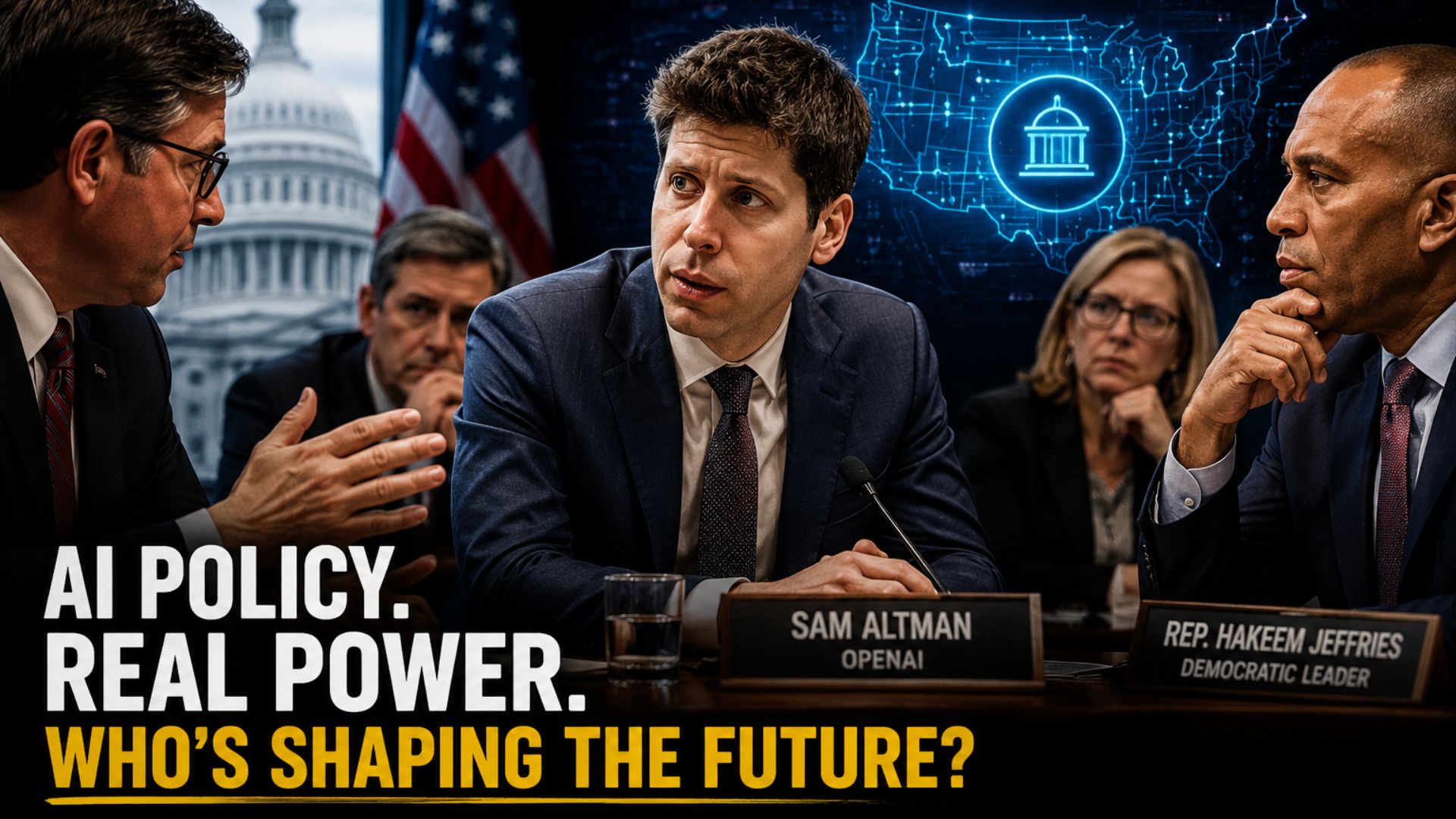
OpenAI CEO Sam Altman is meeting with lawmakers and Trump administration officials in Washington following the signing of a new executive order on artificial intelligence.
On the surface, this appears to be a routine policy engagement between a major technology company and government stakeholders.
What stands out to us is that the timing makes this meeting more significant than the public narrative suggests.
The executive order creates a mechanism through which leading AI companies may voluntarily provide government access to frontier models before public release. While the order remains vague, the strategic implications are not.
The real question is not whether OpenAI supports regulation.
The real question is whether OpenAI is helping shape the regulatory architecture that will govern the next phase of AI competition.
For frontier AI companies, regulation is no longer simply a compliance issue.
It is increasingly becoming a competitive moat.
Companies with the resources, legal infrastructure, security capabilities, and political relationships to satisfy government requirements may ultimately benefit from regulatory frameworks that smaller competitors struggle to navigate.
What appears to be oversight may simultaneously function as market consolidation.
Also Read – The Material Facts About Anthropic That Investors Can’t See Yet
The Executive Order and the Emerging Gatekeeper Dynamic
President Trump’s executive order asks AI developers to provide government access to models before deployment.
The public discussion has focused primarily on safety.
The hidden variable is implementation.
Thirty days of government access sounds procedural.
In practice, it may create an entirely new layer of institutional relationships between AI developers and federal agencies.
Sophisticated investors focus less on the wording of executive orders and more on how those orders are operationalized.
Who reviews the models?
Which agencies gain access?
What information is retained?
How are security findings handled?
What informal expectations emerge after the first few reviews?
These questions matter because bureaucratic processes often become industry standards.
The market narrative assumes regulation affects all participants equally.
History suggests otherwise.
Large incumbents typically absorb compliance costs more efficiently than emerging challengers.
The more important signal may be whether regulatory engagement begins creating barriers that disproportionately favor a small group of frontier model providers.
Signals Sophisticated Investors Watch
- Expansion of federal AI review teams
- New government procurement programs
- Security clearance requirements for model access
- Increased hiring of former government officials by AI companies
- Regulatory language that differentiates between frontier and non-frontier models
- Changes in release timelines for advanced systems
These signals may indicate whether regulation is evolving into oversight, partnership, or market gatekeeping.
What Investors Still Cannot See
- Internal discussions between agencies and frontier AI companies
- Criteria used to evaluate model risk
- Informal commitments made outside public disclosures
- Whether compliance burdens will favor incumbents
- How enforcement standards will differ across companies
Sam Altman’s Political Capital Is Becoming a Strategic Asset
Altman’s meetings include senior members of both political parties.
Publicly, this reflects bipartisan engagement.
Strategically, it reflects something more valuable.
Access.
In industries undergoing regulatory formation, access often becomes a competitive resource.
The companies that establish trusted relationships with policymakers frequently gain earlier visibility into policy direction, emerging concerns, and enforcement priorities.
What investors cannot directly observe is whether OpenAI’s political engagement is primarily defensive, offensive, or anticipatory.
Each possibility implies a different strategic trajectory.
A defensive posture suggests concern about future restrictions.
An offensive posture suggests active participation in shaping industry rules.
An anticipatory posture suggests management believes major policy shifts are coming and wants influence before those shifts occur.
The distinction matters because AI remains an industry whose future economics may be determined as much by policy as by technology.
One pattern we noticed is that leading AI firms increasingly resemble critical infrastructure providers rather than software vendors.
As that transition occurs, government relationships become increasingly valuable assets.
Those assets rarely appear on balance sheets.
Yet they may influence competitive outcomes for years.
Signals Sophisticated Investors Watch
- Frequency of White House engagement
- Congressional testimony patterns
- Appointments of former regulators to company leadership
- Closed-door policy roundtables
- Invitations to national security discussions
- Participation in standards-setting initiatives
Such signals may reveal which firms policymakers view as long-term strategic partners.
What Investors Still Cannot See
- Nature of private discussions with policymakers
- Areas of policy disagreement
- Future regulatory concessions being negotiated
- Influence asymmetries among major AI companies
- Whether access is translating into policy advantages
The Pentagon Relationship Changes the Context
Altman’s Washington engagement follows OpenAI’s controversial Pentagon partnership.
Most coverage has focused on the political reaction.
The more important issue is strategic dependency.
Defense relationships can reshape incentives throughout an organization.
Government contracts often provide revenue stability.
They can also influence product priorities, security investments, hiring decisions, and infrastructure allocation.
The hidden variable is how deeply defense requirements become embedded within OpenAI’s operating model.
The market narrative assumes commercial and government AI development will remain separate.
That assumption may prove fragile.
As national security agencies become major consumers of advanced AI systems, frontier developers may face competing demands between commercial growth, public transparency, and strategic government partnerships.
The critical dependency is not contract value.
It is organizational alignment.
How much of OpenAI’s future roadmap becomes influenced by government priorities?
Outside investors have very limited visibility into that question.
Signals Sophisticated Investors Watch
- Expansion of government-sector hiring
- Classified infrastructure investments
- Security-focused research initiatives
- Defense procurement announcements
- Joint projects with intelligence or military agencies
- Changes in product release timing
These developments may reveal whether government demand is becoming a structural component of future growth.
What Investors Still Cannot See
- Revenue contribution from government customers
- Resource allocation between commercial and defense initiatives
- Long-term contractual obligations
- Strategic influence of national security stakeholders
- Potential conflicts between public and government customers
OpenAI’s Political Neutrality Statement Deserves a Different Interpretation
OpenAI recently stated that it has not donated to political campaigns and has not established political action committees.
Publicly, this positions the company as politically neutral.
From an intelligence perspective, the statement raises a different question.
How much influence actually requires campaign spending?
Influence can emerge through expertise, access, dependence, information sharing, infrastructure relevance, and policy consultation.
The market often overestimates the importance of direct political spending and underestimates the value of becoming indispensable.
A company whose technology becomes critical to national competitiveness may acquire influence regardless of campaign activity.
The more important signal may therefore be institutional dependence rather than political donations.
As governments become more dependent on advanced AI systems, the balance of power may become more complex than traditional lobbying frameworks suggest.
Signals Sophisticated Investors Watch
- Government procurement expansion
- Strategic partnerships with federal agencies
- Participation in regulatory drafting processes
- Inclusion in national competitiveness initiatives
- Public references by policymakers to specific AI companies
These indicators may reveal growing institutional dependence.
What Investors Still Cannot See
- Informal influence channels
- Advisory relationships
- Extent of policy consultation
- Future government reliance on OpenAI infrastructure
- Influence derived from technical capability rather than lobbying
The Market Is Focused on AI Leadership. The Larger Question Is Governance Leadership.
OpenAI publicly supports safety standards, testing requirements, accountability mechanisms, and broad access to AI benefits.
These positions are widely accepted within policy discussions.
The hidden variable is incentive alignment.
Safety slows deployment.
Growth rewards deployment.
Competition accelerates deployment.
Governance attempts to constrain deployment.
These forces are not naturally aligned.
The market narrative assumes they can coexist indefinitely.
That assumption remains largely untested.
The real question is what happens when competitive pressure intensifies.
What happens when a rival launches a superior model?
What happens when safety reviews delay commercialization?
What happens when government expectations conflict with investor expectations?
These are not technical questions.
They are governance questions.
And governance questions frequently determine outcomes long before technology limitations appear.
For investors, the central challenge is that most of the relevant variables remain invisible.
Research capability is partially observable.
Revenue growth is partially observable.
Policy engagement is partially observable.
But the interactions between political influence, national security interests, regulatory architecture, capital requirements, competitive pressure, and executive decision-making remain largely hidden.
The question we kept returning to was not whether OpenAI is becoming more influential in Washington.
It is whether Washington is becoming increasingly dependent on a very small number of AI companies—and whether the market fully understands how that dependency could reshape competition, regulation, and power over the next decade.
This article is for informational purposes only and should not be considered financial advice. Investing in stocks, cryptocurrencies, or other assets involves risks, including the potential loss of principal. Always conduct your own research or consult a qualified financial advisor before making investment decisions. The author and publisher are not responsible for any financial losses incurred from actions based on this article. While efforts have been made to ensure accuracy, economic data and market conditions can change rapidly. The author and publisher do not guarantee the completeness or accuracy of the information and are not liable for any errors or omissions. Always verify data with primary sources before making decisions.

With over 3 years of experience in financial markets, we focus on simplifying global and Indian markets through clear, practical insights. Our expertise also extends to the evolving landscape of digital finance, including blockchain, stablecoins, and decentralized finance (DeFi).