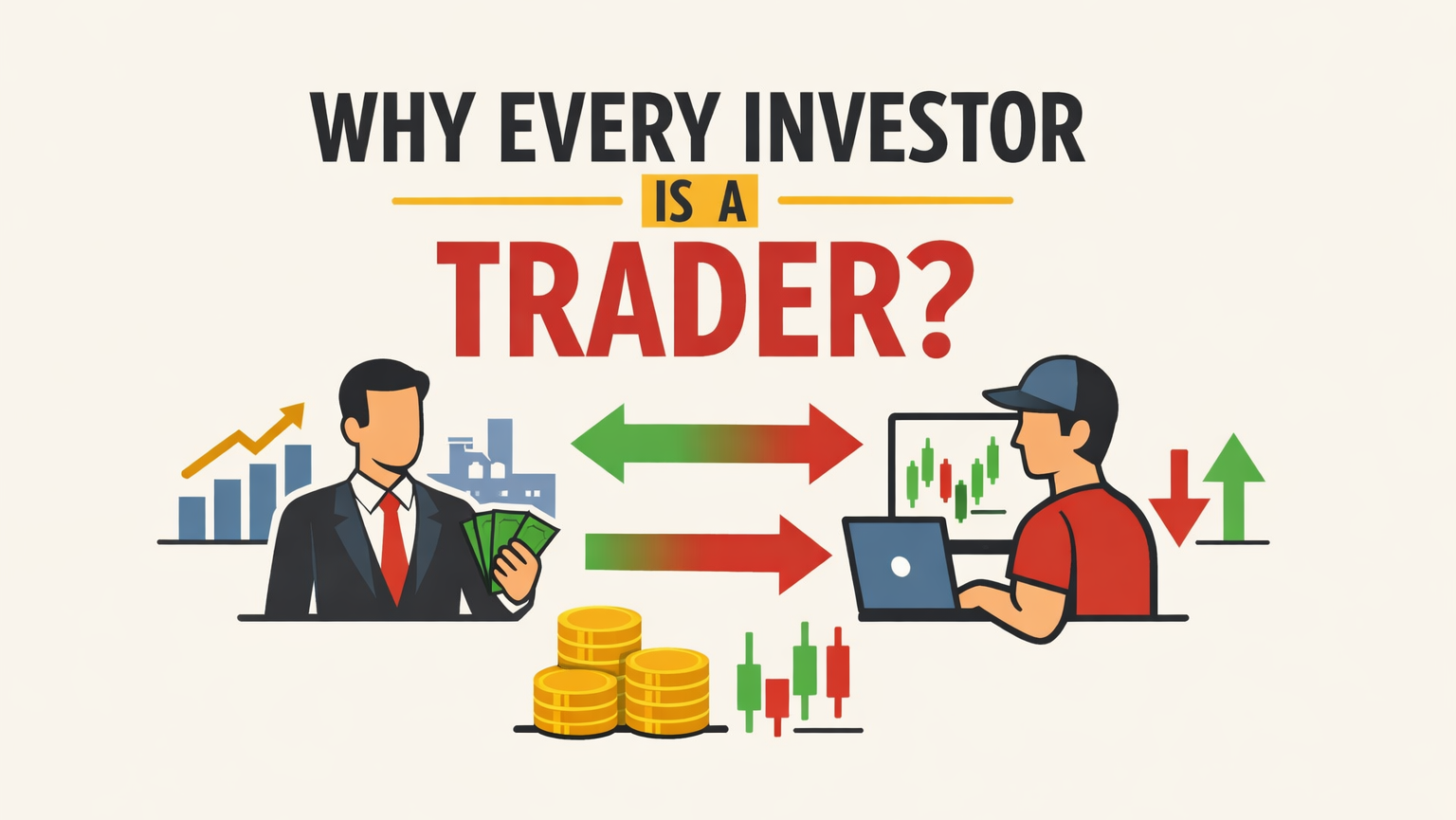
Trading is often portrayed as reckless speculation, while investing is positioned as thoughtful and virtuous. But this framing collapses under scrutiny. Every investment begins with a trade. When you buy shares with a long-term mindset, you are still executing a trade with someone selling. When you exit years later, you trade again – this time with a buyer. Mechanically, investing is simply low-frequency trading stretched across time.
So if both investing and trading rely on the same market actions, the distinction clearly lies somewhere else.
Also Read – I Created the Best Bitcoin Guide You’ll Ever Read
If It’s Not the Act of Trading, Then What Actually Separates Investing from Speculation?
The true difference is not whether trades occur, but why capital is deployed. Investing is driven by ownership – the belief that a business will grow, generate cash flows, and create real economic value over time.
Speculative trading, on the other hand, seeks profit primarily from price movements, often disconnected from long-term value creation.
Frequent buying and selling is not inherently wrong. But when activity shifts from owning risk to arbitraging expectations, the economic character of participation changes – and so do the moral and financial consequences.
Why Can a Well-Reasoned Investment Still Fail?
An investor may buy a stock believing earnings will rise over the next year or two. The reasoning may be sound. The business may even perform exactly as expected. Yet the stock price may stagnate or fall.
This apparent contradiction confuses many market participants – and it reveals something crucial about how markets actually work.
What Makes Financial Markets Fundamentally Different from Every Other Market?
Financial markets are not reactive; they are forward-looking. Prices do not wait for earnings announcements or business results. They continuously absorb expectations about the future. By the time growth, profitability, or industry tailwinds become visible, those narratives are often already reflected in prices.
The market is never asking whether a company will do well. It is asking whether the company will do better than what is already expected.
Who Is Pricing the Future Faster Than You Think?
Modern markets are dominated by participants with extraordinary informational and analytical advantages – institutional investors, analysts, quantitative funds, and algorithmic systems. These players process massive data sets and model future outcomes at speed.
Their collective activity compresses the time window in which new information can create mispricing, especially in the short to medium term. This is why being “right” about a company often isn’t enough.
Why Being Right About the Business Isn’t the Same as Being Right About the Stock?
Stock market returns do not come from predicting the future accurately. They come from recognizing when market expectations about the future are wrong, incomplete, or mispriced.
You can be correct about earnings growth and still lose money if that growth was already priced in. Markets reward expectation gaps, not correctness.
Is Investing Really About Trading Less – or About Understanding Expectations Better?
At its core, investing is not a debate between trading and not trading.
It is a debate between owning value creation and competing over price expectations.
Understanding this distinction is not optional. It is essential for navigating markets responsibly, intelligently, and with realistic expectations of risk and reward.
This article is for informational purposes only and should not be considered financial advice. Investing in stocks, cryptocurrencies, or other assets involves risks, including the potential loss of principal. Always conduct your own research or consult a qualified financial advisor before making investment decisions. The author and publisher are not responsible for any financial losses incurred from actions based on this article. While efforts have been made to ensure accuracy, economic data and market conditions can change rapidly. The author and publisher do not guarantee the completeness or accuracy of the information and are not liable for any errors or omissions. Always verify data with primary sources before making decisions.