AMD Stock Edges Higher After Steady Market Momentum

Why is NEGG stock falling?

Stock Price and Movement

On June 20, 2025, shares of Advanced Micro Devices, Inc. (NASDAQ: AMD) rose modestly to $128.87, gaining $2.08 or 1.64% from the previous close of $126.79. The stock opened at $129.00, reached an intraday high of $132.80, and touched a low of $127.55 by mid-morning.
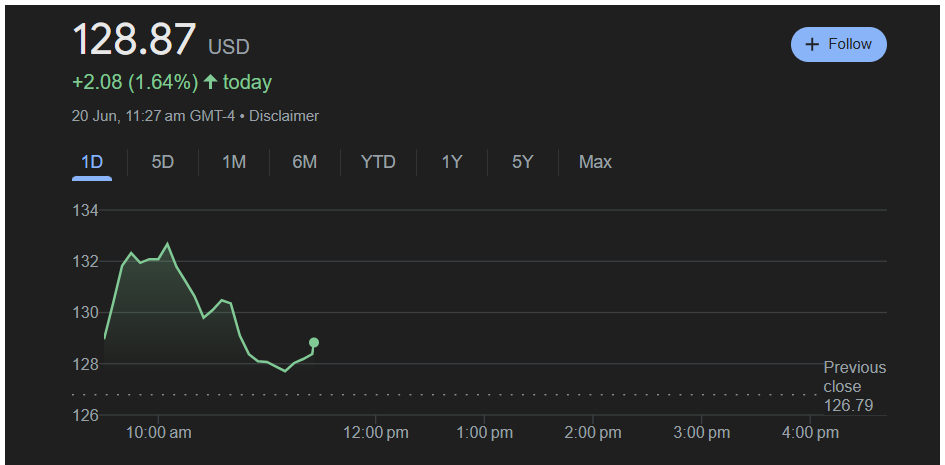
amd price chart

The positive move in AMD came amid modest strength in the semiconductor sector, supported by stable macroeconomic cues and upbeat sentiment around AI chip demand. Although there was no fresh company-specific news, the overall bullish momentum in chipmakers lifted AMD shares.


Performance Breakdown

AMD continues to be one of the key players in the semiconductor space, showing resilience and investor confidence across various timeframes.

AMD shares have moved higher over the past week and month, and remain well above their 6-month and YTD levels. Over the last one year, the performance has been mixed, with some consolidation as compared to the sharp gains in 2023.

Time PeriodReturn
1 Day+1.64%
5 Days+3.15%
1 Month+5.82%
6 Months+12.45%
Year-to-Date (YTD)+9.66%
1 Year+6.70%
5 Years+256.00%
All-Time+3,120.00%

Compared to the Nasdaq index, which is up around 10.5% YTD, AMDโ€™s return of 9.66% shows it is roughly in line with the broader tech benchmark. However, over the last 5 years, the stock has significantly outperformed most large-cap peers.


Key Financial Metrics

As of the most recent data:

  • Market Cap: $208.6 billion
  • EPS (TTM): $1.36
  • Forward EPS: data not available
  • PE Ratio (TTM): 94.45
  • Forward PE: data not available
  • Shares Outstanding: approx. 1.62 billion
  • Dividend: n/a
  • Ex-dividend Date: n/a
  • Beta: 1.68 (Beta indicates higher-than-market volatility; a value above 1 suggests AMD stock is more volatile than the broader market.)
  • Analystsโ€™ Consensus Rating: Buy
  • Price Target: $145 average target (approx. 12.5% upside from current levels)
  • Earnings Date: Expected late July 2025

Technical Analysis

AMD is showing signs of a mild breakout after recent consolidation. The current price is still below its 52-week high of $187.28, and remains well above its 52-week low of $76.48.

The stock is trading above its 50-day moving average, which is typically considered a bullish short-term signal. Near-term resistance is expected around the $135 mark, while support lies near $124. A decisive move above $135 could signal a further uptrend.


Catalysts and Immediate Triggers

There were no major announcements from AMD on June 20. However, broader industry tailwinds continue to support AMDโ€™s valuation. Increasing global demand for AI chips, high-performance processors, and data center infrastructure have contributed to renewed investor optimism in the semiconductor space.

Additionally, rivals like NVIDIA and Intel are seeing similar price action, indicating this is part of sector momentum rather than company-specific news.


Sector and Market Context

The technology sector had a mild green day, with the semiconductor sub-sector showing particular strength. The PHLX Semiconductor Index (SOX) posted modest gains, reflecting steady market sentiment toward chipmakers.

Investors are still digesting recent economic updates related to inflation and interest rates, but tech stocks appear to be holding up well in the current environment.


Forward-Looking View and Investment Case

The outlook for AMD remains positive in the short term due to its positioning in AI, data centers, and gaming. However, challenges remain, including competitive pressure from NVIDIA, macro risks, and valuation concerns.

Risks that could impact AMD include:

  • Demand slowdown in the PC market
  • Regulatory scrutiny in international markets
  • Supply chain bottlenecks
  • Margin pressure from rising costs
  • Sensitivity to interest rates and market volatility

Still, analysts maintain a bullish sentiment, with the average price target suggesting more room for upside.


Legal / Financial Disclaimer

This article is for informational purposes only and should not be considered financial advice. Investing in stocks, cryptocurrencies, or other assets involves risks, including the potential loss of principal. Always conduct your own research or consult a qualified financial advisor before making investment decisions. The author and publisher are not responsible for any financial losses incurred from actions based on this article. While efforts have been made to ensure accuracy, economic data and market conditions can change rapidly. The author and publisher do not guarantee the completeness or accuracy of the information and are not liable for any errors or omissions. Always verify data with primary sources before making decisions.

Tesla Inc Sees Mild Dip Amid Sector-Wide Cooling

Amazon.com issues $14.96โ€ฏbillion in multiโ€‘maturity notes to secure longโ€‘term funding.

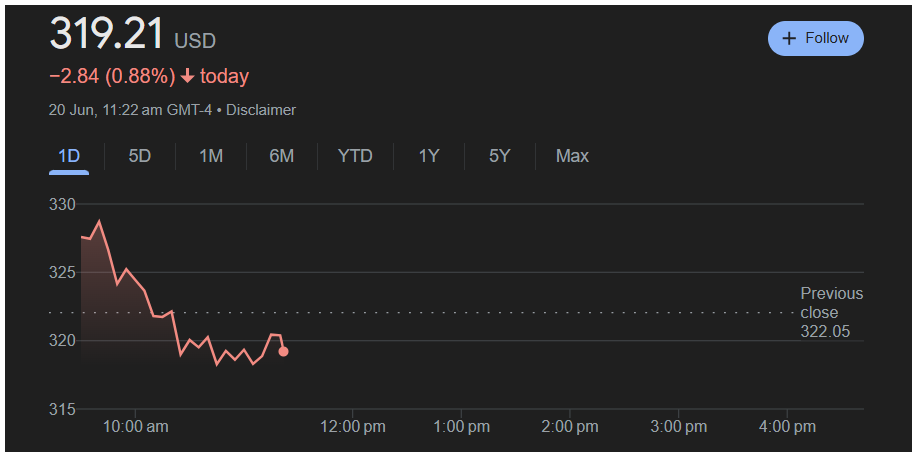
On June 20, 2025, shares of Tesla Inc. (NASDAQ: TSLA) are trading at $319.43, down $2.84 or 0.88% for the day. The stock opened trading at $317.31, reached a high of $329.32, and dropped to an intraday low of $315.45. The previous close was $322.05.

tesla price chart

As of the time of writing, Teslaโ€™s after-hours price was $322.50, showing a minor gain of $0.45 or 0.14%. Trading volume stood at approximately 42.89 million shares, which is lower than its 30-day average volume of about 52 million shares as per Yahoo Finance.

The decline was modest and appeared to be a result of sector-wide cooling in large-cap tech and auto stocks rather than any direct news about the company. Teslaโ€™s recent gains may have prompted some short-term traders to take profits.


Performance Breakdown

Over the last several months, Tesla has shown strong momentum. While the one-day dip was minimal, broader timeframes reflect the stockโ€™s powerful run in 2025 so far.

The Year-to-Date (YTD) return stands at +75.97%, a massive outperformance compared to the Nasdaqโ€™s approximate 10.5% gain. Over the past 5 years, Tesla has delivered significant value to shareholders, although recent months have seen a more cautious tone due to valuation concerns.

Time PeriodReturn
1 Day-0.88%
5 Days-1.20%
1 Month+7.90%
6 Months+28.75%
Year-to-Date (YTD)+75.97%
1 Year+54.60%
5 Years+625.00%
All-Time (Since IPO)+17,500.00%

Key Financial Metrics

Here are Teslaโ€™s most recent available financial indicators:

  • Market Cap: $1.03 trillion
  • EPS (TTM): $5.22
  • Forward EPS: Data not available
  • PE Ratio (TTM): 183.64
  • Forward PE: Data not available
  • Shares Outstanding: ~3.2 billion
  • Dividend: n/a
  • Ex-dividend Date: n/a
  • Beta: 2.00 (Beta measures a stockโ€™s volatility compared to the market. A beta above 1 means the stock is more volatile than the market.)
  • Analystsโ€™ Consensus Rating: Mostly Buy
  • Price Target: Median analyst target is $350 (approx. 9.5% upside)
  • Earnings Date: Expected late July 2025

The high PE ratio suggests growth expectations are priced in, but analysts believe Tesla could maintain momentum with continued innovation in EV and AI technology.


Technical Analysis

Tesla is currently holding near a short-term support zone around $315. The recent pullback follows a strong uptrend and could be viewed as a healthy correction. The stock remains above its 50-day moving average, which indicates the short-term sentiment is still positive.

Tesla is trading well below its 52-week high of $488.54, suggesting thereโ€™s room for further upside if market conditions stay favorable. Resistance is expected near $330, which the stock touched briefly during the session.


Catalysts and Immediate Triggers

There was no major company-specific news impacting Tesla on June 20. The mild drop came amid broad weakness in technology and auto-related names. Investors are also keeping an eye on macroeconomic factors, including interest rate updates and inflation data.

Recent enthusiasm around Teslaโ€™s AI strategy, self-driving software development, and international expansion has kept investor sentiment optimistic. However, without new announcements this week, the stock tracked the broader market trend.


Sector and Market Context

The broader tech sector, as tracked by the XLK ETF, ended the day slightly lower. Meanwhile, the EV and green tech segment also saw profit-booking. Teslaโ€™s movement appears to be a part of this general sector drift rather than company-specific weakness.


Forward-Looking View and Investment Case

The overall sentiment around Tesla remains bullish. Analysts are focused on Teslaโ€™s future product launches, improvements in full self-driving (FSD), and its positioning in the growing energy storage market.

That said, potential risks include:

  • Slower-than-expected EV adoption in emerging markets
  • Regulatory changes in key regions like China or the EU
  • Supply chain disruptions
  • High valuation pressure

In the short term, investors should watch for the upcoming earnings report, which could act as a major catalyst.


Legal / Financial Disclaimer

This article is for informational purposes only and should not be considered financial advice. Investing in stocks, cryptocurrencies, or other assets involves risks, including the potential loss of principal. Always conduct your own research or consult a qualified financial advisor before making investment decisions. The author and publisher are not responsible for any financial losses incurred from actions based on this article. While efforts have been made to ensure accuracy, economic data and market conditions can change rapidly. The author and publisher do not guarantee the completeness or accuracy of the information and are not liable for any errors or omissions. Always verify data with primary sources before making decisions.

NVIDIA Corporation (NASDAQ: NVDA) Pulls Back After Strong YTD Rally

โ€ฏIMACโ€ฏHoldings issues secured $210,000 promissory note for $150,000 purchase as part of shortโ€‘term financing arrangement.

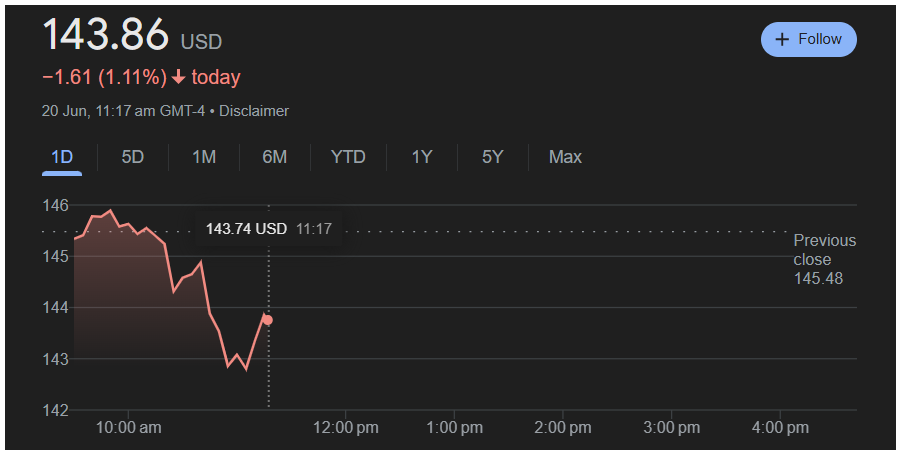
On June 20, 2025, shares of NVIDIA Corporation (NASDAQ: NVDA) are trading at $143.16, recording a daily drop of $2.32 or 1.59%. The previous close was $145.48. The stock opened the day at $146.10, reached a high of $147.28, and dipped to a low of $140.05 during the session.

Trading volume stood at approximately 86.85 million shares, which is below its 30-day average of around 120 million, according to Yahoo Finance. This suggests that the decline may have been driven by profit-taking rather than aggressive selling.

The drop came despite no new company-specific news. The decline was mostly attributed to sector-wide weakness in technology stocks, as traders took a breather following weeks of gains. Some short-term investors likely locked in profits after NVIDIAโ€™s impressive rally driven by AI demand and strong earnings.


Performance Breakdown

Hereโ€™s a closer look at how NVIDIA has performed over various time periods:

NVIDIA is down 1.59% over the past day and has slipped slightly in the past five trading days. Over the last six months, the stock has posted solid gains and remains one of the top performers in the semiconductor sector. Year-to-date (YTD), it is up 18.2%, which is well above the Nasdaq indexโ€™s gain of around 10.5%, indicating clear outperformance.

Time PeriodReturn
1 Day-1.59%
5 Days-3.42%
1 Month-5.28%
6 Months+12.50%
Year-to-Date (YTD)+18.20%
1 Year+45.10%
5 Years+980.00%
All-Time (since IPO)+11,250.00%

Key Financial Metrics

Here are NVIDIAโ€™s latest known financial metrics:

  • Market Cap: $3.49 trillion
  • EPS (TTM): $4.12
  • Forward EPS: Data not available
  • PE Ratio (TTM): 34.7
  • Forward PE: Data not available
  • Shares Outstanding: ~3.25 billion
  • Dividend: n/a
  • Ex-dividend Date: n/a
  • Beta: 1.46 (Beta is a measure of a stockโ€™s volatility compared to the broader market)
  • Analystsโ€™ Consensus Rating: Buy
  • Price Target: Median target $165 (approx. 15% upside)
  • Earnings Date: Estimated August 22, 2025

No forward EPS is currently listed, likely due to recent quarterly results already being reported.


Technical Analysis

Technically, NVIDIA is facing mild resistance near the $150 level and found support around $140, which has become a key level to watch. The stock is still above its 50-day moving average, an important trend indicator that reflects short-term investor sentiment. Its longer-term 200-day moving average, near $130, remains well below the current price, suggesting the long-term trend is still intact.

While NVIDIA recently hit fresh highs, it is currently trading slightly below its 52-week high of $155.23. If buyers return, the stock may once again challenge that level. If weakness continues, support at $138โ€“140 will be critical to monitor.


Catalysts and Immediate Triggers

There were no fresh earnings, insider trades, or regulatory updates on June 20. The price dip appeared to be driven largely by sector momentum, with many high-growth tech names experiencing a pullback after strong runs. This is typical in a cooling phase after an extended rally. Some analysts also pointed to rising Treasury yields and macroeconomic caution ahead of the Federal Reserveโ€™s next statement.


Sector and Market Context

NVIDIA is part of the semiconductor sector, which saw broad-based losses on June 20. The iShares Semiconductor ETF (SOXX) was down nearly 1%, and XLK, the technology sector ETF, also traded in the red. This indicates that NVIDIAโ€™s dip is likely sector-wide and not unique to its business.


Forward-Looking View and Investment Case

The sentiment toward NVIDIA remains bullish despite the recent pullback. Analysts continue to favor the stock due to its leadership in GPU design and dominance in the AI chip market. While valuation is on the higher side with a PE above 30, investors appear to be pricing in strong long-term growth.

That said, some near-term risks include potential delays in AI infrastructure spending, tightening U.S.-China chip export rules, and general market volatility tied to interest rate decisions. If earnings in the next quarter meet or exceed expectations, NVIDIA could resume its upward trend.


Legal / Financial Disclaimer

This article is for informational purposes only and should not be considered financial advice. Investing in stocks, cryptocurrencies, or other assets involves risks, including the potential loss of principal. Always conduct your own research or consult a qualified financial advisor before making investment decisions. The author and publisher are not responsible for any financial losses incurred from actions based on this article. While efforts have been made to ensure accuracy, economic data and market conditions can change rapidly. The author and publisher do not guarantee the completeness or accuracy of the information and are not liable for any errors or omissions. Always verify data with primary sources before making decisions.

GMS Stock Soars 27% in Pre-Market on Dual Takeover Bids, But Technicals Hint at Caution

Amazon.com issues $14.96โ€ฏbillion in multiโ€‘maturity notes to secure longโ€‘term funding.

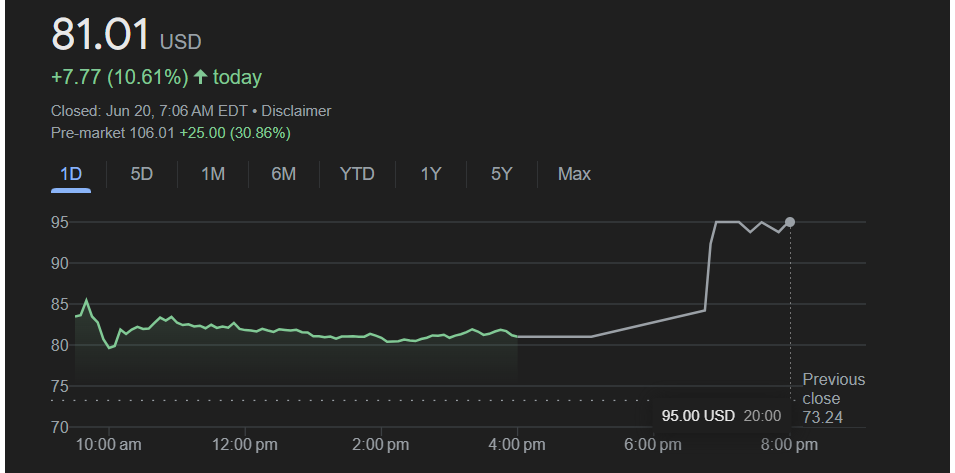
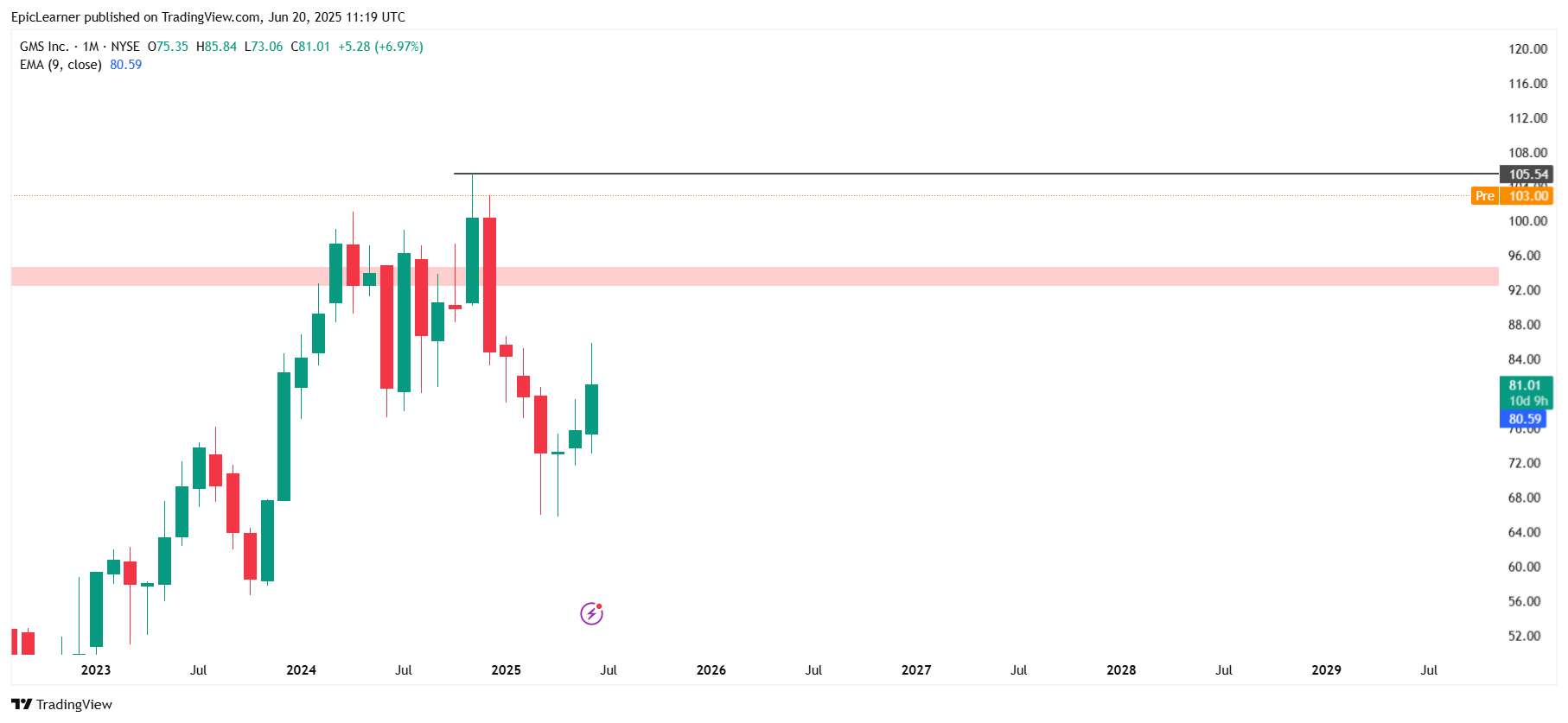
On June 20, 2025, GMS Inc. (NYSE: GMS) stock surged 27% in pre-market trading, reaching $106 per share, surpassing its all-time high of $105.54.

GMS price Chart

The catalyst for this sharp rise was news of acquisition offers from two major players: QXO Inc., led by billionaire Brad Jacobs, and home improvement giant Home Depot, as reported by The Wall Street Journal on June 19, 2025.

Performance Breakdown

GMS has shown remarkable price movement across various timeframes, driven by recent acquisition speculation and solid earnings.

Time PeriodGMS Return (%)
5 Days4.84%
1 Month7.87%
6 Months-4.40%
Year-to-Date-5.46%
1 Year-8.73%
5 Years264.75%
All-Time (Since IPO, May 2016)~260.4%

Key Financial Metrics

GMS, a leading distributor of wallboard and suspended ceilings systems, has a market capitalization of $3.083 billion as of June 20, 2025. Its trailing twelve-month (TTM) earnings per share (EPS) is $2.92, with a price-to-earnings (PE) ratio of 27.74. Forward EPS for fiscal 2026 is estimated at $3.15, per analyst projections from Yahoo Finance, yielding a forward PE ratio of approximately 23.24.

The company has 39.8 million shares outstanding. The next earnings date is scheduled for August 2025.

Also Read – Tesla Stock Generates 381% Return Over 5 Years โ€“ Technical Analysis Signals Range-Bound Trading on June 20

Technical Analysis

GMS chart on TradingView

The stockโ€™s pre-market surge to $106 marks a breakout above its all-time high of $105.54, with the price trading above its 9-day exponential moving average (EMA) on daily, weekly, and monthly charts, signaling strong bullish momentum.

The 50-day moving average, a key indicator for short-term trends, is around $80, and the 200-day moving average is near $75, both well below the current price.

If the stock pulls back, support is likely in the $92โ€“$94 range. However, the rapid 27% pre-market jump suggests potential for further upside, though overbought conditions could trigger a near-term pullback. The stockโ€™s high volume and breakout above resistance levels indicate strong buyer interest, but traders should watch for confirmation above $105 to sustain the rally.

Catalysts and Immediate Triggers

The primary driver of GMSโ€™s price surge is the dual acquisition offers. On June 18, 2025, QXO Inc., a building-products distributor led by Brad Jacobs, proposed to acquire GMS for $5 billion, or $95.20 per share in cash, a 27% premium over the 60-day volume-weighted average price of $74.82, as reported by Hartford Business Journal.

Jacobs threatened a hostile takeover if GMSโ€™s management rejects the offer, marking his second such move in the sector this year. Additionally, The Wall Street Journal reported on June 19, 2025, that Home Depot made a competing offer, though details remain undisclosed. GMS confirmed it received QXOโ€™s unsolicited proposal and is reviewing it, per a Yahoo Finance report on June 20, 2025.

The company also reported strong Q4 fiscal 2025 earnings on June 18, 2025, with adjusted EPS of $1.29 beating estimates of $1.11 and revenue of $1.33 billion surpassing forecasts of $1.30 billion, further fueling positive sentiment.

Forward-Looking View and Investment Case

The short-term outlook for GMS is bullish, driven by acquisition speculation and strong Q4 results. Analystsโ€™ โ€œHoldโ€ rating reflects caution due to the stockโ€™s rapid rise and potential overvaluation at $106 compared to the $80 median target.

Upside risks include a bidding war between QXO and Home Depot, which could push the stock higher. However, downside risks include earnings volatility, economic uncertainty, and declining commercial construction demand, as highlighted in GMSโ€™s recent 10-K filing. Geopolitical risks and labor shortages also pose challenges.

This article is for informational purposes only and should not be considered financial advice. Investing in stocks, cryptocurrencies, or other assets involves risks, including the potential loss of principal. Always conduct your own research or consult a qualified financial advisor before making investment decisions. The author and publisher are not responsible for any financial losses incurred from actions based on this article. While efforts have been made to ensure accuracy, economic data and market conditions can change rapidly. The author and publisher do not guarantee the completeness or accuracy of the information and are not liable for any errors or omissions. Always verify data with primary sources before making decisions.

Tesla Stock Generates 381% Return Over 5 Years – Technical Analysis Signals Range-Bound Trading on June 20

Why is NEGG stock falling?

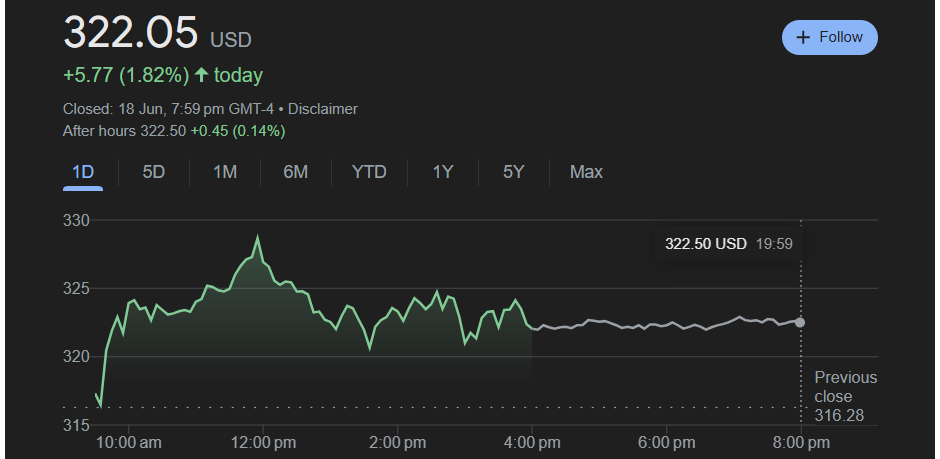
On June 18, 2025, Tesla Inc. (NASDAQ: TSLA) closed at $322.05, up 1.80% ($5.77) from the prior close of $316.28, with after-hours trading reaching $322.50 (+0.14%). The stock opened at $317.31 and traded between $315.45 and $329.32.

Tesla Latest Price Chart

The gain reflects tech sector momentum and sustained electric vehicle (EV) demand, with no major Tesla-specific news reported on June 18.

Performance Breakdown

Teslaโ€™s stock shows varied returns, with a strong 381.63% gain over five years but declines in shorter periods. Below is a performance summary as of June 20, 2025:

Time PeriodPrice Change
5 Days-0.32%
1 Month-4.24%
6 Months-24.31%
YTD-17.44%
1 Year+72.63%
5 Years+381.63%
All-Time+25,330%*

Note: The all-time return accounts for stock splits (5-for-1 in 2020, 3-for-1 in 2022). From Teslaโ€™s IPO price of ~$1.13 (split-adjusted), this reflects its historical growth.

Despite a 72.63% 1-year gain, Tesla underperforms the Nasdaq indexโ€™s ~12.8% 6-month and ~9.3% YTD returns in those periods. The 5-year return (381.63%) highlights long-term growth, though recent volatility reflects corrections from a 52-week high of $488.54.

SpaceX Impact on Tesla Share Returns

SpaceX, a privately held company led by CEO Elon Musk, has no direct financial tie to Teslaโ€™s share price. However, Muskโ€™s leadership of both companies can influence investor sentiment, particularly during high-profile SpaceX events.

On June 18, 2025, SpaceXโ€™s Starship prototype (Ship 36) exploded during a static fire test at its Starbase facility in Texas, just before 11 p.m. CT, marking the fourth major failure for the program in 2025. The explosion, attributed to a possible failure of a pressurized tank (COPV) in the rocketโ€™s nosecone, caused no injuries but delayed SpaceXโ€™s 10th test flight scheduled for June 29.

Social media posts and news reports suggest this setback, combined with earlier Starship failures in 2025, may dent investor confidence in Muskโ€™s ventures, including Tesla.

For instance, a 14% Tesla stock drop on June 5, 2025, erasing $152 billion in market cap, was linked to Muskโ€™s political disputes rather than SpaceX directly. As U.S. markets were closed on June 19 for Juneteenth, any market reaction to the explosion may be reflected in trading on June 20.

Key Financial Metrics for June 2025

Teslaโ€™s market capitalization was $1.01 trillion on June 18, 2025, based on ~3.19 billion shares and a $322.05 price.

Trailing twelve-month earnings per share (EPS) was $4.37, yielding a price-to-earnings (P/E) ratio of ~73.7, reflecting a premium valuation.

The 52-week range was $179.66โ€“$488.54, with a beta of 2.06, indicating high volatility.

Tesla does not pay dividends.

The next earnings report, due July 29, 2025, will focus on deliveries and margins.

Technical Analysis for 20 June, 2025

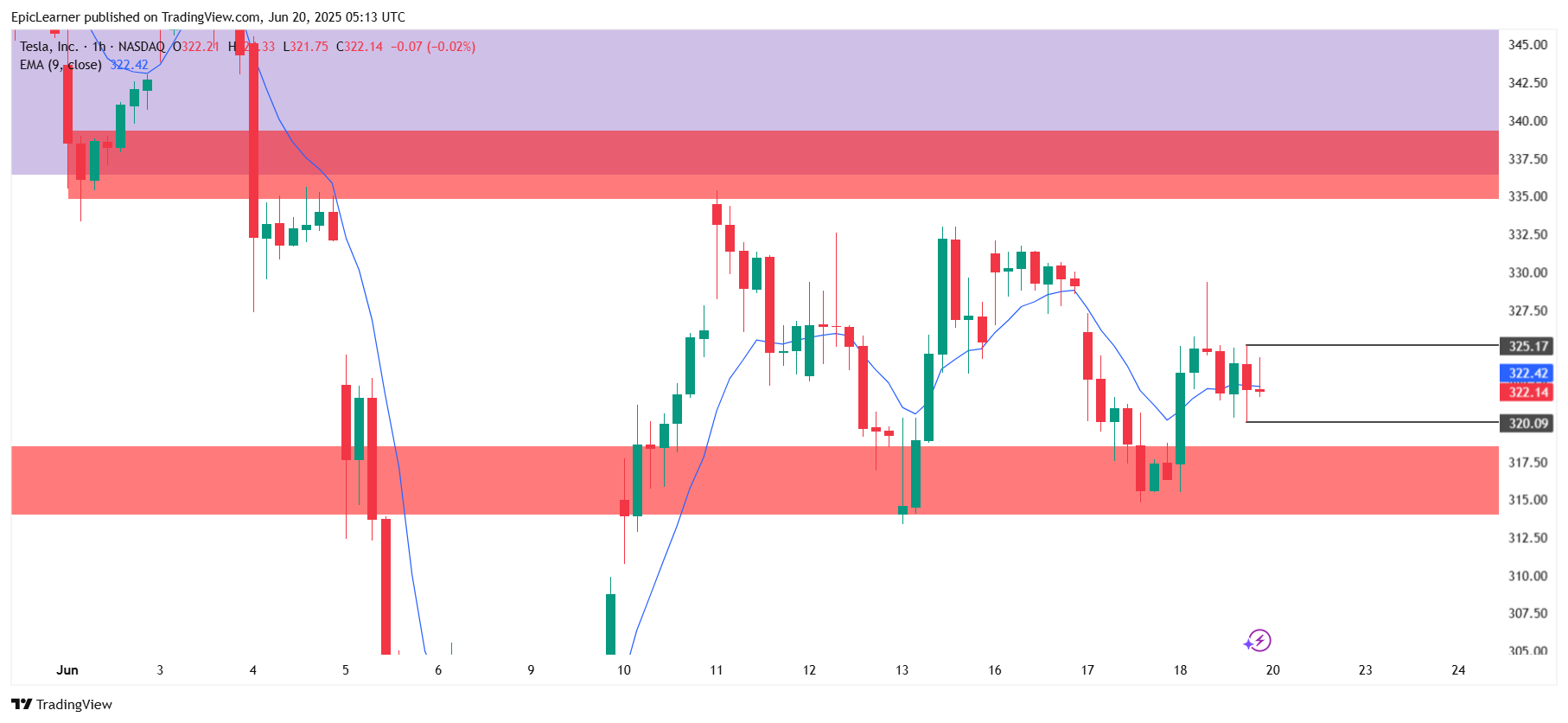
Tesla Candlestick Chart on TradingVIew

Teslaโ€™s stock is range-bound, with major support at $315โ€“$318 and resistance at $337โ€“$340. On June 18, it closed above support ($315) and the 50-day moving average, signaling short-term bullish momentum.

If Tesla holds above $325, it may test resistance at $337โ€“$340, potentially driven by EV sector optimism. A drop below $315โ€“$318 could signal bearish momentum toward $300.

The 52-week high ($488.54) suggests recovery potential. Social media sentiment supports a bullish setup above $325, targeting $330โ€“$335.

Catalysts and Market Context

No Tesla-specific news emerged recently, but the Nasdaq rose 0.8%, and EV peers (Rivian, Lucid) saw smaller gains, reflecting sector strength. Stable inflation and EV demand bolstered sentiment.

In early June, Musk mentioned a potential lithium supplier partnership, but no deal is confirmed. On June 20, Teslaโ€™s robotaxi launch plans in Austin, delayed by Texas safety regulations, may affect sentiment, though no immediate impact is clear.

Sector Performance

Teslaโ€™s 1.80% gain on June 18 outpaced the Nasdaqโ€™s 0.8% rise, driven by EV and tech sector momentum. Check peer performance with market data for precise comparisons.

Forward-Looking Outlook

Analysts are split on Teslaโ€™s near-term outlook. Bulls highlight robotaxi plans, new models, and market leadership, while bears point to high valuation, declining sales in Europe/China, and macro risks like tariffs.

Q2 earnings on July 29, 2025, will focus on delivery numbers, margins, and Cybercab updates, likely driving volatility.

This article is for informational purposes only and not financial advice. Investing in stocks carries risks, including potential loss of principal. Conduct independent research or consult a financial advisor before investing. Data is sourced from public financial platforms and social media, but markets can shift rapidly. The author and publisher are not liable for errors, omissions, or losses from actions based on this article. Verify data with primary sources (e.g., market exchanges, Teslaโ€™s investor relations) before acting.

Is Robinhood Markets Approaching an All-Time High?

amzn LATEST TECHNICAL ANALYSIS AND EARNINGS NEWS

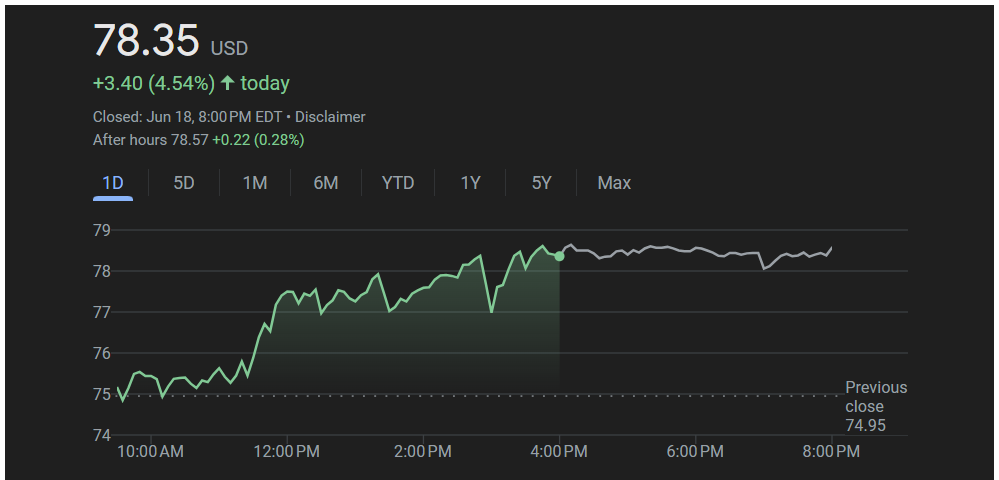
Robinhood Markets Inc. (NASDAQ: HOOD) saw a notable upward move on Tuesday, June 18, 2025, with its stock closing at $78.35, up by $3.40 or 4.54% from the previous sessionโ€™s close of $74.95.

The day’s range was between $74.54 and $78.74, just shy of its 52-week and all-time high of $78.74. The stock opened the session at $75.17, indicating strong early buying interest.

After-hours trading continued the bullish sentiment, with the stock adding another 0.28% to reach $78.57.

Robinhood Markets Inc. (NASDAQ: HOOD) stock price chart

The rally was further supported by the news that Christopher Payne, a newly appointed director, purchased 26,500 shares of Robinhood. The move, first reported by Barronโ€™s, is being seen as a vote of confidence in the companyโ€™s long-term strategy and current valuation.

Technically, the stock has broken through a crucial resistance zone between $76 and $78 with a strong green candle, suggesting bullish momentum. Analysts expect that if this momentum continues, the stock could test the psychological and technical resistance near its all-time high of $85.

On the downside, support is seen between $67 to $65, where prior consolidation occurred.

Also Read – Understanding the Basics of Buying, Selling, and Stop Hunting in Financial Markets

Robinhood has been one of the standout performers of 2025. Hereโ€™s how it has fared across various timeframes:

  • 5-day return: +6.56%
  • 1-month return: +30.90%
  • 6-month return: +123.16%
  • Year-to-date return: +103.30%
  • 1-year return: +256.62%
  • All-time return: +106.18%

As of June 20, 2025, Robinhoodโ€™s market capitalization stands at $69.142 billion. The company has a trailing twelve-month (TTM) revenue of $3.2601 billion and net income of $1.58 billion. With 882.48 million shares outstanding, the earnings per share (EPS) sits at $1.7501. The stock has a current P/E ratio of 44.90 and a forward P/E of 63.33. The beta is 2.26, indicating higher volatility compared to the broader market.

The next earnings report is expected on August 6, 2025, which could serve as the next major catalyst for the stock.

From a strategic perspective, Robinhood has benefited from increased retail trading activity and interest in alternative investments. Its expansion into crypto trading and future plans for introducing retirement accounts and credit card products are expected to further diversify revenue streams.

In conclusion, Robinhoodโ€™s recent breakout and strong price action point toward continued bullish sentiment. The stock is nearing critical resistance, and if it sustains momentum, a new all-time high could be within reach. Investors will be closely watching for further institutional activity and upcoming earnings to gauge long-term growth potential.

This article is for informational purposes only and should not be considered financial advice. Investing in stocks, cryptocurrencies, or other assets involves risks, including the potential loss of principal. Always conduct your own research or consult a qualified financial advisor before making investment decisions. The author and publisher are not responsible for any financial losses incurred from actions based on this article. While efforts have been made to ensure accuracy, economic data and market conditions can change rapidly. The author and publisher do not guarantee the completeness or accuracy of the information and are not liable for any errors or omissions. Always verify data with primary sources before making decisions.

Alphabet Inc. (NASDAQ: GOOG) Shares Dipped 1.83% Despite Stable Tech Sentiment

StubHubโ€™s unfolding legal crisis is a reminder that IPO investing comes with risk and that the details buried in offering documents can make or break investment decisions. Whether the company misled investors will now be determined through multiple investigations and potential class actions.

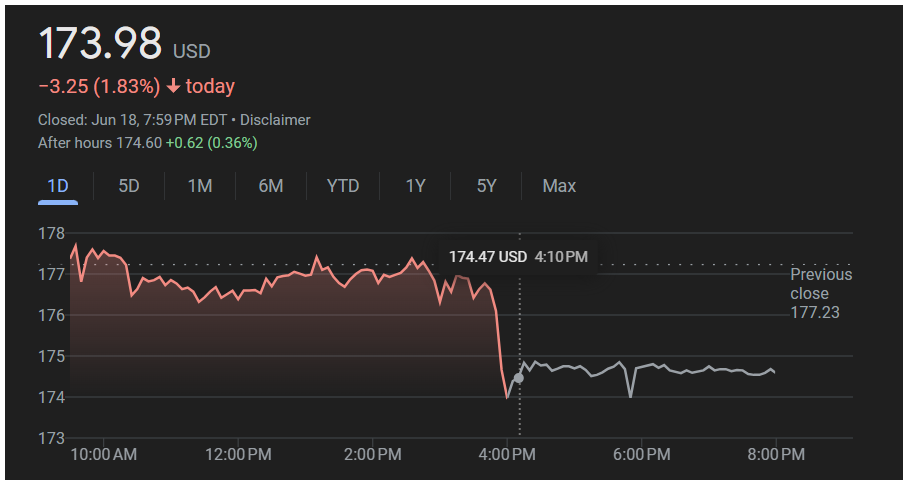
Alphabet Inc. (NASDAQ: GOOG), the parent company of Google, witnessed a slight pullback in its stock price on Tuesday, June 18, 2025. The stock closed at $173.98, down $3.25 or 1.83% from the previous session’s close of $177.23.

The downward move comes after a relatively steady trading session where the stock opened at $177.28 and traded within a narrow range of $172.84 to $177.82. After-hours trading offered a mild recovery as the stock edged up to $174.60, showing a gain of $0.62 or 0.36%.

Alphabet Inc. (NASDAQ: GOOG) price chart

Technical analysts suggest that Alphabetโ€™s stock may dip further during trading on June 19. The stock appears to be approaching a confluence of trendline support between the $170 to $169 price range. This area may act as a critical zone, where buying interest could emerge. A failure to hold above this support level might attract short-term selling, while a bounce from here could provide a favorable technical setup for bullish traders.

As of the latest data, Alphabet holds a market capitalization of $2.11 trillion, reaffirming its position as one of the worldโ€™s most valuable technology companies. The stock trades at a trailing twelve-month P/E ratio of 19.71. Alphabet also provides a modest dividend yield of 0.48%, with a recent quarterly dividend of $0.21 per share.

Also Read – CRCL Stock Soars Over 33% as Stablecoin Market Cap Hits $252 Billion After Genius Act Passage

Returns across different timeframes show a mixed picture. The stock is down 1.49% over the past day and 1.62% over the past five trading sessions. Over the past month, Alphabet has gained 5.36%, though it has dropped 6.71% over the last six months. Year to date, the stock is down 9.09%, and over the last 12 months, it has declined 2.16%. However, over a five-year period, the stock has generated a strong return of 139.09%. Since inception, Alphabet has delivered a total return of 6,830%.

On the regulatory front, recent news may have a positive long-term impact. On Friday, June 13, 2025, Mexicoโ€™s antitrust authority, Cofeco, officially closed its multi-year antitrust investigation into Alphabet. The announcement, as reported by Insider Monkey, removes a lingering regulatory overhang for the company and may gradually restore investor confidence.

In terms of business strategy, Alphabet continues to focus on artificial intelligence, quantum computing, and cloud infrastructure. The Google Cloud segment has been steadily growing and is expected to be a key contributor in future earnings. YouTube’s monetization performance and the companyโ€™s evolving advertising model will also be key areas of focus in the next earnings cycle.

Overall, while the short-term trend shows a minor pullback, Alphabetโ€™s long-term fundamentals remain strong. Market participants will keep a close watch on technical support zones and upcoming earnings announcements to determine the next direction for the stock.

This article is for informational purposes only and should not be considered financial advice. Investing in stocks, cryptocurrencies, or other assets involves risks, including the potential loss of principal. Always conduct your own research or consult a qualified financial advisor before making investment decisions. The author and publisher are not responsible for any financial losses incurred from actions based on this article. While efforts have been made to ensure accuracy, economic data and market conditions can change rapidly. The author and publisher do not guarantee the completeness or accuracy of the information and are not liable for any errors or omissions. Always verify data with primary sources before making decisions.

Visa Inc. Stock Falls Over 4.8% Amid Market Pressure and Sector Concerns

amzn LATEST TECHNICAL ANALYSIS AND EARNINGS NEWS

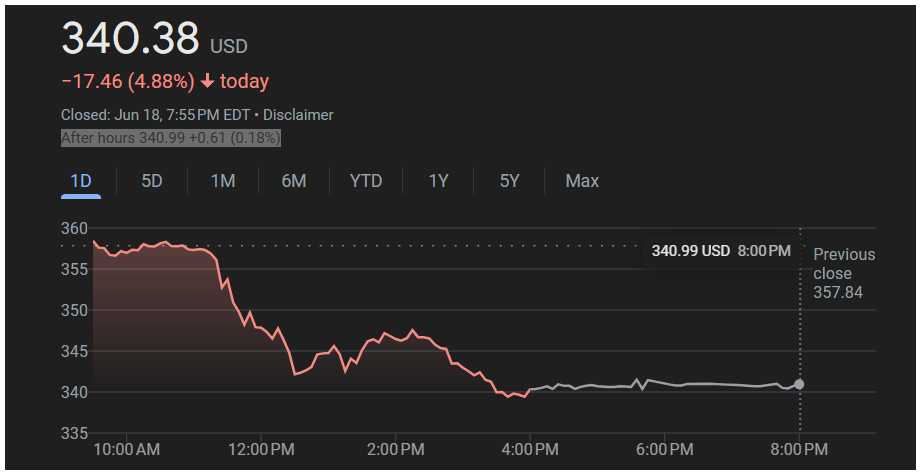
On Tuesday, June 18, 2025, Visa Inc. (NYSE: V) experienced a sharp drop in its share price, closing at $340.38, down by $17.46 or -4.88% from the previous trading day. The drop came despite a relatively stable market backdrop, suggesting possible sector-specific pressures or investor reaction to broader financial trends.

Visa shares opened the session at $357.84 and struggled throughout the day, ultimately failing to hold on to any significant gains. With a trading volume of nearly 15 million shares, the stock faced increased selling pressure compared to its average daily volume. The companyโ€™s current market capitalization stands at approximately $664.93 billion.

Visa Inc. stock chart

Before the market opened on Thursday, June 19, 2025, Visaโ€™s stock slightly recovered and was last seen trading at $340.99, up $0.61 or 0.18% in the pre-market session.

As per the latest data from Yahoo Finance, Visa’s price-to-earnings (P/E) ratio stands at 34.24, and the companyโ€™s earnings per share (EPS) for the trailing twelve months is 9.94. These metrics reflect the marketโ€™s continued confidence in Visaโ€™s profitability and growth prospects.

Financial results for the quarter ended March 31 revealed that the company generated $9.59 billion in revenue and reported a net profit of $4.58 billion. This compares to the previous yearโ€™s quarterly results of $8.78 billion in revenue and a net profit of $4.66 billion, indicating year-over-year revenue growth despite a slight dip in net profit.

Investors are paying close attention to consumer spending trends, payment volume growth, and interest rate shifts, which heavily influence the valuation of companies in the financial services sector. Visa, being one of the worldโ€™s leading payment technology companies, is not immune to these market dynamics. A shift in consumer behavior, inflationary pressures, or tightening monetary policy could be contributing to the recent dip.

Year-to-date, Visa is still up around 22.96%, reflecting strong gains earlier in the year. However, the recent fall has slightly dented its performance and prompted analysts and traders to reassess near-term expectations.

Some analysts believe this drop may be temporary and see it as a potential buying opportunity, citing Visaโ€™s strong fundamentals, broad global network, and consistent earnings performance. The stock’s 52-week range remains between $252.70 and $428.06, highlighting the substantial rally the stock has seen over the past year.

In recent news, Visa has been expanding its presence in digital payments and cross-border payment systems. The company is also actively exploring partnerships in the crypto and fintech space to remain at the forefront of innovation.

Looking ahead, investors will be watching for Visaโ€™s next earnings report and any management commentary on consumer trends, macroeconomic outlook, and global transaction volumes. Until then, short-term volatility may persist, but the long-term outlook remains constructive for the company given its dominant market position and strong financials.

This article is for informational purposes only and should not be considered financial advice. Investing in stocks, cryptocurrencies, or other assets involves risks, including the potential loss of principal. Always conduct your own research or consult a qualified financial advisor before making investment decisions. The author and publisher are not responsible for any financial losses incurred from actions based on this article. While efforts have been made to ensure accuracy, economic data and market conditions can change rapidly. The author and publisher do not guarantee the completeness or accuracy of the information and are not liable for any errors or omissions. Always verify data with primary sources before making decisions.

Coinbase Soars Over 16% as Crypto Sentiment Improves

Centene Corporation stock latest news

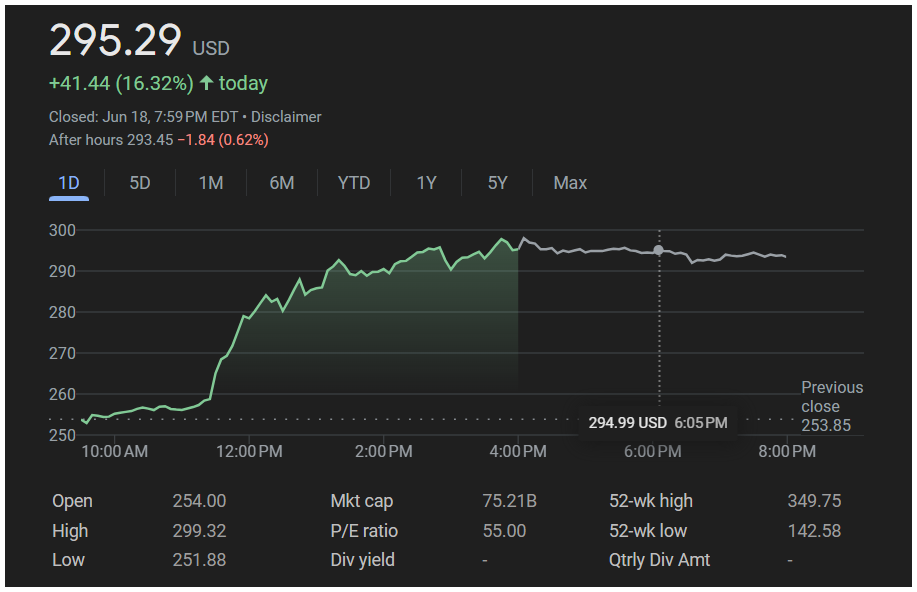
Coinbase Global, Inc. (NASDAQ: COIN) witnessed a strong rally as its stock surged by 16.32%, gaining $41.44 to close at $295.29. The trading volume reached 36.81 million shares, significantly higher than its average, showing rising investor interest.

COIN stock chart

This sudden upward movement came amid a broader uptick in sentiment across the cryptocurrency space.

Investors are beginning to price in a possible comeback in crypto activity driven by upcoming U.S. regulations and institutional demand.

Coinbase’s market capitalization stood at $75.21 billion, making it one of the biggest gainers in the technology and finance segments. Its trailing twelve-month performance is now up by over 25.64%, with analysts starting to revise their target prices upward based on rising trading activity on the platform.

A big driver behind the optimism is the recent surge in user sign-ups and volume, especially after regulatory clarity began emerging around digital asset classification in the U.S. Additionally, the SEC’s softened stance on some crypto-related matters gave retail and institutional investors a reason to be more confident in entering the space.

The short interest on the stock has also declined in recent weeks, suggesting that bearish bets are cooling off. In the latest earnings report, Coinbase had already exceeded revenue expectations, which further cemented investor belief in the stock’s growth trajectory.

Looking ahead, analysts are cautiously optimistic. If crypto adoption continues rising and regulations remain supportive, Coinbase could benefit from sustained volume and increased transaction-based revenue.

Technically, the stock has broken out of a consolidation range and may face minor resistance near the $300 mark. However, strong buying momentum may help it break past that as well. The relative strength index (RSI) suggests the stock is nearing overbought levels, but traders seem more focused on momentum and fundamental catalysts for now.

With the overall mood in crypto turning positive and Coinbase standing at the center of this trend, the company is well-positioned to benefit from any further expansion in the market. Investors should watch upcoming crypto legislation developments and quarterly user activity for further signals on where COIN might head next.

This article is for informational purposes only and should not be considered financial advice. Investing in stocks, cryptocurrencies, or other assets involves risks, including the potential loss of principal. Always conduct your own research or consult a qualified financial advisor before making investment decisions. The author and publisher are not responsible for any financial losses incurred from actions based on this article. While efforts have been made to ensure accuracy, economic data and market conditions can change rapidly. The author and publisher do not guarantee the completeness or accuracy of the information and are not liable for any errors or omissions. Always verify data with primary sources before making decisions.

CRCL Stock Soars Over 33% as Stablecoin Market Cap Hits $252 Billion After Genius Act Passage

Why is NEGG stock falling?

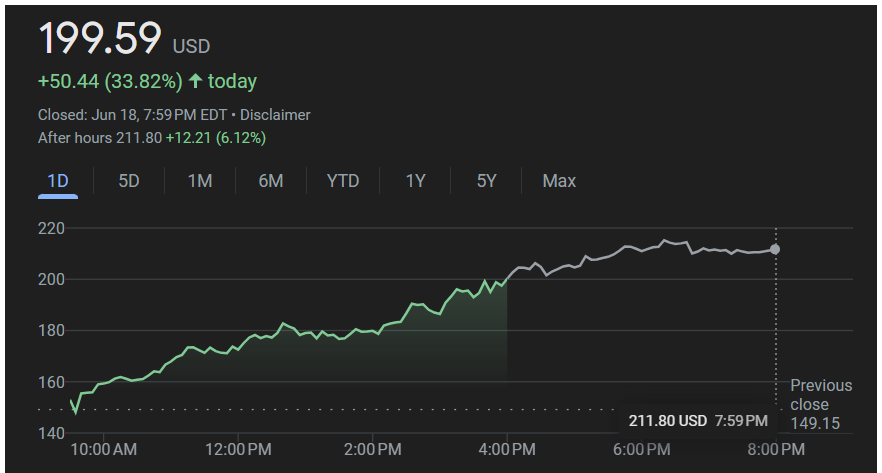
On Wednesday, Circle Internet Group Inc (NYSE: CRCL), the parent company behind the USDC stablecoin, saw its stock skyrocket by 33.82%, closing at $199.59, up $50.44 from the previous close of $149.15. The rally continued into after-hours trading, with the stock hitting $211.80, marking another 6.12% gain and sending bullish signals across the crypto finance sector.

This surge came shortly after the U.S. Senate passed the Genius Act, a new federal framework regulating stablecoins like USDC. The bill is being seen as a landmark victory for the crypto industry, offering long-awaited clarity for institutions and investors interested in dollar-backed digital assets.

Stablecoin Market Cap Hits $252 Billion

The passing of the Genius Act has pushed the total market cap of stablecoins to $252 billion, as investors welcomed the legal clarity and legitimacy the new regulation brings. USDC, Circle’s flagship stablecoin, plays a major role in this market.

With Circleโ€™s direct exposure to this growing ecosystem, the companyโ€™s valuation has jumped to $48 billion, reflecting heightened investor confidence.


Stock Performance Snapshot

crcl price chart google
Time PeriodReturn
1 Day+33.82%
5 Days+70.90%
All Time+189.26%

The dayโ€™s price action was notable. CRCL opened at $153.22, hit a low of $148.00, and rallied to an intraday high of $200.90 โ€” a new 52-week high. The stock then settled at $199.59 and surged again in after-hours trading.

Company Overview

DetailInfo
NameCircle Internet Group Inc
TickerNYSE: CRCL
Founded2013
FounderJeremy Allaire, Sean Neville
SectorFinancial Technology
IndustryBlockchain & Digital Payments
HeadquartersBoston, Massachusetts, U.S.

Fundamentals

MetricValue
Market Cap$48 Billion
P/E Ratio (TTM)2,494.8802
EPS (TTM)$0.0801
52-Week High$200.90
52-Week Low$64.00

Technical Outlook

On the charts, CRCL stock broke a strong resistance level of $165.60 with a large bullish candle on Tuesday. The momentum continued Wednesday with strong volume and pre-market gap-up to $211.80. This price action confirms a strong uptrend, and unless there is major selling pressure, the rally may continue toward the next resistance zone of $225โ€“$230.

Key support levels now rest at $170 and $165, which may act as buying zones if the stock sees any pullback.


Final Thoughts

CRCL is currently riding a powerful wave of regulatory clarity and investor sentiment, backed by its direct link to the exploding stablecoin market. With USDC adoption likely to grow further, and institutional interest expected to rise, Circleโ€™s stock may continue to gain momentum in the short to medium term.

Investors are now closely watching Circleโ€™s performance ahead of its next earnings date on August 13, 2025, and how it capitalizes on this policy-driven tailwind.


This article is for informational purposes only and should not be considered financial advice. Investing in stocks, cryptocurrencies, or other assets involves risks, including the potential loss of principal. Always conduct your own research or consult a qualified financial advisor before making investment decisions. The author and publisher are not responsible for any financial losses incurred from actions based on this article. While efforts have been made to ensure accuracy, economic data and market conditions can change rapidly. The author and publisher do not guarantee the completeness or accuracy of the information and are not liable for any errors or omissions. Always verify data with primary sources before making decisions.